promoting excellence in european robotics

borisblog50

About euRobotics

euRobotics AISBL (Association Internationale Sans But Lucratif) is a Brussels based international non-profit association for all stakeholders in European robotics. euRobotics builds upon the success of the European Robotics Technology Platform (EUROP) and the academic network of EURON, and will not only continue the cooperation but will also strengthen the bond between members of these two community driven organisations. Thus, leading towards the establishment of only one sustainable organisation for the European robotics community as a whole.

One of the association’s main missions is to collaborate with the European Commission (EC) to develop and implement a strategy and a roadmap for research, technological development and innovation in robotics, in view of the launch of the next framework program Horizon 2020. Towards this end, euRobotics AISBL was formed to engage from the private side in a contractual Public-Private Partnership, SPARC, with the European Union as the public side.

The association has been nurtured by the partners of euRobotics, a Coordination Action funded by the EC under FP7 which started in 2010 and ended in December 2012.

The objectives of euRobotics are to boost European robotics research, development and innovation and to foster a positive perception of robotics. It aims at:

  • strengthening competitiveness and ensuring industrial leadership of manufacturers, providers and end users of robotics technology-based systems and services;
  • the widest and best uptake of robotics technologies and services for professional and private use;
  • the excellence of the science base of European robotics.

euRobotics President – Dr Bernd Liepert

euRobotics Vice President Research – Prof.dr.ir. Stefano Stramigioli

euRobotics Vice President Industry – Dr. Rainer Bischoff

Secretary General – Dr. Reinhard Lafrenz

AceForm4.o

Circular Economy

Moving towards a Circular Economy

What is a Circular Economy?

A circular economy is an alternative to the conventional throw away linear economy – make, use, dispose. A circular economy keeps resources in use for long as possible extracting maximum value and minimizing waste and then to recover and/or regenerate new products and materials at the end of each life cycle. In this way overall raw material extraction is kept to an absolute minimum, materials recycled and reused within the economy. Waste becomes a material resource with an associated value. EU´s 2015 implementation plan for Circular Economy addresses aspects related to: Production design and process, consumption, waste management and from waste to resources. In the context of these aspects the concepts of “re-use”, “resource productivity”, “product repair”, “waste to product”, “renewable energy”, “use of renewable ingredient” and “down-cycling” play a very important role.

The Circular Economy offers the opportunity to re-think and re-design the way we make and use products. As well as explores how through a change in perspective we can re-design and build a restorative economy works.

Example: Circular Economy considerations in the context of mayonnaise

Ingredients Processing Final Product
Formulated products Formulated products Formulated products
Concerns/Considerations Concerns/Considerations Concerns/Considerations
Carbon footprint and environmental profile of all ingredients:

  • What ingredients are available?
  • Plant-based ingredient tend to be far more sustainable than animal based ingredient
  • Are there objective ways to assess sustainability?
  • What are the relevant sustainability measurements?
Optimisation of all production steps (sourcing materials, mixing, homogenisation, pumping, packaging, transport) in terms of:

  • Energy efficiency
  • Renewable Energy
  • Resource efficiency: minimising waste of ingredients and other materials used across the whole supply chain
  • Eliminate waste
  • Sustainable ways to increase shelf life
  • Recyclability of all packaging materials
  • Impact of product and ingredient, if it enters the environment, ecosystem and water system
  • Waste management – eliminate and/or minimise post-production and post-consumer waste
Full Life Cycle Assessment to profile environmental impacts

Register and Connect

Register to contribute to the development of Europe’s Strategic Research Agenda and Implementation Plan for Formulated Products.

SIGN UP NOW

Circular Economy & Formulated Products

Discover the alternative to the conventional throw away economy.

READ MORE

Industry 4.0 & Formulated Products

Discover how digital tech is transforming manufacturing.

READ MORE

Consortium

Browse the organisations involved in AceForm4.0

ENVIRONMENT


Environment Action Programme to 2020

Over the past decades the European Union has put in place a broad range of environmental legislation. As a result, air, water and soil pollution has significantly been reduced. Chemicals legislation has been modernised and the use of many toxic or hazardous substances has been restricted. Today, EU citizens enjoy some of the best water quality in the world and over 18% of EU’s territory has been designated as protected areas for nature.

However, many challenges persist and these must be tackled together in a structured way.The 7th Environment Action Programme (EAP) will be guiding European environment policy until 2020. In order to give more long-term direction it sets out a vision beyond that, of where it wants the Union to be by 2050:

“In 2050, we live well, within the planet’s ecological limits. Our prosperity and healthy environment stem from an innovative, circular economy where nothing is wasted and where natural resources are managed sustainably, and biodiversity is protected, valued and restored in ways that enhance our society’s resilience. Our low-carbon growth has long been decoupled from resource use, setting the pace for a safe and sustainable global society.”

It identifies three key objectives:

  • to protect, conserve and enhance the Union’s natural capital
  • to turn the Union into a resource-efficient, green, and competitive low-carbon economy
  • to safeguard the Union’s citizens from environment-related pressures and risks to health and wellbeing

Four so called “enablers” will help Europe deliver on these goals:

  • better implementation of legislation
  • better information by improving the knowledge base
  • more and wiser investment for environment and climate policy
  • full integration of environmental requirements and considerations into other policies

Two additional horizontal priority objectives complete the programme:

  • to make the Union’s cities more sustainable
  • to help the Union address international environmental and climate challenges more effectively.

The programme entered into force in January 2014. It is now up to the EU institutions and the Member States to ensure it is implemented, and that priority objectives set out are met by 2020


More information:

Factsheet:  7th EAP – General Union Environment Action Programme to 2020
българскиčeštinadanskDeutscheesti keelελληνικάEnglishespañolfrançaisGaeilgehrvatskiitalianolatviešu valodalietuvių kalbamagyarMaltiNederlandspolskiportuguêsromânăslovenčinaslovenščinasuomisvenska

Publication: 7th EAP – General Union Environment Action Programme to 2020frde

7eap

Highlight

Sustainable Development: EU sets out its priorities

The Commission is setting out a strategic approach for achieving sustainable development in Europe and around the world. The EU has presented its response to the 2030 Agenda and the Sustainable Development Goals.
Sustainable development

bas bas
top top

News

03/03/2017
Commission starts Clean Air Dialogue with Ireland to promote action for cleaner air for its citizens
News release
08/02/2017
Wildlife Trafficking: Commission steps up enforcement and partners with business sector to crack down on wildlife crime
News release
06/02/2017
Environmental Implementation Review: new way to help Member States apply EU rules benefits citizens, administrations and economy
Press release
26/01/2017
Circular Economy: Commission delivers on its promises, offers guidance on recovery of energy from waste and works with EIB to boost investment
Press release
26/01/2017
Questions and answers: progress made in the Circular Economy Action Plan, Proposal on Waste to Energy, and the new Circular Economy Finance Platform
Memo
17/01/2017
European Commission adopts a report assessing Member States’ marine monitoring programmes
Read more
20/12/2016
European Commission, UN Environment Programme step up cooperation to protect the world’s oceans
Read more
20/12/2016
Commission adopts first European List of ship recycling facilities safe for workers and environmentally sound
Read more
16/12/2016
‘Fitness Check’ evaluation of the EU Birds and Habitats Directives
Read more
15/12/2016
How effective is the EU approach to shale gas?
News release
14/12/2016
Framework for technical cooperation on environment with Iran
News release
12/12/2016
Scientific Conference: Non-Animal Approaches – The Way Forward
News release
07/12/2016
Investing in Europe’s youth: Commission launches European Solidarity Corps
Press release
07/12/2016
Questions and Answers on the European Solidarity Corps
Press release
28/11/2016
EU and Indonesia celebrate cooperation milestone in sustainable management of forests
Press release
28/11/2016
On illegal logging, EU-Indonesia Voluntary Partnership Agreement and FLEGT licenses from Indonesia
Questions and Answers
25/11/2016
EU countries have to drastically reduce consumption of lightweight plastic carrier bags
Press release
22/11/2016
Sustainable Development: EU sets out its priorities
Press release
22/11/2016
Next steps for a sustainable European future – European action for sustainability: Questions & Answers
Fact sheet
22/11/2016
Eurostat publications- Sustainable development: a glance at where the European Union stands
Press Release
16/11/2016
Record number of European cities apply for green awards
Press release
03/11/2016
Commission invests over €220 million in green and low-carbon projects in Member States
Press release
28/10/2016
European companies awarded for their green business solutions
Press release
07/10/2016
Memorandum of Understanding between the Republic of India and the European Union on water cooperation
Read more
05/10/2016
EU welcomes major progress for wildlife conservation at world summit in Johannesburg
Read more
23/09/2016
South Africa and the EU to spur action on Sustainable Development and Climate Change
Joint Press Release
23/09/2016
EU pushes for further tightening of wildlife trade rules at global summit on wildlife conservation
Press Release
15/09/2016
EU and Indonesia set date to start the licensing scheme for legal timber products
Read more…
18/08/2016
Environment: EU opens doors to Indonesia’s licensing scheme for exports of verified legal timber
Read more…
17/08/2016
Circular economy: Commission expands Ecolabel criteria to computers, furniture and footwear
Read more…
13/07/2016
Commission adopts first EU list of invasive alien species, an important step towards halting biodiversity loss
Read more…
01/07/2016
Council and European Parliament reach provisional agreement on the revision of the National Emissions Ceiling Directive
Read more…
03/06/2016
GreenWeek 2016 – Commissioner Vella’s Conclusions. Green investments pay dividends – literally. That was the take-home message for Green Week 2016
Read more…
01/06/2016
The Signatories of the Retailers’ Environmental Action Plan handed-out their pledge to contribute to the implementation of a more Circular Economy to the European Commissioner for the Environment Karmenu Vella
Read more…
31/05/2016
Commission announces winners of the 2015 LIFE Best Awards
Read more…
27/05/2016
New Commission environmental implementation tool could save up to €50 billion
Read more…
25/05/2016
Forty years of investments have improved Europe’s bathing water
Read more (IP/16/1759)…
24/05/2016
Commission awards exemplary projects protecting nature across Europe
Read more (IP/16/1832)…
23/05/2016
The Commission published guidelines (SWD2016)178) on sustainable aquaculture, compatible with environmental protection under the Water Framework Directive and Marine Strategy Framework Directive. These guidelines are aimed at improving business certainty for operators in the sector
Read more…
20/05/2016
The second meeting of the UN Environment Assembly (UNEA) takes place on 23-27 May 2016 at UNEP Headquarters in Nairobi
Read more…

View all our press releases

bas bas

Additional tools

FacebookTwitterYouTubePrint version

Basics

top top

Calendar

9-10/03/2017
Circular Economy Stakeholder Conference
Read more…
15-17/03/2017
Second International Conference on Maritime Spatial Planning
Read more…
24/04/2017
“Noise in Europe” Conference
Read more…
April
Announcing the shortlisted cities for the 2019 European Green Capital and 2018 European Green Leaf Award
Read more…

View all Events

bas bas
top top
bas bas


Additional tools

  • Facebook
  • Twitter
  • YouTube
  • Print version
  • Decrease text
  • Increase text

Circular Economy Strategy

Implementation of the Circular Economy Action Plan

One year after adopting its Circular Economy Package, the Commission reports on the delivery and progress of key initiatives of its 2015 Action Plan: Report on the implementation of the Circular Economy Action Plan and annex.

Together with the report, the Commission also:

For more information: press release and questions and answers.


Circular Economy Stakeholder Conference:

To showcase the key deliverables achieved so far and to debate future deliverables with stakeholders, the Commission and the European Economic and Social Committee are organising a Circular Economy Stakeholder Conference on 9-10 March 2017 in Brussels. On this occasion the European Circular Economy Stakeholder Platform will be announced.

Agenda of the Circular Economy conference.

You can follow the event via web streaming:


Key iniatives for 2017

The Commission will continue to deliver on the Circular Economy Action Plan. This will include the presentation of a strategy for plastics in the circular economy, an assessment of options for the improved interface between chemicals, products and waste legislation, a legislative proposal on water reuse and a monitoring framework on circular economy.


Closing the loop – An EU action plan for the Circular Economy

The European Commission adopted an ambitious Circular Economy Package, which includes revised legislative proposals on waste to stimulate Europe’s transition towards a circular economy which will boost global competitiveness, foster sustainable economic growth and generate new jobs.

The Circular Economy Package consists of an EU Action Plan for the Circular Economy that establishes a concrete and ambitious programme of action, with measures covering the whole cycle: from production and consumption to waste management and the market for secondary raw materials. The annex to the action plan sets out the timeline when the actions will be completed.

The proposed actions will contribute to “closing the loop” of product lifecycles through greater recycling and re-use, and bring benefits for both the environment and the economy.

The revised legislative proposals on waste set clear targets for reduction of waste and establish an ambitious and credible long-term path for waste management and recycling. Key elements of the revised waste proposal include:

  • A common EU target for recycling 65% of municipal waste by 2030;
  • A common EU target for recycling 75% of packaging waste by 2030;
  • A binding landfill target to reduce landfill to maximum of 10% of municipal waste by 2030;
  • A ban on landfilling of separately collected waste;
  • Promotion of economic instruments to discourage landfilling ;
  • Simplified and improved definitions and harmonised calculation methods for recycling rates throughout the EU;
  • Concrete measures to promote re-use and stimulate industrial symbiosis – turning one industry’s by-product into another industry’s raw material;
  • Economic incentives for producers to put greener products on the market and support recovery and recycling schemes (eg for packaging, batteries, electric and electronic equipments, vehicles).

The following legislative proposals on waste have been adopted:

Benefits of the Circular Economy

The Circular economy offers an opportunity to reinvent our economy, making it more sustainable and competitive. This will bring benefits for European businesses, industries, and citizens alike. With this new plan to make Europe’s economy cleaner and more competitive, the Commission is delivering ambitious measures to cut resource use, reduce waste and boost recycling.


For more information:

  • Circular Economy Package: Press release and questions & answers
  • Factsheet: Closing the Loop: Helping consumers choose sustainable products and services
  • Factsheet: Closing the Loop: The Production Phase of the Circular Economy
  • Factsheet: Closing the Loop: Clear Targets and Tools for Better Waste Management
  • Factsheet: Closing the Loop: From Waste to Resources

Events

Background

In December 2014, the Commission decided to withdraw its legislative proposal on waste, but the Commission committed at the same time to use its new horizontal working methods to present a new package by the end of 2015 which would cover the full economic cycle, not just waste reduction targets, drawing on the expertise of all the Commission’s services.

Previous proposal on circular economy:

  • Communication “Towards a circular economy: a zero waste programme for Europe” and annex
  • Legislative proposal to review recycling and other waste-related targets in the EU and annex
  • Ex-post evaluation of Five Waste Streams Directives – Commission staff working document
  • Additional tools

    • Facebook
    • Twitter
    • YouTube
    • Print version
    • Decrease text
    • Increase text

    Plastic Waste – Strategy and background

    https://i0.wp.com/ec.europa.eu/environment/images/new.gifCheck out our new infographic with facts and figures on plastic waste.

    Modern life is unthinkable without plastic, but there’s a catch. Some of the properties that make it so useful, like its low cost, light weight and durability, also make it hard to dispose of.

    In the EU, instead of recycling all our plastic waste, we send a third of it straight to landfill. That’s a waste of resources, and a waste of energy.

    To make things worse, millions of tonnes of this waste end up in the oceans. Birds, turtles and sealife get tangled in plastic bags and abandoned fishing equipment, or they die from eating plastic debris. Over time, larger pieces of plastic break down into tiny particles called microplastic, which can form a sort of plastic soup. These particles can soak up chemical additives and endocrine disruptors, and when they are eaten and enter the food chain, they can end up on our plates.

    It’s a large-scale problem, and it needs a global response. Part of the answer can be found in the Sustainable Development Goals adopted by the UN, which include a target to prevent and significantly reduce marine pollution of all kinds, including marine litter.

    But the EU is also acting on the problem, and the Circular Economy Action Package adopted in December 2015 makes plastics a priority.

    Plastic waste already needed to be collected separately, but the Package proposes raising the recycling target for plastic packaging to 55%, and reducing landfilling to no more than 10% by 2030.

    A new dedicated plastics strategy is also being prepared, to help Europe improve recycling, cut marine litter, and remove potentially dangerous chemicals. The Commission published the roadmap of the Communication on Plastics in a Circular Economy (including action on marine litter) on January 2017.

    It’s the first comprehensive policy response to the plastic challenge, tackling design, manufacturing, use and disposal – a truly strategic approach.


    Studies:


    Conference on Plastic Waste – 30 September 2013

    “The role of plastic waste in a circular economy” 

    plasticThe Commission’s Green Paper on plastic waste in the environment, published on 7 March 2013, has attracted great interest with over 270 replies from public authorities, NGOs, industry and other stakeholders.

    Plastic waste has started to attract increased public attention, notably due to a growing number of reports about marine litter. An estimated amount of more than 100.000 t, mostly so-called micro-plastics, is floating in the world’s oceans. This is a great concern in particular since plastic and POPs concentrated on the surface of micro-plastics could enter the food chain. The potential environmental effects of this phenomenon are only beginning to be fully understood.

    Despite these concerns, apart from the general provisions in the EU Waste Framework Directive, no specific EU legislation addresses plastic waste in a strategic way. In the light of the EU’s policy objective of achieving a resource efficient recycling society it is hard to accept that in Europe we still landfill nearly 50% of plastic waste. On average nearly 80% of plastic in the marine environment is estimated to be coming from land.

    Stepping up plastic waste prevention, preparation for re-use, recycling and separate plastic waste collection, as well as improving plastic design and plastic product design are all essential contributors  to help achieve ‘zero plastic to landfill’ and move to  a circular economy. Plastic products and plastic waste are two sides of the same coin and recycling already starts in the product design phase. Designers need to be involved in the reflection on the entire life cycle of products including the waste phase. All actors designing, producing, using and disposing of plastic products and handling plastic waste will have to contribute to a less wasteful economy.

    The conference brings together high-level experts from very different angles who will help to get a more complete picture on how to adjust the present resource inefficient management of plastic waste and advance towards a more circular economy. The conference will be a platform for lively debates and the sharing of insights into the best possible way forward to address plastic and plastic waste in the future.

    Please note that presentations are available on the event page.

  • Additional tools

    • Facebook
    • Twitter
    • YouTube
    • Print version
    • Decrease text
    • Increase text

    Circular Economy Missions to Third Countries

    INTRODUCTION

    The Circular Economy Missions are a series of high-level political and business meetings in third countries to communicate and promote sustainable and resource-efficient policies.

    The missions are organised by the Directorate-General (DG) for the Environment of the European Commission and aim to build bridges between European institutions, NGOs and companies and the relevant stakeholders in those third countries, interested in the opportunities that the transition to the circular economy brings.

    These initiatives have the potential of strengthening existing and creating new ties between the EU and third country institutions in the field of environment, as well as supporting green European businesses – especially SMEs- to expand their activities abroad.

    OBJECTIVES

    The Circular Economy Missions are conceived with three clear objectives:

    • To increase cooperation between the EU and third countries in the field of environmental policy. This can be achieved by signing political agreements directed at fostering the circular economy, green public procurement and innovative, sustainable and inclusive growth.
    • To achieve a better understanding of the environmental challenges faced by third countries.
    • To promote green solutions through business partnerships abroad. In this regard, the missions will organise matchmaking events between European and local entrepreneurs and will engage in exchange of views with targeted audiences.

    POLICY FOCUS

    The policies to be discussed during the missions will gravitate around circular economy, resource efficiency and sustainable use of natural resources.

    In particular, the missions will focus on topics related to eco-innovation, chemicals and plastic, waste, water management, marine pollution and urban environmental best practices. These issues offer a wide area for further bilateral discussions, not least because they have a great potential for innovative business solutions. For instance, the use of state-of-the-art technologies can help to reduce environmental impacts.


    The next Circular Economy Mission will be to South Africa on 2-5 May 2017

    Past Missions:

    • China (November 2016) – You can access the Agenda here
    • Chile (April 2016)


    OTHER BUSINESS RELATED ACTIVITIES

    The 6th EU-Africa Business Forum (EABF) will be organised as a series of high level thematic events in 2017 culminating in a session at the 5th EU-Africa Summit, scheduled to take place in Abidjan, Côte d’Ivoire on 29-30 November 2017.

    As part of the 6th EU-Africa Business Forum, a number of thematic sessions are slated for 7 June 2017 in Brussels at the European Development Days. Climate change, Sustainable energy and Green economy is one of them.

    Please submit your proposal to lead the thematic session ‘Climate change, Sustainable energy and Green economy’,  one of the EABF thematic sessions at EDD.
    EU-Africa Business Forum – dedicated page on the EDDs website.

    Submission form for EU-Africa Business Forum thematic sessions at EDDs.

    Please note that the deadline for submission is 17 February 2017 .

  • Community

    Join the EDD Community

    Thank you for all your submission proposals for EDD 2017. Proposals are now being reviewed and selected sessions will be announced early April.

    You can join the Community by creating a profile and staying up-to-date with our latest developments.

    In the meantime, you can find out more about this year’s Themes and Topics and the many events surrounding the forum, as well as the Young Leaders Programme.

    Videos of the First Community Meeting are still available in English or French.

    Session formats

    Find out more about the types of sessions organised at EDD 2017.

    We debate

    Thought-provoking debates on global challenges are an interactive manner to engage development actors and stakeholders. Two session formats are available: Auditorium (High-level Panels) and Lab debates.

    We share

    A project or report lab is a great format for organisations to share best practices and knowledge about international cooperation and development policies.

    We solve

    Brainstorming sessions invite practitioners from around the world to gather, discuss and solve the most pressing development challenges.

    We showcase

    The EDD Global Village features stands showcasing successful projects and reports from around the world. It is a great opportunity to network with participants and share stories from the field.

    EU-Africa Business Forum

    The 6th EU-Africa Business Forum (EABF) will be organised as a series of high level thematic events in 2017 culminating in a session at the 5th Africa-EU EU-Africa Summit, scheduled to take place in Abidjan, Côte d’Ivoire on 29-30 November 2017.

    As part of the 6th EU-Africa Business Forum, a number of thematic sessions are slated for 7 June 2017 in Brussels at the European Development Days. Submissions to lead one of the EABF thematic sessions at EDD are now closed.

    The European Commission in consultation with the African Union Commission will select proposals within the month of February 2017 and will notify successful proposals in early April 2017. For further information on the 6th EU-Africa Business Forum you can contact: info@euafrica-businessforum.eu

    EDD 2017 Youth Inclusion

    Youth are a driving force behind some of the most inspiring projects addressing development issues. Sharing their views and experiences is a priority for the European Commission. Read more about the inclusion of youth at EDD 2017:

    Youth Agenda

    The Youth Agenda regroups all youth-related content at EDD 2017.

    Read more

    Creative Youth Activities

    The Creative Youth Activities give a space for youth to get involved in a fun and interactive way.

    Read more

    Young Leaders Programme

    The European Development Days invite young people from around the world to join the debate about development policy and international cooperation.

    Read more

VIDEO HORIZON 2017


something I made something like a blog with video if we only read the other people’s correspondence is not razmisljsnje but only to do a task is jednostovan explore and see what others are doing, in my nothing to do but call the correspondence is now should be understood and do something or give a bright idea for a patent with with something new, but do not make the correspondence but make something new gives you ideas on existing inventions, know that most end went away, they will not understand me and perhaps you need to understand about the cost of write pretend nobg

Robotics within Military Applications

EDITORIAL FEATURE

Robotics within Military Applications

Image Credit: Frances A. Miller | Shutterstock.com

The U.S. Army alone is expected to reduce its numbers from 540,000 to 420,000 people, and military robots will be used to keep things effective with reduced manpower.

Dr. Peter Simon Sapaty, a chief research scientist at the National Academy of Sciences is Kiev suggests that caution is needed when using military robots. He states that more research is needed and most robots require humans in every aspect of their operation.

According to Sapaty, military robots fall into one of three categories: ground; aerial; and maritime.

Ground

Over 5,000 of iRobot’s robot devices have been in use in Iraq and Afghanistan, including the PackBot. Not only does the PackBot move easily on rough terrain and climb and descend stairs, it can also stay in water to a two-meter depth.

Similarly, DRDO’s Daksh, an automatically controlled robot that is powered by electricity and has x-ray, is also used to detect and destroy bombs. In 2013 the company received a four-year $30 million contract by the U.S. Army’s Robotic Systems Joint Program Office (RSJPO) for more robotic systems that investigate dangerous objects and environments from a safe distance, including neutralizing explosive devices as well as screening vehicles and searching buildings, bunkers, caves and tunnels.

Other Robots in use include Boston Dynamics’ LS3s, or robotic terrain mules, that can carry 400 lbs of gear with enough fuel for a 20-mile mission lasting 24 hours. Equipped with computer vision and GPS, it follows a target using terrain sensing. The same company also produces the WildCat, an untethered outdoor runner that moves up to 16 mph on flat terrain.

The runner was funded in part through the U.S. Defense Advanced Research Projects Agency (DARPA), who are also behind a super-soldier suit called TALOS (Tactical Assault Light Operator Suit) due for realease in 2018, and in partnership with U.S. Special Operations Command for release in 2018. An exoskeleton, it has full-body ballistics protection with embedded sensors, antennas, and computers; 3D audio as well as integrated heating and cooling systems; optics for vision in various light conditions; life-saving oxygen and hemorrhage controls.

Aerial

Drones, or unmanned aerial vehicle (UAVs) are being used in the military in a variety of ways that protect a persom from bodily risk, and they often carry weapons or surveillance capabilities. A common type is General Atomics’ Predator Unmanned Combat Air Vehicles (UCAV) that can be equipped with Hellfire missiles. Smaller versions are also being developed primarily for surveillance.

The Northrop Grumman X-47B is a UAV for carrier operations, and it can fly for 50 hours, carry two tons of weaponry and refuel in the air. By 2019 it will be in use as an integrated part of carrier operations.

The SR-72 is a supersonic UAV currently in development. It is suggested that by 2030 this UAV may be able to fly as fast as the Mach 6 (or just over 4,500 mph), while conducting surveillance and reconnaissance. It would also have the ability to launch combat strikes.

Image Credit: sezer66 | Shutterstock.com

Unmanned evacuation capabilities are also desired by the military. Advanced Tactics, Inc. with input from the U.S. military, are at the prototype stage with a 4,400 lb vehicle called the Black Knight Transformer that has vertical take-off and landing (VTOL) and ground driving capabilities. Once complete, it could be used to land in a safe landing zone away from enemy fire to ensure a wounded soldier does not have to be carried, or used in a safe landing zone to pick up cargo to transport when a destination might be inaccessible to or unsafe for ground vehicles. The driving part of the vehicle is designed to be removable to make flying easier, and it will have the capability to be swapped with helicopter wheels or a boat hull for different missions.

Foster-Miller’s TALON has several versions. Remotely controlled, it can run for seven days on lithium ion batteries and is used for a variety of missions including explosive device sensing and disarming and even combat using a small firearms that can fire from its controller from as far as 1,000 meters away.

Another aerial system is the Netherlands Navy’s Goalkeeper, an autonomous and automatic closed weapon system that defends ships against any threat from aircrafts or other vessels in the sea. With two radar systems, it can track 18 threats at a time.

Maritime

Unmanned maritime systems, or UMSs, unmanned underwater vehicles (UUSs) or unmanned surface vehicles (USVs), depending on whether they are submerged or not, are either unattached or attached to a vessel or larger robot, particularly when connectors provide power, control, or data transmission options. Each of those tested have a different design with some having been created for use near the surface of the water, on the surface, or totally underwater.

One of the more sophisticated in development is the U.S. Navy’s Large Displacement Unmanned Undersea Vehicle (LDUUV) for missions longer than 70 days when advanced sensing is needed for open ocean and areas closer to the shore. Testing is planned for 2018, and launch in 2025.

References and Further Reading

Military Robots: Latest Trends and Spatial Grasp Solutions

iRobot Awarded $30 Million Army Contract

Black Knight Transformer

Engineering Humans for War

Iranian General Promises Robot Soldiers

Which Robots Do We Use In Military Applications?

Foster-Miller TALON

Robotics in Security and Military Applications

Robots Soldiers and Cyborgs: The Future of Warfare

Terrestrial and Military Robotics

Robotic Fingers with a Gentle Touch

Disclaimer: The views expressed here are those of the author expressed in their private capacity and do not necessarily represent the views of AZoM.com Limited T/A AZoNetwork the owner and operator of this website. This disclaimer forms part of the Terms and conditions of use of this website.

Read in:

Tell Us What You Think

Do you have a review, update or anything you would like to add to this article?

Leave your feedback

Public Comment

Private Feedback to AZoRobotics.com

Submit

EUF europen university

3rd ehttps://youtu.be/BcjHNtaPXg4dition of the EUF Open Space training

 Open Space 2017 training will take place at the University of Naples Federico II. Register now and take advantage of the early-bird fee!

We are proud to announce that the Philipps-Universität Marburg has joined the European University Foundation!

Published on February 20, 2017Read more

Registrations are open to attend the BEST+ staff training on intercultural communication!

Published on February 15, 2017Read more
While the Erasmus programme got a “+” in 2014, it turns 30 this year! For the occasion, National and European institutions will organise a series of events throughout the year to celebrate the mobility programme that embodies the idea of a peaceful, inclusive and multicultural Europe!
Published on January 19, 2017 


Welcome to the EUF website

The European University Foundation aims to accelerate the modernisation of the European Higher Education Area. The Foundation focuses its action on five pillars and it stands for diversity and social fairness in Higher Education.

Support us

Projects

Projects

The Philipps-Universität Marburg has joined the EUF network

The EUF Board of Directors has unanimously approved the membership of the University of Marburg in the EUF network.

Women innovation

EU Prize for Women Innovators
Share41

News Alert

Commission improves funding conditions for EU-funded researchers

Brussels, 27 February 2017

Researchers working on EU-funded research and innovation projects will receive at least as much salary as they would get if they were working on national projects, and will be eligible for an additional bonus of up to €8000 per year.

This is now guaranteed by a fresh amendment to the provisions of Horizon 2020, the EU’s research and innovation programme, presented by the European Commission today. The disparity between EU and national projects had, in some countries, created an obstacle for researchers to participate in Horizon 2020.

Carlos Moedas, European Commissioner for Research, Science and Innovation, said: “A solution to this serious issue has been found, facilitating the participation of all EU researchers in Horizon 2020 projects. It will contribute to the narrowing of the salary differences between researchers in EU-funded projects, and eventually help countries retain their best talents. This proves how much importance we give to spreading excellence and closing the innovation divide.”

The Commission has tackled the problem by adjusting the salary concept in the Horizon 2020 Model Grant Agreement, and putting it in line with national practice. Under Horizon 2020, the definition of basic salary and additional remuneration is used for calculating reimbursement of personnel costs.

According to a new, broader definition, some of the top-up bonuses that researchers previously received as additional remuneration will now be treated as part of their basic salary, to the level that they would receive when working on nationally-funded projects. In addition, the Horizon 2020 Rules for Participation still allow the payment of additional bonuses under certain conditions, capped at €8000 per person per year.

Before this change, Horizon 2020 provisions had some unintended side effects on researchers in some countries with a low basic salary, whose pay in nationally funded projects is improved with larger bonuses. Commissioner Moedas pledged to address the problem in a speech in November 2016. The new measures will apply retroactively to all on-going Horizon 2020 grants.

More information

EU Prize for Women Innovators
Projects & Success Stories
Photo of labourers
An old technology revisited to save lives at seaTake a look at the prototype of a small experimental sort of zeppelin. It has been equipped with sophisticated radars and sensors with one goal in mind; to become a new and efficient tool for maritime surveillance.

LINKS
Participant Portal
EU-funded projects and results
Other research-related links
HELP
FAQ & enquiries
Help us improve our website
ABOUT US
Our mission
Organisation, Locations, Contacts
Commissioner for Research, Science and Innovation
Related Commission departments (DGs/Agencies)
EU Prize for Women Innovators
Share42

News Alert

Commission improves funding conditions for EU-funded researchers

Brussels, 27 February 2017

Researchers working on EU-funded research and innovation projects will receive at least as much salary as they would get if they were working on national projects, and will be eligible for an additional bonus of up to €8000 per year.

This is now guaranteed by a fresh amendment to the provisions of Horizon 2020, the EU’s research and innovation programme, presented by the European Commission today. The disparity between EU and national projects had, in some countries, created an obstacle for researchers to participate in Horizon 2020.

Carlos Moedas, European Commissioner for Research, Science and Innovation, said: “A solution to this serious issue has been found, facilitating the participation of all EU researchers in Horizon 2020 projects. It will contribute to the narrowing of the salary differences between researchers in EU-funded projects, and eventually help countries retain their best talents. This proves how much importance we give to spreading excellence and closing the innovation divide.”

The Commission has tackled the problem by adjusting the salary concept in the Horizon 2020 Model Grant Agreement, and putting it in line with national practice. Under Horizon 2020, the definition of basic salary and additional remuneration is used for calculating reimbursement of personnel costs.

According to a new, broader definition, some of the top-up bonuses that researchers previously received as additional remuneration will now be treated as part of their basic salary, to the level that they would receive when working on nationally-funded projects. In addition, the Horizon 2020 Rules for Participation still allow the payment of additional bonuses under certain conditions, capped at €8000 per person per year.

Before this change, Horizon 2020 provisions had some unintended side effects on researchers in some countries with a low basic salary, whose pay in nationally funded projects is improved with larger bonuses. Commissioner Moedas pledged to address the problem in a speech in November 2016. The new measures will apply retroactively to all on-going Horizon 2020 grants.

More information

LINKS
Participant Portal
EU-funded projects and results
Other research-related links
HELP
FAQ & enquiries
Help us improve our website
ABOUT US
Our mission
Organisation, Locations, Contacts
Commissioner for Research, Science and Innovation
Related Commission departments (DGs/Agencies)

Navigation path

EU Prize for Women Innovators

Robots

Robots

Find out everything there is to know about robots and stay updated on the latest robots and inventions with the comprehensive articles and interactive features. Learn more about man’s innovative creations as people and scientists continue to invent and interact with robots.

Your SelectionAll


Welcome to EU Careers

borisblog50.PNG

Why an EU career?

Working for the EU

An EU career offers candidates a rich and rewarding work environment. Enjoy making a difference for Europe and working daily on topical issues. Find out what else an EU career has to offer prospective applicants here.

How to apply

Select your contract type

Find out what type of contract with the EU is suitable for you. Explore the range of permanent and temporary contracts that are offered by the EU institutions and learn about the different selection processes that apply for each contract type.

EU Career profiles

Find your ideal role

Discover the varied and stimulating careers the EU institutions have to offer and the type of roles that are available to graduates and non-graduates alike. From competition law and digital forensics to HR and statistics, there is something for everyone.

FAQs

Find answers to your questions

Having problems? Please review our help categories in our FAQs. If you still don’t find an answer, you will be guided to our contact form to send us your question(s).

SMC3

borisblog31

Supply Chain Education to Elevate Success

Stay ahead of the curve with SMC³

Coming Up

Our next conference will be held in Atlanta from January 23-25, 2017.

Jump Start Conference for Supply Chain Education and LTL Solutions

Jump Start 2017

Conference Details

Shared knowledge creates a strong and unified supply chain. That’s why SMC³ extends our lifetime of learning through unparalleled supply chain educational forums across North America. Shippers, LSPs, carriers and technology providers benefit from knowledge-sharing, alliance-building and extensive networking opportunities at SMC³-hosted events.

Supply Chain Conferences

Keep current on industry trends with Connections and Jump Start, our two annual supply chain educational conferences, offering a 360° view of innovation driving the industry and the best practices used by global supply chain leaders.

Jump Start

Logistics and supply chain education take center stage each January at Jump Start, a three-day event that attracts a broad spectrum of middle-to-senior-level decision makers responsible for the seamless movement of domestic and foreign freight. One of transportation’s most anticipated educational and networking forums, Jump Start features targeted sessions, renowned thought leaders, substantive seminars and networking opportunities.
Learn more

Connections

Connecting senior-level supply chain professionals, Connections attracts a wide array of shippers, carriers, logistics providers and technology suppliers. Held in close proximity to transportation centers across the U.S., this three-day event held each June features industry tours, high-impact general sessions, knowledge-expert presentations, seminars, timely breakouts, and premier networking opportunities including the Annual Golf Classic.
Learn more

SMC³ Seminars

Gain a firm foundation in the unique complexities of less-than-truckload (LTL) transportation and transportation contract law through SMC³’s continuing supply chain education series. These seminars and webinars feature instructor-led content, active learning and case study discussion. Ask about customizing content to fit your organization’s unique LTL learning needs.

With thought leadership that extends beyond 80 years of shaping LTL, SMC³ crosses industry boundaries with supply chain education that is timely, innovative and actionable.

“I’ve attended SMC³ conferences for a number of years, and from the content to the networking opportunities, they truly are the best events in the industry. SMC³ is the gold standard in educational content and development in our industry.”Josh Dolan, VP, International Logistics
Target
Download Brochure

Learn about our expert LTL transportation pricing and transit solutions

Download Brochure

Coming Up

Stay up to date!

Be the first to receive the latest updates on Jump Start 2017!

Jump Start Conference for Supply Chain Education and LTL Solutions

Jump Start 2017

Conference Details

LTL Solutions to Simplify Transit Decisions

Put knowledge to work with LTL data & technology from SMC³

Dependability is job-one in transportation. When it comes to optimizing less-than-truckload (LTL) freight transportation, more than 5,000 companies across North America depend on SMC³ LTL solutions to make smarter decisions along the way.

As the industry hub for LTL knowledge, SMC³ delivers data-centric solutions that support shippers, carriers, logistics service companies and technology providers, driving efficiencies across the supply chain by:

  • Simplifying LTL rate complexity and logic
  • Providing access to the most accurate, comprehensive and up-to-date transit detail
  • Facilitating the price negotiation and bidding process
  • Accurately classifying freight in a flash

SMC³ LTL solutions are backed by a lifetime of industry understanding and technical expertise that puts our knowledge to work for you. Delivered with top-tier security and industry-leading speed, reliability and performance, LTL solutions from SMC³ offer unparalleled insight to make smarter LTL freight decisions.

Discover the power of LTL knowledge with data and technology solutions from SMC³.

Shipper LTL Solutions and LTL Transportation Software

SHIPPERS

Efficiently manage and simplify all aspects of LTL freight decisions

Shipper Solutions

Carrier LTL Solutions and LTL Transportation Software

CARRIERS

Improve operational efficiency and strengthen customer relationships

Carrier Solutions

LTL Solutions and LTL Transportation Software for LSPs

LOGISTICS SERVICE PROVIDERS

Efficiently manage and simplify all aspects of LTL freight decisions across customers

LSP Solutions

LTL Solutions and LTL Transportation Software for Technology Providers

TECHNOLOGY PROVIDERS

Learn how TMS and ERP providers integrate with SMC³ for a complete solution

Tech Solutions

“I think it’s safe to say there’s no way to stay viable in our industry long-term – given customer expectations – without deep analytics, real-time optimization and SMC³ services”Chad Earwood, President and CEO
eShipping

Optimize LTL Procurement Every Step of the Way with SMC³…

SMC³ Solutions for LTL Transportation Planning and LTL Transportation Spend

Added Life-Long Value

Your CzarLite® license agreement offers special access to LTL best practices, events, experts and tools.Learn More

CzarLite® | The Base Rate Standard for Shippers

Shippers choose most widely used LTL base rate in North America

Evaluating multiple carriers for your less-than-truckload (LTL) shipments is like comparing apples to oranges unless you start with a neutral, benchmark rate. CzarLite® and CzarLite® XL from SMC³ are the industry benchmarks for thousands of LTL contracts that account for billions of dollars in managed transportation each year.

Providing unrivaled accuracy and usability, the CzarLite® family of base rates empowers you to:

  • Negotiate your transportation spend using a consistent base rate across carriers, to ensure total pricing visibility
  • Quickly evaluate the impact of carrier rate adjustments, discounts and FAK classifications
  • Manage both traditional classification-based and density-based shipment pricing to adapt to global business standards
  • Streamline LTL rate negotiations by reducing or eliminating the need for ambiguous discount structures
  • Easily access and integrate benchmark rates into your business systems and technology platforms

CzarLite® XL, SMC³’s next generation pricing system, represents the industry’s most advanced benchmark base rate available. CzarLite® XL…

Incorporates modern market freight flow patterns and high cost areas, reflecting the most current economic and geographic complexities of North American’s many regions

  • Reflects analysis of 116.8 million freight bills from 33 of the largest LTL carriers, a data set unique to SMC³
  • Is modeled by industry leading data scientists at SMC³, based on more than 80 years of LTL experience

Demo CzarLite® / CzarLite® XL

Put the CzarLite® LTL benchmark family to work for you.

Demo Product

Discover how CzarLite® makes it easy to navigate
LTL decisions across North America.

Added Life-Long Value

Throughout the life of your CzarLite® license agreement, SMC³ delivers special access to LTL best practices, events, experts and tools.

View Associate Membership Benefits

Knowledge Hub

Get a technical overview of CzarLite®Data Sheet

Discover effective price benchmarking with CzarLite®White Paper

Get a technical overview of CzarLite® XLData Sheet

Dive deep into CzarLite® XLWhite Paper

Schedu

Supported programming languages include:

Java(Axis 2, JAX-WS, TCP/IP)
Windows .Net(C#, VB)
SoapUI

SMC³’s Software Development Kit is designed to get you up and running quickly, addressing the most common questions and next steps. Contact Us for your kit today.

SMC³ Partners Value LTL Expertise

Strategic partners deliver complete solutions with SMC³

To expand your offerings, join our esteemed list of partners

Learn More

Best-in-class technology partners across the globe recognize SMC³ as the knowledge hub for less-than-truckload (LTL) solutions. From ERP and supply chain management firms to TMS/WMS companies to supply chain design and planning firms, strategic partners incorporate SMC³’s niche expertise for a complete, integrated solution with smooth implementation.

Partners value SMC³ for…

  • Easy access to industry expertise from the proven leader in LTL solutions
  • Knowledgeable sales support through education and joint calls with prospective customers
  • Dependable technical support throughout the implementation cycle with your customers
  • Increased corporate, product and technology visibility and support with collaborative marketing projects – joint press releases, marketing collateral – as well as new product announcements, enhancements and technical support Q&A
  • Informative group meetings and educational seminars, with roundtable discussions on current issues and trends in the marketplace
  • Ongoing opportunities to influence future products and enhancements

Valued Partners

*SAP, the SAP logo, and the SAP partner logo are trademarks or registered trademarks of SAP AG in Germany and in several other countries all over the world.

SMC³ Hosted Technology Solution

Learn how SMC³ delivers our secure, accurate web-based LTL solutions – using load balancing, batch processing and authentication – to avoid hardware compatibility issues, provide security and control, and enable easy integration with critical business systems.

KENZFIGE OFFSHORE DEMANDING CONDITIONS EXCEPTIONAL SOLUTIONS

DEMANDING CONDITIONS, EXCEPTIONAL SOLUTIONS

Kenz Figee Group is a leading designer, manufacturer and service partner for offshore- and harbour cranes.

More about us

OFFSHORE CRANES

Kenz Cranes designs and builds a broad range of offshore cranes and lifting solutions.

Offshore Cranes

OFFSHORE EQUIPMENT

We design and install fit for purpose equipment for diverse type of installations.

Offshore equipment

SERVICE

Kenz Crane Services delivers high-end service and maintenance on offshore cranes all over the world.

Service

ABOUT US

The Kenz Figee Group combines almost 200 years of experience in the design, production and maintenance of offshore- and harbour cranes.

About us

KENZ FIGEE GROUP

Based in Zaandam, the Netherlands, Kenz Figee is an established supplier of cranes and lifting solutions for the offshore- and harbour industries. Established in 1836, we build and design cranes that fit the specific needs of our clients, as well as international industry standards and legislation. Through experience, we know the importance of efficiency and reliability in the offshore- and harbour industries and as such we constantly work at innovative solutions that make day-to-day operations more efficient. In order to achieve this, we work with people who understand- and have a feeling for the work you do; who consider it a challenge to work out the best solution for your lifting- and hoisting requirements.

Read more

OPEN SCIENCE

OPEN SCIENCE

The European Organization for Nuclear Research, known as by its French acronym CERN, makes all of its results widely available through an open source digital library. Image credit: 2005-2016 CERN

The European Organization for Nuclear Research, known as by its French acronym CERN, makes all of its results widely available through an open source digital library. Image credit: 2005-2016 CERN

Science is currently undergoing a revolution thanks to a new approach to the scientific process based on openness, inclusiveness and cooperation, known as Open Science. The EU’s Commissioner for Research, Science and Innovation, Carlos Moedas, aims to keep Europe at the vanguard of this change by promoting open access to scientific data and publications. This type of open collaboration will help research and innovation to generate the knowledge and solutions needed to tackle long-term societal challenges such as health, climate change or energy.

All
Bioeconomy
Horizon 2020
Women in Science
Innovation Union
30th Anniversary
Open Innovation
Open Science
Open to the World

PhD student Urban Wünsch learned valuable lessons on a training trip aboard the Danish research ship Dana. Image credit: Urban Wünsch

20 February 2017

Sample labelling in the North Sea helping link up Europe’s research ships

Urban Wünsch never expected product labelling to be the hardest part of a seven-day voyage across the North Sea.

Using satellite data from the EU’s Sentinel missions along with other data is helping scientists figure out how to improve shipping safety. Copyright 2016 EUMETSAT

10 November 2016

New trends identified by computers that scour web, satellite data

Highly sophisticated computers are mining vast amounts of data from the web, digital maps and satellite imagery to pick out trends in areas like demographics, transport and the environment.

The percentage of the French population living in urban areas has gone from 62 % in 1960 to 80 % in 2015. 'Nasa photo satellite de Paris' by Nasa is in the public domain

31 October 2016

Disused factories and satellites helping thwart urban sprawl

Europe’s big cities have been spreading their tentacles into surrounding villages and farmland for centuries. Now, satellite analysis is helping free up old parking lots, disused factories and abandoned roads to keep new developments inside the city limits.

Carlos Moedas, European Commissioner for Science, Research and Innovation, said the public is no longer willing to accept scientific advice on trust in a time when contradictory information is available at the touch of a button. Image courtesy of the European Union/ Jennifer Jacquemart, 2016

04 October 2016

Science advisers need to explain the evidence – EU research commissioner

People no longer take science advice on trust, and science advisers need to provide evidence for their recommendations, according to Carlos Moedas, European Commissioner for Science, Research and Innovation.

 Text and data mining uses software that can sift through large quantities of material to find connections and contradictions that would otherwise be impossible to uncover. Image credit: Flickr/ Christiaan Colen

14 September 2016

Copyright shift would put Europe ahead in ‘future of research’ data mining

In today’s digital age, it can feel as though we are drowning in a deluge of data, and the scientific field is no different. According to a 2014 study, one paper is published every 30 seconds, and more than 70 000 papers have been published on a single protein, a tumour suppressor called p53.

European Commissioner for Research, Innovation and Science, Carlos Moedas, said that the public needs to trust scientists to help determine fact from fiction. Credit: Matt Wilkinson for ESOF 2016

28 July 2016

Public should be at heart of 21st-century science – Commissioner Moedas

Enhancing trust in science through public engagement and open, transparent research is vital if we are to avoid descending into a ‘post-factual society’, according to Carlos Moedas, the European Commissioner for Research, Innovation and Science.

The EU has dedicated more money for migration research in its updated 2016-2017 work programme. Image credit: ‘Wien - Westbahnhof, Migranten am 5 Sep 2015’ by Bwag is licensed under CC BY-SA 4.0

27 July 2016

EU targets migration with 2017 research budget

The EU has adjusted its 2017 research funding plans to help bring science to bear on Europe’s migration problem, enhance open science and increase innovation.

Carlos Moedas, European Commissioner for Research, Science and Innovation, has championed Open Science. Image courtesy of the European Commission

20 April 2016

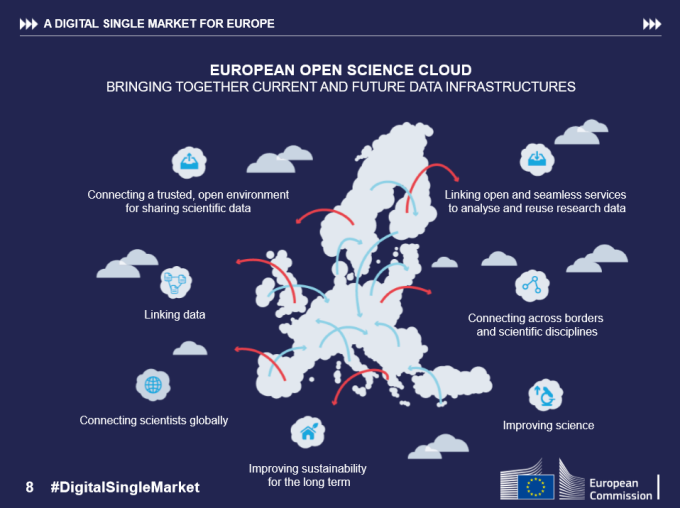
EU launches open science cloud to take research data across borders, disciplines

The EU has outlined its plans for a European Open Science Cloud that will bring together existing infrastructures and open up scientific data across disciplines and across Member States.

Dr Henrik C. Wegener is the chair of the EU's Scientific Advice Mechanism, which for its first task will provide advice on how to measure CO2 emissions with greater real-world accuracy. Image courtesy of Dr Wegener

05 April 2016

Advice on CO2 vehicle emissions testing in six months – EU science panel’s Dr Henrik C. Wegener

The EU’s new Scientific Advice Mechanism (SAM) panel will deliver its first official advice to the European Commission – on how to close the gap between vehicle CO2 emission levels in the real world and those detected under test conditions – within six months, according to Dr Henrik C. Wegener, Chief Academic Officer at the Technical University of Denmark, and chair of the SAM High Level Group.

The European open science cloud is part of a transformation happening in research, known as open science. Image credit: Shutterstock/ gashgeron

27 July 2015

European science cloud on the horizon

Europe’s researchers have access to super-fast networks, common data storage facilities, and shared computing resources. The challenge now is to link them all together into a single science cloud.

PAGES

horizon 2020

MARINE STEEL PRODUCTSlogo Home About Us Products Contact MARINE STEEL PRODUCTS Marine Steel Marine Steel Products Products Gratings / Stair Treads Tubes Flanges (Steel/Stainless Steel) Plates Bars Profiles Fittings Our Office Dintelweg 99 3198 LB Rotterdam – Europoort Netherlands +31 (0) 10.820.89.05 info@marinesteel.nl Tubes tubes We can supply processed tubes, such as bending, sand blasted and primed, galvanized and cut to size. If you need a dimension that’s not in our program, please contact us. Type Size DIN Welded Black Tube 1/2″ trough 10″ DIN Welded Galvanised Tube 1/2″ trough 10″ ASTM Seamless Tube Black 1/2″ trough 12″ Sch40/80 ASTM Seamless Tube Galvanised 1/2″ trough 4″ Sch 40/80 Stainless Steel Tube 304L/316L 1/2″ trough 10″ Sch10/40 Sta

MARINE STEEL PRODUCTS

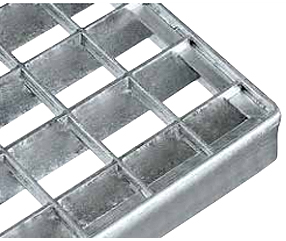
Gratings / Stair Treads

Available from stock

Glass Reinforced Plastic Grating (GRP)

We supply from stock standard sizes in various colors
3007 x 1007 x 38
3660 x 1220 x 38

If you need customized sizes we can cut to size.

Weld Pressed Gratings, Galvanized steel PAD Grating (Offshore)

Weld Pressed Gratings

We supply from stock standard sizes
6000 x 1000 x 100 x 30 x 5 x 30
6000 x 600 x 100 x 30 x 5 x 30

If you need customized sizes we can cut to size.

Galvanized steel PA Grating (Anti-slip)

Galvanized-steel-PA-Grating-(Anti-slip)

We supply from stock standard sizes
400 x 600 x 30 x 2
400 x 700 x 30 x 2
500 x 700 x 30 x 2
400 x 800 x 30 x 2
500 x 800 x 30 x 2
600 x 800 x 30 x 2
500 x 900 x 30 x 2
600 x 900 x 30 x 2
500 x 1000 x 30 x 2
600 x 1000 x 30 x 2
700 x 1000 x 30 x 2
800 x 1000 x 30 x 2
900 x 1000 x 30 x 2
1000 x 1000 x 30 x 2
1200 x 1000 x 30 x 2
1500 x 1000 x 30 x 3

If you need customized sizes we can cut to size.

Galvanized steel LP Grating (Weld Pressed)

Galvanized-steel-LP-Grating-(Weld-Pressed)

We supply from stock standard sizes
400 x 600 x 30 x 2
400 x 700 x 30 x 2
500 x 700 x 30 x 2
400 x 800 x 30 x 2
500 x 800 x 30 x 2
600 x 800 x 30 x 2
500 x 900 x 30 x 2
600 x 900 x 30 x 2
500 x 1000 x 30 x 2
600 x 1000 x 30 x 2
700 x 1000 x 30 x 2
800 x 1000 x 30 x 2
900 x 1000 x 30 x 2
1000 x 1000 x 30 x 2
1200 x 1000 x 30 x 2
1500 x 1000 x 30 x 3

If you need customized sizes we can cut to size.

Galvanized steel stair treads

Galvanized-steel-stair-treads

We supply from stock standard sizes
500 x 200
600 x 200
700 x 200
800 x 200
900 x 200
1000 x 200

If you need customized sizes we can cut to size.

Fasteners (clips)

Galvanized clips for steel and GRP Gratings
Stainless steel clips for GRP gratings

Fasteners-(clips)

Please send your inquiries and learn our competitive prices and great service. Class certification and cut to size possible.

ABOUT MARINE STEEL

Marine Steel Works & Supply BV is a ferro & Non Ferro Wholesaler

We supply a variaty of products; Steel, Stainless Steel, Copper, Brass, Bronze, Aluminium, Zinc & Lead. In different types of materials; Pipes, Fittings, Profiles, Bars, Beams & Gratings

And also we can provide you with machining en cut to size plates.

OUR OFFICE

 Dintelweg 99
3198 LB Rotterdam – Europoort
Netherlands

 +31 (0) 10.820.89.05

 info@marinesteel.nl

24/7-365 AVAILABILITY

We are available 24/7-365 if needed, after hour’s phone number: +31 (0) 6.24.383.666. Never hesitate to contact us

Office hours Monday-Friday:08.00 – 17.00


borisblo5borisblog5borisblog6borisblog7

borisblog1.PNGborisblog2.PNGborisblog3.PNGborisblog9.PNGborisblog6.PNG

marine steel products

MARINE STEEL PRODUCTS

Gratings / Stair Treads

Available from stock

Glass Reinforced Plastic Grating (GRP)

We supply from stock standard sizes in various colors
3007 x 1007 x 38
3660 x 1220 x 38

If you need customized sizes we can cut to size.

Weld Pressed Gratings, Galvanized steel PAD Grating (Offshore)

Weld Pressed Gratings

We supply from stock standard sizes
6000 x 1000 x 100 x 30 x 5 x 30
6000 x 600 x 100 x 30 x 5 x 30

If you need customized sizes we can cut to size.

Galvanized steel PA Grating (Anti-slip)

Galvanized-steel-PA-Grating-(Anti-slip)

We supply from stock standard sizes
400 x 600 x 30 x 2
400 x 700 x 30 x 2
500 x 700 x 30 x 2
400 x 800 x 30 x 2
500 x 800 x 30 x 2
600 x 800 x 30 x 2
500 x 900 x 30 x 2
600 x 900 x 30 x 2
500 x 1000 x 30 x 2
600 x 1000 x 30 x 2
700 x 1000 x 30 x 2
800 x 1000 x 30 x 2
900 x 1000 x 30 x 2
1000 x 1000 x 30 x 2
1200 x 1000 x 30 x 2
1500 x 1000 x 30 x 3

If you need customized sizes we can cut to size.

Galvanized steel LP Grating (Weld Pressed)

Galvanized-steel-LP-Grating-(Weld-Pressed)

We supply from stock standard sizes
400 x 600 x 30 x 2
400 x 700 x 30 x 2
500 x 700 x 30 x 2
400 x 800 x 30 x 2
500 x 800 x 30 x 2
600 x 800 x 30 x 2
500 x 900 x 30 x 2
600 x 900 x 30 x 2
500 x 1000 x 30 x 2
600 x 1000 x 30 x 2
700 x 1000 x 30 x 2
800 x 1000 x 30 x 2
900 x 1000 x 30 x 2
1000 x 1000 x 30 x 2
1200 x 1000 x 30 x 2
1500 x 1000 x 30 x 3


ISKES EXPANDS ITS OPERATING HORIZON

borisblog15


TUGS & TOWING NEWS

ISKES EXPANDS ITS OPERATING HORIZON
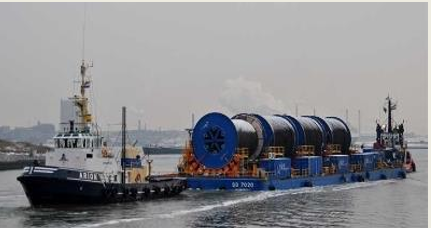
Iskes Towage & Salvage is expanding its operational horizons by mobilising tugs in European markets. It moved its azimuthing tractor drive (ATD)-type tug, Arion, from Ijmuiden in the Netherlands to operate in the German port of Lubeck-Travemunde on the Baltic coast. Arion will be employed for assisting with the mooring operations of roro vessels sailing to and from the port of Travemunde. As well as working with these freight and passenger ferries, the tug will be used to assist the increasingly large cargo vessels calling into Lubeck. Iskes has also started operating in the port of Lisbon with effect from 1 January this year, in a joint venture with Rebonave. Assets and know-how from both organisations will be deployed to service customers in the Portuguese port. The Dutch ports of IJmuiden and Amsterdam remain the primary focus for Iskes, and the company’s fleet of tugs has been strengthened by the arrival of a number of new vessels over the past year. The 82-tonnes Damen 3212 type tug Mars entered service in the second half of January, following the arrival of Telstar in October. The latter is a hybrid tug built to the Eddy tug design and offers a high degree of manoeuvrability and a low environmental impact. (Source: Tug Technology & Business)

A dvertisement

borisblog1

borisblog2

PORTLAND’S TUGBOATS THE SHEPHERDS OF SHIPS
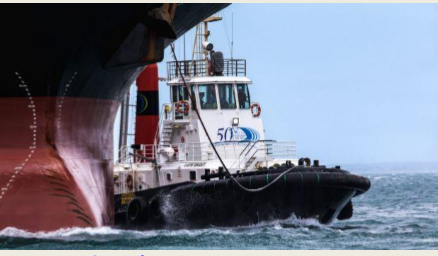
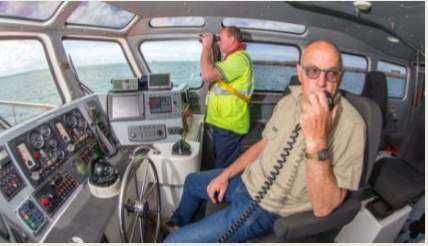
The port is deep dark as the Cape Grant answers to skipper Allan Geraldene’s touch on the controls and reverses out of its berth. The sound of its engines, up here on the bridge, is a mere grumble. It’s illusory: below decks two great diesel motors, each with 12 cylinders and capable of producing 1400 horsepower, fairly bellow. Big funnels baffle the sound. The Cape Grant’s twin, the Cape Nelson, is sliding into the pre-dawn, too, under the command of Garry John. Work to be done. Together, these two tugs and their various masters and crews herd ships 20 times their size from the ocean into the port of Portland, nudge and bully them to moorings at one of several wharves, and haul and push them out again. The two stubby vessels are the port’s heavy-duty labourers. Portland, Victoria’s first European settlement and the only deep-water harbour between Adelaide and Melbourne, exists largely because it lies within the western crook of Portland Bay, offering shelter from often cruel seas at the far reaches of what is known as the Shipwreck Coast. Space at the wharves is rare. The port is the world’s largest hardwood wood chip exporter. The world’s thirst for mineral sands, grain, softwood logs, aluminium and live animals also keeps the harbour in restless movement, and several large cruise ships arrive each year. This morning the tugs must send the bulk carrier Royal For ward , loaded with wood chips, on its way to China. The Cape Grant nudges up to the ship’s bow and a rope snakes down, enabling integrated rating Paul Westlake and marine engineer Henry Kraak to secure a tow-line. The Cape Nelson does much the same manoeuvre down at the ship’s stern, and soon both tugs are in reverse, hauling the loaded ship off the wharf, turning it to face out to sea. Radio commands go back and forth from the Portland pilot, Altaf Hussain, who is commanding the Royal Forward from its bridge. Once the ship is out to sea, Hussain will clamber down a ladder and return to port aboard the small pilot’s launch. Soon, with the Royal Forward steaming away, the Cape Grant drags from another wharf the China Spirit , loaded high with softwood logs. Allan Geraldene’s light touch on the controls makes it seem so simple, the gentle nudging and the full-power reverse towing in a tight section of the harbour. He’s been working on tugs since 1980 and skippering since 1984. A windless dawn reveals a perfectly calm sea. It is often not like this. In winter and spring, westerlies howl. Big depressions out in the Southern Ocean send swells of five metres into the bay. In summer and autumn, the big blows come from the south and the east, and there is no shelter from them even in this

borisblog4

sheltered harbour. Shepherding cargo ships in a tight harbour with a sudden squall ripping in, turning the towering steel sides of those ships into giant sails, is a tricky science requiring calm nerves and decades of experience. A single ship is typically 55,000 tonnes dead-weight, and is often loaded with another 50,000 tonnes of cargo. The tugs need to be nimble. They are: two propellers driven by those big engines sit within pods that swing 360 degrees, enabling these workhorses to spin on the proverbial sixpence. It is a ballet.

borisblog5.PNG

3/27

sheltered harbour. Shepherding cargo ships in a tight harbour with a sudden squall ripping in, turning the towering steel sides of those ships into giant sails, is a tricky science requiring calm nerves and decades of experience. A single ship is typically 55,000 tonnes dead-weight, and is often loaded with another 50,000 tonnes of cargo. The tugs need to be nimble. They are: two propellers driven by those big engines sit within pods that swing 360 degrees, enabling these workhorses to spin on the proverbial sixpence. It is a ballet

borisblog6

EVENT ON THE ROLE OF DIGITAL TECHNOLOGY IN THE SHIPPING SECTOR
The second European Shipping Week is being organised from Monday 27 February to Friday 3 March 2017 in Brussels. As an associated partner of this high level event, the European Tugowners Association is hosting a workshop at the Permanent Representation of Malta headquarters (rue Archimède 25, Brussels) on the morning of the 27th of February (9.3012.30). The event, coorganized by the Maltese EU Council Presidency, will focus on the Role of Digital Technology in the implementation of the Ship Energy Efficiency Management Plan. Discussions should especially take into consideration the existing IT infrastructure, best practices for fuel operation of ships or the role of the EU telecom sector in the increasing digitalization of the maritime industry. Moreover, the European Commission will also present recent developments on digitalisation and more specifically on the efforts to create the framework conditions for a European Maritime Single Window environment. The speakers: Robert Ashdown – IACS; Tore Longva – DNV GL; Martti Alatalo – Danfoss; Harold van Meer – Kotug Smit. Please confirm your participating by sending an e-mail to: tte.maltarep@gov.mt or info@eurotugowners.com. We look forward to seeing you during the 2017 European Shipping Week. (Press Release)

TUG TRAINING CENTRE OPENS ON HUMBERSIDE, UK
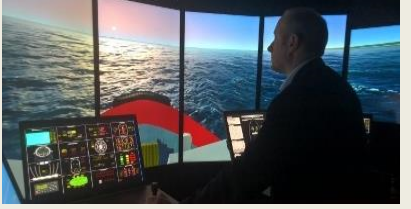
Tug and port operations training will be an important part of what Modal Training will offer from its new £7 million (US$9 million) facility in the UK. It has invested in a tug simulator as part of a

borisblog6

borisblog7

large suite of simulation equipment at a new centre in Immingham on the south bank of the Humber. Modal has installed a Kongsberg K-Sim class B tug simulator and is currently building a set of crane simulators that can be used for training in port operations. It has also invested in Kongsberg simulators for teaching ship navigation, dynamic positioning, offshore vessel and engineroom operations. Sam Whitaker, director of Modal and director of strategic projects at the nearby Grimsby Institute said the facility will become a centre of training excellence for the maritime, ports, energy and logistics sectors. “The tug simulator will be used for training Humber pilots and supporting port operations,” he told Tug Technology & Business, adding: “We hope smaller port operators will also use this for multi-skill training.” Tug operations can be taught on a specially designed Kongsberg K-Sim class B bridge simulator. This can be configured for workboat and tug training, and for teaching ship handling and tug-ship interfaces. The software includes hydrodynamic modelling that allows vessels, objects, weather conditions and equipment to behave as they would in real life. The simulator can be used for monitoring and control, thruster and propulsion control and dynamic positioning training. It works in combination with other simulator systems so trainees can operate a tug alongside another team on a ship. Mr Whitaker said Modal Training is the first independent training organisation in the UK to offer such a comprehensive a range of Kongsberg simulators. The full line up of Kongsberg simulators at Modal Training includes: K-Sim class A offshore vessel simulator, with a fore and aft bridge; K-Sim class B tug simulator; K-Sim class B offshore support vessel simulator; K-Sim class C dynamic positioning simulator; K-Sim engine and control room simulator; K-Sim navigation simulator; K-Sim VTS simulator. Modal Training business development manager Ella Brown said the company was also working with Offshore Simulator Centre (OSC) AS in Norway to create a sophisticated crane driver simulator training suite. The suite of equipment will be unique to Modal Training’s facility. “The OSC suite will see individuals train to drive all types of cranes, across a wide range of portside and offshore operations. We can facilitate training for cranes that are used on vessels and rigs, both to move items between the two, or vessel to vessel. The simulators are designed to give trainees the skills and experience they need to work on all of these,” she said. “Importantly, the crane simulators can also be used to simulate operations with bridge and remotely operated vehicles. This will allow whole teams of crane drivers, deck hands and offshore vessel operators to train together in a wide range of critical scenarios.” (Source: Tug Technology & Business)

ACCIDENTS – SALVAGE NEWS

WORK BEGINS TO REFLOAT CARGO SHIPS THAT RAN AGROUND IN SHARJAH DURING STORM
Work has begun to refloat several cargo ships that ran aground in a storm last week in which at least three sailors died. Five vessels were washed up on the coasts of Sharjah and Umm Al Quwain. On Sunday, one cargo ship was being floated at Al Hamriya beach after running aground off Sharjah in bad weather. Another vessel sank in the storm, claiming the lives of at least three Indian sailors, whose bodies were recovered from the sea. Two crewmen were rescued by coastguards and five

borisblog8

were helped from the sinking ship. Two others in the 12man crew remain unaccounted for. Municipality teams and representatives of the company managing one of the other ships are now working on manoeuvring the ship towards the sea to allow tugs to pull it into deeper water to float it. Capt Sanjay Prasher flew in from India to manage the operations to refloat the vessel. “The ship has 18 crew members from India, they have not been harmed or injured during the bad weather. They have been on the ship since it ran aground,” said Capt Prasher. Hawsers from the tugs were attached to the ship and one of the grounded vessel’s anchors raised while the other was dropped to maintain stability as the tugs turned its bow. “It will be a slow process to nose the ship towards the sea. There is sand accumulated around the ship due to it being aground all this time,” said Capt Prasher. “Tugboats can’t pull hard or else the ship would lean to one side, which might be dangerous.” Capt Prasher said: “We are waiting for the high tide. The tide will take much of the ship’s weight making it easier to manoeuvre. “Weather conditions can also affect the process of moving it.” According to his estimates, the ship may need 48 hours to be floated, weather permitting. On the beach, municipality teams and police were coordinating efforts to ensure no environmental issues arose from the operation

borisblog9

APL AUSTRIA CONTINUES TO BURN
A cargo fire on the container ship APL Austria in Port Elizabeth, South Africa continued to burn on Wednesday. South African media reports suggested that the fire had been contained Tuesday night, but video from the scene this morning showed that it continued to smolder belowdecks. The vessel has been brought alongside at the Port of Ngqura, and the responders have removed burned containers from the above-deck stacks to give firefighters better access. As of yet, the responders have not been able to get down to the level of the fire. Port operator Transnet has deployed firefighting-equipped tugs to assist in suppressing the blaze and cooling the hull. Authorities say that

borisblog10

the fire poses no structural danger to the vessel. The vessel is loaded with about 3,000 containers, and the operator says that there is hazardous material cargo on board, including refrigeration gases and paint. European experts in hazmat firefighting have been flown in to help deal with the blaze. Captain Nigel Campbell of the South African Maritime Safety Authority told Herald Live that “we need to understand all of the cargo in the hold to decide on the medium to be used” to put out the fire. He added that the response team has placed less-flammable containers around the area of the blaze to create a firebreak. The fire broke out Monday as the Austria was arriving at the Algoa Bay anchorage. The response teams met her out in the bay, and were later allowed to moor her at Port Elizabeth as a port of refuge. All crew are safe and accounted for. Four nonessential crewmembers were evacuated shortly after the fire broke out, according to the non-profit sea rescue organization NSRI; one of the evacuees had a leg injury and was treated on shore. Belowdecks cargo fires can be difficult to address on container ships, especially on larger vessels with deeper holds. The steel boxes compartmentalize and contain any smoldering cargo, and the location is difficult and dangerous for firefighters to enter. A container fire on the CCNI Arauco in Hamburg last September took 48 hours to put out: repeated attempts to flood the hold with CO2 were not effective, and the response team ultimately had to borrow 45,000 liters of advanced firefighting foam (AFFF) to smother the blaze. Uwe-Peter Schieder, vice chairman of IUMI’s Loss Prevention Committee, says that container fires are even harder to fight under way. “At sea, below-deck fires cannot be fought with water and so CO2 is used instead to displace the oxygen and extinguish the fire. However, if the fire is burning within a container, the box will protect it from the CO2 and so this method of fire-fighting is rarely successful. Currently there are no other methods of fighting a container ship fire below deck [at sea],” he warned last October.

borisblog11
HEAVY LIFT DYNAMICS OF THE SEWOL FERRY SALVAGE
The Sewol was a RoPax vessel built in 1994. She sank off southwest Korea on April 16, 2014 with the loss of 304 lives, many of them schoolchildren. The vessel capsized and sank in 44m water depth, coming to rest on her port side on a level seabed. Divers searched for missing bodies until November, 2015. The last body found was in October. Nine bodies were still missing at the time of writing this paper. They are believed to be inside the wreck, probably in the damaged superstructure area. For salvage planning, OrcaFlex was used to predict dynamic sling tensions under a range of potential operating conditions. The models developed used

borisblog12

7/27

fully coupled analysis with the motions of the Dalihao crane barge being driven by diffraction force RAOs and influenced by the crane hook loads through appropriately modeled sling systems to the submerged Sewol model. Simultaneously, the Sewol model was driven with diffraction force RAOs and was given a seabed ground reaction as well as sling loads from the crane barge. The seabed interface permitted the Sewol to respond in pitch and roll. Heel equilibrium solution during bow lift. Labels indicate vessel frame numbers. Each frame identified is drawn with a different line color in the Excel chart. The frames are shown with the vessel trimmed. Hence Frame 173, in the region where the bow slings attach, appears raised. Frames 0, 6 and 6 are indicated and can be seen to be without any significant seabed contact. The upper short blue arrow indicates the location and magnitude of the combined sling loads. The upper red arrow indicates the location and magnitude of the combined added buoyancy force. The central purple arrow, pointing down, indicates the location and magnitude of the combined weight force. The lower brown arrow indicates the location and magnitude of FG, the ground reaction force. The variable Tpivot, is the transverse distance of FG from the keel. At this distance, FG causes a moment that balances the system such that there is no net heeling moment. The brown trapezoidal area beneath the seabed indicates the reaction pressure that would provide the force FG, if applied over the area of hull calculated to be in contact with the seabed in this load condition. She the complete salvage report

borisblog13

walkway, spilling about 10 gallons of oil discharge. Watchstanders at Coast Guard Sector New Orleans received a call at 3:19 a.m. reporting the incident, and a 45’ response boat medium crew was dispatched from Coast Guard Station Venice at 3:36 a.m. The Coast Guard crew arrived on scene at 4:30 a.m. and transported the lift boat crew back to the Venice station. There were no injuries, according to the Coast Guard. The 87’x19’ cutter Brant arrived at 10:41 a.m. to monitor the Superior Trust, while an MH-65 helicopter aircrew from Air Station New Orleans conducted an overflight. Superior Energy was developing a salvage plan to recover the Superior Trust and has a pollution cleanup company on standby, Coast Guard officials said. I.G. Petroleum, L.L.C., deployed a response vessel to survey the damage to the platform and begin repair

borisblog14

borisblog16

OCEAN RANGER ANNIVERSARY
Today, 15 February, marks the 35th anniversary of the loss of the drilling rig Ocean Ranger and all 84 persons on board. The world’s largest semi-submersible was working on the Hibernia field 166 miles east of St.John’s when it was struck by a severe storm. The rig was supposed to withstand harsh conditions but a sea broke through a portlight washing out the ballast control room. Unable to prevent further flooding, the crew attempted to abandon the rig in appalling conditions, but did not survive. A Royal Commission found numerous faults in the design of the rig, inspection, training and safety procedures. At the time of the loss there were two other drill rigs nearby, Sedco 704 and Zapata Ugland. Both suffered damage, but survived. All three had standby boats in the area, but there was little they could do but assist in recovering bodies. The standby boat for Zapata Ugland was Nordertor. Built in 1976 by Hitzler, Lauenburg, it was owned by Offshore Supply Association. Seaforth Highlander was standby boat for Ocean Ranger. It was built in 1976 by Ferguson Brothers, Port Glasgow, Scotland and was operating for the Seaforth Fednav joint venture. A sister tug/supplier Seaforth Jarl from the same builders in 1975 was lost December 18, 1983 when an improperly secured deck load of chain ran overboard and capsized the vessel. The crew was rescued by Arctic Shiko. Sixty-five miles to the east the Russian Mekhanik Tarasov was struck by the same storm. On a trip from Trois-Rivières, QC to Leneingrad, it attempted to assist in the Ocean Ranger rescue operation, but took a severe list eventually capsizing February 16 with the loss of 32 of its 37 crew. The crew of the Atlantic Project were more fortunate. All survived a fire aboard their vessel between Newfoundland and Nova Scotia February 14, 1982. The ship reached Halifax safely February 15, thus escaping the worst of the storm.

borisblog17

borisblog18

COAST GUARD RESPONDS TO ALASKA TUG GROUNDING
A Coast Guard Station Ketchikan Response Boat— Medium crew and Marine Safety Detachment Ketchikan pollution team responded to the tug boat Samson Mariner when it ran aground while towing a barge in the vicinity of north Tongass Narrows in Rosa Reef, Alaska, Wednesday evening Coast Guard Sector Juneau command center watchstanders received notification via VHF-FM radio from the captain aboard the Samson Mariner that his vessel ran aground and had a minor breach in the hull. Station Ketchikan and pollution responders were immediately launched, arrived on scene, placed boom around the tug and verified that crew of the Samson Mariner plugged the breached hull. The Samson Mariner, which is operated by Samson Tug & Barge Co., Inc. of Sitka, Alaska, has 30,000 gallons of fuel on board and the barge has 40,000 gallons of diesel on board. Three Southeast Alaska Petroleum Response Organization tugs took the barge to Ward Cove where it will be anchored and assessed for damage. No damage to the barge or injuries have been reported.

OFFSHORE NEWS

HISTORIC SUPPLY SHIPS – THE STORFONN
Although the VS 476 is fairly closely related to the VS 469, because of the larger number of the class produced and their longevity in the industry they are worth a mention. Four were built in 1985 and 1986 at the Danish Orskov shipyard all initially owned by Norwegian investors, probably as part of a process, which remained slightly obscure to most of us, known as the KS investment scheme. This was a scheme which gave Norwegian professionals tax breaks if they invested in ships. The first of the four to enter service was the Storfonn (Photographed as Maersk Chieftain in Brazil by Tony Poll in 2005), to be followed by the Kongsgaard, the Kingshav and the Challenger III (Photographed as

borisblog19

Maersk Challenger by Victor Gibson at a North Sea exploration rig in 2007). But of course 1986 was the year when the oil price fell to $8 a barrel resulting in a difficult time for all offshore vessel owners, and in many cases leaving the ships in the direct ownership of the investors. And as in the world today there were advantages for the more innovative shipowners, particularly those with a bit of money in the bank. This resulted in the British offshore support company Ocean Inchcape (OIL) bareboating the four ships, which became the Oil Chieftain, Oil Challenger, the Oil Champion and the Oil Chancellor. My book “The History of the Supply Ship”, chronicles a spokesman for OIL saying, “we are sure we will soon find contracts in the North Sea because there is still a market for that type of anchor-handler”. In fact the four ships were often employed as platform supply vessels. They had a deck area of 633 m2 and other capability included the ability to carry 1400 m3 of diesel and 618 m3 of mud. Their four B&W Alpha engines delivered 14,400 bhp giving them 160 tons of bollard pull. Later at least one of them had an enhanced winch fitted for deep water work out in Brazil. The four ship were purchased outright by Maersk Supply at the end of the five year OIL bareboat charter and became the Maersk Cs. Maersk had been in the business for some years but on a fairly small scale, and it may be that the purchase of these four ship was the start of their major assault on the offshore support business, and in the following weeks we will see further Maersk ships which were in themselves innovative. The four ships were variously employed in the North Sea, in Brazil and in Canada and today two of them are still owned and operated by Blue Star Line. The Maersk Chancellor which has been working in Canada for much of its life departed from Halifax in November 2016 for scrapping in Turkey. The Maersk Champion is still working out in Brazil, apparently defying the

borisblog20

borisblog21borisblog22

Danish offshore shipowner Maersk Supply Service (MSS) shared a picture through its social media channels on Monday showing three of its AHTS vessels moving the Transocean-owned rig, the Henry Goodrich, off the East Coast of Canada. “The three musketeers,” as the company called them, were moving the rig for Canadian energy company Husky Energy which has the Henry Goodrich under contract until May 2018. The rig has been under contract with Husky since May 2016 on a dayrate of $275,000. It was moved from Norway to Canada in April last year by two of the vessels moving the rig now, the Maersk Detector and Maersk Dispatcher, helped by the ALP Winger. Upon arrival, Husky Energy used the rig at the White Rose oil field development project, some 350 kilometers off the coast of Newfoundland. During this latest rig move operation, the final and youngest member of the Maersk moving trio was the 2015-built Maersk Cutter. According to latest AIS data, all three vessels arrived just offshore St. Johns from the location near the SeaRose FPSO vessel which is operating on the White Rose field. Offshore Energy Today reached out to Maersk Supply Service to seek more information about the operation. We will update the article if and when we receive the company’s response. (Source: Offshore Energy Today)

DOF TO SUPPORT TECHNIPFMC IN PRELUDE FLNG OPS
DOF Subsea has been awarded a contract by Technip Oceania, part of TechnipFMC in Australia, for the provision of multi-purpose support vessel (MSV) Geoholm for Shell’s Prelude FLNG project in Australia. DOF Subsea informed on Tuesday that the 2006-built Geoholm will be required to provide ROV and light construction support services to TechnipFMC in Australia for the Prelude

borisblog23

FLNG water intake riser installation. The company recently secured a Safety Case for Geoholm and the vessel will be available in the Asia Pacific region from the beginning of the second quarter of 2017. John Loughridge, DOF Subsea EVP, Asia Pacific, said, “We look forward to working with TechnipFMC in Australia to deliver a safe and efficient project.” To remind, in December last year, Shell awarded an engineering and project management services contract in support of the Prelude FLNG project to TechnipFMC. The work is being managed and delivered from the company’s operating center in Perth, Western Australi

borisblog24

Bourbon, a marine services provider for the offshore oil & gas industry, has been awarded a pipelay contract by Total for the subsea development of the Hylia project, offshore Gabon. Bourbon said on Tuesday that this is its first pipelay contract awarded by Total Gabon for the engineering, procurement, construction and installation (EPCI) of 25 km of 6” rigid pipeline as part of the Hylia Water Injection Project using Zap-Lok technology. For the execution of this contract, Bourbon is subcontracting key suppliers, mainly Cortez Subsea, for pipelay equipment and Wood Group for the pipeline design and pipelay engineering. According to the company, operations are scheduled to start in the second quarter of 2017 offshore Gabon with an MPSV from the Bourbon Evolution 800 series. ROV services and a PSV, all provided by Bourbon, will also support survey and air diving operations for spool and riser installation. Patrick Belenfant, Bourbon’s Senior VP Subsea Services, commented: “We are very proud of the trust that Total has placed in us for this first pipelay EPCI contract. Such a comprehensive project allows Bourbon and its Gabonese partners to demonstrate our capacity to bring the best integrated services and cost-effective solutions to our clients.” (So urce: Offshore Energy Today)

HARVEY GULF IN SUBSEA PACT WITH HELIX
Gulf of Mexico-focused contractor Harvey Gulf has teamed up with Helix’s marine contracting

borisblog25

business unit Canyon Offshore to provide ROV and survey capabilities on the vessel Harvey Intervention. The 91 meters long multipurpose support vessel (MPSV) was delivered by Florida-based Eastern Shipbuilding in 2012. The newly formed alliance with the ROV operator Canyon, should boost Harvey’s subsea portfolio of services in addition to two subsea newbuilds the Harvey Sub-Sea and the Harvey BlueSea also constructed by Eastern Shipbuilding. The delivery of the Harvey Sub-Sea was due in in 2016, after outfitting and sea trials, while the Harvey Blue-Sea is anticipated for delivery in early 201

borisblog26.PNG

borisblog27

WIND UP APPLICATION FILED AGAINST EMAS AMC, EZRA SAYS
Logistics provider Necotrans Singapore filed an application to wind up Ezra Holdings’ associate borisblog28

NOK 18 million (some $2.1 million) and a net cash effect of approximately NOK 50 million ($6 million) after repayment of the vessel debt. “We are excited to secure the Rem Etive and to continue her deployment for our clients in the APAC region,” said Mark Heine, divisional director marine and member of Fugro’s board of management. “With three multi-year IRM contracts already in place, two of which were awarded in recent weeks, this vessel is the best fit with our fleet to enable us to continue our delivery excellence and efficient performance in subsea IRM projects.” (S ource: Subsea World News)

LAID UP SHIP TO BE CONVERTED INTO STANDBY VESSEL
After 18 months lay up outside Ålesund the “Olympic Poseidon” was to be converted into a standby vessel operated by Høyland Offshore and renamed “Sayan Cloudberry”. As part of the restructuring of Stig Remøy offshore shipping company Olympic Ship, the bank Nordea became owner of three offshore vessels. Two of them, the “Olympic Hera” and “Olympic Commander”, were chartered by the Austevoll shipping company DOF, which also has an option to purchase the vessels. The “Olympic Poseidon” has been sold to Sevnor and was handed over on Feb 13, 2017. She was then moved to Steinsland in Bergenfor installation of firefighting canons and a rescue boat. The vessel, which has no contract to go to, should also be reclassified. The anchor handling characteristics will be retained. The “Sayan Cloudberry” will be operated by Høyland Offshore, which already operates the “Sayan Princess” for Sevnor. The plan is to offer it on term contracts. Funding is by the owners of the Cyprus company Sevnor Ltd. One of the owners is Gunnar Nordsletten, a Norwegian who is living in Russia. The company already owns two ice-class cargo ships that are sailing between Murmansk and Yamal. The Sevnor Ltd. has also entered into a strategic partnership with Viking Supply Ships for Russia where Sevnor is responsible for marketing and commercial operations. In the offshore segment owner they already supply ship Sayan Princess, operating in the spot market in the UK sector. In addition, they have an anchor handling vessels being commissioned in Turkey, which will be ready during the year. Hull and superstructure and 40 containers with equipment bought from SPP in South Korea, after they failed to complete the new building for an Italian company. Neither the contract in wait. – Vier looking for more ships, says Babisnki. Nordea will not comment How the deal turns out business for the seller, is uncertain. According to E24, Nordea had pledged to ship 150 million when they took over ownership before Christmas. Outstanding debt in the ship may have been lower. Press Officer Christian Steffensen in Nordea in Norway say they do not want to comment on the matter. (Source: Vesseltracker)

WIND UP APPLICATION FILED AGAINST EMAS AMC, EZRA SAYS
Logistics provider Necotrans Singapore filed an application to wind up Ezra Holdings’ associate

borisblog29

15/27

company EMAS AMC with the High Court of Singapore on February 6. EMAS AMC is a wholly owned unit of Ezra’s associate Emas Chiyoda Subsea, which is owned 40% by Ezra, 35% by Chiyoda and 25% by NYK. Ezra said in a Singapore stock exchange filing on Tuesday that it was made aware of the application on February 13, following an advertisement published in the Straits Times newspaper. According to the company, the winding up application against EMAS AMC was fixed for hearing on March 3, 2017. EMAS AMC is currently seeking advice on the application while Ezra is assessing the impact of the wind up against EMAS AMC on Ezra as well as on its subsidiaries. In the meantime, Ezra added, the company will hold discussions with relevant parties. Ezra is already under pressure due to EMAS AMC’s missed payment for the hire of Forland’s Lewek Inspector vessel. EMAS AMC’s obligations under the charter party were guaranteed by Ezra. No longer wanting to wait for the payment, Forland served Ezra a statutory demand seeking payments owed for the vessel charter earlier in February, Forland gave Ezra three weeks to make the payment, or otherwise, its solicitors would move for Ezra to be wound up by the court. EMAS also owes payments to Ocean Yield for the vessel Lewek Connector for which the company in December asked for a standstill agreement for December 2016 and January 2017. However, earlier this week, the owner terminated the charter “to protect the company’s legal interest.” Related to the charter termination, Ezra said it is open to entering into discussions with Ocean Yield. First financial quarter delays Ezra made an application to Singapore Exchange Securities Trading Limited (SGX-ST) seeking a 30-day extension to announce the Group’s unaudited Financial Statement for the first financial quarter ended November 30, 2016. The company had since made a further application to SGXST seeking a 60-day extension, instead of a 30-day extension, to announce the 1Q results. Ezra is currently in discussions with various stakeholders and is consolidating its funding requirements. The company said in Tuesday’s SGX filing that if this effort does not achieve a favorable and timely outcome, the Group would be faced with “a going concern issue.” The company added that the outcome of the discussions might materially impact businesses and operations of the Group, and in turn, its Financial Statement for 1Q 2017.

borisblog30

borisblog31

POLARCUS SHOOTS SEISMIC FOR CHARIOT OFF MOROCCO
Chariot Oil & Gas has started 3D seismic acquisition over Kenitra exploration permit (Kenitra) and Mohammedia exploration permits I-III (Mohammedia) offshore Morocco. The survey follows the award of a 75% interest and operatorship of Kenitra, in partnership with the Office National des Hydrocarbures et des Mines (ONHYM) which holds a 25% carried interest. The survey, being conducted by Polarcus, will enable the company to develop the portfolio of drillable prospects and potentially identify additional material prospectivity. This seismic campaign will fulfil the work commitment for the current licence phase on both licences, Chariot said. Kenitra, with an area approximately 1,400 km2 and in water depths ranging from 200 m to 1,500 m, was formerly part of the Rabat Deep offshore exploration permits I-VI (Rabat Deep), in which Chariot now has a 10% interest and a capped carry on the RD-1 well which is anticipated to be drilled in early 2018. Larry Bottomley, CEO of Chariot said: “In line with our strategy we continue to manage our portfolio proactively. This award allows us to capture the extension of the Lower Cretaceous play which spreads from Mohammedia into the Kenitra acreage. With our focus on de-risking our assets, Chariot will develop the drilling inventory on these permits through seismic acquisition which capitalizes on the current excellent seismic contract rates.”

borisblog32.PNG

Huisman Equipment has welcomed Siem Helix 2 vessel to its Schiedam facility in the Netherlands. The second well intervention vessel built for Siem Offshore will be outfitted with a Huisman well intervention tower during its stay at Schiedam, Huisman informed throperiod of 7 years, with options to extend the charter up to 22 years. Siem Helix 2 has a length of 158 meters, a beam of 31 meters and an accommodation capacity for 150 peopleugh social media. Siem Helix 2 is a sister vessel to Siem Helix 1, which is currently conducting work offshore Brazil for Petrobras. Both vessels were chartered by the Helix Energy Solutions in 2014 for an initial

borisblog35borisblog36

Ocean Yield will charter its Lewek Connector subsea vessel to Singapore’s Ezra, under newly agreed terms. The move comes just a few days after the owner had terminated the charter for the vessel it had with Ezra’s cash-strapped subsidiary Emas AMC. For background, Emas AMC in December 2016, requested the standstill agreement relating to the bareboat charter of the ultra- deepwater multipurpose, flexlay subsea construction vessel for December 2016 and January 2017. At the time, Ocean Yield noted EMAS AMC’s restructuring efforts by its parent company EMAS Chiyoda Subsea without confirming whether it would comply to the request or not. Emas AMC is a subsidiary of Emas Chiyoda Subsea, which, in turn, is owned 40% by Ezra Holdings Ltd., 35% by Chiyoda Corporation and 25% by Nippon Yusen Kabushiki Kaisha (“NYK”). EMAS-AMC AS’ obligations under the charterparty for the Lewek Connector are guaranteed by Ezra Holdings Limited. On Monday, February 13, Ocean Yield said that, in order to protect the company’s legal interest, a notice of termination related to the bareboat charter of the 2011-built Lewek Connector has now been served. The company then saud it was still in talks regarding a a potential short-term contract for the vessel to a related company of Ezra Holdings at a reduced rate while a long-term solution is being discussed. This has now materialized as Ocean Yield on Thursday said that it entered into a contract for the Lewek Connector with a related company of Ezra for a period of four months at a rate of $40,000 per day. Ocean Yield also said it would continue to participate in the discussions regarding a financial restructuring of the EMAS Chiyoda Subsea Group. W i n d u p p e t i t i o n Apart from its dealings with Ocean Yield, EMAS AMC has been a subject of a wind-up petition filed by logistics provider Necotrans Singapore. Necotrans filed an application to wind up Ezra Holdings’ associate

company EMAS AMC with the High Court of Singapore on February 6. According to the company, the winding up application against EMAS AMC has been fixed for hearing on March 3, 2017. Ezra is already under pressure due to EMAS AMC’s missed payment for the hire of Forland’s Lewek Inspector vessel. EMAS AMC’s obligations under the charter party were guaranteed by Ezra. No longer wanting to wait for the payment, Forland served Ezra a statutory demand seeking payments owed for the vessel charter earlier in February, Forland gave Ezra three weeks to make the payment, or otherwise, its solicitors would move for Ezra to be wound up by the court. (Source: Offshore Energy

borisblog37

company EMAS AMC with the High Court of Singapore on February 6. According to the company, the winding up application against EMAS AMC has been fixed for hearing on March 3, 2017. Ezra is already under pressure due to EMAS AMC’s missed payment for the hire of Forland’s Lewek Inspector vessel. EMAS AMC’s obligations under the charter party were guaranteed by Ezra. No longer wanting to wait for the payment, Forland served Ezra a statutory demand seeking payments owed for the vessel charter earlier in February, Forland gave Ezra three weeks to make the payment, or otherwise, its solicitors would move for Ezra to be wound up by the court. (Source: Offshore Energy Today )

PGS NARROWS LOSS AS REVENUES SINK ON LOW PRICING
Petroleum Geo-Services (PGS), a marine geophysical company, narrowed its fourth quarter 2016 loss while its revenues dropped by 33 pct due to low contract pricing. In its quarterly report on Thursday, the geophysical company posted a smaller net loss for the fourth quarter of 2016 totaling $156.1 million, versus $334.6 million in the year-before period. PGS’ net loss before tax for 4Q 2016 was $118.7 million, compared to $357.1 million in the prior-year quarter. The company recorded impairment charges, excluding impairment of MultiClient library, of $12 million for the full year 2016 and $7.8 million in 4Q 2016, primarily relating to adjustments to the expected schedule for returning cold-stacked vessels to operation. Jon Erik Reinhardsen, PGS President and Chief Executive Officer, said: “As a result of low activity levels and continued excess supply of vessels, the marine contract market remained challenging through 2016.” Further, PGS’ revenues during the last quarter of 2016 decreased by $75.2 million, or 33%, totaling $154.1 million, compared to $229.3 million in the corresponding period of 2015. This reflects a 33% reduction in marine contract revenues and a 38% reduction in total MultiClient revenues. Lower marine contract revenues in 4Q 2016, compared to 4Q 2015, were due to low pricing for contract work, more nonchargeable vessel time and limited capacity allocated to marine contract activities, PGS explained. MultiClient pre-funding revenues decreased $47.1 million in 4Q 2016, or 48%, compared to 4Q 2015, owing to less capacity used for MultiClient surveys and weaker sales from surveys in the processing phase. MultiClient late sales revenues in 4Q 2016 decreased by $15.1 million, or 22%, compared to 4Q 2015. MultiClient sales vary significantly between quarters and regions and the company said it had relatively greater success in realizing sales in 3Q than it had in 4Q. More stable oil price ‘to benefit seismic market’ Going forward, PGS said it expects the higher and more stable oil price and improved cash flow among clients, combined with an increasing constraint on available streamers in the industry, to benefit the marine 3D seismic market fundamentals. The company expects the volume of marine 3D seismic acquired by the industry to increase in 2017 compared to 2016, partly driven by an expected increase of 4D streamer monitoring surveys and more MultiClient 3D projects. Based on the current operational projections and with reference to disclosed risk factors, PGS stated it expects full year 2017 gross cash cost to be approximately $700 million. According to the company, the increase from 2016 is primarily driven
18TH VOLUME, NO. 15 DATED 19 FEBRUARY 2017

by more operated capacity and an expected increase in fuel prices, partly offset by further cost reductions. MultiClient cash investments are expected to be approximately $275 million, with a prefunding level of approximately 100%. Approximately 55% of the 2017 active 3D vessel time is expected to be allocated to MultiClient acquisition. Capital expenditure is expected to be approximately $150 million, of which approximately $85 million relates to completion of the new build Ramform Hyperion, which is currently under construction at the shipyard Mitsubishi Heavy Industries Shipbuilding in Japan. It is scheduled to be delivered in March 2017. The order book totaled $215 million at December 31, 2016 (including $113 million relating to MultiClient), compared to $190 million at September 30, 2016 and $240 million at December 31, 2015

borisblog38borisblog39.PNG

18TH VOLUME, NO. 15 DATED 19 FEBRUARY 2017

19/27

by more operated capacity and an expected increase in fuel prices, partly offset by further cost reductions. MultiClient cash investments are expected to be approximately $275 million, with a prefunding level of approximately 100%. Approximately 55% of the 2017 active 3D vessel time is expected to be allocated to MultiClient acquisition. Capital expenditure is expected to be approximately $150 million, of which approximately $85 million relates to completion of the new build Ramform Hyperion, which is currently under construction at the shipyard Mitsubishi Heavy Industries Shipbuilding in Japan. It is scheduled to be delivered in March 2017. The order book totaled $215 million at December 31, 2016 (including $113 million relating to MultiClient), compared to $190 million at September 30, 2016 and $240 million at December 31, 2015. (Source: Offshore Energy Today)

Advertisement

HORNBECK SAYS REFINANCING NEEDED TO REPAY ITS DEBT
Hornbeck Offshore in the US says it has sufficiently liquidity to fund operations through the end of 2018, but needs to refinance to meet upcoming debt obligations. Announcing fourth quarter 2016 results, Hornbeck Offshore said that, as of 31 December 2017 it had a cash balance of US$217.0 million. In addition, the company has an undrawn revolving line of credit with a current borrowing base of US$200 million which, under certain circumstances, is likely to be capped at US$75 million during a portion of fiscal 2017. This credit facility is available for all uses of proceeds, including working capital, if necessary. The company said that although it remains in compliance with all covenants under the facility, its ability to access the full amount of the borrowing base is subject to an anti-cash hoarding provision that, pro forma for deployment of the use of proceeds, limits its cash balance to US$50 million at any time the facility is drawn. The company projects that, even with the current depressed operating levels, cash generated from operations together with cash on hand should be sufficient to fund its operations and commitments at least through the end of its current guidance period ending 31 December 2018. However, it does not currently expect to have sufficient liquidity to repay three tranches of unsecured debt that mature in fiscal years 2019, 2020 and 2021, respectively, unless it

20/27

can refinance or restructuring the debt. “Refinancing in the current climate is not likely to be achievable on terms that are in line with the company’s historic cost of debt capital,” said Hornbeck. “The company remains fully cognizant of the challenges currently facing the offshore oil and gas industry and continues to review its capital structure and assess its strategic options.” As of 31 December 2016, the company had 44 offshore support vessels and two multipurpose supply vessels stacked. For the three months ended 31 December 2016, the company had an average of 46.5 vessels stacked compared to 26.8 vessels stacked in the prior-year quarter and 44.1 vessels stacked in the sequential quarter. The company recorded a net loss for the fourth quarter of 2016 of US$19.2 million compared to a net loss of US$2.7 million in the same period 12 months ago, and a net loss of US$16.5 million for the third quarter of 2016. Revenues were US$41.9 million for the fourth quarter of 2016, a decline of US$46.8 million, or 52.8 per cent compared to the same period in 2015

borisblog40

WINDFARM NEWS – RENEWABLES

OLYMPIC CHOOSES KONGSBERG K-WALK KIT FOR OLYMPIC ORION
Norway’s Olympic Shipping has chosen Kongsberg Maritime’s new K-Walk integrated vessel gangway solution for installation aboard the multipurpose offshore vessel (MPSV) Olympic Orion to provide transfer of personnel and materials between the vessel and offshore wind turbines. K-Walk will be integrated with the advanced Kongsberg Information Management System (K-IMS) and the existing K-Pos Dynamic Position system on board Olympic Orion, which will be upgraded as part of the installation in the latter half of 2017. The system is activated prior to entering a wind turbine’s safety zone, reducing vessel speed and launching the K-Walk hook up process during approach. Because of the integration with the DP, the gangway is said to be able to move into position while the vessel is still moving, positioning it safely as the vessel arrives on station. Kongsberg said that the integration of K-Walk with K-IMS enables in-depth mission planning, resulting in increased productivity and efficiency by finding the most preferred route for increased service capability within the wind farm. The K-Walk solution for Olympic Orion is also expected to improve time for mobility and safety with an integrated lift system for transfer of people and goods, including electric trolleys, currently under design, for movement of pallets across the gangway. “K-Walk provides Olympic Orion with total oversight of route planning and gangway hook-up operations. It enables better real-time and long-term management decisions, and empowers safer, more predictable, and efficient operations through reduced human interaction and automation based on the deep integration of critical systems on board,” said Stene Førsund, Executive Vice President, Global Sales and Marketing, Kongsberg Maritime. Bjørn Kvalsund, COO of Olympic Subsea, said that this gangway solution might be installed on several other Orion vessels ”in order to provide W2W services into an expanding and interesting market segment.” (Source: Offshore Wind)

borisblog41

MV FLATHOLM GETS BUSY AT GALLOPER OWF
Lowestoft based multipurpose vessel MV FlatHolm finished off a busy year in 2016 with a successful charter to James Fisher Marine Services Ltd, undertaking a variety of service activities in connection with the Galloper Offshore Wind Farm during November and December. The Galloper project was busy, last year, with turbine foundation preparation and MV FlatHolm provided daily cover, making sure the site was clear and checking for hazards and obstructions which might have hindered operations with the scour protection rock placement work. Being based locally in Lowestoft, MV FlatHolm was able to be on standby for any situation which might require immediate deployment, offering efficient and cost effective support whenever needed. The versatile 24m vessel also completed operations with the deployment of two Triaxiswaverider buoys before the planned charter conclusion. (Source: MarineLink)

CWIND INVESTS IN LARGEST CREW TRANSFER VESSEL TO DATE
CWind, a leading provider of services to the offshore wind industry, announced today that it has invested in the Company’s largest crew transfer vessel to date. Newly named as CWind Phantom, the 27.4m catamaran can hold 20,000 litres of fuel and has a 20 ton cargo capacity, making her suitable for longer stretches of work at wind farms located further from shore. This investment demonstrates the Company’s ability to evolve with the changing market. CWind’s fleet now totals 18, with access to additional cable installation and maintenance vessels via CWind’s parent company, Global Marine Systems Limited. “Our experience on the world’s largest offshore wind farms has helped us build a diverse range of vessels that meet the changing needs of our valued clients,” said Lee Andrews, Managing Director for Power at CWind. “Transporting technicians quickly, safely and comfortably to and from sites, even in tough weather conditions, is critical to

borisblog42.PNG

borisblog43.PNG

wind farm, developed by wpd, will feature 18 Senvion’s 6.15MW turbines. At the end of December 2016, MPI Enterprise completed the installation of the 18 turbines at the site. Initially planned to be commissioned by the end of 2016, the wind farm will be put into full operation in the second quarter of 2017. The commissioning was postponed due to BVT, the company in charge of the wind farm’s substation, entering insolvency. (Source: Offshore Wind)

borisblog44

Seacat Enterprise, a 27metre High Speed Utility Vessel (HSUV) built for the Cowes-headquartered offshore energy support vessel operator, Seacat Services, has started sea trials on Thursday, 16 February, according to South Boats IoW, the builder of the vessel. Seacat Enterprise is a product of a long-term collaborative R&D programme between South Boats IoW and Alicat Marine Design, and will be the first vessel of its kind in Seacat Services’ fleet and on the offshore wind market. The new catamaran, launched on 12 January, has a number of structural modifications and features that enable the vessel to carry up to four 20-foot containers, along with a full complement of 24 safety-trained personnel and six crew. A new stern fender system allows cargo to be unloaded from the aft deck via crane, increasing the range of options available for the transfer of key equipment at port and at sea. This system is coupled with an all new dynamic bow fender design. Seacat Enterprise’s increased fuel capacity is said to allow the vessel to remain operational for extended periods between port calls. Seacat Eneterprise’s sister vessel, Seacat Weatherly, is scheduled for delivery later this year. (Source: Offshore Wind)

borisblog45.PNG

Seacat Enterprise, a 27metre High Speed Utility Vessel (HSUV) built for the Cowes-headquartered offshore energy support vessel operator, Seacat Services, has started sea trials on Thursday, 16 February, according to South Boats IoW, the builder of the vessel. Seacat Enterprise is a product of a long-term collaborative R&D programme between South Boats IoW and Alicat Marine Design, and will be the first vessel of its kind in Seacat Services’ fleet and on the offshore wind market. The new catamaran, launched on 12 January, has a number of structural modifications and features that enable the vessel to carry up to four 20-foot containers, along with a full complement of 24 safety-trained personnel and six crew. A new stern fender system allows cargo to be unloaded from the aft deck via crane, increasing the range of options available for the transfer of key equipment at port and at sea. This system is coupled with an all new dynamic bow fender design. Seacat Enterprise’s increased fuel capacity is said to allow the vessel to remain operational for extended periods between port calls. Seacat Eneterprise’s sister vessel, Seacat Weatherly, is scheduled for delivery later this year. (Source: Offshore Wind)

18TH VOLUME, NO. 15 DATED 19 FEBRUARY 2017

borisblog47.PNG

24/27

DREDGING NEWS

DREDGING AFRICA LAUNCHES NEW DREDGER
Dredging Africa Pty based in Pretoria, South Africa, recently completed construction of the cutter dredge Mvubu – 450. According to the company, the dredger – specifically designed for the South African conditions – was launched on the 19th of January 2017 in Cape Town. Commissioning and fine tuning of the dredge systems was completed by the end of January. DA001 or Mvubu 450 as she is affectionately known was specifically designed to clean lined dams. It has a specially adapted horizontal auger to carry material to the center of its cutter assembly were the pump mouth awaits the incoming material to be pumped away. This cutter is equipped with specially designed cutter teeth to loosen hard material and with high pressure jet nozzles to loosen and fluidize tough material. A set of stainless steel wheels prevent the cutter mechanism to come in contact with the plastic lining on the bottom of lined dams. This is further avoided by the stainless steel protective cage over the front of the cutter shroud. Forward and backward travel is facilitated by a treble winch system running along a navigation cable. Mvubu 450 has capacity to pump 450m³ of slurry per hour against 43m total dynamic head at 1400RPM. Power is provided by a Scania industrial diesel engine of 276kW at 1800RPM. Control of the dredge is done by state of the art systems including engine management system, Deap Sea Controller, a SCADA system, pressure sensing and flow rate instrumentation, a nuclear density measuring instrument and other controls. (Source: Dredging Today)

YARD NEWS

LAKE ASSAULT TO BUILD PITTSBURGH FIREBOAT
Lake Assault Boats, a leading manufacturer of purpose-built and mission-specific fire and rescue boats, has been chosen to construct a 34-foot fireboat by the Pittsburgh Bureau of Fire in Pittsburgh, PA. The fireboat will respond to emergencies and help manage fires on waterways, waterfronts, rail lines, and marinas that lie along the Allegheny and Monongahela Rivers, which join together in Pittsburgh to form the Ohio River. The contract is valued at more than $540,000. The craft will be delivered in summer 2017. “We are thrilled to be appointed by the City of Pittsburgh and its Equipment Leasing Authority to engineer and construct this extremely powerful fireboat to protect resources that lie along the city’s iconic riverfront areas,” said Chad DuMars, Lake Assault Boats vice president of operations. “Our team is especially excited to manufacture the first fireboat in its class capable of pumping up to 3,000 gallons of water per minute.” The 34-foot fireboat is a deep V-hull

borisblog48

DATED 19 FEBRUARY 2017

25/27

borisblog50   features excellent outward visibility and includes a 15,000 BTU rooftop AC unit, an adjustable (and full suspension) operator’s seat, additional bench seating, SCBA mounting brackets, a chart table with storage, and a cuddy cabin for general storage. The craft also features a full spectrum of Garmin (GRMN) electronics, including chart plotter, HD radar, sonar, and a forward looking infrared (FLIR) system, all controlled through 12- and 16-inch touchscreens.Other notable features include a full complement of LED floodlights and spotlights, a raised engine compartment/work deck, an automatic engine compartment fire suppression system, a hinged radar arch, dive bottle racks, and a removable canvas awning. Once delivered, Lake Assault will provide three days of onsite training with Pittsburgh Bureau of Firepersonnel. DuMars added, “Pittsburgh hasn’t had a fireboat in service in more than forty years, and this purchase reflects a major commitment by the city to better protect vital resources that simply can’t be reached by traditional firefighting apparatus.

borisblog49

borisblog50

26/27

were built by Krasnoye Sormovo shipyard to Damen design), eight CSD (one of them, CSD 650, was built in Russia), 38 dredger pumps and other equipment,” said Olivier Marcus. The company has designed a range of TSHD ships for dredging operations in water areas of ports, canals, rivers and lakes. Damen Shipyards Group (with its Head Office in Gorinchem, the Netherlands) operates 40 ship- and repair yards employing 9,000 people worldwide. Damen has delivered more than 6,000 vessels in more than 100 countries and delivers approximately 160 vessels annually to customers worldwide. Damen specializes in construction of tugs, boats, patrol vessels, highspeed craft, cargo ships, dredgers, platform service vessels, oil spill response ships, frigates and super yachts. ( Source : Portnews )

ONEZHSKY SHIPYARD TO LAUNCH THE FORTH BOAT OF PROJECT ST23WIМ ON 21 FEBRUARY 2017 ССЗ
Onezhsky Shipbuilding, Ship Repair Yard (Petrozavodsk, Republic of Karelia) is going to launch the forth boat of Project ST23WIМ (Hull No 104) named Yevgeny Vasilyev on 21 February 2017, Vladimir Maizus, Director General of the shipyard, told IAA PortNews on the sidelines of the 4th International Forum of Dredging Companies which opened in Moscow today, 15 February 2017. The ship was designed by the Design Bureau of Marinetec Group. There is a project to build six boats of this design. The boats are intended for the delivery of pilots, commissions and crew members to other vessels and for transportation of cargo. Onezhsky Shipbuilding, Ship Repair Yard (Onega Shipyard) was founded in 2002 on the basis of shiprepair facilities of the Belomorsky-Onezhsky Shipping Company, formed in 1944. In 2011, after the enterprise management dismissal the production stopped, and the company went bankrupt. In late 2014 the enterprise was transferred to the state ownership and resumed its shipbuilding / repair activit

‘Cluster’

‘Cluster’ in-depth case studies and peer reviews: to move beyond the figures that are available for comparison, more qualitative studies can be carried out on activity domains where a region shows relative specialisation. This involves expert work on value chain analysis (undertaken in an international environment and enlightening the spatial division of labour), context conditions for the operation of the cluster, labour market situation, etc. It also involves an analysis of the linkages between the cluster and other clusters or industries, in order to examine whether one can talk about related variety across the areas of regional specialisation. One interesting approach is the ‘revealed skill relatedness’ (RSR) method (Neffke and Svensson Henning, 200922). RSR measures the degree to which industries share similar skill requirements, and this is seen as a very important vehicle for knowledge transfer between clusters (through people mobility). It is based on a network analysis using data on job changes between industries, showing proximity between industries in terms of skill sets.
Sophisticated analyses of clusters such as Henning et al. (2010)23 combine this type of analysis with a functional analysis linking economic structure to cluster challenges and assessing the functions taken by the cluster initiative. The functions analysed are: knowledge creation and knowledge diffusion; identification of opportunities and barriers; stimulation of entrepreneurship/management of risk and uncertainty; market formation; mobilisation of resources; and legitimation. These types of analysis are conducted by experts who study the cases in close cooperation with cluster actors: this helps to take into account innovation opportunities identified by leading actors (companies, universities, intermediaries, etc.) Mixing regional experts with international experts helps to give more weight to the international competitiveness issue. Adding key stakeholders from foreign clusters brings in a useful peer review dimension to the analysis.

4. Foresight: the aim of foresight is to capture existing expert intelligence sources on future trends and make them accessible for present decision-making. The role of foresight is to elucidate possible paths for the future in order to open the debate on possible development paths. Foresight has the following characteristics24: Action-oriented; Open to alternative futures; Participatory; and Multidisciplinary. There is a multiplicity of methods that can be used and combined to implement foresight studies, the best known being expert panels and multi-round Delphi surveys. They differ in their expected benefits, conditions of use, time requirement, etc. and their common feature is that they rely heavily on expert knowledge and involve interactions between experts (Table 1; see more details on the FOREN website). For RIS3, foresight studies would ideally combine regional expertise with international expertise able to put regional assets in perspective with wider trends.

borisblog34

Step 2 – Governance: ensuring participation and ownership

At the beginning of a RIS3 design process, it is necessary to define the scope and expected goal, with a view to ensuring participation of the key actors and securing ownership of the approaches defined in the strategy.

With respect to the ultimate and long-term goal of the RIS3, the Vision for the future of the region should underpin the whole process: all analyses, debates, participative actions, pilot projects, etc. should be seen as participating towards the long term goal identified in the Vision. Potential actors relevant to the RIS3 process span from public authorities to universities and other knowledge-based institutions, investors and enterprises, civil society actors, and external experts who can contribute to the benchmarking and peer review processes.

Defining the scope of the RIS3 is crucial, since different stakeholders will have different expectations and agendas on the question at stake, often restricted to their own areas of action. Since RIS3 aims to achieve more effectiveness in all public action targeting regional transformation, a wide view of innovation is to be adopted. This will emphasise that innovation may occur everywhere, in different forms, and not only in the form of high technology development in metropolitan areas:

• Including innovation in services and in the public sector, in addition to innovation in the manufacturing sector which most policies currently target; • Encompassing innovation based on different types of knowledge bases, leading to different modes of innovation (Table 2): 1) the ‘STI’ (Science, Technology, Innovation) mode, based on analytical knowledge/basic research (science push/supply-driven approach) and synthetic knowledge/applied research (user-driven approach), emphasising product and process innovations; and 2) the ‘DUI’ (Doing, Using, Interacting) mode, based on synthetic and symbolic knowledge (market/user-driven), emphasising competence building and organisational innovations.25

With respect to policy areas and organisations involved, the above wide view means that several policy areas are concerned with the RIS3, beyond the traditional science and technology and economy ministries and agencies. Interministerial Committees are tools to cope with this need for a wide conclusion of stakeholders.

A RIS3 is an exercise that deals with policies developed by local, regional and national authorities (as well as EU Cohesion policy and EU research policy). This multi-level dimension of policy implies that governance mechanisms need to include stakeholders and decision-makers from these various levels. It also involves that links must be established between strategies for research (usually decided upon at national level) and strategies for innovation (usually under the responsibility of or developed in coordination with regional authorities). They use different
25 Lorenz P. and Lundvall B.A. (2006), How Europe’s Economies Learn. Coordinating Competing Models

borisblog35

borisblog36

A criticism that was sometimes levelled at the RIS process was that it was prone to being ‘captured’ by traditional interest groups in the region, groups that were more interested in preserving the regional status quo than transforming the regional economy through innovation. Although this criticism can be overdone (because regional governments, for example, had to be involved in the RIS process), the design of the RIS3 architecture needs to anticipate the risk of capture and make it more difficult for traditional groups to frustrate the process.

In the Open Innovation era, where social innovation and ecological innovation entail behavioural change at the individual and societal levels if the challenges of health, poverty and climate change are to be addressed, the regional governance system should be opened to new stakeholder groups coming from the civil society that can foster a culture of constructive challenge to regional status quo.

In particular, in order to guarantee a livelier and truly place-based entrepreneurial process of discovery that generates intensive experimentation and discoveries, it is imperative that new demand-side perspectives, embodied in innovation-user or interest groups of consumers, are represented along with intermediaries who offer a knowledge-based but market-facing perspective. This means that the traditional, joint-action management model of the triple helix, based on the interaction among the academic world, public authorities, and the business community, should be extended to include a fourth group of actors representing a range of innovation users, obtaining what is called a quadruple helix.27 This is the necessary organisational counterpart of an open and user-centred innovation policy, because it allows for a greater focus on understanding latent consumer needs, and more direct involvement of users in various stages of the innovation process. RIS3 processes can develop environments which both support and utilise user-centred innovation activities also with the aim of securing better conditions to commercialise R&D efforts.

The quadruple helix allows for a variety of innovations other than the ones strongly based on technology or science, in the spirit of the wide concept of innovation at the basis of RIS3, but it requires significant flexibility, adaptation of processes, acquisition of new skills, and potential re-distribution of power among organisations. This in turn calls for collective leadership and moderation of the process as necessary practices for achieving successful governance.

Leadership assumes many forms. Three different, but equally important forms of leadership are the following: political leadership (the people who are chosen by the electorate to represent us and to lead our governments); managerial leadership (the people who manage the ‘enterprise function’ in the public, private and third sectors); and intellectual leadership (the people who play a leading role in connecting their universities to the worlds in and beyond their regions). The Guide does not presume to suggest which form of leadership is the best or the most appropriate, because this is a decision that needs to be made at the regional level, where the choice can be informed by local knowledge of competence, credibility and character, the essential attributes of a leader.

27 Arnkil R., et al. (2010), Exploring Quadruple Helix. Outlining user-oriented innovation models. University of Tampere, Work Research Center, Working Paper No. 85 (Final Report on Quadruple Helix Research for the CLIQ project, INTERREG IVC Programme).
38

Although a leader needs to have certain personal attributes, like the ones identified above, leadership research has taken a ‘relational turn’ in recent years. Rather than being a static ‘thing’ that a minority of people possess, leadership is now understood as a dynamic relationship between leaders and led in which both sides play an active role in finding joint solutions to common problems. In this context, a way to secure understanding and ownership of the main strategic orientations is to allow for effective collaborative leadership among the key actors involved in the process. When innovation processes embrace many different areas of the society, as in the case of RIS3, collaboration among stakeholders holds the key to successful implementation of innovative practices, implying that leadership has to be shared and exercised across organisations. Collaborative leadership requires the emergence of collaborative practices, as actors must find ways of managing conflict themselves.

In order to moderate the RIS3 design process, actors playing the role of boundary spanners between the organisations are needed. These are actors endowed with an interdisciplinary knowledge or experience of interaction with several different types of organisations; hence they can facilitate new connections across sectors, foster new conversations between disciplines, and inject novelty into the process. This in turn helps to overcome the sectoral and disciplinary silos that reproduce old habits and routines, locking regional economies into their traditional paths of development.

Boundary spanning skills tend to emerge from activities that straddle sectors, disciplines and professions and they are invariably fashioned in action learning environments where there is a high degree of novelty associated with the activity. Examples of such activities include technology transfer, knowledge exchange, venture funding, regional economic development, business services, and management consultancy, all of which afford an overview of the regional economy. Formal recognition of the boundary spanning role, and its significance for universities, businesses and the regional economy, would do much to promote a skill set that is critically important to the moderation of the RIS3 process, particularly of the entrepreneurial process of discovery, which lies at the heart of the process.

As far as the structure of the management body is concerned, it will clearly vary according to local circumstances, it must be supported by robust governance arrangements. The RIS experience is instructive here because it shows that local diversity can exist within a generic governance system. The governance system of a typical RIS project revolved around three elements — Steering Group, Management Team and Working Groups — and they worked in the following way:

• Steering Group: the SG was responsible for the overall performance of the project and it normally included members of the business community, local and regional government, and key innovation actors, all of whom were expected to embed the project in their respective fields of activity. The size of the SG was always carefully considered: too few members could compromise the consensus-building process, while too many members could be a recipe for a bureaucratic and unwieldy process. An appropriate balance was a membership of around fifteen people meeting as a group every two or three months. The main tasks would typically include the following: setting objectives and monitoring activities, selecting the members of the Management Team, supervising the work
39

programme, political and institutional support, and liaising with the European Commission. The chair of the SG was invariably a local notable drawn from the business community, academia or the public sector; • Management Team: the MT was responsible for implementing the RIS project under the general guidance of the SG. The composition of the MT varied a lot between the regions, though all regions had a Project Manager who was supported by a small team of up to three people. The main tasks of the MT often included the following: liaising with the EC and providing progress reports, providing a secretariat to the SG, launching and coordinating the study assessment tasks of the project, and fostering regional consensus around the project, acting as a focal point for networking with other RIS regions to draw on their experiences. Choosing the location of the MT was an important decision because how the project was perceived was largely a function of where it was physically situated; • Working Groups: the WG mechanism fulfilled two purposes: it helped to build regional consensus for the RIS project throughout the region and it provided a means to engage the business community, especially if the Working Groups were sector-based, as they were in regions with strong sectoral specialisations. Where they were most effective, Working Groups had clearly defined terms of reference and a credible timetable for the delivery of results. The conclusions of the Working Groups were supposed to inform the strategic discussions in the Steering Group.

Many regions will be able to draw on their unique RIS experience when they embark upon their RIS3 strategies because these two processes have a good deal in common. It is important to remember that regions are not being asked to do something totally new when they begin the RIS3 journey of discovery. The original RIS experience also offers some instructive lessons with regard to the involvement of the business community in the process:

• Communications: a clear communications strategy was deemed to be of enormous importance, especially for the business community. The businesses actually involved in RIS projects also required honest and timely feedback; • Management: the Management Team and Steering Group personnel often played a key role in maintaining effective communication, especially where the chair of the Steering Group or the leader of the Management Group was a prominent local business leader or a wellconnected local networker (as they were in Yorkshire and Humber and Dytiki Macedonia respectively); • Sector Champions: Sector champions can help to engage the local business community in traditional sectors as well as in new or emerging sectors, both of which need to embrace innovation; • Local Media: the involvement of local media helped to raise the profile of the RIS exercise, especially in RIS Aragon, where two journalists from daily newspapers were involved in the RIS process from the outset. Frequent coverage in the media helped the project to resonate in the local business community; • Pilot Projects: To overcome the criticism of the RIS process being no more than a ‘talking shop’, it was found that pilot projects led by local business leaders were an effective form of action learning which generated useful information as well as helped to maintain the active engagement of the business community.
40

Some or all of these engagement mechanisms will be relevant to the RIS3 exercise because the latter involves an even deeper and more iterative relationship with the business community. But innovation is increasingly a collective social endeavour, and the business community should not be expected to carry the full burden of innovation on its own shoulders. Success in the innovation stakes will increasingly go to countries and regions that transcend the sterile ideological debate about private versus public and embrace the fact that innovation is a collective social endeavour, at the heart of which is a judicious private + public partnership.

Getting firms, universities, development agencies and regional governments to accept that innovation is a collective social endeavour — where participants freely acknowledge that working in concert can deliver far more than working in isolation — is arguably the most important ingredient in the ‘recipe’ for purposeful entrepreneurial search. This does not displace the firm from the forefront of the search process; but it does mean that the costs and risks associated with entrepreneurial search are shared and therefore do not become too prohibitive for the firm that is leading the search process.

To tap the potential of related variety, regional authorities and development agencies will need to behave less like traditional public bureaucracies and more like innovation animateurs, brokering new connections and conversations in the regional economy. New opportunities are emerging in old regions as a result of connections and conversations that are now occurring but which never occurred in the past despite the parties being co-located in the same region (proving that cognitive proximity is far more important than mere physical proximity).

The onus of responsibility for creating such iterative processes rests primarily with public sector bodies, especially universities, development agencies and regional governments. Learning by doing will help these public sector bodies to appreciate the needs of firms, but more formal action learning programmes will also be needed. A good example of such a programme is the Place-Based Leadership Development Programme, which regions may wish to adapt and adopt to help them acquire the iterative skills needed in the RIS3 exercise (see Figure 2).

Figure 2 – A Place-based leadership development programme
borisblog36

Under such a programme, universities, development agencies and regional governments could jointly identify a project to explore the prospects for related variety in the regional economy. Collaborative leadership development expertise would be developed through each actor bringing substantive knowledge (‘know what’), professional networks (‘know who’) and skills (‘know how’) to the initiative and explicitly sharing their knowledge and experience with other members of the project team. The participants are then encouraged to introduce these collaborative leadership skills back into their respective public bodies to help the latter to behave less like traditional bureaucracies and more like animateurs of innovation and development. The formation of a Knowledge Leadership Group would give an institutional expression to the alliance between universities, development agencies and regional governments.

Finally, as the original RIS programme took consensus-building seriously, it is worth distilling the lessons from that experience as a starting point for the RIS3 exercise. In the best cases, the consensus-building process focused on three inter-related themes, namely awareness-raising, priority-shaping and fostering a sense of ownership, each of which merits attention. Awarenessraising was achieved in a number of different ways, including: (i) a project launch event such as a high profile seminar or conference (ii) a series of presentations throughout the region to key sectors, especially to the business community and the higher and vocational training institutions (iii) publicity through radio, television and newspaper coverage (iv) the distribution of customised brochures (v) the creation of a specialised project web site and (vi) the use of iconic companies in the region as ambassadors for the project. Awareness-raising needs to be measured and also needs to be calibrated with action, otherwise there is a danger that expectations will be raised too early in the process, leading to disillusionment before the project has had time to show some tangible results.

Enabling key actors to shape the priorities of the programme proved to be an important way of retaining their commitment. Each actor will have a keen sense of their own priorities, as well as their own diagnosis of the strengths and weaknesses of the regional economy, and these views were subjected to critical review through a combination of SWOT analyses and collective debate. Giving all participants the opportunity to shape the policy priorities is the key point to establish because this process of open deliberation spawned a sense of ownership.

A sense of ownership was a natural outcome of the consensus-building process when the latter was properly conducted. A sense of shared ownership among the Steering Group members proved to be particularly important and this intangible asset was enhanced by regular consultation with participants and by securing concrete outputs, proving that the RIS exercise was about results as well as processes, more than just a ‘talking shop’ in other words.

Multi-level/multi-fund approach to RIS3

The process of innovation and the policies that shape it operate at multiple levels, from the global to the local. For many key actors involved in the region, notably private firms and leading universities, the development of the region will not be their primary focus. While regional public authorities do have a territorial responsibility, innovative public services are increasingly being delivered by external organisations. At the same time, although many national government agencies and the European Union itself operate a range of innovation-orientated policies that do
borisblog38

borisblog39

borisblog40


41

Under such a programme, universities, development agencies and regional governments

Step 3 – Elaboration of an overall vision for the future of the region

This step is the development of a shared and compelling Vision on the economic development potential of the region and the main direction for its international positioning. It is a highly political step. Its value mainly rests on getting the political endorsement for the subsequent steps, particularly for the implementation of the strategy.

The main quality of a Vision is its mobilising power: it should attract regional stakeholders around a common bold project, a dream, which many feel they can contribute to and benefit from. It will be easier to run this step when a regional ‘grand figure’ (a politician, an industrialist, a leading academic, a well-known artist…) pushes the Vision forward on a large scale. Times of crisis often provide a good opportunity to generate such new Visions, starting from the wellacknowledged need to escape the crisis. The main difficulty for a Vision is to be ambitious but still credible: few regions can realistically claim that they want to become the ‘most innovative region of the EU’. Over-ambitious claims might undermine a RIS3 from the start, if the Vision cannot be taken seriously by regional stakeholders.

At this stage, the purpose is to reach the willingness to act towards the transformation of the regions and support the regional consensus necessary to perform the other steps.

The ‘dream’ should be bold and wide enough to accommodate realistic priorities and specific development paths. The Vision should pinpoint possible paths for the economic renewal and transformation of the region. It may, for example, present the region as a new technology hub, based on the high density of technology-driven public and private actors; it may stress its potential as the central node in a cross-border area and emphasise its connectivity assets; it may make the link between exceptional natural assets and innovation potential; it may build on the skill sets of the population as the main driving force for future development, it may use flagship projects in cultural and creative industries to develop the innovative image of the region, etc.

Finally, the Vision should also include justifications for its relevance in terms of meeting societal challenges, such as providing more healthy living conditions for its citizens, reducing outmigration, providing new employment opportunities for specific categories of the population, combating social divide, etc. These justifications go much beyond the alleged classical benefits of innovation for job and economic value creation.

The elaboration of the overall vision for the future requires the identification of the combined place-specific features of a region. In order to help policy-makers and managing authorities to identify the dominant characteristics of their own administrative regions, it is possible to construct a three-dimensional box diagram, within which individual administrative regions can be positioned or situated (see Figure 6). The sides of the box reflect the three priorities of Europe 2020, and each side of the box provides the typology which most concisely captures the major features associated with each of the individual Europe 2020 challenges.28 28 The regional categories depicted by the sides of the box diagram here with regard to the smart growth, sustainable growth and inclusive growth dimension of Europe 2020, are exactly the same categories as those used in the
46

For the purposes of this guide, the classification scheme used here is intended to be indicative rather than definitive and schematic rather than exhaustive, and in particular cases other classification schemes may be more appropriate.

For the Europe 2020 smart growth typology, the most concise framework is provided by the OECD (2011) regional innovation typology in which regions are grouped into three broad types, namely knowledge regions, industrial production zones, and non-Science & Technology-driven regions, within which there are various sub-categories. These three broad categories reflect the major observed differences in terms of the relationships between knowledge, innovation and regional characteristics. EU regions can be classified into one of these broad smart growth groupings in terms of the role played by knowledge in fostering their local innovation processes.

For the Europe 2020 sustainable growth typology, the classification scheme which most concisely captures the different combinations of environmental and energy challenges is based on the relationship between the built environment and the natural environment. At its most fundamental level, this gives us four types of region, namely regions which in nature are primarily rural regions, rural near urban regions, urban regions, and urban-coastal regions.29

For the Europe 2020 inclusive growth typology, the classification scheme which most concisely captures the very different social inclusion issues faced by regions is that which is also adopted by the ESPON (2010) DEMIFER project. This has two broad types of region, namely regions facing population decline and population outflows and regions facing population growth and population inflows. Migration is a highly selective phenomenon and mobility is highly correlated with skills and income. Population outflow regions generally face a combination of more rapid population ageing and economic decline, which in turn have significant adverse impacts on both innovation and environmental issues.

In Figure 6, each individual axis represents one of the three Europe 2020 agenda dimensions. The combination of the smart growth, sustainable growth and inclusive growth typologies allows for twenty-four possible tripartite types of place characteristics, each of which is depicted by a different cell in the three-dimensional box of regions.

results/outcome indicators classification scheme on the use of results/outcome indicators within a reformed Cohesion Policy adopted by the international panel of experts advising the EU Commissioner for Regional Policy Johannes Hahn, Directorate General for Regional Policy. 29 This sustainable growth classification scheme of primarily urban, primarily rural near urban, primarily rural and primarily urban and coastal, closely resembles the OECD (2011b) regional typology based on the dominant built environment and natural environment features, which uses three types of regions, namely predominantly urban regions, predominantly intermediate regions, and predominantly rural regions, respectively.

borisblog42

borisblog43

Table 4 – Innovation strategies for different types of regions according to internal and external connectivity

Connecting globally Sustaining momentum
Cluster building Deepening pipelines
Types of regions Peripheral regions lacking strong research strengths and international connections
Regions with strong local cluster organisations wellnetworked with policy actors
Small groupings of competitive businesses with limited local connectivity
Regions dependent on limited number of global production networks/ value chains
Key challenge Building a global pipeline
Building up new regional hinges connected to regional firms — building critical mass
Improving local networking connecting more local actors to growing regional network
Extending connectivity and networks around hub
Main policy option
Helping regional actors take first steps in international cooperation
Bringing outside actors in, and helping to collectively shape future trends
Channelling innovation support to stimulate growth through regional clusters
Helping second-tier innovators become market leading and shaping
Example of regions
Madeira, Tallinn, Tartu, Attica, Sardinia
Ile-de-France, Baden-Württemberg, Flanders, Toronto
Skane, Navarra, Auckland, NordPas-de-Calais
Piemonte, Eindhoven, Seattle, North East of England
Source: Regional Innovation Monitor,32 based on Benneworth and Dassen 201133

An element closely intertwined to formulating an effective vision is RIS3 communication. Good communication of the RIS3 is essential to ensure its endorsement by all stakeholders of the region, and beyond. Communication is needed all along the process, adapting the content to the stage reached (adoption of a vision, adoption of policy priorities, endorsement of an action plan, implementation of key projects, etc.. The implementation of RIS across Europe has delivered the following lessons regarding the crucial components of a communication strategy, which are also valid in the RIS3 context (Innovating Regions in Europe Network 2005)34:

1. Definition of goals: the main goal should be to place the RIS project in a national and European context, to inform and create an attractive image for the identified target group of the project. But it can also pursue the goal of identifying and extending this target group by embarking stakeholders that are not yet part of the process. And it may serve the wider purpose of informing public opinion about the need to support the development of knowledge-based business in the region;

32 http://www.rim-europa.eu. 33 Benneworth P. and Dassen A. (2011), Strengthening global-regional connectivity in regional innovation strategies. Report for the OECD. 34 Innovative Regions in Europe Network (2005), RIS Methodological Guide, Stage 0.
50

2. Identification of the stakeholder groups and their motivation: different target groups have different needs and should be reached with different tools. Traditional SMEs, high-tech companies, universities, transfer institutions, business intermediaries, local and regional authorities, national bodies, the media, etc. have a different understanding and expectations of an RIS. The goal of the strategy should be to make sure that they all endorse and contribute to the strategy from their perspective. To this end, appropriate communication methods and expected results need to be spelled out for each target group;

3. Definition of traditional communication tools: the tools include the use of a logo which builds and reinforces the regional identity and puts innovation at its core; attractive and dynamic web pages, including parts in English for wider dissemination; newsletters and leaflets to complete the information with traditional communication tools; specific publications on certain aspects of the RIS (key analyses, peer review reports, etc.); conferences and seminars, including participation in international conferences, which give the opportunity to diffuse synthetic material on the RIS; and press and TV campaigns. The content of the communication should include strategic lines and priorities but also communication and demonstration on flagship projects;

4. Definition of active communication tools: active tools mainly include pro-active activities such as targeted visits to stakeholders or concerted workshops and seminars. Examples of active tools are: visiting the sites, marketing of the participants to the project; press conferences (various with different scenarios); round table discussions; meetings with local and regional politicians; etc. Conferences and seminars are frequently used: launch conferences ease the awareness and stimulate the participation of the actors in the exercise, but it is not easy to decide on the content of the message to be passed on. Conferences in the middle of the process stimulate the participation of regional actors in the construction of the strategy and validation of analyses. An end conference is necessary since all stakeholders in the region are supposed to adhere to the strategy and implement it in their own area.
51

Step 4 – Identification of priorities

Smart specialisation involves making smart choices. In fact, smart specialisation is all about facilitating that choice, selecting the right priorities and channelling resources towards those investments that have the potentially highest impact on the regional economy. The priority setting for national and/or regional research and innovation strategies for smart specialisation should consist of the identification of a limited number of innovation- and knowledge-based development priorities in line with existing or potential sectors for smart specialisation, on the basis of the elements and steps presented in this guide.

Priorities in RIS3 need to:

• Define concrete and achievable objectives. These objectives should be based on present and future competitive advantage and potential for excellence, as derived from the analysis of regional potential for innovation-driven differentiation; • In addition to technological, sectoral or cross-sectoral priority areas, horizontal priorities need to be defined. These could involve the diffusion and/or application of Key Enabling Technologies (see Annex II), aspects related to social innovation, or the financing of the growth of newly established companies, which is often a bottleneck in many regions that have prioritised the creation of new technology-based firms but fail to see these firms grow and create jobs.

As has been explained in previous sections, the selection process needs to be based on quantitative as well as qualitative information on the different possible domains for a national/regional smart specialisation. The key criteria for filtering the range of possible priority areas down to only a few priorities are:

• the existence of key assets and capabilities (incl. specialised skills and labour pools) for each of the areas proposed and, if possible, an original combination of these (cross-sector; cross-cluster), • the diversification potential of these sectors, cross-sectors or domains, • critical mass and/or critical potential within each sector, • the international position of the region as a local node in global value chains.

All this relevant information is to be examined by decision/policy-makers in order to select a few priorities focusing on the existing strengths of the economy but also on emerging opportunities. A good smart specialisation strategy will catalyse structural change and the emergence of critical clusters so that agglomeration externalities, economies of scale, economies of scope and local spillovers can be fully realised in the process of knowledge production and distribution.

A regional economy clearly provides the appropriate dimensional framework for such processes of decision, strategic implementation, agglomeration of resources and materialisation of spillovers. However, national economies might also be a good framework, particularly in the case of small countries.
52

But how to present the prioritised areas? If the areas are presented in a too generic way, such as eco-innovation, green energy, sustainable mobility or healthcare, most regions will fail to point out their unique competitive strengths. To be credible, effective and suitable for a concrete action plan (see next step), the priorities need to be expressed more precisely, such as ICT-based innovation for active ageing, innovative solutions to reduce city congestion, wood-based solutions for eco-construction, etc.

Prioritisation always entails risks for those who have to select those few domains that, as a result, will get privileged access to public funding. Common approaches followed in the past, which should not be repeated, were:

• spreading the money across the most powerful lobbies with the frequent outcome that there were too many priorities aimed at preserving the status quo rather than looking at future opportunities; or • imitating other regions. In that case, if the choice proved to be a mistake, at least this was a mistake others have made as well. At the end of the day regions contributed to producing a system with too many small sites doing the same things and where agglomeration externalities were dissipated.

These approaches failed to take into account the essential knowledge in this matter, which is entrepreneurial knowledge. Research and innovation strategies for Smart Specialisation should address the difficult problem of prioritisation and resource allocation based on the involvement of all stakeholders in a process of entrepreneurial discovery, which should secure a regionally- and business-driven, inclusive and open prioritisation process.

There are different methodologies for organising such processes, e.g. surveys, seminars with participatory leadership methods, crowdsourcing, etc.

Such an open, participatory process, together with reliance on robust evidence based on regional assets, are the best guarantees to avoid both the risk of capture by interest groups and the risk of lock-in into traditional activities. Once the priorities are adopted it is important that the strategy is validated and endorsed by a broad regional constituency (in the form of a representative Council or Forum, or through top-level events).

53

Step 5 – Definition of coherent policy mix, roadmaps and action plan

Experience with Regional Innovation Strategies throughout Europe has shown that it is good practice to combine the adoption of strategies with an agreement on an Action Plan and even the simultaneous launch of pilot projects (IRE 2007).35 Analytical and Strategic phases tend to remain invisible to many field actors. Strategies that stop before this step run the risk of remaining unimplemented and/or not credible. Pilot projects, once their success is proven, can be used as flagships of the RIS3, to demonstrate that they go beyond rhetoric and involve concrete action.

As priority areas for the region’s transformation are defined in the previous step, a coherent multi-annual Action Plan should be elaborated by the RIS3 management bodies, including:

• Definition of the broad action lines corresponding to the prioritised areas and the challenges faced within these areas; • Definition of delivery mechanisms and projects; • Definition of the target groups; • Definition of the actors involved and their responsibilities; • Definition of measurable targets to assess both results and impacts of the actions; • Definition of timeframes; • Identification of the funding sources, targeted to the several groups and projects (developing and completing Figure 5).

This planning process involves both the incorporation of existing programmes and instruments, on the basis of evidence on their effectiveness and relevance for the prioritised areas, and inclusion of new instruments, justified according to their contribution to the overall strategy goals. There is a wide menu to choose from in order to compose a balanced and appropriate policy mix. It is useful to use taxonomies, such as those presented in Table 5 and Table 6, to determine whether these instruments are likely to address, collectively, the strategic goals of the RIS3.

Table 5, Table 6, Table 7, Table 8 and Table 9 present examples of strategies and associated mixes of action lines and instruments, according to regional types and to the institutional power of the region: this latter element underlines the necessity to embed national-level policies into the policy mix, seen from a regional perspective. Each action line and instrument needs to be accompanied by measurable indicators reflecting results achieved, according to the mission and objective, but also impacts reached, assessed through evaluations.

35 Innovative Regions in Europe Network (2007), RIS Methodological Guide, Stage 2.
54

Table 5 – Regional innovation delivery instruments: a taxon

borisblog44.PNG


EFIS

borisblog14

Efis logo

Join us at the centre

At EFIS Centre, we “practice what we preach” about open innovation systems. We actively welcome new applications for membership from individual scholars and practitioners and like-minded organisations working on all aspects of innovation systems and related fields. EFIS Centre members are invited to co-develop ideas for new strands of research on or testing of new instruments to enhance innovation system performance.

Applications from students or individuals should include a recent CV and a summary of interests in innovation systems research or policy.

Applications from organisations should include a half-page summary of the mission and recent activities and a list of up to five recent projects or initiatives relevant to the EFIS Centre mission. At least two CVs of staff members should be provided, one of whom should be designated as the representative contact point.

Applications can be sent at any time by email to info@efiscentre.eu.

Annual membership fees for 2017 are:

• €75 for students (Masters or doctoral studies)
• €150 for individual membership
• €500 for corporate/institutional members

Members receive our quarterly e-newsletter ‘System thinking’ including a review of recent developments in innovation system research and policy; as well as preferential rates for our ‘Innovation System Insights’ workshop series that will launch in the first semester 2017.

Dr. Bernard Musyck

Dr. Bernard Musyck

Managing Director

m. musyck@efiscentre.eu
skype. bmusyck

Alasdair Reid

Alasdair Reid

Policy Director

m. reid@efiscentre.eu
skype. alasdairreid

Elina Griniece

Elina Griniece

Principal Researcher

m. griniece@efiscentre.eu
skype. elina_griniece

Henry Varga

Henry Varga

Associate Researcher

m. varga@efiscentre.eu
skype. hvarga

Tharwat Jaber

Tharwat Jaber

Associate Researcher
Sirin Elci

Sirin Elci

Associate Researcher

m. sirin.elci@inomer.org
skype. sirinelci

Alessandro Muscio

Alessandro Muscio

Associate researcher

m.info@efiscentre.eu
skype. alessandro_muscio

EFIS Centre at Digital Infrastructure for Research 2016

1 September 2016

– Research is becoming more global and increasingly dependent…

Map data ©2017 Google

European Future Innovation System Centre asbl

Avenue Maurice Maeterlinck, 12
1348, Louvain-la-Neuve
Belgium

BE 0506.798.967

t. +32 475 324 056
m. info@efiscentre.eu

Follow us :

twitter.png

Facebook logo on blue background

Send us a message

POWER BATT

borisblog32

PowerBatt

Global presence and recognition

  • Presence on 4 continents and 28 countries
  • In co-operation with Pilsen Science and Technology Park (Czech Republic) and Slovak University of Technology in Bratislava
  • PowerBatt has been tested and is used by global companies across industries such as: TVH, Jungheinrich, Still, Yale, Continental, Ahold, Volvo, Toyota


PowerBatt

PowerBatt products

  • Increase battery’s capacity up to 100% and more (up to manufacturing level)
  • Double the lifespan of a battery
  • Increase efficiency, serviceability and reliability of batteries
  • Decrease the consumption of energy and CO2 emissions – all this at a fraction of the price of a new battery
  • PowerBatt brings to its clients significant savings up to 85% in comparison with purchasing of new battery!

    PowerBatt represents preventive and sensitive solution for treatment of lead-acid batteries with the long-term effects.

    Regular use of PowerBatt is currently the easiest and the most effective way of reducing the costs related to the battery management.
    At the same time it has positive environmental effects as well.


TRUCK & CAR – SUMMARY

The following product range has been specially developed for treatment and prevention of starting lead-acid batteries

PowerBatt Truck:

  • busses, trucks
  • construction and agricultural vehicles
  • army, police, firefighter vehicles
  • ships

PowerBatt Car:

  • personal cars

Particularly in the starting battery segment, standard battery lifespan varies from 10 to 36 months, depending on usage (truck, bus or ship) and climate conditions.

After the respective period, battery has to be replaced for a new one.

News

16. 08. 2016PowerBatt Golf carts  14 months ago, at the beginning of 2015, we have started a pilot test in Ciputra Golf resort, Surabaya…

Distribution network

Distribution network

NEWS

Indonesia – Linde staff training for Linde Indonesia

22.09.2016

News

16. 08. 2016PowerBatt Golf carts  14 months ago, at the beginning of 2015, we have started a pilot test in Ciputra Golf resort, Surabaya…

More news

Distribution network

POWERBATT TECHNOLOGY

Problems of batteries

Sulphate

  • Prolongation of battery’s charging time
  • Longer down-time – lower work performance
  • Faster deterioration of a battery
  • More often blackouts
  • Low charging efficiency due to decreasing capacity and lifespan of a battery

Creation of brown sediment

  • Low resistance to short circuits
  • Degradation of electrode’s active surface – destruction of the original structure

PowerBatt with its unique composition subdue the natural processes of battery’s degeneration, which are by the industry standards considered to be irreversible.

Challenges

Unique, patented and proven technology by customers.

Effects

Saves costs and boosts performance

  • Prolongs lifespan of batteries and increases battery performance and capacity – thus decreases costs needed for restoring portfolio of batteries
  • Decreases consumption of energy during battery charging. Helps to save costs connected to waste disposal
  • Regular application chemically optimizes the characteristics of a battery, significantly slowdowns decreasing in capacity and performance of battery – thus increases batteries effectivity, functionality and reliability
  • Increasing and balancing of the capacity of individual cells provides reliability of whole system

Easy to use and protects the environment

  • Application is not technologically or investment demanding and takes place directly at the customer´s site
  • Liquid is simply added every 6 to 12 months to battery’s electrolyte according to the type, method and conditions of use
  • Connects financial gains with a responsible approach to the environment
  • It prevents early battery replacement and decreases energy consumption while lowering levels of CO2 emissions and toxic lead waste in the environment

Regular use of PowerBatt is currently the easiest and the most effective way of reducing the costs related to the battery management. At the same time it has positive environmental effects as well.

Uniqueness

In comparison with the general practices in the industry (invasive desulphutation) PowerBatt offers unique approach to solve causes of degeneration of accumulators.

Removal of crystallized sulfate by natural chemical reactions without using invasive methods – preventive and sensitive solution.

Unique composition of the product contributes to restoring of the original structure and quality of electrodes; thereby it increases the capacity of active substance, performance and reliability of the entire system.

In case of regular treatment, it significantly subdue the natural processes of degeneration of a battery, which are by the industry standards considered to be in irreversible – preventive, complex, added value solution.

Unlike the general practices in the industry the treatment of batteries is realized directly at the client´s site, without the use of specific technologies.

News

16. 08. 2016PowerBatt Golf carts  14 months ago, at the beginning of 2015, we have started a pilot test in Ciputra Golf resort, Surabaya…

More news

PATENTS & CERTIFICATES

Granted patents wordwide Obtained certifications
  • Slovak Republic
  • Australia
  • USA
  • Russia
  • European Union Patent
  • China
  • Official supplier to NATO member – the Slovak Army
  • ISO 9001 – quality management
  • ISO 14001 – environmental system
  • Slovak Technical Norm
  • Certificate of origin – in compliance with EU law

Test performed by an independent authority Slovak Technical University in Bratislava, confirms the positive effect the PowerBatt has on electrochemical activity of electrodes and recommends its application

News

16. 08. 2016PowerBatt Golf carts  14 months ago, at the beginning of 2015, we have started a pilot test in Ciputra Golf resort, Surabaya…

More news

Distribution network

Distribution network

SELECTED REFERENCES

PowerBatt is widely used by leading companies and institutions across industries worldwide.

Logistics Military Public transport Energy Manufacturing Retail
  • TVH
  • Jungheinrich
  • Yale
  • Volvo Truck
  • Dachser Logistic
  • Schenker Spedition
  • Rhenus
  • Kuehne & Nagel
  • Slovak Army
  • Slovak Ministry of Interior
  • Slovak civil defence forces
  • Vienna Transport Co.
  • Brno Transport Co.
  • Bologna Transport Co.
  • Several regional bus
    companies in Slovakia
  • Slovak Highway Co.
  • JAVYS Nuclear
    Decommissioning company
    (Slovakia)
  • CEZ – Czech energy group
  • SSE – Slovak energy group
  • Continental
  • Bosch
  • Geberit
  • Thyssen Krupp
  • Polyester
  • Strabag
  • Anglo American
    Group
  • Chemosvit
  • AHOLD
  • EDEKA
  • IKEA
  • BILLA
  • DM Drogerie
  • Lidl
  • Metro

Distribution network

Distribution network

REFERENCE LETTERS


EU BOOK SHOP

Publication details

Guide to Research and Innovation Strategies for smart specialisation (RIS 3)

Guide to Research and Innovation Strategies for smart specialisation (RIS 3)

document will be improved and updated on a regular basis. Most of the concepts This guide has been conceived as a methodological guidance for policy-makers and implementing bodies on how to prepare for and how to design, draft and implement a national/regional research and innovation strategy for smart specialisation (RIS3). Rather than an all-encompassing, prescriptive document, the guide is to be understood as a general orientation document which will evolve as the concept develops. Indeed, the developed here are based on the previous experience that the European Commission has gained over the years by working with the regions through initiatives such as STRIDE and the PRAIS, as well as the former RIS. It also gained from comparative studies by the OECD in this field. This guide intends to highlight new features and aspects that improve the previous knowledge and make innovation strategies and policies more effective. Countries and regions that already have gained experience in designing and implementing innovation strategies should now support activities for revisiting and upgrading them, while for the others the challenge is to engage in this process and develop their own innovation strategies for smart specialisation. Part I of the guide defines the policy context of smart specialisation. Part II presents the concept, its rationale and economic fundamentals. In particular, it addresses the issue of the entrepreneurial process of discovery, which is a key feature of smart specialisation, and provides guidance on how to develop distinctive and original areas of specialisation. The guide sets out a number of practical steps to design a national/regional RIS3, namely: 1. the analysis of the national/regional context and potential for innovation, 2. the set-up of a sound and inclusive governance structure, 3. the production of a shared vision about the future of the country/region, 4. the selection of a limited number of priorities for national/regional development, 5. the establishment of suitable policy mixes, and 6. the integration of monitoring and evaluation mechanisms. These steps are presented in Part III and further detailed and developed in Annex I. The guide also presents, in Annex II, an array of delivery instruments at the disposal of national and regional policy makers for the development of the strategy and also advice on horizontal approaches, such as sustainable growth, social innovation and skills development. The document contains examples of different experiences on the development of innovation strategies. Consistently, this guide is to be interpreted as the ‘trunk’ establishing the skeleton structure from which a number of ‘branches’ develop and grow. These branches are delivery instruments and horizontal approaches. These were identified in Annex II based on their relevance for Structural Funds co-financing, and in particular for the ERDF and the ESF. Finally, those who are interested in self-assessing their RIS3 process and strategy should be interested in Annex III, which offers a fiche with relevant questions. The elaboration of the guide has been channeled through the Smart Specialisation Platform (S3 Platform). This platform was created by the European Commission in 2011 to provide assistance to Member States and regions in developing and reviewing their national/regional RIS3 strategies

Corporate author(s):
European Commission,
Directorate-General for Regional and Urban Policy
Private author(s):
Dominique Foray,
John Goddard,
Xabier Goenaga Beldarrain seemore
Themes:
Industrial research and development,
Regional policy and regional economies
Target audience:
Specialised/Technical
Key words:
regional development,
innovation,
Community regional policy,
economic intelligence,
industrial policy,
research and development

PDF

Details Identifiers Catalogue number Price
Available languages: Select language:
  English 
Publication year: 2012 ISBN: 978-92-79-25094-1

DOI: 10.2776/65746

KN-32-12-216-EN-C Free

PAPER

Details Identifiers Catalogue number Price
Available languages: Select language:
  English 
Pages: 128 _

Weight: 478 g

Publication year: 2012

ISBN: 978-92-79-25094-1

DOI: 10.2776/65746

KN-32-12-216-EN-C Free

ONLINES3

borisblog5

1.1 RIS3 vision sharing
Vision Sharing logo

The development of a vision is an integral part of the RIS3. A vision outlines where the region would like to be in the future, what the main goals are, and why are they important. As highlighted in the RIS3 Guide (Foray et al., 2012), this vision should be clear and widely communicated to the stakeholders in order to keep them engaged in the RIS3 process. Despite this, some regions do not actively seek to communicate their RIS3 vision or process.

The mapping process of RIS3 strategies indicated that around 73% of the mapped regions held dedicated information events and around 60% spread information through other means such as websites and brochures. There is a clear need to encourage regional policymakers to communicate with stakeholders more actively. One method to do this could be to provide policymakers with ready-made visually attractive material on RIS3

Description of the method

The simplest option is to provide policymakers with ready information material templates that could be easily used to share information and to request feedback on the RIS3 process. Template designs could take a range of forms, including brochures, websites, social media, etc. These templates would be designed to look attractive and they would describe the RIS3 process concisely. The content could also be translated into all official EU languages to make the RIS3 process more accessible to everyone. The templates would be available for download from the Online S3 platform. Additionally, information about the role of communication in the RIS3 process and instructions for using the templates would be provided. The instructions would tell how to fill in the templates with own information, such as vision, contact details, etc., and how to use them to effectively communicate with the stakeholders.

Another option would be to create a tool that retrieves relevant digital content from other services and combines them into a template for policymakers to use. This would ensure up-to-date information on the templates and possible personalisation of content. However, this approach can be technically difficult to develop, whereas using standarised templates does not require the development of bespoke applications.

Communication with stakeholders takes place in all the phases of the RIS3 process. Therefore, different types of informational material are needed for each phase:

  1. 1. At the initial stage of the process → templates for:
    • Informing stakeholders on RIS3
    • Inviting them to collaborate
  2. During the formulation of the strategy → templates for:
    • Informing on the progress, planned policies, and vision
    • Inviting to collaborate and to give feedback
  3. When the strategy is in place → templates for:
    • Informing stakeholders on the final strategy, implemented policies, and results
    • Requesting feedback
Usability and impact
Overall, the method has a high probablility of improving communication about the RIS3 process across regions. Even highlighting the importance of communication on the Online S3 platform is likely to encourage regions to communicate with stakeholders about the RIS3 process. However, by saving policymakers’ time and effort in providing ready templates both for every phase and for multiple channels, there is an even greater chance of improving communication. Additionally, this measure will save time for many policymakers across the EU. Finally, the ready-made templates guarantee the consistency of information on RIS3 in the EU.
Required data

The information used in the templates has a different emphasis in each stage:

  1. Start of the process:
    • General information on smart specialisation and the R&D&I funding from the EU
    • Invitation to collaborate
  2. During the formulation:
    • Information on the progress, planned policies, vision of the region, etc.
    • Invitation to give collaborate and to give feedback
  3. Strategy in placeable
    • Information on the strategy, implemented policies, and the results
    • Invitation to give feedback,

Additionally, a guide is needed on the website. Firstly, it should contain information about the role of communication in the RIS3 process. Secondly, it should assist users in filling in the templates with correct information and to distribute them effectively through multiple channels.

Relevant data sources

Ideas for the templates can be drawn from similar material created by regions:

  • e.g. helsinkismart.fi

The data on RIS3 can be retrieved from multiple sources:

  • S3 platform
  • RIS3 guide
  • Other official material from the EU

Multiple tools exist for creating the templates:

  • Microsoft Word, PowerPoint, Sway, etc.
  • Lots of infographic providers on the internet
  • infogr.am, piktochart.com, venngage.com, etc.
Implementation roadmap
  1. Download the templates that are suitable for the step of the progress
  2. Fill them in with required information
  3. Distribute the ready material to stakeholders through multiple channels
References

Guide to Research and Innovation Strategies for Smart Specialisation (RIS 3)    may 2012 pdf

SMART SPECIALISATION PLATFORM

Smart Specialisation Platform

“RIS3 Assessment Wheel” – A synthetic tool to position yourselves and your RIS3 *“RIS3 Assessment Wheel” – A synthetic tool to position yourselves and your RIS3 *

The development of a tool for the synthetic representation of the progress made in drafting/designing a RIS3 allows condensing a huge amount of information in one visual modality. Although limitations might play a significant role, namely those linked to making a complex process appear simple, the assessment wheel can usefully support a number of activities, e.g. self-assessments, peer-reviews, expert contributions, presentations at dissemination, discussion and negotiation meetings, etc.

The wheel is built on the basis of the six steps described in the RIS3 Guide and the identification of 3 critical factors for each step.

The scaling tool (from 0 to 5) estimates the seriousness of the evidence provided in the process as far as each critical factor is concerned with the following meaning:

  • 0 = no information available on the specific element
  • 1 = poor
  • 2 = to be improved
  • 3 = fair
  • 4 = strong
  • 5 = excellent

InfoA quick guide to use the wheel.

Once the assessment is complete, the final result would appear in a form of “spider graph” where the strongest and weakest positioning would be easily highlighted. This immediate visual recognition of strengths and weaknesses would allow focusing further activity such as:

  • completion / upgrade of the national or regional RIS3;
  • appropriate consideration of territorial features, priorities and needs in the multi-level governance process at country level;
  • preparation and negotiation of funding programmes such as the EU cohesion policy operational programmes;
  • reviews, comparisons and benchmarking;
  • reflection on training/coaching activity needed in a particular defined segment;
  • definition of co-operation activities and establishment of mutual learning / twinning tools.

AdvicePlease note that the concise explanatory table below is just a quick reference tool to assist you with the assessment of the regional/national RIS3 using the steps of the RIS3 Guide. Therefore, a thorough evaluation exercise requires an assessment of the region/country according to the detailed definitions/explanations available in the RIS3 Guide and Annexes.

RIS3 Guide Steps Sections RIS3 Guide reference Short explanatory Marks
STEP 1
ANALYSIS OF REGIONAL / NATIONAL CONTEXT
Regional / National Assets Step 1 (page 18) + Annex I (pages 28-33) – regional / national assets’ endowment
– SWOT
– innovation potential & skills for knowledge based development
0 to 5
Outward Dimension Step 1 (page 19) + Annex I (pages 28-33) – connectivity – knowledge, trade & skills flows
– positioning in trans-regional and international value chains
– trans-regional/international collaboration networks
Entreprenurial Dynamics Step 1 (page 20) + Annex I (pages 28-33) – start-ups, clusters, entrepreneurial networks
– FDI
– new forms of self-employment, etc.
STEP 2
GOVERNANCE
Governance Structures Step 2 (page 21) + Annex I (pages 34-44) – identification of specific bodies and definition of their tasks, roles and responsibilities 0 to 5
Broad Participation – interactive, consensus-based application of collaborative leadership principles
– quadruple helix actors (involvement of boundary spanners)
Management & Communication – use of open forum discussion and citizen dialogue
– e-governance
STEP 3
SHARED VISION
Broad View of Innovation Step 3 (page 22) + Annex I (pages 45-50) – are social, organisational, service and market innovation considered beside technological and science based innovation? 0 to 5
Grand Challenges – societal inclusive, environmental and sustainable economic development
Scenario Analysis – risk assessment and contingency plan for possible future changes
STEP 4
IDENTIFICATION OF PRIORITIES
Revision of Past Priorities Step 4 (page 22) + Annex I (pages 51-52) – critical revision of past experiences (from RIS to RIS3)
– dynamic identification of actual or potential areas with competitive advantages
0 to 5
Consistency – alignment with context analysis and harvesting of entrepreneurial discoveries and DAE
Critical Mass – concentration of resources to the limited number of priorities
STEP 5
POLICY MIX
Roadmap Step 5 (page 23) + Annex I (pages 53-58) – including action plan and pilot projects 0 to 5
Balance – appropriate mix of targeted and horizontal measures
Framework Conditions – e.g. allowing for support to experimentation, etc.
STEP 6
MONITORING & EVALUATION
Output & Result Indicators Step 6 (pages 24-25) + Annex I (pages 59-64) – selection of a limited number of output & result Indicators linked to priorities with clearly identified baselines and targets 0 to 5
Monitoring – mechanisms, supported by appropriate data collection, to verify how the activities in the RIS3 are delivering the output and result targets
RIS3 Update – revision of priorities and policy mix as a result of the monitoring exercise

Info*The final layout of the RIS3 assessment wheel was elaborated by the S3 Platform on the basis of the original contribution and proposal by Christian Saublens, Executive Manager of EURADA – the European Association of Development Agencies.borisblog7borisblog8

Consortium
Twelve organisations across Europe

The consortium brings together 12 organisations from Academia, Business and Government. The organisations represent Spain, Greece, Belgium, Austria, Slovenia, Slovakia, the United Kingdom and Finland.

The diversity of the organization types and the geographic location of the ONLINE-S3 partners ensure that the project results will reach different communities and countries across Europe. The different expertise of the project’s consortium will also safeguard the existence of complementary skills and approaches in order to reach the project’s objectives. All project partners have important and complimentary roles in the project’s Work Packages. They collaborate regularly both by means of on-site physical meetings and tele-conferences throughout the project cycle.

online S3 Consortium map
Universities and research labs

Logo AUTHTwo interdisciplinary research units from the Aristotle Univ. will work together, Urban and Regional Innovation Research (URENIO) and Online Sourced – Web INformation Distributed Systems (OSWINDS).

URENIO Research and OSWINDS

Logo NAPIEROne of the largest academic institutes in the United Kingdom. The University’s research focuses on specialist areas aligned to needs of industry, ensuring it has an immediate impact, contributes to business improvement and produces positive effects for economy and society.

NAPIER University

Logo Univ. of EdinburghEducational Institution based in the United Kingdom. The university is represented through the Edinburgh Centre for Carbon Innovation, which is commissioned to accelerate Scotland’s progress towards a sustainable future. Its thematic areas include policy, innovation and skills.

University of Edinburgh

Logo AALTOEducational Institution based in Finland. The AALTO School of Science is known for its research and education in the fields of innovation and entrepreneurial ecosystems and intelligent cities and has extensive experience in EU funded research projects.

AALTO-Korkeakoulusaatio

Logo European Future Innovation System CentreNot for profit research centre based in Belgium. It promotes the understanding of the performance and development perspectives of the European Research Area and European, national and regional, innovation systems, particularly in relation to societal challenges.

European Future Innovation System Centre

Research-driven companies and agencies

Logo RTDIResearch and Development Consultancy based in Spain. RTDI offers consultancy services on technology brokering, R&D integral management, IPR management, exploitation planning for innovative solutions, business and Investment plans.

Research, Technology Development and Innovation, S.L.

Logo INTELSPACE SAResearch-driven company based in Greece. It specializes in the development and management of innovation ecosystems and intelligent cities. The company has created a portfolio of solutions for intelligent cities, mainly in the fields of the innovation economy and governance.

INTELSPACE Technologies Kainotomias SA

Logo INNOVA INTEGRA LimitedMulti-disciplinary research and innovation company based in the United Kingdom. Comprises young creative and highly skilled computer scientists and electronic engineers as well as retained professional consultants with expertise in Data Protection, socio-technical, and cognitive -developmental psychology.

INNOVA INTEGRA Limited

Logo EIMResearch and Development Consultancy based in Slovenia. Its main activities include advice, assistance and professional support services for SMEs, regional development, economic research and development, and HR development.

Ekonomski Institut Maribor, Ekonomske Raziskave in Podjetnistvo D.O.O.

Logo Research and Innovation Management GmbHResearch and Development Consultancy based in Austria. It holds expertise in three commercial sectors: “service of automatic data processing”, “innovation consultancy”, and “event of trainings and seminars”

Research and Innovation Management GmbH

Logo Slovak Business AgencyPublic Organization based in Slovakia. It supports the development and growth of Slovak SMEs to improve their competitiveness at the local, regional, national levels, on the EU market and globally. It Is part of the Enterprise Europe Network.

Slovak Business Agency

Regional authorities

Logo Region of Kentriki MakedoniaNUTS 2 Public Authority based in Greece. It is a dynamic organisation with multilevel responsibilities, aiming to improve the living standards of the nearly two million residents of the region and to enhance decentralization into a dynamic growth lever for the Greek region.

Region of Central Macedonia (RCM)

WP Title
ID
Deliverable name
Due date
WP1: RIS3 strategies state of play and trends

D1.1

WP deliverables specifications

Jul 2016 (M3)

D1.2

Methodologies for strategic planning at the regional level – a survey.

Nov 2016 (M7)
WP2: Online S3 mechanism for RIS3 policy advice

D2.1

RIS3 methodologies in the 6 steps- Conclusions from the review (WP1): specifications and designs

Dec 2016 (M8)

D2.2

Open consultation and workshops: specifications from the users

Dec 2016 (M8)

D2.3

Online S3 mechanism for knowledge-based policy advice

Mar 2018 (M23)

WP3: Online S3 platform creation

D3.1

Online S3 platform design document and prototype

Apr 2017 (M12)

D3.2

Online S3 platform, applications and tools

Aug 2017 (M16)

WP4: Tools, apps and e-services

D4.1

Specifications of the applications and tools

Aug 2017 (M16)

D4.2

Applications and tools

Mar 2018 (M23)

WP5: Pilot experimentation of the platform

D5.1

Methodology on the implementation and training about the use of the platform and the services.

Jun 2017 (M14)

D5.2

Execution of the pilots

Jan 2018 (M21)

WP6: Project dissemination, scalability and sustainability

D6.1

Dissemination strategy and work plan. Project website and social media accounts

Aug 2016 (M4)

D6.2

Dissemination report V1.0

Apr 2017 (M12)

D6.3

Dissemination report V2.0

Apr 2018 (M24)

D6.4

Open access papers and final workshop report

Apr 2018 (M24)

D6.5

Exploitation and Sustainability plan

Apr 2018 (M24)

WP7: Project management and coordination

D7.1

Project online collaborative tool and data management plan

Jul 2016 (M3)

D7.2

Periodic project report and financial statements

Apr 2017 (M12)

D7.3

Periodic project report and financial statements and final project report

Apr 2018 (M24)

WP8: Ethics requirements

D8.1

Data Protection

Apr 2018 (M24)

D8.2

Ethics approvals for the research

Apr 2018 (M24)

WP Title
ID
Deliverable name
Due date
WP1: RIS3 strategies state of play and trends

D1.1

WP deliverables specifications

Jul 2016 (M3)

D1.2

Methodologies for strategic planning at the regional level – a survey.

Nov 2016 (M7)
WP2: Online S3 mechanism for RIS3 policy advice

D2.1

RIS3 methodologies in the 6 steps- Conclusions from the review (WP1): specifications and designs

Dec 2016 (M8)

D2.2

Open consultation and workshops: specifications from the users

Dec 2016 (M8)

D2.3

Online S3 mechanism for knowledge-based policy advice

Mar 2018 (M23)

WP3: Online S3 platform creation

D3.1

Online S3 platform design document and prototype

Apr 2017 (M12)

D3.2

Online S3 platform, applications and tools

Aug 2017 (M16)

WP4: Tools, apps and e-services

D4.1

Specifications of the applications and tools

Aug 2017 (M16)

D4.2

Applications and tools

Mar 2018 (M23)

WP5: Pilot experimentation of the platform

D5.1

Methodology on the implementation and training about the use of the platform and the services.

Jun 2017 (M14)

D5.2

Execution of the pilots

Jan 2018 (M21)

WP6: Project dissemination, scalability and sustainability

D6.1

Dissemination strategy and work plan. Project website and social media accounts

Aug 2016 (M4)

D6.2

Dissemination report V1.0

Apr 2017 (M12)

D6.3

Dissemination report V2.0

Apr 2018 (M24)

D6.4

Open access papers and final workshop report

Apr 2018 (M24)

D6.5

Exploitation and Sustainability plan

Apr 2018 (M24)

WP7: Project management and coordination

D7.1

Project online collaborative tool and data management plan

Jul 2016 (M3)

D7.2

Periodic project report and financial statements

Apr 2017 (M12)

D7.3

Periodic project report and financial statements and final project report

Apr 2018 (M24)

WP8: Ethics requirements

D8.1

Data Protection

Apr 2018 (M24)

D8.2

Ethics approvals for the research

Apr 2018 (M24)

Pilots
online S3 Consortium map
Onlline S3 Open Call

ONLINE-S3 will test the project’s platform in four different pilot areas, namely EU Regions and countries with different levels of development of their RIS3, and with different modes or governance traditions. More specifically, the two pilot areas will constitute Scotland and Central Macedonia, in addition to two other Regions which will be selected after an open call which we will publish during the project. Interested parties will be able to access the open call through the project’s website.

Region of Central Macedonia (RCM)

Logo Region of Kentriki Makedonia

Aims to

advance specialisation further, focus on specific points in the value chains and their intersection, specific strategic projects planning, specific tools and models analysis, entrepreneurial development, consultation in a broader area with different digital & physical tools, budgeting, strategic mass alignment, business intelligence, follow up and results analysis/ feedback etc. Priority sectors of its RIS3 strategy are agri-food, building materials, clothing & textile, tourism. Supporting sectors of the strategy are: i) ICT, ii) energy technologies, iii) green technologies and environment, and iv) transport & logistic technologies and tools.

Scotland

Scotish flag

Aims to

a) translate the 5 step process of entrepreneurial discovery into a Scottish version of the S3 strategy able to offer policy advice to stakeholder groups on smart specialization, modify the current website to communicate this and the programmes tasked with generating smart, sustainable and inclusive growth; b) draw upon the lessons learnt from the first phase of implementation as a basis for future Smart City and Sustainable island programmes to comply with steps 1, 2 and 3 of the process; and c) integrate of the EU Digital strategy into the existing S3 strategy and exploit the synergies this offers for growth. In Scotland’s RIS3, the major priority sectors include: food & drink, sustainable tourism, financial & business services, creative industries, energy, life sciences.

Open call to select two more EU regions

Logo online S3

Aims to

engage two more regional/national authorities to experiment with the ONLINE-S3 platform and services. The authorities will evaluate the project’s solutions within its time duration, provide feedback for their improvement and expand the level of synergies, thus enhancing collaborative learning and best practice exchange. Additionally, they will have the opportunity to improve and advance their own RIS3. The selection of the two authorities will take place with the purpose of achieving good geographical coverage and a variety in Region sizes and RIS3 strategy types. The open call will be published around Month 8 (December 2016) of the project. Interested parties shall be able to access the open call through the project’s website.

The online S3 community

The Online S3 stakeholder community is a network of policy makers, researchers, innovators and civic organizations. It offers advice on the design and implementation of smart specialisation strategies. Membership of this network offers the following benefits:

  • access to information on the methodologies of smart specialisation;
  • consultations with peer groups on research and innovation developments underpinning the design of smart specialisation strategies;
  • involvement in the process of entrepreneurial discovery supporting smart specialisation as a research and innovation strategy;
  • collaboration in the development of a mutual learning environment, able to support the co-design of such research and innovation strategies, by sharing ideas, exploring product development, delivery platforms, knowledge-based services, applications and underpinning toolkits;
  • empowerment of stakeholders in the rapid proto-typing, testing, monitoring of evaluation of these strategies as roadmaps driving the implementation of such place-based development policies.
Join the stakeholder community, please sign up and become a member
online S3 Consortium map
Become a member
Applicant details

Your Name (required)

Your Email 1(required)

Organization/Company name (required)

The logo of your company / organization.2

Address

Street

City

Country (required)

Tel.:

Webpage [http://www.xxxxxx.xxx](required)

Where exactlly are you placed?

The following coordinates are used to place your organization on the geographical map of the online S3 community.

Powered by Leaflet — Map data © OpenStreetMap contributors, CC-BY-SA

Marker at: none

Organisation profile

Type (required)


Company
Academia Technology know how provider
Public authority
Intermediary

Your role in the network(required)

Network memberPartnerOther
Write a short description no more than 15 lines (Required)


Main activities

Write a short description no more than 15 lines (Required)

Type what you see captcha

Specific terms regarding personal data protection and IPR

1. By providing your email address you agree to be informed via email and wordpress.com utility with news and other content by the online S3 community. Your contact details will not be sold or provided in any other way, other than publishing them to the directory of members to any other third party other than the online S3 consortium. You can unsubscribe or modify the settings of the email notification at any time.

2. By uploading the logo you provide the online S3 consortium the right to publish your logo in the online S3 website and modify its dimensions as required. The allowed file types are png|jpg|jpeg|gif. The preferred dimension of the logo is 90px height and 150px width. The size of the file you will upload should not exceed 200kb

Online S3: a H2020 project under ISSI-4-2015
About the project
About online S3 projectThis project aims to develop an e-policy platform augmented with a toolbox of applications and online services, which will assist national and regional authorities in the EU in elaborating or revising their smart specialisation agenda, in terms of policies and strategy.
Read more…

Subscribe to our news list

* indicates required
Email Address *
First Name
Last Name
Organisation / Company / Entity name *

online S3 consultation
Online consultation on RIS3 methods
Very interesting discussion on smart specialisation, please help us by sharing your thoughts.

Reducing the distance between thinkers and doers in the entrepreneurial discovery process: An exploratory study

Reducing the distance between thinkers and doers in the entrepreneurial discovery process: An exploratory study Researchers suggest that the gap among thinkers and doers explains why the modern research system in the field of management has not yet reached its full potential. Scholars and institutions, who are participating to improve the effectiveness of policy-making, become more and more willing to use participatory, action research and experience-based methodologies. Santini et al. (2016) published a paper called “Reducing the distance between thinkers and doers in the entrepreneurial d […]

RIS3 Strategies Repository

During the mapping exercise, conducted in the implementation of WP1 RIS3 Strategies state of play and emerging trends, the RIS3 design process has been investigated in 30 European regions (9 at national level and 21 at regional level). Different documents have been identified and examined. The following list includes strategic documents and can be considered as a RIS3 strategies repository. Austria (AT) innovatives Wien 2020 bf [pdf] 791.43 KB Belgium (BE) smart specialisation in Flanders [pdf] 929.13 KB (BE) STI in Flanders 2016 maart2016 [pdf] 5.46 MB (BE) Strategie de spécialisat […]
Online S3 platform:
methods and online assistants for RIS3
Phase 1: Governance
Step 1: GovernanceIncluding (1) Governance Structure, which defines the governance of the RIS3 strategy based on the particular regional context; (2) Broad Participation of actors from the quadruple helix in the design and implementation of RIS3; and (3) Management and Communication, which defines the consensus-building process focused on awareness-raising, priority-shaping and fostering a sense of ownership, and links between strategies taken at different levels that enable the identification of a policy mix.
Phase 2: Analysis of context
Step 2: Analysis of contextIncluding (1) Regional / national Assets, which shed light on the potential for knowledge-based transformation of the economy, identify potential niches for smart specialisation, and describe regional/local assets’ endowment; (2) Outward Dimension, which makes a thorough presentation of a region’s profile and position in terms of extroversion and international competitiveness; and (3) Entrepreneurial Dynamics, which builds a systematic understanding of areas that have the greatest potential for future development.
Phase 3: Strategy formulation
Step 3: Strategy formulationAmong stakeholders, including (1) a Broad View of Innovation, from business, environmental and societal point of view; (2) Grand Challenges that enrich the basic vision of the region with problems and challenges to address; and (3) Scenario Analysis, in which a series of future scenarios are elaborated. Possible Risks should be identified and assessed through a Risk Assessment matrix. At the end, a final scenario should be developed including various options according to possible changes.
Phase 4: Priority setting
Step 4: Priority settingIncluding (1) a Revision of past priorities to gain experience from previous innovation strategies; (2) Consistency of priority objectives and goals with geographical characteristics of the region; and (3) Critical Mass for identification of a limited number of priority activities and technologies for regional specialisation, as well as participatory processes for the engagement of stakeholders and the civil society in setting the innovation strategy objectives.
Phase 5: Policy mix
Step 5: Policy mixIt is the action plan for the implementation of strategy, including (1) a Roadmap that leads to the definition rules and tools in order to reach the prioritised goals; (2) Balance of proposed policy mix between horizontal and vertical actions, and a detailed description of actions that are included into the RIS3 action plan; and (3) the regional / national framework conditions for the implementation of the S3 strategy.
Phase 6: Monitoring & evaluation
Step 6: Monitoring & evaluationAt this step the framework for RIS3 monitoring and evaluation is created, including (1) Output and result indicators, with output indictors measuring the direct outcome of RIS3 actions, and result indicators measuring the change and evolution of the regional productive structure and innovation performance; (2) Monitoring that defines the systematic collection of data and assessment, and (3) continuous Update of RIS3 action plan.
IPTS S3 platform
What is the Smart Specialisation?
  • Evidence-based considering all assets and problems in a region, incl. External perspective / internal / global market (critical mass? Opportunities? excellence? cooperation? Value chains?)
  • No top-down decision, but dynamic /entrepreneurial discovery process uniting key stakeholders around shared vision
  • Mobilisation of investments and synergies across different departments and governance levels (EU-national-regional)
  • All forms of innovation – no only technology driven
  • Differentiation: SWOT analysis (all types of assets), competitive advantages, potential for excellence, opportunities
  • Concentration of resources on priorities, problems and core needs (no sprinkler principle, no picking the winners, yes to catalytic investments)
  • Place-based economic transformation: rejuvenating traditional sectors through higher value-added activities, cross-sectoral links, new market niches by sourcing-in and disseminating new technologies rather than re-inventing the wheel; exploiting new forms of innovation

Source: M. Landabaso, Research and innovation strategies for smart specialization

RIS3 Guide
RIS3 GuideThe Guide on Research and Innovation Strategies for Smart Specialisation is targeted at Structural Funds Managing Authorities, policy-makers and regional development professionals. It sets out the concept and provides orientations on how to develop research and innovation strategies for smart specialisation (RIS3).
Read more …
“RIS3 Assessment Wheel” – A synthetic tool to position yourselves and your RIS3

Assesment wheelThe development of a tool for the synthetic representation of the progress made in drafting/designing a RIS3 allows condensing a huge amount of information in one visual modality. Although limitations might play a significant role, namely those linked to making a complex process appear simple, the assessment wheel can usefully support a number of activities, e.g. self-assessments, peer-reviews, expert contributions, presentations at dissemination, discussion and negotiation meetings, etc.

The wheel is built on the basis of the six steps described in the RIS3 Guide and the identification of 3 critical factors for each step. The scaling tool (from 0 to 5) estimates the seriousness of the evidence provided in the process as far as each critical factor is concerned.
Read more …

S3 platform
The Platform is hosted by the Institute for Prospective Technological Studies (IPTS) in Seville, part of the European Commission’s Joint Research Centre. It is made up of three main parts:
A project management and research team at the IPTS; A Steering Team gathering representatives of several Commission Services; A Mirror Group composed of leading academics and experts in the fields of innovation and regional development, as well as representatives of networks such as EURADA, ERRIN, EBN, OECD, European Cluster Observatory and European Cluster Alliance).
Read more…
  • Technological innovation is now an increasingly and unstoppable current, but how can you navigate it?
    RTDI can help you: our commitment to this philosophy is constant and core part of they way we understand progress.
    The goal: mutual success.


  • Smart Cities are one of the most exciting challenges societies face today, and technology is in its core.
    We build, promote and support R&D and Innovation initiatives in this area focussing in the people.


  • Technology
    offers great opportunities for creating a future for traditional manufacturing sectors and Industry in general, and R&D is the path to make them true. We help both high-tech and technology-demanding SMEs in going over this path.
  • Societies today need to face the challenge of energy for people and enterprises tomorrow. New technologies are needed for changing energy supply, transport and use. We work with different stakeholders in carrying our R&D in this area, as well as in increasing market readiness.


  • Internet-based and location-based services
    and related technologies, and Artificial Intelligence are key areas of Internet as one of the main world’s drivers. We carry out our own R&D in these areas, also supporting others in their efforts of making lifes and businesses better.

RTDI School
innowizard
InnovaBlog
ITRBlabs

  • “Life isn’t about finding yourself. Life is about creating yourself.”

    George Bernard

Our Partners

Kubiquity
Disruptive Concepts
European Dynamics
VEA Global

Associated to

Contact Information

Smartphone+34 915485459

Location iconResearch Technology Development and Innovation S.L. (RTDI)
C/ Mozart 42 7C
Madrid, 28008, Spain

Email iconinfo@rtdi.eu

 blog11

market and markets 2

HomeAerospace and Defense

Aerospace and Defense

For Aerospace & Defense, we work with a veritable list of the world’s largest Commercial Aviation & Defense firms. Our expertise lies in Business Research, customized country/region level analyses, and market intelligence across high growth niche and cutting edge technologies. Our team of highly qualified analysts and SMEs track global high growth markets and facilitates research requirements across a large client base networking with industry experts across the globe. The team converges data and maps developments at a country or sub-segment level across the entire A&D value chain to offer unparalleled expertise and insight. We offer a robust research methodology and augment insights garnered through primary interviews with leading industry experts, with in-house databases on Aircraft, Airports, and Defense expenditure/inventory mapping across regions and statistical analyses to ensure the right market size estimates and projections.

The marine industry has been witnessing significant growth due to a rise in marine trading, maritime tourism, and the use of inland waterways. Marine trading of goods is expected to double from around 9 billion to 20 billion tons per annum in the next 10 years. The market for naval defense systems and equipment is estimated to witness nominal changes as the number of platforms and personnel is expected to remain constant. MarketsandMarkets has a dedicated team of experts who closely work with the industry to capture in-depth market insights and real-time intelligence for decision makers.

Case Studies

  • MnM’s client was interested in assessing the global market for in-flight entertainment & connectivity. The key objectives of the study were to determine the market size for the period between 2014 and 2020, with special emphasis on …

  • One of the leading Tier 1 companies in radar manufacturing engaged MnM to understand current and futuristic market scenario, product segmentation, and competitive positioning for X-Band Radar Market in space applications for its bus…

  • MnM’s client was interested in assessing the market for VTOL (Vertical Take-off and Landing) UAV (Unmanned Aerial Vehicle) for civil and commercial markets across the globe. The key objectives of the study were to determine the civi…

  • One of the leading Tier 1 companies in Space component manufacturing engaged MnM to understand current & futuristic market scenario, product segmentation, and competitive positioning for DC-DC Converters Market in Space applications…

  • The client was interested to know about the small arms market by application, type, product, mechanism, firing systems, along with category and caliber in both, non-lethal and lethal small arms segment.

  • The seat actuation system provider was interested in understanding which segments of the aircraft seat actuation business would offer good opportunities in the next few years. The key focus of the study included the following:

  • MnM’s client expressed interest in understanding the dynamics of the arms and ammunition market in Russia with analysis of the market in terms of end users, calibers, technologies, types, firing systems, along with details of techno…

  • MnM’s client was interested in assessing the market for Nerve Gas Auto Injectors in the U.S., Canada, Europe (UK, France, Germany, Poland, Spain, and Italy), and American allies in the Middle East (Saudi Arabia, Qatar, Jordan, Egypt…

  • One of the leading Tier 1 companies engaged MnM to understand current and futuristic market scenario, product segmentation, and competitive positioning for mission recorder market globally for its business expansion strategies.

  • MnM’s client was interested in assessing the global market for shooting ranges. The key objectives of the study were to determine the market size for the period between 2014 and 2021, with special emphasis on the various product seg…

  • Client was interested in the market of the GPS Synchronized Clock by component, such as hardware and software, along with defense and commercial applications. His particular area of interest was in market splits for Asia-Pacific cou…

  • One of the top leading electrical and electronic equipment manufacturers was interested in market size, pricing and end-user requirements of the electronic flight bag (EFB) globally, across verticals such as hardwar…

  • MnM’s client was interested in assessing the market size of the commercial aircraft oxygen system market (passenger & crew oxygen system) globally. The key objectives of the study were to determine the market size of the overall com…

  • MnM’s client was interested in assessing the global market for civil armored vehicles. The key objectives of the study were to determine market revenue and volume for the period starting from 2014 to 2021, with special emphasis on t…

  • MnM’s client was interested in assessing the market for brass rifle casings in North America. Key objectives of the study were to determine market revenue and volume for the period of 2014 to 2020, with special emphasis on potential…

  • The Baggage Handling System provider was interested in understanding which specific segments of the BHS business would offer good opportunities and their expected fruition in the next few years. The key focus of the study included t…

  • MnM’s client was interested in assessing the global market for aircraft anti-icing. The key objectives of the study were to determine the market revenue for the period of 2014 to 2021, with special emphasis on various fluid type, ap…

  • MnM’s client was interested in assessing market for Video Surveillance Systems for different aircraft types. The key objective of the study was to determine the current market size and forecast the market of the video surveillance s…

Got a problem statement ?
let our analyst help you.
Select Country
Afghanistan
Albania
Algeria
Andorra
Angola
Anguilla
Antarctica
Antigua and Barbuda
Argentina
Armenia
Aruba
Australia
Austria
Azerbaijan
Bahamas, The
Bahrain
Bangladesh
Barbados
Belarus
Belgium
Belize
Benin
Bermuda
Bhutan
Bolivia
Bosnia and Herzegovina
Botswana
Brazil
British Indian Ocean Territory
Brunei
Bulgaria
Burkina Faso
Burundi
Cambodia
Cameroon
Canada
Cape Verde
Central African Republic
Chad
Chile
China
Cocos (Keeling) Islands
Colombia
Comoros
Congo – the Democratic Republic of the
Congo, Republic of the
Costa Rica
Côte d’Ivoire
Croatia
Cuba
Curacao
Cyprus
Czech Republic
Denmark
Djibouti
Dominica
Dominican Republic
Ecuador
Egypt
El Salvador
Equatorial Guinea
Eritrea
Estonia
Ethiopia
Europe
Falkland Islands (Malvinas)
Fiji
Finland
France
Gabon
Gambia
Georgia
Germany
Ghana
Greece
Greenland
Grenada
Guatemala
Guinea-Bissau
Guyana
Haiti
Heard Island and McDonald Islands
Holy See (Vatican City State)
Honduras
Hong Kong
Hungary
Iceland
India
Indonesia
Iran – Islamic Republic of
Iraq
Ireland
Israel
Italy
Jamaica
Japan
Jordan
Kazakhstan
Kenya
Kiribati
Korea, North
Korea, South
Kuwait
Kyrgyzstan
Laos
Latvia
Lebanon
Lesotho
Liberia
Libya
Liechtenstein
Lithuania
Luxembourg
Macau
Macedonia
Madagascar
Malawi
Malaysia
Maldives
Mali
Malta
Marshall Islands
Mauritania
Mauritius
Mexico
Moldova
Monaco
Mongolia
Montenegro
Morocco
Mozambique
Myanmar
N Guinea
Namibia
Nauru
Nepal
Netherlands
Netherlands Antilles
New Zealand
Nicaragua
Niger
Nigeria
Northern Mariana Islands
Norway
Oman
Pakistan
Palau
Palestinian Territories
Panama
Papua New Guinea
Paraguay
Peru
Philippines
Poland
Portugal
Qatar
Romania
Russia
Rwanda
Saint Kitts and Nevis
Saint Lucia
Saint Vincent and the Grenadines
Samoa
San Marino
Sao Tome and Principe
Saudi Arabia
Senegal
Serbia
Seychelles
Sierra Leone
Singapore
Slovakia
Slovenia
Solomon Islands
Somalia
South Africa
Spain
Sri Lanka
Sudan
Suriname
Swaziland
Sweden
Switzerland
Syria
Taiwan
Tajikistan
Tanzania
Thailand
Timor-Leste
Togo
Tonga
Trinidad and Tobago
Tunisia
Turkey
Turkmenistan
Tuvalu
Uganda
Ukraine
United Arab Emirates
United Kingdom
United States
Uruguay
Uzbekistan
Vanuatu
Venezuela
Vietnam
Virgin Islands – U.S.
Virgin Islands – British
Wallis and Futuna
Western Sahara
Yemen
Zambia
Zimbabwe
Enter text from the image

8 6 2 7 3

Our Team

  • Call Us
  • +1-888-600-6441(Corporate office hours)
  • +1-888-600-6441(US/Can toll free)
  • +44-800-368-9399(UK o

HomeAutomotive and Transportation

Automotive and Transportation

Automotive industry is among the world’s most competitive industries driven by ever-evolving technologies, regulatory demands, and consumer expectations. Further, the industry influences and in turn is influenced by competitive and user dynamics across its allied industry segments, thus adding complexity in operations and demand for continuous innovation. MarketsandMarkets’ Automotive & Transportation practice provides a wide spectrum of business research and consulting solutions to all segments of automotive industry covering its entire value chain including vehicle manufacturers, component manufacturers, and materials manufacturers. On the demand side, we work with automotive distribution companies and transportation service providers.

Case Studies

  • MnM’s client was interested in assessing market for side-shafts in passenger car segment. The key objectives of the study were to determine the global market sizing and forecast of the product along with market forecast, to capture …

  • MnM’s client was interested in assessing market for Particulate Matter (PM) Sensor Market on a global level. The key objective of the study was to provide a global level analysis of the PM sensor market.

  • MnM’s client was interested in assessing model mapping of leading off-highway engine manufacturers with parameters such as OEM, model, version, engine model, power, bore, stroke, RPM, length, width, height, displacement, aspiration,…

  • One of the leading automotive component manufacturers was interested in North America’s pricing analysis of various automotive systems, analyzing opportunities for the stakeholders, competitive landscape of market leaders, company p…

  • MnM’s client was interested in assessing market potential of Fuel Injection System (FIS) in two-wheeler segment by country. The key objectives of the study were to determine market size and potential of the product and its component…

  • One of the leading Tier 1 companies engaged MnM to understand current & futuristic market scenario, product segmentation, and competitive positioning for Automotive Control Panel Market for its business expansion strategies.

    • MnM’s client was interested in assessing market for outsourcing of Transmission Eng. services in automotive industry in India
    • The key objectives of the study were to determine geographic focus for target products by understanding mar…
  • One of the top manufacturers for gaskets and seals was interested in assessing the market of Multi Layered Gaskets for:

    • Head Gaskets
    • Exhaust Manifold
    • Intake Manifold
    • Valve Covers
    • Turbochargers …
  • MnM’s client was interested in assessing the global market for OE Automotive Batteries for Passenger Cars and Sports Cars. Along with market sizing, the client was also interested in the electric and hybrid vehicle outlook. The key …

  • MnM’s client wanted to understand the scenario of Automotive Sensors in India and Technologies used in various automotive sensors

Got a problem statement ?
let our analyst help you.
Select Country
Afghanistan
Albania
Algeria
Andorra
Angola
Anguilla
Antarctica
Antigua and Barbuda
Argentina
Armenia
Aruba
Australia
Austria
Azerbaijan
Bahamas, The
Bahrain
Bangladesh
Barbados
Belarus
Belgium
Belize
Benin
Bermuda
Bhutan
Bolivia
Bosnia and Herzegovina
Botswana
Brazil
British Indian Ocean Territory
Brunei
Bulgaria
Burkina Faso
Burundi
Cambodia
Cameroon
Canada
Cape Verde
Central African Republic
Chad
Chile
China
Cocos (Keeling) Islands
Colombia
Comoros
Congo – the Democratic Republic of the
Congo, Republic of the
Costa Rica
Côte d’Ivoire
Croatia
Cuba
Curacao
Cyprus
Czech Republic
Denmark
Djibouti
Dominica
Dominican Republic
Ecuador
Egypt
El Salvador
Equatorial Guinea
Eritrea
Estonia
Ethiopia
Europe
Falkland Islands (Malvinas)
Fiji
Finland
France
Gabon
Gambia
Georgia
Germany
Ghana
Greece
Greenland
Grenada
Guatemala
Guinea-Bissau
Guyana
Haiti
Heard Island and McDonald Islands
Holy See (Vatican City State)
Honduras
Hong Kong
Hungary
Iceland
India
Indonesia
Iran – Islamic Republic of
Iraq
Ireland
Israel
Italy
Jamaica
Japan
Jordan
Kazakhstan
Kenya
Kiribati
Korea, North
Korea, South
Kuwait
Kyrgyzstan
Laos
Latvia
Lebanon
Lesotho
Liberia
Libya
Liechtenstein
Lithuania
Luxembourg
Macau
Macedonia
Madagascar
Malawi
Malaysia
Maldives
Mali
Malta
Marshall Islands
Mauritania
Mauritius
Mexico
Moldova
Monaco
Mongolia
Montenegro
Morocco
Mozambique
Myanmar
N Guinea
Namibia
Nauru
Nepal
Netherlands
Netherlands Antilles
New Zealand
Nicaragua
Niger
Nigeria
Northern Mariana Islands
Norway
Oman
Pakistan
Palau
Palestinian Territories
Panama
Papua New Guinea
Paraguay
Peru
Philippines
Poland
Portugal
Qatar
Romania
Russia
Rwanda
Saint Kitts and Nevis
Saint Lucia
Saint Vincent and the Grenadines
Samoa
San Marino
Sao Tome and Principe
Saudi Arabia
Senegal
Serbia
Seychelles
Sierra Leone
Singapore
Slovakia
Slovenia
Solomon Islands
Somalia
South Africa
Spain
Sri Lanka
Sudan
Suriname
Swaziland
Sweden
Switzerland
Syria
Taiwan
Tajikistan
Tanzania
Thailand
Timor-Leste
Togo
Tonga
Trinidad and Tobago
Tunisia
Turkey
Turkmenistan
Tuvalu
Uganda
Ukraine
United Arab Emirates
United Kingdom
United States
Uruguay
Uzbekistan
Vanuatu
Venezuela
Vietnam
Virgin Islands – U.S.
Virgin Islands – British
Wallis and Futuna
Western Sahara
Yemen
Zambia
Zimbabwe
Enter text from the image

7 5 6 2 1

Our Team

HomeChemical and Materials

Chemical and Materials

Chemical manufacturers have been trying to overcome the major challenges of continuously changing regulatory landscape and customer demands. They are looking for innovative products and models, newer locations for manufacturing and consolidation as means to win more customers, curtail cost, and gain profits. In this scenario, a holistic understanding of the value chain becomes extremely important. The Chemicals and Advanced Materials team of MarketsandMarkets works with manufacturers to analyze the complexities in value chain and recommend growth strategies. We generate reports on organic chemicals, petrochemicals, polymers, fibers, fertilizers, agricultural chemicals, industrial gases, and specialty chemicals. We provide syndicated, pre-booked reports (as per client requirement), and customization services on all topics.

Case Studies

  • Strategic Assessment of the Crude Oil Flow Improvers (Cofi) Market in Russia and China

    Know More

  • Market Assessment and Customer Analysis of Silicone Elastomers in Asia-Pacific

    Know More

  • The client was interested in understanding the various applications of silicone products specifically for electronics market. For the purpose, MnM proposes to conduct this global market analysis of silicone products used in various …

  • MnM’s client was interested in assessing the global organo-functional silanes market along with market share analysis of major/key industry players. The key objectives of the study were to develop a detailed understanding of the cur…

  • MnM’s client who is a global specialty chemical company that produces a broad range of advanced materials, additives and functional products, specialty chemicals, and fibers was interested in project involving “Assessment of Bio-der…

  • MnM’s client who is one of the leading manufacturer of quartz and ceramics was interested in project involving “Assessment of Boron Nitride Powder and Hot Pressed Shapes market”. The key objective for the study involved :

  • MnM’s client who is one of the leading manufacturer of silicones was interested in project involving “Assessment of Core Silicone Fluid market and detailed customer list for different applications”. The key objective for the study i…

  • MnM’s client who is a multinational company active both in the consumer and industrial sector was interested in project involving “Consumers and Business user survey and insight analysis for Padded Mailers in North America”. The key…

  • MnM’s client who is a manufacturer of products that enhance the surface qualities of coatings and inks, make composites tougher, and expand the possibilities of paper and film with barrier, functional, and aesthetic features was int…

  • MnM’s client who is one of the leading manufacturer of silicone based adhesives was interested in project involving “Assessment of Pressure Sensitive Adhesive market”. The key objective for the study involved :

  • MnM’s client who is one of the leading suppliers of Carbon Black Master Batch and conductive concentrates was interested in project involving “Assessment for Carbon Black Master Batches for use in Engineering Polymers”. The key obje…

  • MnM’s client who is is a 100% Saudi Arabian venture and a new entrant into the Trading and Distribution of Petro chemicals in the Middle East was interested in project involving “Assessment of Heat Transfer Fluid market in GCC and M…

  • MnM’s client who is the producer of various high-strength fibres for industrial purposes and was interested in project involving “Assessment of Cooling Textile Fabrics market”. The key objective for the study involved:

  • MnM’s client who is one of the leading manufacturer of petrochemicals was interested in project involving “Global Market Assessment of Ethoxylates, Esterquats, Betaine and EO-PO Copolymer for different applications and geography”. T…

  • MnM’s client is a world leader in catalysis and surface science specially in the production of heterogeneous catalysts and design of process plants based on catalytic processes. The client was interested in the project “Identificati…

  • MnM’s client who is a strong engineering plastics player in pre-coloured ABS and ABS specialties was interested in project involving “Assessment of Engineering Plastics market and database of injection molders in North America”. The…

Got a problem statement ?
let our analyst help you.
Select Country
Afghanistan
Albania
Algeria
Andorra
Angola
Anguilla
Antarctica
Antigua and Barbuda
Argentina
Armenia
Aruba
Australia
Austria
Azerbaijan
Bahamas, The
Bahrain
Bangladesh
Barbados
Belarus
Belgium
Belize
Benin
Bermuda
Bhutan
Bolivia
Bosnia and Herzegovina
Botswana
Brazil
British Indian Ocean Territory
Brunei
Bulgaria
Burkina Faso
Burundi
Cambodia
Cameroon
Canada
Cape Verde
Central African Republic
Chad
Chile
China
Cocos (Keeling) Islands
Colombia
Comoros
Congo – the Democratic Republic of the
Congo, Republic of the
Costa Rica
Côte d’Ivoire
Croatia
Cuba
Curacao
Cyprus
Czech Republic
Denmark
Djibouti
Dominica
Dominican Republic
Ecuador
Egypt
El Salvador
Equatorial Guinea
Eritrea
Estonia
Ethiopia
Europe
Falkland Islands (Malvinas)
Fiji
Finland
France
Gabon
Gambia
Georgia
Germany
Ghana
Greece
Greenland
Grenada
Guatemala
Guinea-Bissau
Guyana
Haiti
Heard Island and McDonald Islands
Holy See (Vatican City State)
Honduras
Hong Kong
Hungary
Iceland
India
Indonesia
Iran – Islamic Republic of
Iraq
Ireland
Israel
Italy
Jamaica
Japan
Jordan
Kazakhstan
Kenya
Kiribati
Korea, North
Korea, South
Kuwait
Kyrgyzstan
Laos
Latvia
Lebanon
Lesotho
Liberia
Libya
Liechtenstein
Lithuania
Luxembourg
Macau
Macedonia
Madagascar
Malawi
Malaysia
Maldives
Mali
Malta
Marshall Islands
Mauritania
Mauritius
Mexico
Moldova
Monaco
Mongolia
Montenegro
Morocco
Mozambique
Myanmar
N Guinea
Namibia
Nauru
Nepal
Netherlands
Netherlands Antilles
New Zealand
Nicaragua
Niger
Nigeria
Northern Mariana Islands
Norway
Oman
Pakistan
Palau
Palestinian Territories
Panama
Papua New Guinea
Paraguay
Peru
Philippines
Poland
Portugal
Qatar
Romania
Russia
Rwanda
Saint Kitts and Nevis
Saint Lucia
Saint Vincent and the Grenadines
Samoa
San Marino
Sao Tome and Principe
Saudi Arabia
Senegal
Serbia
Seychelles
Sierra Leone
Singapore
Slovakia
Slovenia
Solomon Islands
Somalia
South Africa
Spain
Sri Lanka
Sudan
Suriname
Swaziland
Sweden
Switzerland
Syria
Taiwan
Tajikistan
Tanzania
Thailand
Timor-Leste
Togo
Tonga
Trinidad and Tobago
Tunisia
Turkey
Turkmenistan
Tuvalu
Uganda
Ukraine
United Arab Emirates
United Kingdom
United States
Uruguay
Uzbekistan
Vanuatu
Venezuela
Vietnam
Virgin Islands – U.S.
Virgin Islands – British
Wallis and Futuna
Western Sahara
Yemen
Zambia
Zimbabwe
Enter text from the image

5 0 3 2 5

Our Team

HomeEnergy and Power

Energy and Power

The energy industry is undergoing a sea change with high degrees of freedom in terms of volatility of oil prices in the past 2 years, and is expected to only stay range bound in the near future. The power industry maintains stability in terms of growth through focused energy-efficiency programs, distributed generation, smart metering, and renewable energy schemes.

MarketsandMarkets brings both techno-commercial acumen to evaluate and critique on the industry to dissect the vagaries of the value chain, and at the same time offers strategic advice and tools to penetrate and diversify uncharted products/regions, thereby accelerating the triple-bottom lines for companies.

Case Studies

  • Market Assessment and Market Penetration Study for Power Generator Market

    Know More

  • Strategic Assessment of IT Services Market by Solutions for Oil and Gas Sector

    Know More

  • A leading provider of motor oil and automotive lubricants with over 300 service centers is interested to assess market potential for power generator market in Europe and Russia.

    • To Estimate the Power Generator Market …
  • MnM’s client was interested in assessing the market for power rental. The key objectives of the study were to determine the market revenue for the period of 2014 to 2021, with special emphasis on various fuel type, applications, and…

  • MNM’s Client, one of the top 5 Heavy Duty Engine and Spare Parts manufacturers- was interested in competitive intelligence of heavy duty engines and Spare part aftermarket across different zones in India. The key focus of the study …

  • MNM’s client, One of the top Petrochemical Company in Middle East, was interested in competitive intelligence study which aims to analyze the major manufacturers of Polyolefin foam manufacturers in Middle East, China, India & South …

    1. MNM’s client wanted to estimate and analyze the diesel generator rental for offshore oil & gas in Europe market size by application (offshore rigs, OSV & commercial vessels) and by key countries (Netherlands, Germany, Denmark, Norway, Turk…
  • One of the leading Tier 1 companies engaged MnM to understand current & futuristic market scenario for marine engine and gensets market by application, by geography and by engine type. The key objectives were-

    1. To iden…
    1. To estimate and forecast the market potential of Sand Control, Sub Surface Safety Valves, Production Packers, Smart Wells, Multistage Fracturing tools, Gas lift products further segment by sub-category till 2020
    2. To analyze the market…
  • MnM’s client was interested to assess the Global market potential associated Valve in the application areas Oil and Gas, Energy and Power, Mining and Others. Client wanted us to suggest them upon which application, size and type of …

  • One of the renowned manufacturer of Tunnel boring machine and Raise bore machine was interested in knowing Tunnel Boring Machine market size for 2014 to 2019 and Raise Boring Machine Market Overview, Status and the upcoming Projects…

  • MNMs Client, One of the leading Tier 1 companies engaged MnM to understand current & futuristic market scenario for digital oil field market. To provide a detailed analysis of Global DOF market encompassing Competitor assessment and…

  • MnM’s client who is one of the leading industry players in pressure relief valves and rupture disc market was interested in knowing the market potential of pressure relief valves, rupture disc and explosion vent industry. The key ob…

  • MnM’s client wanted to know the design capacity and throughput for crude oil pipelines over 30 inches in diameter in the North American geography. The company also wanted to whether the cost of constructing crude oil pipelines has doubled over the l…
  • MNM’s client wanted to know the market size of Global offshore mooring system, further segmented by region. The regional market sizes were further segmented by the countries, by application (FPSO, TLP, SPAR Platform, Semi-Submersible, and FLNG), by …
  • MnM’s client was interested to know investment in various IT solutions and services from oil and gas sector in Middle-East and Africa. The client has special focus on Saudi Arabia, UAE, Qatar, Oman, Kuwait in Middle-East and Nigeria, Algeria, Angol…
  • MnM’s client was interested to know about the information on environmental water microbiology tests. This includes microbiology testing done on water used for drinking (from taps), bottled water, waste, recreation, and building systems.To be clear t…
  • MnM’s client was interested in assessing a market estimates and competitor information for POWER RENTAL MARKET IN CHINA & SOUTH-EAST ASIA. The key objectives of the study were to determine attractive geographies and attractive end-user applications,…
  • MNM’s client, market leader in Power Substation segment, was interested in assessing market for packaged substations in Central Asia – Indonesia, Vietnam, Thailand, Columbia, and Qatar. The key objectives of the study were to determine geographic fo…
  • MnM’s client was interested in assessing a market size and competitive scenario for GLOBAL PROCESS-GAS OIL-FREE SCREW COMPRESSOR MARKET. The key objectives of the study were to determine attractive end-user applications, attractive geographies along…
  • MnM’s client was interested in assessing market for Rod lift market by components and by technology. Further split of rod pump components in different parts for 2012 to 2014. …
  • MnM’s client was interested in conveyor belt market for the food and beverages industry by understanding market potential and scenario (current & forecast). The key objectives of the study were to determine conveyor belt (synthetic, modular, timing …
  • MnM’s client, one of the market leaders in capacitors market, was interested to assess the Global market potential associated with their Product range in the application areas Power Generation, Transmission, Distribution and Testing, By Product Type…
  • MNM’s client is one of the leading power and automation technology groups engaged MnM to understand current and futuristic market scenario, product segmentation, and competitive scenario for power consumables which consists of compressors, different…
  • MNM’s client, A Switzerland based company was looking to enter the testing, characterization and failure analysis market for Solar, LEDs and LEDs in Automotive in India. The company wanted to understand the current market opportunities and future po…
  • MNM’s client was interested in assessing market for Heavy Earth Moving Equipment(Excavators, Hydraulic Breakers, Surface Drill Rigs, Underground drill rigs and Crushers & Screens) based on certain parameters such as GDP, Construction output Index, C…
  • MnM’s client was interested in assessing a market entry strategy for NEW ENGINE PLATFORM rated (2500 hp to 4750 hp), at (720-1200 rpm and 1500-1800 RPM, across the globe in Marine Engine market. The key objectives of the study were to determine attr…
  • MNM’s client, one of the leading petrochemical manufacturing company engaged MnM to understand current & futuristic market scenario for global petrochemical and chemical analysis market size for 2012 to 2020 by instruments, consumables, end-users, a…
  • MnM’s client was interested to assess the Global market potential associated Valve in the application areas Oil and Gas, Energy and Power, Mining and Others. Client wanted us to suggest them upon which application, size and type of valve to concentr…
  • Client engaged MnM to understand current & futuristic market scenario for North American Oilfield Equipment Rental industry. The key objective was to understand the product and service offerings of Irongate Energy services in detail and develop a m…
  • MnM’s client was interested in knowing the Cost Analysis of Hydrogen production methods globally. The key objectives of the study were to estimate the cost involved both capital and operating in the production of hydrogen through various methods and…

Got a problem statement ?
let our analyst help you.
Select Country
Afghanistan
Albania
Algeria
Andorra
Angola
Anguilla
Antarctica
Antigua and Barbuda
Argentina
Armenia
Aruba
Australia
Austria
Azerbaijan
Bahamas, The
Bahrain
Bangladesh
Barbados
Belarus
Belgium
Belize
Benin
Bermuda
Bhutan
Bolivia
Bosnia and Herzegovina
Botswana
Brazil
British Indian Ocean Territory
Brunei
Bulgaria
Burkina Faso
Burundi
Cambodia
Cameroon
Canada
Cape Verde
Central African Republic
Chad
Chile
China
Cocos (Keeling) Islands
Colombia
Comoros
Congo – the Democratic Republic of the
Congo, Republic of the
Costa Rica
Côte d’Ivoire
Croatia
Cuba
Curacao
Cyprus
Czech Republic
Denmark
Djibouti
Dominica
Dominican Republic
Ecuador
Egypt
El Salvador
Equatorial Guinea
Eritrea
Estonia
Ethiopia
Europe
Falkland Islands (Malvinas)
Fiji
Finland
France
Gabon
Gambia
Georgia
Germany
Ghana
Greece
Greenland
Grenada
Guatemala
Guinea-Bissau
Guyana
Haiti
Heard Island and McDonald Islands
Holy See (Vatican City State)
Honduras
Hong Kong
Hungary
Iceland
India
Indonesia
Iran – Islamic Republic of
Iraq
Ireland
Israel
Italy
Jamaica
Japan
Jordan
Kazakhstan
Kenya
Kiribati
Korea, North
Korea, South
Kuwait
Kyrgyzstan
Laos
Latvia
Lebanon
Lesotho
Liberia
Libya
Liechtenstein
Lithuania
Luxembourg
Macau
Macedonia
Madagascar
Malawi
Malaysia
Maldives
Mali
Malta
Marshall Islands
Mauritania
Mauritius
Mexico
Moldova
Monaco
Mongolia
Montenegro
Morocco
Mozambique
Myanmar
N Guinea
Namibia
Nauru
Nepal
Netherlands
Netherlands Antilles
New Zealand
Nicaragua
Niger
Nigeria
Northern Mariana Islands
Norway
Oman
Pakistan
Palau
Palestinian Territories
Panama
Papua New Guinea
Paraguay
Peru
Philippines
Poland
Portugal
Qatar
Romania
Russia
Rwanda
Saint Kitts and Nevis
Saint Lucia
Saint Vincent and the Grenadines
Samoa
San Marino
Sao Tome and Principe
Saudi Arabia
Senegal
Serbia
Seychelles
Sierra Leone
Singapore
Slovakia
Slovenia
Solomon Islands
Somalia
South Africa
Spain
Sri Lanka
Sudan
Suriname
Swaziland
Sweden
Switzerland
Syria
Taiwan
Tajikistan
Tanzania
Thailand
Timor-Leste
Togo
Tonga
Trinidad and Tobago
Tunisia
Turkey
Turkmenistan
Tuvalu
Uganda
Ukraine
United Arab Emirates
United Kingdom
United States
Uruguay
Uzbekistan
Vanuatu
Venezuela
Vietnam
Virgin Islands – U.S.
Virgin Islands – British
Wallis and Futuna
Western Sahara
Yemen
Zambia
Zimbabwe
Enter text from the image

2 6 1 1 6

Our Team

  • Call Us
  • +1-888-600-6441(Corporate office hours)
  • +1-888-600-6441(US/Can toll free)
  • +44-800-368-9399(UK office hours)

HomeInformation and Communication Technology

Information and Communication Technology

Information and Communication Technology (ICT) is continuously driven by disruptive concepts and technologies demanding the vendor organizations to achieve a quick Concept-to-Market turnaround time to better serve their customers.
MarketsandMarkets operates intensely in close quarters with stakeholders from all sections of the ICT ecosystem, with a focus on providing a robust market intelligence covering global and regional analysis and assessment, market forecasts, competitive analysis, strategic end-user analysis, and insights to address the current trends and future outlook for the various emerging technologies.
Our ICT team provides in-depth insights to every engagement from the perspectives of business, technology, operations, sales, end user, and future outlook for sustainability and growth of our clientele.

Case Studies

Got a problem statement ?
let our analyst help you.
Select Country
Afghanistan
Albania
Algeria
Andorra
Angola
Anguilla
Antarctica
Antigua and Barbuda
Argentina
Armenia
Aruba
Australia
Austria
Azerbaijan
Bahamas, The
Bahrain
Bangladesh
Barbados
Belarus
Belgium
Belize
Benin
Bermuda
Bhutan
Bolivia
Bosnia and Herzegovina
Botswana
Brazil
British Indian Ocean Territory
Brunei
Bulgaria
Burkina Faso
Burundi
Cambodia
Cameroon
Canada
Cape Verde
Central African Republic
Chad
Chile
China
Cocos (Keeling) Islands
Colombia
Comoros
Congo – the Democratic Republic of the
Congo, Republic of the
Costa Rica
Côte d’Ivoire
Croatia
Cuba
Curacao
Cyprus
Czech Republic
Denmark
Djibouti
Dominica
Dominican Republic
Ecuador
Egypt
El Salvador
Equatorial Guinea
Eritrea
Estonia
Ethiopia
Europe
Falkland Islands (Malvinas)
Fiji
Finland
France
Gabon
Gambia
Georgia
Germany
Ghana
Greece
Greenland
Grenada
Guatemala
Guinea-Bissau
Guyana
Haiti
Heard Island and McDonald Islands
Holy See (Vatican City State)
Honduras
Hong Kong
Hungary
Iceland
India
Indonesia
Iran – Islamic Republic of
Iraq
Ireland
Israel
Italy
Jamaica
Japan
Jordan
Kazakhstan
Kenya
Kiribati
Korea, North
Korea, South
Kuwait
Kyrgyzstan
Laos
Latvia
Lebanon
Lesotho
Liberia
Libya
Liechtenstein
Lithuania
Luxembourg
Macau
Macedonia
Madagascar
Malawi
Malaysia
Maldives
Mali
Malta
Marshall Islands
Mauritania
Mauritius
Mexico
Moldova
Monaco
Mongolia
Montenegro
Morocco
Mozambique
Myanmar
N Guinea
Namibia
Nauru
Nepal
Netherlands
Netherlands Antilles
New Zealand
Nicaragua
Niger
Nigeria
Northern Mariana Islands
Norway
Oman
Pakistan
Palau
Palestinian Territories
Panama
Papua New Guinea
Paraguay
Peru
Philippines
Poland
Portugal
Qatar
Romania
Russia
Rwanda
Saint Kitts and Nevis
Saint Lucia
Saint Vincent and the Grenadines
Samoa
San Marino
Sao Tome and Principe
Saudi Arabia
Senegal
Serbia
Seychelles
Sierra Leone
Singapore
Slovakia
Slovenia
Solomon Islands
Somalia
South Africa
Spain
Sri Lanka
Sudan
Suriname
Swaziland
Sweden
Switzerland
Syria
Taiwan
Tajikistan
Tanzania
Thailand
Timor-Leste
Togo
Tonga
Trinidad and Tobago
Tunisia
Turkey
Turkmenistan
Tuvalu
Uganda
Ukraine
United Arab Emirates
United Kingdom
United States
Uruguay
Uzbekistan
Vanuatu
Venezuela
Vietnam
Virgin Islands – U.S.
Virgin Islands – British
Wallis and Futuna
Western Sahara
Yemen
Zambia
Zimbabwe
Enter text from the image

5 9 7 3 3

Our Team

  • Vice PresidentInformation and Communication Technology
  • Associate DirectorInformation and Communication Technology
  • Research ManagerInformation and Communication Technology
  • Research ManagerInformation and Communication Technology

HomePackaging Construction and Mining

Packaging Construction and Mining

The rapidly increasing global population and urbanization have created significant opportunities for packaged consumer & industrial products, residential dwellings & commercial space, and mineral mining in the last few decades. This trend is expected to continue in the near future as well.
Market intelligence reports on the Packaging, Building & Construction, and Mining & Metals sectors provide assistance in identifying prospective markets as well as guidance on how to capitalize on dynamic market trends and respond to the rapidly changing trend for environment-friendly materials. The PCM research team at MarketsandMarkets provides its clients in-depth understanding about the following:
  • Various market segmentations
  • Potential markets for their products at global, regional, and country levels
  • Emerging technologies and advanced equipment or processing lines
  • Competitive landscapes, covering integral subsegments of key companies to provide an overview of their financial performance, sales & distribution channels, and high-growth focus areas
MarketsandMarkets also provides strategic recommendations to clients to formulate go-to-market strategies for different regions and helps them identify potential competitors.
Dedicated research teams of industry experts, advisors, and subject matter expertise add strategic and valuable insights to assist clients in making informed decisions across any of these three industries.

Case Studies

  • Market Potential, Market Attractiveness and Competitive Landscape for Fresh Food Packaging in Europe

    Know More

  • Market Sizing and Overview of Mining Sector and Mining Equipment in Africa

    Know More

Got a problem statement ?
let our analyst help you.
Select Country
Afghanistan
Albania
Algeria
Andorra
Angola
Anguilla
Antarctica
Antigua and Barbuda
Argentina
Armenia
Aruba
Australia
Austria
Azerbaijan
Bahamas, The
Bahrain
Bangladesh
Barbados
Belarus
Belgium
Belize
Benin
Bermuda
Bhutan
Bolivia
Bosnia and Herzegovina
Botswana
Brazil
British Indian Ocean Territory
Brunei
Bulgaria
Burkina Faso
Burundi
Cambodia
Cameroon
Canada
Cape Verde
Central African Republic
Chad
Chile
China
Cocos (Keeling) Islands
Colombia
Comoros
Congo – the Democratic Republic of the
Congo, Republic of the
Costa Rica
Côte d’Ivoire
Croatia
Cuba
Curacao
Cyprus
Czech Republic
Denmark
Djibouti
Dominica
Dominican Republic
Ecuador
Egypt
El Salvador
Equatorial Guinea
Eritrea
Estonia
Ethiopia
Europe
Falkland Islands (Malvinas)
Fiji
Finland
France
Gabon
Gambia
Georgia
Germany
Ghana
Greece
Greenland
Grenada
Guatemala
Guinea-Bissau
Guyana
Haiti
Heard Island and McDonald Islands
Holy See (Vatican City State)
Honduras
Hong Kong
Hungary
Iceland
India
Indonesia
Iran – Islamic Republic of
Iraq
Ireland
Israel
Italy
Jamaica
Japan
Jordan
Kazakhstan
Kenya
Kiribati
Korea, North
Korea, South
Kuwait
Kyrgyzstan
Laos
Latvia
Lebanon
Lesotho
Liberia
Libya
Liechtenstein
Lithuania
Luxembourg
Macau
Macedonia
Madagascar
Malawi
Malaysia
Maldives
Mali
Malta
Marshall Islands
Mauritania
Mauritius
Mexico
Moldova
Monaco
Mongolia
Montenegro
Morocco
Mozambique
Myanmar
N Guinea
Namibia
Nauru
Nepal
Netherlands
Netherlands Antilles
New Zealand
Nicaragua
Niger
Nigeria
Northern Mariana Islands
Norway
Oman
Pakistan
Palau
Palestinian Territories
Panama
Papua New Guinea
Paraguay
Peru
Philippines
Poland
Portugal
Qatar
Romania
Russia
Rwanda
Saint Kitts and Nevis
Saint Lucia
Saint Vincent and the Grenadines
Samoa
San Marino
Sao Tome and Principe
Saudi Arabia
Senegal
Serbia
Seychelles
Sierra Leone
Singapore
Slovakia
Slovenia
Solomon Islands
Somalia
South Africa
Spain
Sri Lanka
Sudan
Suriname
Swaziland
Sweden
Switzerland
Syria
Taiwan
Tajikistan
Tanzania
Thailand
Timor-Leste
Togo
Tonga
Trinidad and Tobago
Tunisia
Turkey
Turkmenistan
Tuvalu
Uganda
Ukraine
United Arab Emirates
United Kingdom
United States
Uruguay
Uzbekistan
Vanuatu
Venezuela
Vietnam
Virgin Islands – U.S.
Virgin Islands – British
Wallis and Futuna
Western Sahara
Yemen
Zambia
Zimbabwe
Enter text from the image

1 6 1 9 4

Our Team

HomeSemiconductor and Electronics

Semiconductor and Electronics

The semiconductor industry is at the forefront of technology and continues to fuel numerous innovative applications across industry segments. Due to rising cost of designing and developing chips with new technology, in-house R&D is no longer a viable source of growth in the industry. MnM works with industry players across the value chain to reduce the risk within the supply chain, plan future activities with accurate market forecasts, identify the go-to-market strategy, and anticipate the demand for future production cycles. MnM caters to original equipment manufacturers (OEMs), electronic manufacturing service (EMS) providers, component suppliers, integrated device manufacturers (IDMs), fabless foundries, open-source appropriate technology (OSAT) providers, electronic design automation (EDA) companies, and other stakeholders of the semiconductor industry.

Electronic instrumentation and smart sensor systems are the fastest-growing segments of the semiconductor market. Smart sensors are used in instrumentation devices for applications in the electronics, communication, and industrial automation industries. The introduction of new semiconducting materials, such as polymers, is expected to lower the cost, size, and weight of electronic devices in the near future.

Case Studies

  • Opportunity Assessment of Printed Sensor Based Smart Labels

    Know More

  • Market Opportunity Assessment for Tunable Diode Laser Analyzer

    Know More

  • MnM’s client who is one of the leading manufacturer of Non-Destructive Testing equipments was interested in project involving “Non-destructive Testing Equipment and Service Market in U.S.”. The key objective for the study involved :…

  • The company was a fortune 500 company and into Packaging Industry. It wanted to understand the opportunity of Sensor based Smart Labels in Food, Chemical, Pharmaceuticals, and Retail industry. The company wanted to have a go-to-mark…

  • The company (client), a leading manufacturer of hearth, was interested in project involving “Hearth Market”. The study also demanded to define, describe, and forecast the hearth market on the basis of fuel, product, style, and regio…

  • MnM’s client who is one of the leading industry players in Electric Enclosure and IT Racks market was interested in knowing the market potential of various types of enclosures and IR racks. The client needed to understand the potent…

  • The company (client), a leading manufacturer of TDLA, was interested in project involving “Market Opportunity Assessment for TDLA”. The study demanded in-depth analysis of the TDLA market by application and region.The client also wa…

  • This assignment was for “Assessment of new product launch: Lensless Smart Sensor”. The client needed to understand in-depth analysis of Machine Vision systems market for various application and by different geographic market. The cl…

  • North American Market Analysis by products and services

  • Brazil Market Analysis by technology, products, services, and verticals

  • Building Automation Market in Brazil

  • MnM’s client who is one of the leading manufacturer of Electric Heat Tracing (EHT) systems was interested in project involving “Assessment of Electric Heat Tracing Systems market and detailed by applications and geography”. The key …

  • MnM’s client who is one of the leading manufacturer of Electric Heating systems was interested in project involving “Assessment of Electric Heating Systems market in India and detailed by products”. The key objective for the study i…

  • MnM’s client who is one of the leading industry players in image sensors was about to launch new product in image sensor market. As a result client was interested in knowing the market potential of machine vision industry. The key o…

  • MnM’s client who is one of the leading manufacturer of print, digital and supply chain solutions was interested in project involving “Assessment of Printed Sensor Based Data Labels market”. The key objective for the study involved

  • MnM’s client who is one of the leading manufacturer analyzer was interested in project involving “TDLA market, analysis and forecast till 2020”. The key objective for the study involved:

    1. In-depth analysis of TD…
  • MnM’s client who is one of the leading industry players in semiconductor and ICT vertical was interested in knowing the R&D benchmarking and forecasting study. The key objective for the study involved :

    1. Analyze…
  • MnM’s client who is one of the key manufacturer of metal and non metal enclosures was interested in project involving “Global Electric Enclosures and IT Racks Market”. The key objective for the study involved :

  • MnM’s client who is one of the leading manufacturers of hearth and fireplaces was interested in project involving “Hearth Market Assessment”. The key objective for the study involved:

    1. In-depth analysis of Heart…
  • MnM’s client who is one of the leading manufacturer of Structural Health Monitoring (SHM) sensors was interested in Structural Health Monitoring market for U.S. and Europe region. In order to cater applications segment, case studies…

  • MnM’s client who is one of the leading manufacturer of inks and ink systems for printed electronics, was interested in project involving “Strategic Market Opportunity Assessment for Ink Systems for Printed Electronics ”. The key obj…

Got a problem statement ?
let our analyst help you.
Select Country
Afghanistan
Albania
Algeria
Andorra
Angola
Anguilla
Antarctica
Antigua and Barbuda
Argentina
Armenia
Aruba
Australia
Austria
Azerbaijan
Bahamas, The
Bahrain
Bangladesh
Barbados
Belarus
Belgium
Belize
Benin
Bermuda
Bhutan
Bolivia
Bosnia and Herzegovina
Botswana
Brazil
British Indian Ocean Territory
Brunei
Bulgaria
Burkina Faso
Burundi
Cambodia
Cameroon
Canada
Cape Verde
Central African Republic
Chad
Chile
China
Cocos (Keeling) Islands
Colombia
Comoros
Congo – the Democratic Republic of the
Congo, Republic of the
Costa Rica
Côte d’Ivoire
Croatia
Cuba
Curacao
Cyprus
Czech Republic
Denmark
Djibouti
Dominica
Dominican Republic
Ecuador
Egypt
El Salvador
Equatorial Guinea
Eritrea
Estonia
Ethiopia
Europe
Falkland Islands (Malvinas)
Fiji
Finland
France
Gabon
Gambia
Georgia
Germany
Ghana
Greece
Greenland
Grenada
Guatemala
Guinea-Bissau
Guyana
Haiti
Heard Island and McDonald Islands
Holy See (Vatican City State)
Honduras
Hong Kong
Hungary
Iceland
India
Indonesia
Iran – Islamic Republic of
Iraq
Ireland
Israel
Italy
Jamaica
Japan
Jordan
Kazakhstan
Kenya
Kiribati
Korea, North
Korea, South
Kuwait
Kyrgyzstan
Laos
Latvia
Lebanon
Lesotho
Liberia
Libya
Liechtenstein
Lithuania
Luxembourg
Macau
Macedonia
Madagascar
Malawi
Malaysia
Maldives
Mali
Malta
Marshall Islands
Mauritania
Mauritius
Mexico
Moldova
Monaco
Mongolia
Montenegro
Morocco
Mozambique
Myanmar
N Guinea
Namibia
Nauru
Nepal
Netherlands
Netherlands Antilles
New Zealand
Nicaragua
Niger
Nigeria
Northern Mariana Islands
Norway
Oman
Pakistan
Palau
Palestinian Territories
Panama
Papua New Guinea
Paraguay
Peru
Philippines
Poland
Portugal
Qatar
Romania
Russia
Rwanda
Saint Kitts and Nevis
Saint Lucia
Saint Vincent and the Grenadines
Samoa
San Marino
Sao Tome and Principe
Saudi Arabia
Senegal
Serbia
Seychelles
Sierra Leone
Singapore
Slovakia
Slovenia
Solomon Islands
Somalia
South Africa
Spain
Sri Lanka
Sudan
Suriname
Swaziland
Sweden
Switzerland
Syria
Taiwan
Tajikistan
Tanzania
Thailand
Timor-Leste
Togo
Tonga
Trinidad and Tobago
Tunisia
Turkey
Turkmenistan
Tuvalu
Uganda
Ukraine
United Arab Emirates
United Kingdom
United States
Uruguay
Uzbekistan
Vanuatu
Venezuela
Vietnam
Virgin Islands – U.S.
Virgin Islands – British
Wallis and Futuna
Western Sahara
Yemen
Zambia
Zimbabwe
Enter text from the image

7 7 1 8 1

Our Team

QUANTUM

Xcellis – Uncompromising Storage to Power Your Workflows A powerful and scalable system that simplifies storage architecture and streamlines operations. Xcellis enhances workflows, boosts efficienc…

MARKET MARKET

blog4borisblog1.PNG

blog5borisblog7

borisblog8

BORISBLOG9.PNG

borisblog11

Case Studies

  • MnM’s client was interested in assessing the global market for in-flight entertainment & connectivity. The key objectives of the study were to determine the market size for the period between 2014 and 2020, with special emphasis on …

  • One of the leading Tier 1 companies in radar manufacturing engaged MnM to understand current and futuristic market scenario, product segmentation, and competitive positioning for X-Band Radar Market in space applications for its bus…

  • MnM’s client was interested in assessing the market for VTOL (Vertical Take-off and Landing) UAV (Unmanned Aerial Vehicle) for civil and commercial markets across the globe. The key objectives of the study were to determine the civi…

  • One of the leading Tier 1 companies in Space component manufacturing engaged MnM to understand current & futuristic market scenario, product segmentation, and competitive positioning for DC-DC Converters Market in Space applications…

  • The client was interested to know about the small arms market by application, type, product, mechanism, firing systems, along with category and caliber in both, non-lethal and lethal small arms segment.

  • The seat actuation system provider was interested in understanding which segments of the aircraft seat actuation business would offer good opportunities in the next few years. The key focus of the study included the following:

  • MnM’s client expressed interest in understanding the dynamics of the arms and ammunition market in Russia with analysis of the market in terms of end users, calibers, technologies, types, firing systems, along with details of techno…

  • MnM’s client was interested in assessing the market for Nerve Gas Auto Injectors in the U.S., Canada, Europe (UK, France, Germany, Poland, Spain, and Italy), and American allies in the Middle East (Saudi Arabia, Qatar, Jordan, Egypt…

  • One of the leading Tier 1 companies engaged MnM to understand current and futuristic market scenario, product segmentation, and competitive positioning for mission recorder market globally for its business expansion strategies.

  • MnM’s client was interested in assessing the global market for shooting ranges. The key objectives of the study were to determine the market size for the period between 2014 and 2021, with special emphasis on the various product seg…

  • Client was interested in the market of the GPS Synchronized Clock by component, such as hardware and software, along with defense and commercial applications. His particular area of interest was in market splits for Asia-Pacific cou…

  • One of the top leading electrical and electronic equipment manufacturers was interested in market size, pricing and end-user requirements of the electronic flight bag (EFB) globally, across verticals such as hardwar…

  • MnM’s client was interested in assessing the market size of the commercial aircraft oxygen system market (passenger & crew oxygen system) globally. The key objectives of the study were to determine the market size of the overall com…

  • MnM’s client was interested in assessing the global market for civil armored vehicles. The key objectives of the study were to determine market revenue and volume for the period starting from 2014 to 2021, with special emphasis on t…

  • MnM’s client was interested in assessing the market for brass rifle casings in North America. Key objectives of the study were to determine market revenue and volume for the period of 2014 to 2020, with special emphasis on potential…

  • The Baggage Handling System provider was interested in understanding which specific segments of the BHS business would offer good opportunities and their expected fruition in the next few years. The key focus of the study included t…

  • MnM’s client was interested in assessing the global market for aircraft anti-icing. The key objectives of the study were to determine the market revenue for the period of 2014 to 2021, with special emphasis on various fluid type, ap…

  • MnM’s client was interested in assessing market for Video Surveillance Systems for different aircraft types. The key objective of the study was to determine the current market size and forecast the market of the video surveillance s…


Got a problem statement ?
let our analyst help you.
Select Country
Afghanistan
Albania
Algeria
Andorra
Angola
Anguilla
Antarctica
Antigua and Barbuda
Argentina
Armenia
Aruba
Australia
Austria
Azerbaijan
Bahamas, The
Bahrain
Bangladesh
Barbados
Belarus
Belgium
Belize
Benin
Bermuda
Bhutan
Bolivia
Bosnia and Herzegovina
Botswana
Brazil
British Indian Ocean Territory
Brunei
Bulgaria
Burkina Faso
Burundi
Cambodia
Cameroon
Canada
Cape Verde
Central African Republic
Chad
Chile
China
Cocos (Keeling) Islands
Colombia
Comoros
Congo – the Democratic Republic of the
Congo, Republic of the
Costa Rica
Côte d’Ivoire
Croatia
Cuba
Curacao
Cyprus
Czech Republic
Denmark
Djibouti
Dominica
Dominican Republic
Ecuador
Egypt
El Salvador
Equatorial Guinea
Eritrea
Estonia
Ethiopia
Europe
Falkland Islands (Malvinas)
Fiji
Finland
France
Gabon
Gambia
Georgia
Germany
Ghana
Greece
Greenland
Grenada
Guatemala
Guinea-Bissau
Guyana
Haiti
Heard Island and McDonald Islands
Holy See (Vatican City State)
Honduras
Hong Kong
Hungary
Iceland
India
Indonesia
Iran – Islamic Republic of
Iraq
Ireland
Israel
Italy
Jamaica
Japan
Jordan
Kazakhstan
Kenya
Kiribati
Korea, North
Korea, South
Kuwait
Kyrgyzstan
Laos
Latvia
Lebanon
Lesotho
Liberia
Libya
Liechtenstein
Lithuania
Luxembourg
Macau
Macedonia
Madagascar
Malawi
Malaysia
Maldives
Mali
Malta
Marshall Islands
Mauritania
Mauritius
Mexico
Moldova
Monaco
Mongolia
Montenegro
Morocco
Mozambique
Myanmar
N Guinea
Namibia
Nauru
Nepal
Netherlands
Netherlands Antilles
New Zealand
Nicaragua
Niger
Nigeria
Northern Mariana Islands
Norway
Oman
Pakistan
Palau
Palestinian Territories
Panama
Papua New Guinea
Paraguay
Peru
Philippines
Poland
Portugal
Qatar
Romania
Russia
Rwanda
Saint Kitts and Nevis
Saint Lucia
Saint Vincent and the Grenadines
Samoa
San Marino
Sao Tome and Principe
Saudi Arabia
Senegal
Serbia
Seychelles
Sierra Leone
Singapore
Slovakia
Slovenia
Solomon Islands
Somalia
South Africa
Spain
Sri Lanka
Sudan
Suriname
Swaziland
Sweden
Switzerland
Syria
Taiwan
Tajikistan
Tanzania
Thailand
Timor-Leste
Togo
Tonga
Trinidad and Tobago
Tunisia
Turkey
Turkmenistan
Tuvalu
Uganda
Ukraine
United Arab Emirates
United Kingdom
United States
Uruguay
Uzbekistan
Vanuatu
Venezuela
Vietnam
Virgin Islands – U.S.
Virgin Islands – British
Wallis and Futuna
Western Sahara
Yemen
Zambia
Zimbabwe

Enter text from the image

6 7 4 8 6

Our Team


Teslin, Yukon

borisblog1

For other uses, see Teslin.

Teslin at dusk

The community of Teslin includes the Village of Teslin in Yukon, Canada. Teslin is situated at historical Mile 804 on the Alaska Highway along Teslin Lake.[1] The Hudson’s Bay Company established a small trading post at Teslin in 1903 (i.e. Teslin Post). In the 2011 census, the population of the village was 122, a decrease of 13.5% from the 2006 census, and that of the reserve was 138, a decrease of 11.5% from 2006.[2]

Teslin is home to the Teslin Inland Tlingit First Nation. The name Teslin came from a Tlingit word “Teslintoo.” Teslin has one of the largest Native populations in Yukon. Much of the community’s livelihood revolves around traditional hunting, trapping and fishing.

Culture[edit]

Teslin is made up of two moieties; Wolf and Crow. Under the moiety of Wolf there are two clans; Eagle (Dakhl’awedi’) and Wolf (Yanyedi). The Crow moiety have three clans; Raven’s Children (Kukhhittan or Crow), Frog (Ishkitan) and Split tail Beaver (Deshitan). Under their matrilineal kinship system, children are considered born into the mother’s clan, and descent is traced through her line.[3]

Government[edit]

In 1995 the Teslin Inland Tlingit negotiated and signed a land claims agreement with the federal government, under which they re-established their own government and became self-sustaining.[3] The Teslin Inland Tlingit now enact their own legal and political framework for government-to-government relations with Canada and the Yukon.

The Teslin Tlingit Council have the right to make their own laws and regulations. There are many different departments within Teslin Tlingit Council (TTC), for example: Finance, Lands and Resources, Health and Social.[3]

The people have developed the Teslin Tlingit Council Clan System Government, which combines traditional Tlingit Clan culture with contemporary organizational and management principles. The five clans (Eagle, Crow, Frog, Wolf, and Beaver) each appoint five members to the 25-member General Council, and have recognized Elders (persons 58 years and older) on the Elders Council.[4]

Gallery[edit]

Terminal, Teslin Airport
Runway 08
Teslin Airport

Climate[edit]

[hide]Climate data for Teslin Airport
Month Jan Feb Mar Apr May Jun Jul Aug Sep Oct Nov Dec Year
Record high humidex 8.8 10.3 12.2 19.4 28.4 35.1 33.9 32.2 26.6 17.8 10.6 8.0 35.1
Record high °C (°F) 7.8
(46)
11.0
(51.8)
13.0
(55.4)
22.0
(71.6)
29.0
(84.2)
33.3
(91.9)
31.1
(88)
32.5
(90.5)
26.1
(79)
18.3
(64.9)
10.0
(50)
9.0
(48.2)
33.3
(91.9)
Average high °C (°F) −12.6
(9.3)
−7.7
(18.1)
−0.2
(31.6)
7.0
(44.6)
13.6
(56.5)
18.8
(65.8)
20.2
(68.4)
18.6
(65.5)
12.6
(54.7)
4.3
(39.7)
−6.2
(20.8)
−8.9
(16)
5.0
(41)
Daily mean °C (°F) −17.1
(1.2)
−13.6
(7.5)
−6.5
(20.3)
0.7
(33.3)
6.9
(44.4)
11.9
(53.4)
14.1
(57.4)
12.2
(54)
7.3
(45.1)
0.4
(32.7)
−10.2
(13.6)
−13.4
(7.9)
−0.6
(30.9)
Average low °C (°F) −21.5
(−6.7)
−19.5
(−3.1)
−12.8
(9)
−5.6
(21.9)
0.1
(32.2)
4.9
(40.8)
7.9
(46.2)
5.8
(42.4)
1.9
(35.4)
−3.6
(25.5)
−14.2
(6.4)
−17.8
(0)
−6.2
(20.8)
Record low °C (°F) −52.8
(−63)
−50.6
(−59.1)
−41.1
(−42)
−27.8
(−18)
−23.9
(−11)
−4.0
(24.8)
−1.7
(28.9)
−4.0
(24.8)
−20.0
(−4)
−25.0
(−13)
−40.6
(−41.1)
−48.0
(−54.4)
−52.8
(−63)
Record low wind chill −60.4 −53.4 −49.3 −31.2 −13.4 −4.2 −2.0 −5.0 −13.0 −33.2 −51.1 −59.3 −60.4
Average precipitation mm (inches) 26.5
(1.043)
16.1
(0.634)
14.2
(0.559)
9.4
(0.37)
24.0
(0.945)
30.7
(1.209)
44.2
(1.74)
41.4
(1.63)
48.7
(1.917)
38.5
(1.516)
27.4
(1.079)
25.2
(0.992)
346.3
(13.634)
Average rainfall mm (inches) 0.2
(0.008)
0.1
(0.004)
0.2
(0.008)
3.8
(0.15)
22.6
(0.89)
30.7
(1.209)
44.2
(1.74)
41.4
(1.63)
46.9
(1.846)
17.9
(0.705)
1.2
(0.047)
0.2
(0.008)
209.5
(8.248)
Average snowfall cm (inches) 29.2
(11.5)
18.3
(7.2)
14.9
(5.87)
5.9
(2.32)
1.4
(0.55)
0.0
(0)
0.0
(0)
0.0
(0)
1.9
(0.75)
22.0
(8.66)
27.6
(10.87)
27.0
(10.63)
148.4
(58.43)
Average precipitation days (≥ 0.2 mm) 10.8 7.9 7.4 5.2 10.3 12.2 14.8 14.8 15.8 15.0 13.9 12.2 140.5
Average rainy days (≥ 0.2 mm) 0.2 0.2 0.3 2.1 9.8 12.2 14.8 14.8 15.4 8.2 0.4 0.4 78.9
Average snowy days (≥ 0.2 cm) 10.9 7.8 7.0 3.4 0.8 0.0 0.0 0.1 1.1 8.3 13.6 11.9 65.0
Average relative humidity (%) 78.2 74.6 65.5 50.7 41.9 42.9 49.6 51.2 59.1 68.7 79.0 79.1 61.7
Source: Environment Canada Canadian Climate Normals 1981–2010[5]

Notable Teslin Tlingit[edit]

  • Marian C. Horne (born 1943), politician (Yukon Party), elected in 2006 as MLA, Minister of Justice and Minister responsible for Women’s Directorate in the Yukon Legislative Assembly[4]
  • George Johnston (1884–1972), trapper and photographer, founder of “Teslin Taxi.” He captured the life of the inland Tlingit people of Teslin and Atlin in numerous photos taken between 1910 and 1940.[6][7] Johnston also brought the first car to Teslin; it was a 1928 Chevrolet. He built a 3 to 5 mi (4.8 to 8.0 km) road for his “Teslin taxi” since the Alaska Highway had not been built yet.[8] In winter, he put chains on the car, painted it white, and drove it on frozen Teslin Lake. The ’28 Chevy has been restored and is now on permanent display at the George Johnston Museum in Teslin.[9]

See also[edit]

References[edit]

External links[edit]

Coordinates: 60°10′02″N 132°43′18″W

==Notable Teslin Tlingit==
* Marian C. Horne (born 1943), politician (Yukon Party), elected in 2006 as MLA, Minister of Justice and Minister responsible for Women’s Directorate in the Yukon Legislative Assembly[http://www.revparl.ca/english/issue.asp?art=1377&param=198 Marian C. Horne, “Yukon’s Self Governing First Nations”], ”Canadian Parliamentary Review”, Vol 33 no 2, 2010, accessed 5 October 2014
* George Johnston (1884–1972), trapper and photographer, founder of “Teslin Taxi.” He captured the life of the inland Tlingit people of Teslin and [[Atlin, British Columbia|Atlin]] in numerous photos taken between 1910 and 1940.[http://books.google.ca/books?id=sYbMSivXJuwC&pg=PA74&lpg=PA74&dq=George+Johnston+teslin+-museum&source=bl&ots=V0SOY8usEN&sig=0jpqSAcgTI1m5DkuWG-DX-5Jcao&hl=en&sa=X&ei=uUMMU_OZDMrdoAScxoCoBg&ved=0CDIQ6AEwATgK#v=onepage&q=George%20Johnston%20teslin%20-museum&f=false ”The Cultural Work of Photography in Canada”], edited by Carol Payne, Andrea Kunard[http://whitehorsestar.com/archive/print/8301/ “George Johnston captured the history of Teslin on film”], ”Whiteshorse Star” Johnston also brought the first car to Teslin; it was a [[Chevrolet Series AB National|1928 Chevrolet]]. He built a {{convert|3|to|5|mi|abbr=on}} road for his “Teslin taxi” since the Alaska Highway had not been built yet.[http://www.yukon-news.com/letters-opinions/teslin-taxi Jim C. Robb, Teslin Taxi], ”Yukon News,” 2014 In winter, he put chains on the car, painted it white, and drove it on frozen Teslin Lake. The ’28 Chevy has been restored and is now on permanent display at the George Johnston Museum in Teslin.[http://www.gjmuseum.yk.net/gjohnston.html “George Johnston”], George Johnston Museum

YUKON

Yukon

From Wikipedia, the free encyclopedia
This article is about the Canadian territory. For other uses, see Yukon (disambiguation).
Yukon
Flag of Yukon
Flag
Coat of arms of Yukon
Coat of arms
Motto: (No official motto)[1]
YT

Canadian Provinces and Territories

Confederation June 13, 1898 (9th)
Capital Whitehorse
Largest city Whitehorse
Largest metro Whitehorse
Government
 • Commissioner Doug Phillips
 • Premier Sandy Silver (YLP)
Legislature Yukon Legislative Assembly
Federal representation (in Canadian Parliament)
House seats 1 of 338 (0.3%)
Senate seats 1 of 105 (1%)
Area
 • Total 482,443 km2(186,272 sq mi)
 • Land 474,391 km2(183,163 sq mi)
 • Water 8,052 km2 (3,109 sq mi)  1.7%
Area rank Ranked 9th
4.8% of Canada
Population (2011)
 • Total 33,897 [2]
 • Estimate (2016 Q1) 37,193 [3]
 • Rank Ranked 12th
 • Density 0.1/km2 (0.3/sq mi)
Demonym(s) Yukoner
Official languages English, French
GDP
 • Rank 12th
 • Total (2011) C$2.660 billion[4]
 • Per capita C$75,141 (3rd)
Time zone UTC-8
Postal abbr. YT
Postal code prefix Y
ISO 3166 code CA-YT
Flower Fireweed
Tree Subalpine fir[5]
Bird Common raven
Website www.gov.yk.ca
Rankings include all provinces and territories

Downtown Whitehorse along the Yukon River

Yukon[6] (/ˈjuːkɒn/; French pronunciation: [jykɔ̃]; also commonly called the Yukon) is the westernmost and smallest of Canada‘s three federal territories (the other two are Northwest Territories and Nunavut). The territory is very sparsely populated with its about 35,000 people on almost half a million square kilometres. Whitehorse is the territorial capital and Yukon’s only city.

The territory was split from the Northwest Territories in 1898 and was named the “Yukon Territory”. The federal government’s Yukon Act, which received royal assent on March 27, 2002, established “Yukon” as the territory’s official name,[6] though “Yukon Territory” is also still popular in usage and Canada Post continues to use the territory’s internationally approved postal abbreviation of YT.[7] Though officially bilingual (English and French), the Yukon Government also recognizes First Nations languages.

At 5,959 m (19,551 ft), Yukon’s Mount Logan, in Kluane National Park and Reserve, is the highest mountain in Canada and the second-highest on the North American continent (after Denali in the U.S. state of Alaska). Most of Yukon has a subarctic climate, characterized by long cold winters and brief warm summers. The Arctic Ocean coast has a tundra climate.

Notable rivers include the Yukon River, after which the territory was named, as well as the Pelly, Stewart, Peel, White and Tatshenshini rivers.

History[edit]

Main article: History of Yukon

Long before the arrival of Europeans, central and southern Yukon was populated by First Nations people, and the area escaped glaciation. Sites of archeological significance in Yukon hold some of the earliest evidence of the presence of human occupation in North America.[8][9] The sites safeguard the history of the first people and the earliest First Nations of the Yukon.[9]

The volcanic eruption of Mount Churchill in approximately 800 AD in what is now the U.S. state of Alaska blanketed southern Yukon with a layer of ash which can still be seen along the Klondike Highway, and which forms part of the oral tradition of First Nations peoples in Yukon and further south in Canada.

Coastal and inland First Nations had extensive trading networks. European incursions into the area only began early in the 19th century with the fur trade, followed by missionaries. By the 1870s and 1880s gold miners began to arrive. This drove a population increase that justified the establishment of a police force, just in time for the start of the Klondike Gold Rush in 1897. The increased population coming with the gold rush led to the separation of the Yukon district from the Northwest Territories and the formation of the separate Yukon Territory in 1898.

Geography[edit]

Map of Yukon

Main article: Geography of Yukon

The territory is the approximate shape of a right triangle, bordering the U.S. state of Alaska to the west and northwest for 1,210 km (752 mi) mostly along longitude 141° W, the Northwest Territories to the east and British Columbia to the south.[10] Its northern coast is on the Beaufort Sea. Its ragged eastern boundary mostly follows the divide between the Yukon Basin and the Mackenzie River drainage basin to the east in the Mackenzie mountains.

Most of the territory is in the watershed of its namesake, the Yukon River. The southern Yukon is dotted with a large number of large, long and narrow glacier-fed alpine lakes, most of which flow into the Yukon River system. The larger lakes include Teslin Lake, Atlin Lake, Tagish Lake, Marsh Lake, Lake Laberge, Kusawa Lake and Kluane Lake. Bennett Lake on the Klondike Gold Rush trail is a lake flowing into Nares Lake, with the greater part of its area within Yukon.

Canada’s highest point, Mount Logan (5,959 m or 19,551 ft), is in the territory’s southwest. Mount Logan and a large part of the Yukon’s southwest are in Kluane National Park and Reserve, a UNESCO World Heritage Site. Other national parks include Ivvavik National Park and Vuntut National Park in the north.

Mount Logan from the southeast

Other watersheds include the Mackenzie River, the Peel Watershed and the AlsekTatshenshini, and a number of rivers flowing directly into the Beaufort Sea. The two main Yukon rivers flowing into the Mackenzie in the Northwest Territories are the Liard River in the southeast and the Peel River and its tributaries in the northeast.

Notable widespread tree species within Yukon are the black spruce and white spruce. Many trees are stunted because of the short growing season and severe climate.[11]

The capital, Whitehorse, is also the largest city, with about three-quarters of the population; the second largest is Dawson City (pop. 2,016), which was the capital until 1952.

Climate[edit]

Köppen climate types in Yukon

While the average winter temperature in the Yukon is mild by Canadian arctic standards, no other place in North America gets as cold as the Yukon during extreme cold snaps. The temperature has dropped down to −60 °C (−76 °F) three times, 1947, 1954, and 1968. The most extreme cold snap occurred in February 1947 when the abandoned town of Snag dropped down to −63.0 °C (−81.4 °F).[12]

Unlike most of Canada where the most extreme heat waves occur in July, August, and even September, The Yukon’s extreme heat tends to occur in June and even May. The Yukon has recorded 36 °C (97 °F) three times. The first time was in June 1969 when Mayo recorded a temperature of 36.1 °C (97 °F). 14 years later this record was almost beaten when Forty Mile recorded 36 °C (97 °F) in May 1983. The old record was finally broken 21 years later in June 2004 when the Mayo Road weather station, located just northwest of Whitehorse, recorded a temperature of 36.5 °C (97.7 °F).[13]

Average daily maximum and minimum temperatures for selected locations in Yukon[13]
City July (°C) July (°F) January (°C) January (°F)
Whitehorse 21/8 70/46 −11/−19 12/−2
Dawson City 23/8 73/46 −22/−30 −8/−22
Old Crow 20/9 68/48 −25/−34 −13/−29

Demographics[edit]

Map showing locations of all municipalities of Yukon

Distribution of Yukon’s eight municipalities by type

Main article: Demographics of Yukon

The population of Yukon as of December, 2014 is 37,183, an increase of 19.5% from 2004.[14] With a land area of 474,712.64 km2 (183,287.57 sq mi), it had a population density of 0.1/km2 (0.2/sq mi) in 2011.[15]

Municipalities by population[edit]

Name Status[16] Official name Incorporation date[17] Population
(2011)[15]
Population
(2006)[15]
Change[15] Land area
(km²)[15]
Population density
[15]
Carmacks Town Village of Carmacks November 1, 1984 503 425 +18.4% 36.95 13.6/km2
Dawson Town City of Dawson January 9, 1902 1,319 1,327 −0.6% 32.45 40.6/km2
Faro Town Town of Faro June 13, 1969 344 341 +0.9% 203.57 1.7/km2
Haines Junction Town Village of Haines Junction October 1, 1984 593 589 +0.7% 34.49 17.2/km2
Mayo Town Village of Mayo June 1, 1984 226 248 −8.9% 1.06 213.2/km2
Teslin Town Village of Teslin August 1, 1984 122 141 −13.5% 1.92 63.5/km2
Watson Lake Town Town of Watson Lake April 1, 1984 802 846 −5.2% 6.11 131.3/km2
Whitehorse City City of Whitehorse June 1, 1950 23,276 20,461 +13.8% 416.54 55.9/km2
Total 27,185 24,378 +11.5% 733.08 37.1/km2

Ethnicity[edit]

According to the 2006 Canada Census the majority of the territory’s population was of European descent, although it has a significant population of First Nations communities across the territory.

The top ten ancestries were:[18]

Ranking Ethnic group Population
1. English 8,795
2. North American Indian 7,070
3. Scottish 7,005
4. Canadian 6,075
5. Irish 5,735
6. German 4,835
7. French 4,330
8. Ukrainian 1,620
9. Dutch (Netherlands) 1,475
10. Norwegian 1,340

The 2011 National Household Survey examined Yukon’s ethnocultural diversity and immigration. At that time, 87.7% of residents were Canadian-born and 24.2% were of Aboriginal origin. The most common countries of birth for immigrants were the United Kingdom (15.9%), the Philippines (15.0%), and the United States (13.2%). Among very recent immigrants (between 2006 and 2011) living in Yukon, 63.5% were born in Asia.[19]

Language[edit]

First Nations linguistic groups by tribes/clans[20]
Linguistic group Tribe/clan
Gwich’in Vuntut Gwitchin First Nation, Old Crow
Hän Tr’ondëk Hwëch’in First Nation, Dawson City
Upper Tanana White River First Nation, Beaver Creek

  • Small communities near Tok (Alaska)
Northern Tutchone Selkirk First Nation

Southern Tutchone Champagne and Aishihik First Nations, Haines Junction

Kaska Ross River Dena Council, Ross River

Inland Tlingit Teslin Tlingit Council
Tagish Carcross/Tagish First Nation
Mother tongue, 2011 census[21]
Rank Language Population Percent
1. English 28,065 82.9%
2. French 1,455 4.3%
3. German 805 2.4%
4. Tagalog 425 1.3%
5. Kaska 265 0.8%
6. Northern Tutchone 200 0.6%
7. Spanish 180 0.5%
8. Southern Tutchone 140 0.4%
8. Dutch 130 0.4%
10. Chinese 130 0.4%

The most commonly reported mother tongue among the 33,145 single responses to the 2011 Canadian census was English at 28,065 (85%).[21] The second-most common was 1,455 (4%) for French.[21] Among 510 multiple respondents, 140 of them (27%) reported a mother tongue of both English and French, while 335 (66%) reported English and a ‘non-official language’ and 20 (4%) reported French and a ‘non-official language’.[21]

The Yukon Language Act “recognises the significance” of aboriginal languages in Yukon; however, only English and French are available for laws, court proceedings, and legislative assembly proceedings.[22]

Religion[edit]

The 2011 National Household Survey reported that 49.9% of Yukoners reported having no religious affiliation, the highest percentage in Canada. The most frequently reported religious affiliation was Christianity, reported by 46.2% of residents. Of these, the most common denominations were the Catholic Church (39.6%), the Anglican Church of Canada (17.8%) and the United Church of Canada (9.6%).[23]

Economy[edit]

Yukon’s historical major industry was mining (lead, zinc, silver, gold, asbestos and copper). The government acquired the land from the Hudson’s Bay Company in 1870 and split it from the Northwest Territories in 1898 to fill the need for local government created by the population influx of the gold rush.

Thousands of these prospectors flooded the territory, creating a colourful period recorded by authors such as Robert W. Service and Jack London. The memory of this period and the early days of the Royal Canadian Mounted Police, as well as the territory’s scenic wonders and outdoor recreation opportunities, makes tourism the second most important industry.

Manufacturing, including furniture, clothing, and handicrafts, follows in importance, along with hydroelectricity. The traditional industries of trapping and fishing have declined. Today, the government sector is by far the biggest employer in the territory, directly employing approximately 5,000 out of a labour force of 12,500, on a population of 36,500.[24]

On 1 May 2015, Yukon modified its Business Corporations Act,[25][26][27] in an effort to attract more benefits and participants to its economy. One amendment to the BCA lets a proxy be given for voting purposes. Another change will allow directors to pursue business opportunities declined by the corporation, a practice off-limits in most other jurisdictions due to the inherent potential for conflicts of interest.[24] One of the changes will allow a corporation to serve as a director of a subsidiary registered in Yukon.[28] The legislation also allows companies to add provisions in their articles of incorporation giving directors blanket approval to sell of all of the company’s assets without requiring a shareholder vote.[28] If provided for by a unanimous shareholders agreement, a corporation is not required to have directors at all.[29] There is increased flexibility regarding the location of corporate records offices, including the ability to maintain a records office outside of the Yukon so long as it is accessible by electronic means.[29]

Tourism[edit]

Yukon welcome sign

Yukon’s tourism motto is “Larger than life”.[30] Yukon’s major appeal is its nearly pristine nature. Tourism relies heavily on this, and there are many organized outfitters and guides available to hunters and anglers and nature lovers of all sorts. Sports enthusiasts can paddle lakes and rivers with canoes and kayaks, ride or walk trails, ski or snowboard in an organized setting or access the backcountry by air or snowmobile, climb the highest peaks in Canada or take a family hike up smaller mountains, or try ice climbing and dog sledding. There are also various festivals and sporting events such as the Yukon International Storytelling Festival and Yukon Sourdough Rendezvous.

There are many opportunities to experience pre-colonial lifestyles by learning about Yukon’s First Nations.[31] Wildlife and nature observation is exceptional and a wide variety of large mammals, birds, and fish are easily accessible, whether or not within Yukon’s many territorial[32] parks (Herschel Island Qikiqtaruk Territorial Park,[33] Tombstone Territorial Park,[34] Fishing Branch Ni’iinlii’njik Park,[35] Coal River Springs Territorial Park)[36] and national parks (Kluane National Park and Reserve, Vuntut National Park, Ivvavik National Park) and reserves, or nearby Liard River Hot Springs Provincial Park in British Columbia.

The latitude enables the view of aurora borealis in Yukon.

Arts and culture[edit]

See also: Music of Yukon

Although English is the main language used in the territory, as evidenced by the census, the Government of Yukon recognizes several aboriginal languages as part of the cultural heritage of the territory: the Tlingit, and the less common Tahltan, as well as seven Athapaskan languages, Upper Tanana, Gwitchin, Hän, Northern Tutchone, Southern Tutchone, Kaska and Tagish, some of which are rare.[37] As noted above, the “aboriginal identity population” makes up a relatively small part of the total population, accounting for about 25 percent. Notwithstanding, the aboriginal culture is strongly reflected in such areas as winter sports, as in the Yukon Quest sled dog race. The modern comic-book character Yukon Jack depicts a heroic aboriginal persona. By far the strongest cultural and tourism aspect of Yukon, however, is the legacy of the Klondike Gold Rush (1897–1899), which inspired such contemporary writers at the time as Robert W. Service, Jack London and Jules Verne and which continues to inspire films and games from Mae West’s Klondike Annie to The Yukon Trail (seeCultural legacy of the Klondike Gold Rush). Notable residents have included Leslie Nielsen, Erik Nielsen and Pierre Berton.

Events and festivals[edit]

Yukon also has a wide array of cultural and sporting events and infrastructures that attract artists, participants and tourists from all parts of the world; Yukon International Storytelling Festival, Dawson City Music Festival,[38] Yukon Quest, Yukon Sourdough Rendezvous, the Adäka Cultural Festival, the Yukon Beringia Interpretive Centre,[39] Northern Lights Centre,[40] Klondike Gold Rush memorials and activities, Takhini Hot Springs, and the Whitehorse fish ladder.[41]

Government[edit]

Chief Isaac of the Hän, Yukon Territory, 1898

In the 19th century, Yukon was a segment of North-Western Territory that was administered by the Hudson’s Bay Company, and then of the Northwest Territories administered by the federal Canadian government. It only obtained a recognizable local government in 1895 when it became a separate district of the Northwest Territories.[42] In 1898, it was made a separate territory with its own commissioner and an appointed Territorial Council.[43]

Prior to 1979, the territory was administered by the commissioner who was appointed by the federal Minister of Indian Affairs and Northern Development. The commissioner had a role in appointing the territory’s Executive Council, served as chair, and had a day-to-day role in governing the territory. The elected Territorial Council had a purely advisory role. In 1979, a significant degree of power was devolved from the commissioner and the federal government to the territorial legislature which, in that year, adopted a party system of responsible government. This change was accomplished through a letter from Jake Epp, the Minister of Indian Affairs and Northern Development, rather than through formal legislation.

In preparation for responsible government, political parties were organized and ran candidates to the Yukon Legislative Assembly for the first time in 1978. The Progressive Conservatives won these elections and formed the first party government of Yukon in January 1979. The Yukon New Democratic Party (NDP) formed the government from 1985 to 1992 under Tony Penikett and again from 1996 under Piers McDonald until being defeated in 2000. The conservatives returned to power in 1992 under John Ostashek after having renamed themselves the Yukon Party. The Liberal government of Pat Duncan was defeated in elections in November 2002, with Dennis Fentie of the Yukon Party forming the government as Premier.

The Yukon Act, passed on April 1, 2003, formalized the powers of the Yukon government and devolved additional powers to the territorial government (e.g., control over land and natural resources). As of 2003, other than criminal prosecutions, the Yukon government has much of the same powers as provincial governments, and the other two territories are looking to obtaining the same powers.[citation needed] Today the role of commissioner is analogous to that of a provincial lieutenant governor; however, unlike lieutenant-governors, commissioners are not formal representatives of the Queen but are employees of the federal government.

Although there has been discussion in the past about Yukon becoming Canada’s 11th province, it is generally felt[by whom?] that its population base is too sparse for this to occur at present.

At the federal level, the territory is represented in the Parliament of Canada by a single Member of Parliament and one senator. Members of Parliament from Canadian territories are full and equal voting representatives and residents of the territory enjoy the same rights as other Canadian citizens. One Yukon Member of Parliament, Erik Nielsen, was the Deputy Prime Minister under the government of Brian Mulroney, while another, Audrey McLaughlin, was the leader of the federal New Democratic Party from 1989 to 1995.

Federal representation[edit]

The entire territory is one riding (electoral district) in the Canadian House of Commons, also called Yukon. The current holder of the seat is Liberal Member of Parliament Larry Bagnell following his victory in the 2015 federal election.

Yukon is allocated one seat in the Senate of Canada and has been represented by three Senators since the position was created in 1975. The Senate position is held by Conservative senator Daniel Lang, who was appointed by then-Prime Minister Stephen Harper on December 22, 2008.[44][45] It was previously filled by Ione Christensen, of the Liberal Party. Appointed to the Senate in 1999 by Prime Minister Jean Chrétien, Christensen resigned in December 2006 to help her ailing husband. From 1975 to 1999, Paul Lucier (Liberal) served as Senator for Yukon. Lucier was appointed by Prime Minister Pierre Trudeau.

First Nations[edit]

Much of the population of the territory is First Nations. An umbrella land claim agreement representing 7,000 members of 14 different First Nations was signed with the federal government in 1993. Eleven of the 14 Yukon First Nations have negotiated and signed comprehensive land claim and self-government agreements. The 14 First Nations speak eight different languages. The territory once had an Inuit settlement, located on Herschel Island off the Arctic coast. This settlement was dismantled in 1987 and its inhabitants relocated to the neighbouring Northwest Territories. As a result of the Inuvialuit Final Agreement, the island is now a territorial park and is known officially as Qikiqtaruk Territorial Park, Qikiqtaruk being the name of the island in Inuvialuktun.
Government Seat Chief
Carcross/Tagish First Nation Carcross Khà Shâde Héni Andy Carvill[46]
Champagne and Aishihik First Nations Haines Junction Steve Smith[47]
First Nation of Na-cho Nyak Dun Mayo Simon Mervyn[48]
Kluane First Nation Burwash Landing Mathieya Alatini[49]
Kwanlin Dün First Nation Whitehorse Doris Bill[50]
Liard River First Nation Watson Lake Daniel Morris[51]
Little Salmon/Carmacks First Nation Carmacks Eric Fairclough[52]
Ross River Dena Council Ross River Jack Caesar[53]
Selkirk First Nation Pelly Crossing Kevin McGinty[54]
Ta’an Kwach’an Council Whitehorse Kristina Kane[55]
Teslin Tlingit Council Teslin Richard Sidney[56]
Tr’ondëk Hwëch’in Dawson City Roberta Joseph[57]
Vuntut Gwitchin First Nation Old Crow Bruce Charlie[58]
White River First Nation Beaver Creek Angela Demit[59]

Infrastructure[edit]

Road sign on Dempster Highway, Eagle Plains

Before modern forms of transportation, the rivers and mountain passes were the main transportation routes for the coastal Tlingit people trading with the Athabascans of which the Chilkoot Pass and Dalton Trail, as well as the first Europeans.

From the Gold Rush until the 1950s, riverboats plied the Yukon River, mostly between Whitehorse and Dawson City, with some making their way further to Alaska and over to the Bering Sea, and other tributaries of the Yukon River such as the Stewart River. Most of the riverboats were owned by the British-Yukon Navigation Company, an arm of the White Pass and Yukon Route, which also operated a narrow gauge railway between Skagway, Alaska, and Whitehorse. The railway ceased operation in the 1980s with the first closure of the Faro mine. It is now run during the summer months for the tourism season, with operations as far as Carcross.

Today, major land routes include the Alaska Highway, the Klondike Highway (between Skagway and Dawson City), the Haines Highway (between Haines, Alaska, and Haines Junction), and the Dempster Highway (linking Inuvik, Northwest Territories to the Klondike Highway), all paved except for the Dempster. Other highways with less traffic include the “Robert Campbell Highway” linking Carmacks (on the Klondike Highway) to Watson Lake (Alaska Highway) via Faro and Ross River, and the “Silver Trail” linking the old silver mining communities of Mayo, Elsa and Keno City to the Klondike Highway at the Stewart River bridge. Air travel is the only way to reach the far north community of Old Crow.

Whitehorse International Airport serves as the air transport infrastructure hub, with scheduled direct flights to Vancouver, Kelowna, Calgary, Edmonton, Yellowknife, Inuvik, Ottawa, Dawson City, Old Crow and Frankfurt. Whitehorse International Airport is also the headquarters and primary hub for Air North, Yukon’s Airline. Every Yukon community is served by an airport or community aerodrome.[citation needed] The communities of Dawson City and Old Crow have regular scheduled service through Air North. Air charter businesses exist primarily to serve the tourism and mining exploration industries.

See also[edit]

Main article: Outline of Yukon

References[edit]

  1. Jump up^ Mardy Derby (January 31, 2016). “Whitehorse Legion looking for a Yukon motto”. CBC News. Retrieved February 9, 2016.
  2. Jump up^ “Population and dwelling counts, for Canada, provinces and territories, 2011 and 2006 censuses”. Statistics Canada. February 8, 2012. Retrieved February 8, 2012.
  3. Jump up^ “Population by year of Canada of Canada and territories”. Statistics Canada. September 26, 2014. Retrieved March 20, 2016.
  4. Jump up^ “Gross domestic product, expenditure-based, by province and territory (2011)”. Statistics Canada. November 19, 2013. Retrieved September 26, 2013.
  5. Jump up^ “Government of Yukon: Emblems and Symbols”. Archived from the original on February 12, 2012.
  6. ^ Jump up to:a b “Yukon Act, SC 2002, c 7”. CanLII. Retrieved February 22, 2011.
  7. Jump up^ “Table 8 Abbreviations and codes for provinces and territories, 2011 Census”. Statistics Canada. December 30, 2015. Retrieved January 9, 2016.
  8. Jump up^ Borkhataria, Cecile (January 16, 2017). “Did the first humans arrive in North America 10,000 years earlier than thought? Bones fund in Canada cave show ‘indisputable’ marks from stone tools”. Daily Mail.
  9. ^ Jump up to:a b Services, Cultural. Archaeology Program. Department of Tourism and Culture. [Online] March 8th, 2011. [Cited: April 7th, 2012.] http://www.tc.gov.yk.ca/archaeology.html.[permanent dead link]
  10. Jump up^ “Boundary Facts”. International Boundary Commission. Archived from the original on June 11, 2011. Retrieved October 18, 2011. Length of boundary by province — Yukon- 1,210 km or 752 miles
  11. Jump up^ Carl Duncan, “The Dempster: Highway to the Arctic ArchivedMay 4, 2009, at the Wayback Machine.” accessed 2009.10.22.
  12. Jump up^ “Life At Minus 80: The Men Of Snag”. The Weather Doctor. Retrieved 2014-12-19.
  13. ^ Jump up to:a b “National Climate Data and Information Archive”. Environment Canada. Retrieved 2014-12-19.
  14. Jump up^ “Yukon Monthly Statistical Review, June 2015” (PDF). Retrieved July 20, 2015.
  15. ^ Jump up to:a b c d e f “Population and dwelling counts, for Canada, provinces and territories, and census subdivisions (municipalities), 2011 and 2006 censuses (Yukon)”. Statistics Canada. January 13, 2014. Retrieved January 15, 2014.
  16. Jump up^ “Yukon Communities”. Yukon Government: Department of Community Services. November 7, 2013. Retrieved January 15, 2014.
  17. Jump up^ “Association of Yukon Communities Incorporation Dates”. Association of Yukon Communities. Retrieved June 14, 2014.
  18. Jump up^ Statistics Canada. “Ethnic origins, 2006 counts, for Canada, provinces and territories”.
  19. Jump up^ “Immigration and Ethnocultural Diversity, 2011 National Household Survey” (PDF). Statistics Canada. Retrieved July 20, 2015.
  20. Jump up^ Council of Yukon First Nations[dead link]
  21. ^ Jump up to:a b c d “Focus on Geography Series, 2011 Census, Yukon”. Statistics Canada. Retrieved July 20, 2015.
  22. Jump up^ “Language Act, Statues of the Yukon (2002)” (PDF). Retrieved February 22, 2011.
  23. Jump up^ “Immigration and Ethnocultural Diversity, 2011 National Householder” (PDF). 2.statcan.ca. Retrieved February 22, 2011.
  24. ^ Jump up to:a b cbc.ca: “Go north, not west: Yukon lures businesses with new company rules”, 1 May 2015
  25. Jump up^ gov.yk.ca: “BUSINESS CORPORATIONS ACT” ArchivedOctober 16, 2015, at the Wayback Machine., 1 May 2015
  26. Jump up^ gov.yk.ca: “O.I.C. 2015/06 BUSINESS CORPORATIONS ACT”Archived October 9, 2015, at the Wayback Machine., 1 May 2015
  27. Jump up^ gov.yk.ca: “O.I.C. 2015/07 SOCIETIES ACT” Archived October 9, 2015, at the Wayback Machine., 1 May 2015
  28. ^ Jump up to:a b theglobeandmail.com: “Yukon’s move to draw corporations worries shareholders coalition”, 18 Jun 2015
  29. ^ Jump up to:a b deallawwire.com: “Changes of note to the Yukon Business Corporations Act”, 2 Jun 2015
  30. Jump up^ Travel Yukon Archived October 12, 2008, at the Wayback Machine.
  31. Jump up^ “Yukon First Nation Tourist Association”. Yfnta.org. Retrieved February 22, 2011.
  32. Jump up^ “Territorial Parks”. Environmentyukon.gov.yk.ca. Retrieved February 22, 2011.
  33. Jump up^ “Herschel Island Qikiqtaruk Territorial Park”. Environmentyukon.gov.yk.ca. Retrieved February 22, 2011.
  34. Jump up^ “Tombstone Territorial Park”. Environmentyukon.gov.yk.ca. Retrieved February 22, 2011.
  35. Jump up^ “Fishing Branch Ni’iinlii’njik Park”. Environmentyukon.gov.yk.ca. Retrieved February 22, 2011.
  36. Jump up^ “Coal River Springs Territorial Park”. Environmentyukon.gov.yk.ca. Retrieved February 22, 2011.
  37. Jump up^ Yukon Territory History and Culture, Pinnacle Travel
  38. Jump up^ “Dawson Music Festival”. Dcmf.com. Retrieved February 22, 2011.
  39. Jump up^ “Yukon Beringia Interpretive Centre”. Beringia.com. Retrieved February 22, 2011.
  40. Jump up^ “Northern Lights Centre”. Northernlightscentre.ca. Retrieved February 22, 2011.
  41. Jump up^ “Whitehorse fish ladder”. Yukonenergy.ca. February 1, 2011. Retrieved February 22, 2011.
  42. Jump up^ Coates and Morrison, p.74
  43. Jump up^ Coates and Morrison, p.103
  44. Jump up^ “Senators – Detailed Information”. Parliament of Canada. Retrieved December 23, 2008.
  45. Jump up^ “Former Yukon MLA named to Senate seat”. Cbc.ca. December 22, 2008. Retrieved February 22, 2011.
  46. Jump up^ “Executive Council”. Ctfn.ca. Retrieved 2016-10-31.
  47. Jump up^ “Dän nätthe dä̀tthʼi (Chief and Council)”. Champagne and Aishihik First Nations. Retrieved 2016-10-31.
  48. Jump up^ “Governance and Administration”. First Nation of Nacho Nyak Dun. 2016-10-20. Retrieved 2016-10-31.
  49. Jump up^ “Chief and Council”. Kluane First Nation. Retrieved 2016-10-31.
  50. Jump up^ “Doris Bill elected Kwanlin Dun chief”. CBC News. 2014-03-20. Retrieved 2016-10-31.
  51. Jump up^ “Liard First Nation”. Kaska Dena Council. Retrieved 2016-10-31.
  52. Jump up^ “Chief & Council”. Little Salmon Carmacks First Nation. Retrieved 2016-10-31.
  53. Jump up^ “Ross River Dena Council elects Jack Caesar as chief”. CBC News. 2015-12-12. Retrieved 2016-10-31.
  54. Jump up^ Selkirk First Nation. “The Council”. Selkirk First Nation. Retrieved 2016-10-31.
  55. Jump up^ “Chief and Council”. Government of the Ta’an Kwäch’än Council. Retrieved 2016-10-31.
  56. Jump up^ “Richard Sidney elected chief of Teslin Tlingit Council”. CBC News. 2016-07-15. Retrieved 2016-10-31.
  57. Jump up^ “Roberta Joseph new chief of Dawson’s Tr’ondek Hwech’in”. CBC News. 2014-10-10. Retrieved 2016-10-31.
  58. Jump up^ “Bruce Charlie elected new chief of Vuntut Gwitchin First Nation”. CBC News. 2016-05-03. Retrieved 2016-10-31.
  59. Jump up^ “Chief & Council”. White River First Nation. Retrieved 2016-10-31.

Further reading[edit]

External links[edit]

Coordinates: 64°N 135°W

Navigation menu

In other projects

PowerBat

borisblod101
Enter a caption
boris-blog105
Enter a caption

Enter a caption

PowerBatt

Global presence and recognition

  • Presence on 4 continents and 28 countries
  • In co-operation with Pilsen Science and Technology Park (Czech Republic) and Slovak University of Technology in Bratislava
  • PowerBatt has been tested and is used by global companies across industries such as: TVH, Jungheinrich, Still, Yale, Continental, Ahold, Volvo, Toyota and others

more information

PowerBatt

PowerBatt products

  • Increase battery’s capacity up to 100% and more (up to manufacturing level)
  • Double the lifespan of a battery
  • Increase efficiency, serviceability and reliability of batteries
  • Decrease the consumption of energy and CO2 emissions – all this at a fraction of the price of a new battery!

more information

News

16. 08. 2016PowerBatt Golf carts  14 months ago, at the beginning of 2015, we have started a pilot test in Ciputra Golf resort, Surabaya…

More news

PowerBatt brings to its clients significant savings up to 85% in comparison with purchasing of new battery!

PowerBatt represents preventive and sensitive solution for treatment of lead-acid batteries with the long-term effects.

Regular use of PowerBatt is currently the easiest and the most effective way of reducing the costs related to the battery management.
At the same time it has positive environmental effects as well.

myTumorrows

borisblog34

THE NEXT STEP TOWARDS EARLIER ACCESS TO DRUGS IN DEVELOPMENT

Born out of personal experience, we felt there was something inherently wrong in the rationale how access to investigational drugs for patients without treatment options was organized. I would have expected that being a medical doctor and having led a large pharma company would have helped me in navigating local approval, regulatory affairs and discussions with biotech back in 2012. This was not the case. Read more →

Written by

Ronald Brus

Dr. Ronald Brus

Founder & CEO

borisblog42

borisblog43borisblog44

ALSO FEATURED THIS WEEK

PLEASE REACH OUT TO US DIRECTLY WITH YOUR QUESTIONS OR FEEDBACK.
UNDERSTANDING HOW WE CAN HELP IS VERY IMPORTANT TO US.

CONTACT US
Facebook Twitter Youtube LinkedIn

Unsubscribe


Born out of personal experience, we felt there was something inherently wrong in the rationale how access to investigational drugs for patients without treatment options was organized. I would have expected that being a medical doctor and having led a large pharma company would have helped me in navigating local approval, regulatory affairs and discussions with biotech back in 2012. This was not the case.

It was then that myTomorrows was born. myTomorrows aims to make development stage drugs available to physicians and their patients facing unmet medical needs, those who cannot participate in clinical trials due to the exclusion criteria.

Combining deep medical, technological and regulatory expertise, we have proven that the platform model for facilitating drugs in development works — for physicians and their patients, for drug makers, and even for governments. Over the last years we have been able to support hundreds of physicians in many countries in treating patients that would otherwise have not had any further options. Where patients are facing an unmet medical need, we see our role in breaking down barriers and making access to promising drugs possible.

Last week we announced that two new investors, Octopus Ventures from London and EQT Ventures from Stockholm, have joined myTomorrows. Together with Balderton Capital and Sofinnova Parters, who supported us already in 2014, this group invested €10m in myTomorrows. They share the belief that the current model for access to development-stage medicines is there because of tradition rather than because it puts the patient first or helps in gathering the best data to practice rational pharmacotherapy. There is a real problem that needs to be solved and with the support of a strong and experienced team, this is the next step towards change.

With the necessary funding in place, we want to attract key multidisciplinary talent that can help us to further unburden regulators and turn the traditional access model on its head. Physicians and patients can expect that myTomorrows will become active in more countries to help more patients globally.

The way medicines are developed today is changing. We will see the collection of efficacy data move out of an artificial clinical setting and into the real world, treating regular patients. Focusing on creating access for the large group of patients that cannot participate in clinical trials, the myTomorrows concept will play a key role in the development of real-world evidence collection.

Alongside the funding round to help expand the myTomorrows vision, James Shannon has been appointed chairman of the supervisory board. I am personally very happy to have someone like James head up the myTomorrows board, with his heavy experience as Chief Medical Officer at GlaxoSmithKline as well as leading pharma development at Novartis he is a very inspiring man. In his words, this is what he believes myTomorrows will mean to physicians and their patients in future:

“Signaling regarding drug effectiveness will increasingly move to the real world setting with data sets coming from a wider range of patients than are normally included in typical clinical trials. myTomorrows changes the drug development model as we know it, for the better. The technology layers make searching and accessing investigational drugs a seamless process for physicians and their patients,”

James Shannon MD.

  • Follow
    Go to the profile of myTomorrows

    myTomorrows

    Expanding access to drugs in development. We provide services to patients and physicians in need of diagnostic tests and drugs in development.

  • Following
    myTomorrows Blog

    myTomorrows Blog

    Facilitating services to physicians and patients in need of drugs in development when there are no treatment options left.

  • Responses

    Quantum sensing with massive and fast entangled atoms from dissociation of rotationally and vibrationally cold dimers in supersonic beams

    PROJECT OVERVIEW

    PS ID: PS-PL-103846
    Status: Open
    Date of last Modification: 19/01/2017
    Date of Publication: 19/01/2017
    Closure Date: 15.03.2017

    PROJECT DESCRIPTION

    Proposal Outline:

    Studies of entanglement in a pair of fast and massive atoms created in a process of controlled dissociation of homonuclear diatoms are proposed in order to extends a gallery of “objects” between which creation of entanglement is possible. Outcome of this approach can be used to broaden quantum sensing to atoms that possess rest mass and considerable kinetic energies. Using technique of supersonic molecular beam, methods of laser spectroscopy and stimulated Raman adiabatic passage (STIRAP), quantum entanglement between two atoms possessing antiparallel components of a nuclear atomic angular momentum in a single act of selective molecular dissociation can be created. Analysis of the quantum entanglement will rely on a detection of coincidences of two atoms with antiparallel components of a nuclear atomic angular momentum appearing in two distant detectors localized in so-called planes of detection using a process of spin state selective two-photon excitation-ionization (TPEI). Results of studies of quantum entanglement between atoms “born” from a single dimer would gain interest of scientists investigating tests of quantum mechanics and aspects of quantum sensing with hot (not ultra-cold) and massive (not photons with no rest mass) objects. It will pioneer the way towards better understanding subtleties of quantum information processing and quantum sensing.

    PARTNER PROFILE SOUGHT

    Required skills and Expertise:

    Theoretical and experimental experience in molecular spectroscopy of 2-group, 12-group and lanthanide (Yb, Er, Dy) dimers in supersonic beam experience. Experience in stimulated Raman adiabatic passage (STIRAP) and spin state selective two-photon excitation-ionization (TPEI).

    Description of work to be carried out by the partner(s) sought:

    Theoretical and experimental studies of stimulated Raman adiabatic passage (STIRAP), creation of pairs of entangled atoms followed by spin state selective two-photon excitation-ionization (TPEI), detection of the created entanglement and study Bell inequalities for the system of a pair of massive neutral fast atoms. Molecular spectroscopy of van der Waals dimers (Zn2, Cd2, Hg2, Yb2, Er2, Dy2, Be2, Mg2, Ca2, Sr2, Ba2, Ra2) in supersonic beams.

    Type of partner(s) sought:

    university level research group

    industrial end-user


    Looking for a Coordinator for your proposal:
    No

    Location

    PROPOSER INFORMATION
    Organisation:Jagiellonian University, Faculty of Physics. Astronomy and Applied Computer Science
    Department:Physics
    Type of Organisation:
    University
    Country:
    Poland
    Manipulation of Molecules with Electromagnetic Fields
    Mikhail Lemeshko,1,2,3, ∗ Roman V. Krems,4,3, † John M. Doyle,2 and Sabre Kais5 1ITAMP, Harvard-Smithsonian Center for Astrophysics, 60 Garden Street, Cambridge, MA 02138, USA 2Physics Department, Harvard University, 17 Oxford Street, Cambridge, MA 02138, USA 3Kavli Institute for Theoretical Physics, University of California, Santa Barbara, CA 93106, USA 4Department of Chemistry, University of British Columbia, Vancouver, BC V6T 1Z1, Canada 5Departments of Chemistry and Physics, Purdue University, West Lafayette, Indiana 47907, USA (Dated: September 18, 2013)
    I. INTRODUCTION
    The past few decades have witnessed remarkable developments of laser techniques setting the stage for new areas of research in molecular physics. It is now possible to interrogate molecules in the ultrafast and ultracold regimes of molecular dynamics and the measurements of molecular structure and dynamics can be made with unprecedented precision. Molecules are inherently complex quantum-mechanical systems. The complexity of molecular structure, if harnessed, can be exploited for yet another step forward in science, potentially leading to technology for quantum computing, quantum simulation, precise field sensors, and new lasers. The goal of the present article is to review the major developments that have led to the current understanding of molecule – field interactions and experimental methods for manipulating molecules with electromagnetic fields. Molecule – field interactions are at the core of several, seemingly distinct, areas of molecular physics. This is reflected in the organization of this article, which includes sections on Field control of molecular beams, External field traps for cold molecules, Control of molecular orientation and molecular alignment, Manipulation of molecules by nonconservative forces, Ultracold molecules and ultracold chemistry, Controlled many-body phenomena, Entanglement of molecules and dipole arrays, and Stability of molecular systems in high-frequency super-intense laser fields. By combining these topics in the same review, we would like to emphasize that all this work is based on the same basic Hamiltonian. This review is also intended to serve as an introduction to the excellent collection of articles appearing in this same-titled volume of Molecular Physics [1–27]. These original contributions demonstrate the latest developments exploiting control of molecules with electromagnetic fields. The reader will be treated to a colourful selection of articles on topics as diverse as Chemistry in laser fields, Quantum dynamics in helium droplets, Effects of microwave and laser fields on molecular motion, Rydberg molecules, Molecular structure in external fields, Quantum simulation with ultracold molecules, and Controlled molecular interactions, written by many of the leading protagonists of these fields. This article is concerned chiefly with the effects of electromagnetic fields on low-energy rotational, fine-structure and translational degrees of freedom. There are several important research areas that are left outside the scope of this paper, most notably the large body of work on the interaction of molecules with attosecond laser pulses and high harmonic generation [28], coherent control of molecular dynamics [29] and optimal control of molecular processes [30]. We limit the discussion of resonant interaction of light with molecules to laser cooling strategies. We do not survey spectroscopy or transfer of population between molecular states. Even with these restrictions, this is a vast area to review, as is apparent from the number of references. We did our best to include all relevant results, with an emphasis on experimental work. However, some references may have been inadvertently omitted, for which the authors apologize. The in-depth discussion of selected topics of this article can be found in previous review articles. In particular, Refs. [31–41] provide an introduction to the field of cold molecules, Refs. [33, 42–46] review the work on controlled molecular beams, and Refs. [47–51] discuss molecules in short laser pulses. This special issue and review article have been prepared in celebration of the 60th birthday of Professor Bretislav Friedrich, who is currently a Research Group Leader at the Fritz Haber Institute of the Max Planck Society and Honorarprofessor at the Technische Universit¨at Berlin. Bretislav has made key contributions that became the origin of several of the research areas described here. Bretislav’s work is an example of transformative research that converts simple ideas into profound results. Inspired by Bretislav’s work is the present article.
    ∗ mikhail.lemeshko@gmail.com † rkrems@chem.ubc.ca
    2
    Manipulation of Molecules with Electromagnetic Fields
    Mikhail Lemeshko,1,2,3, ∗ Roman V. Krems,4,3, † John M. Doyle,2 and Sabre Kais5 1ITAMP, Harvard-Smithsonian Center for Astrophysics, 60 Garden Street, Cambridge, MA 02138, USA 2Physics Department, Harvard University, 17 Oxford Street, Cambridge, MA 02138, USA 3Kavli Institute for Theoretical Physics, University of California, Santa Barbara, CA 93106, USA 4Department of Chemistry, University of British Columbia, Vancouver, BC V6T 1Z1, Canada 5Departments of Chemistry and Physics, Purdue University, West Lafayette, Indiana 47907, USA (Dated: September 18, 2013
    The past few decades have witnessed remarkable developments of laser techniques setting the stage for new areas of research in molecular physics. It is now possible to interrogate molecules in the ultrafast and ultracold regimes of molecular dynamics and the measurements of molecular structure and dynamics can be made with unprecedented precision. Molecules are inherently complex quantum-mechanical systems. The complexity of molecular structure, if harnessed, can be exploited for yet another step forward in science, potentially leading to technology for quantum computing, quantum simulation, precise field sensors, and new lasers. The goal of the present article is to review the major developments that have led to the current understanding of molecule – field interactions and experimental methods for manipulating molecules with electromagnetic fields. Molecule – field interactions are at the core of several, seemingly distinct, areas of molecular physics. This is reflected in the organization of this article, which includes sections on Field control of molecular beams, External field traps for cold molecules, Control of molecular orientation and molecular alignment, Manipulation of molecules by nonconservative forces, Ultracold molecules and ultracold chemistry, Controlled many-body phenomena, Entanglement of molecules and dipole arrays, and Stability of molecular systems in high-frequency super-intense laser fields. By combining these topics in the same review, we would like to emphasize that all this work is based on the same basic Hamiltonian. This review is also intended to serve as an introduction to the excellent collection of articles appearing in this same-titled volume of Molecular Physics [1–27]. These original contributions demonstrate the latest developments exploiting control of molecules with electromagnetic fields. The reader will be treated to a colourful selection of articles on topics as diverse as Chemistry in laser fields, Quantum dynamics in helium droplets, Effects of microwave and laser fields on molecular motion, Rydberg molecules, Molecular structure in external fields, Quantum simulation with ultracold molecules, and Controlled molecular interactions, written by many of the leading protagonists of these fields. This article is concerned chiefly with the effects of electromagnetic fields on low-energy rotational, fine-structure and translational degrees of freedom. There are several important research areas that are left outside the scope of this paper, most notably the large body of work on the interaction of molecules with attosecond laser pulses and high harmonic generation [28], coherent control of molecular dynamics [29] and optimal control of molecular processes [30]. We limit the discussion of resonant interaction of light with molecules to laser cooling strategies. We do not survey spectroscopy or transfer of population between molecular states. Even with these restrictions, this is a vast area to review, as is apparent from the number of references. We did our best to include all relevant results, with an emphasis on experimental work. However, some references may have been inadvertently omitted, for which the authors apologize. The in-depth discussion of selected topics of this article can be found in previous review articles. In particular, Refs. [31–41] provide an introduction to the field of cold molecules, Refs. [33, 42–46] review the work on controlled molecular beams, and Refs. [47–51] discuss molecules in short laser pulses. This special issue and review article have been prepared in celebration of the 60th birthday of Professor Bretislav Friedrich, who is currently a Research Group Leader at the Fritz Haber Institute of the Max Planck Society and Honorarprofessor at the Technische Universit¨at Berlin. Bretislav has made key contributions that became the origin of several of the research areas described here. Bretislav’s work is an example of transformative research that converts simple ideas into profound results. Inspired by Bretislav’s work is the present article
     II. MOLECULES IN FIELDS
    A. Individual molecules
    Unlike atoms, molecules possess the vibrational and rotational degrees of freedom, with characteristic energy scales ∼100 MHz – 100 THz. Electronic excitations in molecules usually correspond to optical transition frequencies (1014− 1015 Hz), vibrational excitations to the infrared region (1013 −1014 Hz), and rotational excitations to the microwave region (109 −1011 Hz). In addition to the spin-orbit and hyperfine interactions, intrinsic to any atomic or molecular system, the rotational motion of molecules gives rise to new perturbations, such as Λ-doubling, which generates closely spaced energy levels with characteristic excitation frequencies < 100 MHz [52]. The eigenstates of a molecular Hamiltonian can be generally expanded in products of the electronic, vibrational and rotational states dressed by the electron and nuclear spin states. The interactions of the electrons and nuclei with the static and far-off-resonant optical fields used in experiments give rise to matrix elements with magnitudes ≤ 100 GHz. Except in special cases, these interactions are unlikely to perturb the electronic and vibrational structure of molecules. On the other hand, the rotational, fine and hyperfine structure can be strongly altered by an applied field. In this section, we summarize general considerations at the core of the analysis of molecular structure in dc and non-resonant ac fields. Sec. VI discusses the effects of resonant and nearly resonant optical fields on molecular energy levels. In the absence of external fields, the molecular energy levels can be labeled by four quantum numbers, corresponding to the eigenvalues of four commuting operators: the Hamiltonian, the square of the total angular momentum J2, the Z-component of J and the parity operator, in addition to other (almost) good quantum numbers, if any. The presence of an axially symmetric external field perturbs the isotropy of space, which leads to couplings between states of different J. The operators describing field-induced interactions can be expressed in terms of rank−1 spherical tensors, leading to selection rules |∆J| = 0,1 for couplings in first order and |∆J| = 0,2 for couplings in second order. Since the rotation about the field axis leaves the system invariant, the projection M of the total angular momentum on the field direction remains a good quantum number. This quantum number is no longer good if two non-parallel fields are applied. Maxwell’s equations define the magnetic B and electric E fields in terms of the vector A and scalar ϕ potentials as follows B = ∇×A (1) E = ∇ϕ− ∂A ∂t . (2) This shows that E is a vector, whereas B is a pseudovector. As a result, electric-field-induced interactions must couple states of different parity, while interactions induced by the magnetic field must conserve parity. It should also be noted that, for an electromagnetic wave, the magnitudes of the magnetic and electric fields are related as E = Bc, where c is the speed of light. This implies that it is much easier to perturb the molecular energy levels by an electric field than by a magnetic one. The effect of a dc electric field on the molecular structure is determined by the matrix elements of the operator VE = −µ·E, (3) where µ =Pn qnrn, the vectors rn give the positions of charges qn and the sum extends over both the electrons and the nuclei in the molecule. For molecules in a particular electronic and vibrational state, it is convenient to define the permanent dipole operator d = hψ|µ|ψi, where |ψi is a product of the electronic and vibrational states. This vector operator depends on the angles that specify the orientation of the molecule’s symmetry axis in a space-fixed coordinate frame. In the ground electronic state, the magnitude of d ranges from zero for nonpolar molecules to ∼ 10 Debye for strongly polar molecules. The interaction of a molecule with an electric field can be characterized by a dimensionless parameter η = dE/∆±, which gives the ratio of the Stark energy to the splitting of the opposite parity levels ∆± at zero field. For example, for closed-shell linear molecules, ∆± is determined by the rotational constant Be, while for symmetric top molecules or open-shell molecules in a Π electronic state ∆± is given by the value of the Λ-splitting. The Stark shifts of the molecular energy levels are approximately quadratic functions of the electric field magnitude when η ≪ 1 and linear when η ≫ 1. In the case of a linear rigid rotor, an electric field creates a coherent superposition of the rotational states |˜ JMi=X J c ˜ JM J |JMi.
    While J is not a good quantum number, it is often possible to introduce an adiabatic label, ˜ J, such that the hybrid state |˜JMi→|JMi when the electric field magnitude E → 0. The degree of molecular orientation in the laboratory frame is given by the expectation value of the orientation cosine, hcosθi˜JM =h˜JM|cosθ|˜JMi, which corresponds to the expectation value of the electric dipole moment in the space-fixed frame, hdi˜ JM = dhcosθi˜ JM. Note that at any finite value of the electric field, the molecular orientation is confined to a finite range of angles, e.g. at a relatively strong field value of 100 kV/cm the axis of a NaK molecule (d = 2.7 Debye, Be = 0.091 cm−1) keeps librating with the amplitude ±25◦. According to the uncertainty principle, in order to achieve a perfect orientation, hcosθi = 1, one would need to hybridize an infinite number of the angular momentum states. A force acting on a molecule in an electric field is given by the negative gradient of the Stark energy, WStark, F = −∇WStark(E) (5) This can be used to confine molecular ensembles in external field traps and manipulate (accelerate, decelerate or deflect) molecular beams. The ground state of a molecule in an external field is always high-field seeking. Since creating a local maximum of a dc field is forbidden by the Earnshaw theorem [53, 54], trapping and decelerating high-fieldseeking molecules presents a challenge. A number of techniques such as Alternating-Gradient Stark Deceleration [55– 62], ac electric trapping [63–66], and and optical deceleration and trapping [67–71] have been developed to deal with this problem, as discussed in Sec. III. Due to a high density of states, all states of complex polyatomic molecules are high-field seeking. Trapping weak-field-seekers in a field minimum is more feasible, but leads to a number of issues such as collision-induced relaxation resulting in trap loss, as discussed in Section IV. Molecules with partially filled electronic shells exhibit the Zeeman effect. A magnetic field interacts with the electronic spin and orbital angular momenta, which, if coupled to the molecular axis, results in molecular alignment. Since the magnetic-field operator couples states of the same parity, molecules in a magnetic field are aligned, but not oriented. Semiclassically this can be thought of as a linear combination of magnetic moment projections in both directions along the molecular axis. The Zeeman interaction operator can be generally written as [72]
    Vm = (gLΛ + gSΣ)
    MΩµBB J(J + 1)
    , (6)
    where gL = 1 and gS ≈ 2 are the orbital and spin gyromagnetic ratios, µB is the Bohr magneton, B is the magnetic field magnitude, M is the projection of the total angular momentum J on the laboratory Z-axis, Λ and Σ are the projections of the electron orbital and spin angular momenta onto the molecular axis, and Ω = Λ + Σ. While a magnetic field hybridizes states of the same parity, it may bring states of opposite parity close together. When this happens, the dynamical properties of molecules, such as molecular orientation [73, 74] and collision dynamics [75–84], become very sensitive to external electric fields. The action of a far-detuned optical field on molecular rotational states was first considered by Zon and Katsnelson [85], and independently by Friedrich and Herschbach [67, 86, 87]. In a far-off-resonant radiative field of intensity I, the rotational levels of a molecule undergo a dynamic Stark shift, as given by the Hamiltonian [88] H = BJ2 −g(t) I 2cε0 eje∗ l αlab jl (ω), (7)
    where ej and el are the polarizations of incoming and outgoing photons, αlab jl (ω) is the dynamic (frequency-dependent) polarizability in the laboratory frame, and g(t) gives the time-profile of the pulse. We note that higher-order terms in the multipole expansion of the potential, such as second-order hyperpolarizability, pertaining to the 4th power of the field strength, are likely negligible at laser intensities below 1012 W/cm2, see, e.g., Ref. [89]. For a linear molecule the only nonzero polarizability components in the molecular frame are αzz = αk and αxx = αyy = α⊥. In the case of a linearly polarized laser field, Hamiltonian (7) can be recast as (in units of Be): H = J2 −g(t)∆η(ω)cos2 θ −g(t)η⊥(ω), (8) where θ is the angle between the molecular axis and the polarization vector of the laser field. Thus, because of the azimuthal symmetry about the field vector, the induced dipole potential involves just the polar angle θ between the molecular axis and the polarization axis of the laser pulse. The dimensionless interaction parameter ∆η(ω) = ηk(ω) − η⊥(ω) with ηk,⊥(ω) = αk,⊥(ω)I/(2ε0cBe). We note that Eq. (8) was derived in Refs. [67, 86] using the semiclassical approach and the rotating wave approximation. The polarization vector of an optical field defines an axis of cylindrical symmetry, Z. The projection, M, of the angular momentum J on Z is then a good quantum number, while J is not. However, one can again use the value of.
    J of the field-free rotational state that adiabatically correlates with the hybrid state as a label, denoted by ˜ J, so that |˜ J,M;∆ηi→|J,Mi for ∆η → 0. For clarity, we also label the values of ˜ J by the tilde, e.g. with ˜0 corresponding to ˜ J = 0. The induced-dipole interaction (8) preserves parity, hybridizing states with even or odd values of J, |˜ J,M;∆ηi =X J c ˜ JM J (∆η)|JMi, J + ˜ J even, (9)
    and therefore aligns molecules in the laboratory frame. Aligned molecules do not possess a space-fixed dipole moment, in contrast to species oriented by an electrostatic field. We note that at the far-off-resonant wavelengths (∼1000 nm) usually employed in alignment and trapping experiments, the dynamic polarizability αij(k) approaches its static limit, αij(0), for a number of molecules, e.g. CO, N2, and OCS. However, this is not the case for alkali dimers having low-lying excited 1Σ and 1Π states, such as KRb and RbCs. Virtual transitions to these states contribute to the ground-state dynamic polarizability, rendering it a few times larger than the static value [90, 91]. A far-off-resonant optical field of sufficiently large intensity leads to the formation of “tunneling doublets” – closelying states of opposite parity with the same M and ∆ ˜ J = 1 [67]. The doublet states can be mixed by extremely weak electrostatic fields, which paves the way to achieving strong molecular orientation in the laboratory frame [92, 93]. The energy gap between neighboring doublets increases with the field intensity, and is proportional to 2√∆η in the strong-field limit [94]. As we demonstrate below, at large ∆η interaction between two ground-state molecules can be described within the lowest tunneling doublet [95]. Detailed theory of combined action of electrostatic and laser fields with noncollinear polarizations has been elaborated in refs. [94, 96–99] for continuous-wave and pulsed laser fields. As discussed in Section VD, molecules can also be aligned by short laser pulses. In the nonadiabatic regime a laser pulse leads to the formation of a rotational wave packet with time-dependent coefficients, ψ(∆η(t)) =X J cJ(∆η(t))|J,Miexp−iEJt ~ (10) where EJ labels the energies of the field-free J-states. The alignment cosine, hcos2 θi(t), also becomes time-dependent and the molecules exhibit “revivals” – nonzero alignment after a pulse has passed. The effect of combined electrostatic field and short laser pulses was first studied by Cai et al. [100], and subsequently by a number of theorists and experimentalists, see Sec. VB.
    B. Long-range intermolecular interactions
    Interactions between molecules at large intermolecular separations are particularly important for the two-body, fewbody and many-body dynamics at low temperatures. In fact, the work of many authors including Bohn and coworkers [101–105], Micheli and coworkers [106, 107], Gorshkov and coworkers [108], and Lemeshko and Friedrich [95, 109] aiming at the suppression of inelastic scattering at ultralow temperatures relies on the controllability of the longrange dipole-dipole interactions, which play the dominant role in the interaction potential between polar molecules separated by a large distance [110]. For non-polar molecules, the interaction potential at large intermolecular distances is usually dominated by the quadrupole-quadrupole interactions, which can also be tuned by external fields [111–114]. A gas of molecules with tunable long-range interactions can be exploited to study novel many-body physics, as discussed in Section VIII. The analytical form of the long-range intermolecular interactions can be obtained using the multipole expansion of the electrostatic interaction between the electrons and nuclei of two molecules separated by a distance r, generally written as [115–118]
    V =
    ∞ Xn 1,n2=0X νλ
    (−1)ν+λ An(n1,n2) rn+1
    C(n1n2n;νλ ν + λ)Yn1ν (θ1,φ1)Yn2λ (θ2,φ2)Yn,−ν−λ (θ,φ), (11)
    where
    An(n1,n2) = (4π)
    3 2
    (−1)n2 (2n + 1) (2n + 1)! (2n1 + 1)!(2n2 + 1)!
    1 2
    Qn1Qn2, (12)
    C(J1J2J,M1M2M) are the Clebsch-Gordan coefficients [119, 120], Qnirepresents the ni-th multipole moment of
    molecule i (i = 1,2), and n = n1 + n2. The angles (θ1,2,φ1,2) and (θ,φ) give the orientation of the molecular axes and the intermolecular radius-vector in the laboratory frame, respectively. The lowest order non-zero multipole for a neutral heteronuclear diatomic molecule is the dipole moment corresponding to ni = 1. For a homonuclear diatomic molecule, it is the quadrupole moment with ni = 2. When r is large, the interaction of Eq. (11) can be treated as a perturbation. The long-range interaction between neutral molecules is thus determined by the matrix elements of the operator (11), which can be evaluated with high accuracy if the eigenstates of the isolated molecules are known; in this article we do not discuss retardation effects. Eq. (11) and the rules of angular momentum algebra [119–122] can be used to establish the following useful results. If molecules are in states with J = 0, the diagonal long-range interaction is given by the van der Waals potential ∼ C6/r6 (plus higher order terms). For molecules in states with J > 1, the dominant contribution to the long-range potential is determined by the quadrupole-quadrupole interaction, decaying as ∼ C5/r5. In the limit of ultracold temperatures, the effect of intermolecular potentials with the long-range van der Waals or quadrupole-quadrupole interactions can be described by the s-wave scattering length a. The scattering length determines the effective contact interaction (4π~2a/m)δ(r) which enters as a pseudopotential in the many-body Gross-Pitaevskii equation. If the molecules are prepared in superpositions of different parity states, the intermolecular potential at large r is dominated by the dipole-dipole interaction. The dipole-dipole interaction decays as ∼ 1/r3 and possesses an anisotropic angular dependence. The contact interaction is no longer sufficient to parametrize the system and it is necessary to introduce an anisotropic pseudopotential [123]. In the studies of molecular Bose-Einstein condensates, the pseudopotential is often written as a sum of the contact interaction, representing the short-range part of the interaction, and an explicit dipole-dipole interaction term derived from the multipole expansion [124, 125]. This is equivalent to the Born approximation and is accurate for most systems of interest. Dipole-dipole interactions can be created (and tuned) by applying a dc electric field, which orients polar molecules in the laboratory frame, Eq. (4). One can also engineer tunable dipole-dipole interactions by dressing molecules with microwave fields [126]. In this case, a microwave field is applied to couple the rotational states of different parity (e.g. J = 0 and J = 1). While the time average of the laboratory frame dipole moment thus created is zero, the dipole moment is non zero in the rotating frame. Since all molecules oscillate in phase, this gives rise to non-zero dipole-dipole interactions. This effect can be used to tune the magnitude and sign of the dipole-dipole interactions [106–108] and achieve the dipole blockade of microwave excitations in ensembles of polar molecules [126]. It is worth noting that the term “long-range”, although used in physical chemistry for any interactions at large r, needs to be redefined in the context of ultracold scattering and many-body physics of ultracold molecules. The “long-range” potentials V (r) correspond to a diverging integralR V (r)dr. In this sense, the dipole-dipole interaction is long-range in three dimensions, but short range in two and one dimensions. In the absence of screening [127], in systems with long range interactions the energy per particle depends not only on the particle density, but also on the total number of particles.
    III. FIELD CONTROL OF MOLECULAR BEAMS
    The molecular beam technique was pioneered in 1911 by Dunoyer [128], who demonstrated that sodium atoms travel in vacuum along straight lines and thereby confirmed one of the key assumptions of the kinetic theory of gases. Ten years later Kallmann and Reiche from the Kaiser Wilhelm Institute for Physical Chemistry and Electrochemistry in Berlin 1 proposed to deflect a beam of polar molecules using an inhomogeneous electric field. The goal of the experiment was to determine whether a dipole moment is a property of individual molecules or if it arises only in the bulk due to the intermolecular interactions [129]. The article of Kallmann and Reiche prompted Stern to publish a proposal describing his ongoing experiment [130], which later became the celebrated Stern-Gerlach experiment on spatial quantization, based on deflection of an atomic beam in an inhomogeneous magnetic field [131]. The first experiment on electric field deflection of polar molecules was performed by Stern’s graduate student Wrede several years later [132]. In the following decades, control over the transverse molecular motion was achieved by developing focusing techniques for molecular beams. In 1939, Rabi proposed the molecular beam magnetic resonance method that allowed for accurate measurements of magnetic dipole moments [133]. In the 1950’s, Bennewitz and coworkers used electric fields to focus a molecular beam onto a detector [134], and Townes and coworkers used an electric quadrupole to
    1 Now Fritz Haber Institute of the Max Planck Society
    focus a state-selected beam of ammonia molecules to a microwave cavity, a key ingredient of the maser [135, 136]. Further technological developments allowed for control of more complex species. The electrostatic deflection technique allowed to separate different stereoisomers of complex molecules [137]. Alternating gradient focusing technique provided a means to transversely confine high-field seeking molecules, including polyatomic species [55–58, 60–62, 138– 144], such as benzonitrile (C7H5N) [59], and complexes formed between benzonitrile molecules and argon atoms [145]. The same technique was used for the development of electric field guides for polyatomic molecules in specific rotational states [146]. The alternating gradient technique also allowed selective control of structural isomers of neutral molecules [144, 147], and spatial separation of state- and size-selected neutral clusters [148]. The velocity selection of molecules can be performed using a curved electrostatic guide [149–153] or a rotating nozzle [154, 155]. Strebel et al. demonstrated velocity selection of ammonia molecules with a rotating nozzle, followed by guiding using a charged wire [156]. Magnetic deflection of molecular beams has been used for state analysis and selection, see Ref. [157] and references therein. When subject to an intense laser field, molecules acquire an induced dipole moment. This opens a way to manipulate the motion of any polarizable molecules, not just of polar ones, by modulating the intensity of an applied laser field. Stapelfeldt et al. [158] demonstrated the deflection of a molecular beam by a gradient of an intense laser field. Optical deflection of I2 and CS2 molecules was also demonstrated by Sakai et al. [159]. Purcell and Barker measured the effect of molecular alignment on the optical dipole force acting on molecules, and proposed to use molecular axis polarization to control the translational motion [160]. Zhao et al. demonstrated a cylindrical lens for molecules formed by a nanosecond laser pulse [161] and a laser-formed “molecular prism” that allowed them to separate a mixture of benzene and nitric oxide [162]. The prism was also used to separate benzene and carbon disulfide molecules [163]. Averbukh et al. proposed and experimentally demonstrated spatial separation of molecular isotopes using nonadiabatic excitation of vibrational wavepackets [164, 165]. The effects of laser-induced pre-alignment on the Stern-Gerlach deflection of paramagnetic molecules by an inhomogeneous static magnetic field were studied in Ref. [166]. It was theoretically shown that using strong femtosecond laser pulses one can efficiently control molecular deflection in inhomogeneous laser fields [167]. Gershnabel and Averbukh investigated deflection of rotating rigid rotor and symmetric top molecules in inhomogeneous optical and static electric fields and discussed possible applications for molecular optics [166, 168–170]. Two experiments investigated the effect of microwave fields on molecules in a molecular beam [171, 172], opening the prospect for manipulation of molecular beams with low-frequency ac fields. Quantum state dependent deflection of OCS molecules and characterization of the resulting single-state molecular beam by impulsive alignment was recently demonstrated by Nielsen et al. [173]. Although experiments on controlling the transverse motion of molecular beams date back to the work of Stern and Gerlach, control of the longitudinal motion remained a challenge until very recently. Electric field deceleration of neutral molecules was first attempted by John King at the Massachusetts Institute of Technology to produce a slow beam of ammonia in order to obtain a maser with an ultranarrow linewidth. At the University of Chicago, Lennard Wharton constructed an 11-m-long molecular beam machine for the acceleration of LiF molecules in highfield-seeking states from 0.2 to 2.0 eV, aiming to produce high-energy molecular beams for reactive scattering studies. Unfortunately, both of these experiments were unsuccessful and were discontinued [55, 174]. Only in 1999, Meijer and coworkers demonstrated that the longitudinal motion of molecules can be controlled by the ‘Stark decelerator’ – they slowed a beam of metastable CO molecules from 225 m/s down to 98 m/s [175]. Soon thereafter, Gould and coworkers presented a proof-of-principle experiment demonstrating the slowing of a beam of Cs atoms [176]. In a Stark decelerator, an array of electrodes creates an inhomogeneous electric field with periodic minima and maxima of the field strength. Polar molecules travelling in this electric field potential lose kinetic energy, when climbing the potential hills, and gain kinetic energy, when going down the hills. To prevent kinetic energy gain, the electric field is temporally modulated so that the molecules most often travel against the gradient of the electric field potential. To obtain full insight into the dynamics of this process, the group of Meijer studied the phase stability of the Stark decelerator [177–181], the group of Friedrich developed analytic models of the acceleration and deceleration dynamics [181, 182], and Sawyer et al. provided a detailed study of the Stark deceleration efficiency [183]. After Stark deceleration was demonstrated for metastable CO (a3Π) molecules [175], it was applied to a number of other molecules, including 14,15ND3 [184, 185], NH3 [178], OH [186–190], OD [191], NH (a1∆) [192, 193], NO [194], H2CO [195], SO2 [196], LiH [197], CaF [198], YbF [199], and SrF [200, 201]. Stark deceleration of CH3F [202] and CH [203] has been discussed, though not yet realized. Translationally cold ground-state CO molecules were produced by optical pumping of Stark-decelerated metastable CO [204]. Detailed understanding of the deceleration dynamics allowed the development of methods for controlling the longitudinal motion of molecular beams on much smaller length scales. Marian et al. [205] demonstrated an 11 cm long wire Stark decelerator, whereas Meek et al. [206–209] developed a molecular chip decelerator – a structure about 50 mm long – and brought molecules to standstill. Later, molecular spectroscopy experiments were performed on a chip [210, 211]. Based on a similar idea, the microstructured reflection [212] and focusing [213] techniques were demonstrated. As a larger-scale analogue of the chip, deceleration of molecules in a macroscopic traveling potential
    was developed by Osterwalder and coworkers [199, 214, 215]. Quintero-P´erez et al. [216] used the traveling-wave decelerator to bring the ammonia molecules to a standstill. In many cases, Stark deceleration experiments are state-selective and decelerate molecules in low-field-seeking states. Extending the technique to molecules in high-field-seeking states has proven difficult, primarily because high-fieldseekers are attracted to the electrodes, which mars the transverse stability of the beam. To overcome this problem, it has been proposed to use alternating gradient focusers [55, 58, 62], leading to the demonstration of deceleration of metastable CO [56], YbF [57], OH [60], and benzonitrile (C7H5N) [59] in high-field-seeking states, and guiding of low- and high-field-seeking states of ammonia [150]. This is particularly important for polyatomic molecules, which in many cases cease to have low-field-seeking rotational states, due to a large density of states interacting with the field. The Stark deceleration method, as demonstrated by Meijer and coworkers, is applicable only to polar molecules. To make the technique more general, Merkt, Softley, and their coworkers demonstrated an alternative method based on exciting molecules to a Rydberg state, which responds to an electric field due to an enormous dipole moment produced by the Rydberg electron and the ionic core. It was shown that a beam of H2 molecules can be effectively slowed [217, 218]. Beams of paramagnetic atoms and molecules can be slowed using a Zeeman decelerator, which was applied to deceleration of neutral H and D atoms [219–221], metastable Ne atoms [222, 223], oxygen molecules [224, 225], and methyl radicals [226]. Phase stability in a Zeeman decelerator was studied by Wiederkehr et al. [227]. Another type of a Zeeman decelerator recently demonstrated is based on a moving, three-dimensional magnetic trap with tunable velocity [228]. Narevicius et al. [229] proposed to build a Zeeman decelerator using a series of quadrupole traps. This proposal was experimentally realized by Lavert-Ofir et al. [230, 231] for metastable Ne atoms. Using the analogy with optical deflection of molecular beams, Friedrich proposed to use a gradient of an optical dipole force to slow molecules – a so-called “optical scoop” [232]. While the optical scoop technique has not yet been demonstrated experimentally, it was shown that molecules can be trapped in a moving periodic potential of a laser beam [68, 69]. This technique allows one to trap, accelerate, and decelerate molecules preserving their narrow velocity spread, which amounts to an optical decelerator for molecules [70, 71]. Exploiting the ac Stark effect, Enomoto and Momose proposed a microwave decelerator [233], which was experimentally realized by Merz et al. [234]. Finally, Ahmad et al. [235] recently proposed to use coherent pulse trains for slowing multilevel atoms and molecules.
    IV. EXTERNAL FIELD TRAPS FOR COLD MOLECULES
    “If one extends the rules of two-dimensional focusing to three dimensions, one possesses all ingredients for particle trapping.” While referring (mainly) to trapping of charged particles, these words of Wolfgang Paul in his Nobel address [236] also proved prophetic for cold molecules. One of the motivations behind the work on controlling the longitudinal motion of molecular beams was the prospect of slowing molecules to a standstill in order to confine them in a trap. The external field traps exploit the dc Zeeman, dc Stark, or ac Stark effect in order to confine molecules in a particular quantum state by gradients of an applied field. As a consequence of Maxwell’s equations, it is possible to generate a dc field configuration, whether magnetic or electric, with a three-dimensional minimum, but not with a three-dimensional maximum. As a result, dc magnetic and electric fields can only be used to confine neutral molecules in low-field-seeking states [54]. On the other hand, ac fields can be focused with a gradient of intensity leading to a three-dimensional maximum, which, depending on the detuning from resonance, can be used to confine molecules in either low-field-seeking states or high-field-seeking states. By preselecting molecules in a particular quantum state, external field traps effectively orient them, which can be used for a variety of applications such as controlled chemistry [237] or spectroscopy of large oriented molecules [238–240]. Confining molecules in an external field trap can provide long interrogation times for precision spectroscopy experiments compared to molecular beams [185, 241–245] and accurate measurements of the radiative lifetimes of vibrationally and electronically excited states [246–248]. The latter is especially important for free radicals, for which there are few alternative methods. Confining molecules in an external field is also necessary for sympathetic or evaporative cooling, currently the only methods for reaching quantum degeneracy with atomic ensembles. Ultracold molecules may open a new frontier in precision measurements leading to far-reaching applications. It is expected that experiments with ultracold molecules will provide a new, much improved, limit on the value of the electron electric dipole moment [249–251] and the time variation, if any, of the fundamental constants [243, 252–255]. Following the original proposal for buffer-gas loading of atoms and molecules into a magnetic trap [256, 257], Weinstein and coworkers reported the trapping of a neutral molecular radical CaH in a magnetic trap [258]. Beyond stimulating the research on cold molecules, magnetic trapping of molecules in the environment of an inert buffer gas
    TABLE I. Summary of the external field traps developed for neutral molecules to date. Only selected representative references are given. See text for a more comprehensive list of references. Trap type molecule trap depth (K) molecule number density (cm−3) Representative references Electrostatic OH, OD, CO (a3Π1), NH3, ND3 0.1 − 1.2 104 − 108 106 − 108 [151, 188, 191, 216, 248, 272] NH(a1∆), CH3F, CH2O, CH3Cl [266, 280, 282] Chip electrostatic CO (a3Π1) 0.03 − 0.07 103 − 104 107 (10/site) [207] Thin-wire electrostatic NaCs 5 · 10−6 104 − 105 105 − 106 [271] AC electric 15ND3 5 · 10−3 103 − 104 ∼ 105 [63–66] Magneto-electrostatic OH 0.4 105 3 · 103 [267] Magnetic OH 0.2 105 106 [268, 283] Magnetic CaH, NH ∼ 1 108 − 1010 107 − 1010 [193, 258, 262, 284] Magnetic CrH, MnH 1 105 106 [261] Magnetic Cs2 4 · 10−6 105 < 108 [269] Magnetic KRb 0.5 ∼ 20 − 30 104 [285] Optical dipole trap alkali dimers, Sr2 10−6 105 1012 [286–297] Optical lattice KRb, Cs2, Sr2 10−6 104 (0.1 − 1)/site [110, 296–300]
    became a useful tool for Zeeman spectroscopy [259, 260], accurate measurement of the radiative lifetimes of long-lived molecular levels [248] and the study of atomic and molecular collisions at temperatures near and below 1 Kelvin, see Sec. VII. In addition to CaH, the experiments demonstrated the trapping of CrH and MnH [261] as well as of all the four stable isotopomers of NH radicals [81, 262, 263]. Long lifetimes of magnetically trapped molecules exceeding 20 seconds have been achieved [263]. Although not widely used for molecules, trapping of magnetic species in the ground state is possible using an ac magnetic trap developed by Cornell et al. [264]. After achieving magnetic trapping, the number of various traps designed for molecules has quickly multiplied. Following the proposal by Wing [54], Jongma et al. [265] proposed a scheme for trapping of CO molecules in an electrostatic trap. First electrostatic trapping experiment has been performed by Bethlem et al. for Stark-decelerated ammonia molecules [184]. In the follow-up studies, trapping of OH [188], OD [191], metastable CO [248], and metastable NH [266], has been demonstrated. Sawyer et al. demonstrated magneto-electrostatic [267] and then permanent magnetic [268] trapping of OH. Vanhaecke et al. [269] demonstrated trapping of Cs2 molecules in a quadrupole magnetic trap. Hogan et al. [270] demonstrated loading of magnetic atoms into a trap after Zeeman deceleration, a technique that can be likewise used for molecules. Kleinert et al. [271] trapped NaCs molecules in a trap consisting of four thin wires creating a quadrupolar trapping field. The thin wires forming the electrodes of the trap allowed them to superimpose the trap onto a magneto-optical trap. Rieger et al. [151] reported an electrostatic trap consisting of five ring-shaped electrodes and two spherical electrodes at both ends. The trap was continuously loaded with a quadrupole guide, resulting in a steady-state population of trapped molecules. Kirste et al. [272] trapped ND3 molecules in the electrostatic analogue of a Ioffe-Pritchard trap. Van Veldhoven et al. demonstrated a cylindrical AC trap capable of trapping molecules in both low-field-seeking and high-field-seeking states [63, 64]. Schnell et al. developed a linear AC trap for ground-state polar molecules [65, 66]. A storage ring for neutral molecules was proposed by Katz [273] and later realized by Crompvoets et al. [274]. The storage ring led to the development of the molecular synchrotron [275–277], i.e. a ring trap, in which neutral molecules can be accelerated or decelerated with high degree of control [278]. An alternative design for a molecular synchrotron was proposed by Nishimura et al. [279]. A microstructure trap for polar molecules was designed by Englert et al. [280]. Confinement of OH radicals in a magnetoelectrostatic trap [267], which consists of a pair of coils located on the beam axis combined with an electrostatic quadrupole, as well as magnetic reflection by an array of magnets [281] was demonstrated with a Starkdecelerated beam. Accumulation of Stark-decelerated NH molecules in a magnetic trap was demonstrated by Riedel et al. [193]. The possibility of confining polarizable diatomic molecules by a laser field was proposed by Friedrich and Herschbach [67], and first demonstrated for Cs2 molecules by Takekoshi et al. [286]. In subsequent years, optical trapping has become a widely used tool for trapping such species as KRb, LiCs, RbCs, as well as a broad range of homonuclear diatomic molecules, such as Cs2, Sr2, Rb2, K2 [32, 33, 36, 297, 300–302]. Two-dimensional magneto-optical trapping of YO molecules was recently demonstrated by Hummon et al. [303]. When prepared at ultracold temperatures, molecules can be trapped in a periodic potential of a laser beam – optical lattice – similarly to what had been previously achieved with ultracold atoms [297–300, 304]. In order to aid experiments aiming to create controlled ensembles of ultracold molecules trapped in optical lattices, Kotochigova and Tiesinga [305] studied the possibility of manipulating ultracold molecules in optical lattices with microwave fields and Aldegunde et al. [306] presented a detailed study of microwave spectra of cold polar molecules in the presence of electric and magnetic fields. By analogy with optical traps, DeMille et al. [307] proposed to confine molecules in a microwave cavity. Due to small energy separation of the rotational energy levels and the low frequency of microwave fields, microwave traps have the promise of providing strong confinement over a large volume. Microwave trapping of molecules has yet to be realized. Table I summarize
    the current state of the art in the development of external field traps for neutral molecules. While the present article focuses on neutral molecules, it is necessary to acknowledge the tremendous recent progress in cooling and trapping of molecular ions. Due to their charge, even complex molecular ions can be trapped and cooled to milliKelvin temperatures [308–313]. Just like neutral alkali metal dimers prepared from ultracold atoms, molecular ions can be prepared in a selected rovibrational state by optical pumping [314, 315] or sympathetic cooling of previously state selected ions [316]. Molecular ions can be trapped for a few hours, with the rotational state lifetimes (for apolar ions) exceeding 15 minutes [316]. The trapping and the accumulation of ions in specific rovibrational states can be used for highly accurate rotational [317], hyperfine [318], and photodissociation [319] spectroscopy, and provides a new approach to measuring the electric dipole moment of electron [320].
    V. CONTROLLING MOLECULAR ROTATION
    A. Molecular orientation in electrostatic fields
    The development of techniques for orienting and aligning molecules was largely motivated by the prospects of controlling molecular reaction dynamics. In field-free collision experiments, molecules rotate freely with the direction of the internuclear axes distributed uniformly in three-dimensional space. Restricting molecular rotations has long been a challenge. In the early 1960’s Toennies and coworkers studied scattering of state-selected TlF molecules with a wide range of atomic and molecular collision partners in the presence of a homogeneous electrostatic field [321– 325]. Experiments with symmetric top molecules, which possess nearly degenerate states of opposite parity and can, therefore, be effectively oriented by a weak electrostatic field of a hexapole, were pioneered by the groups of Brooks and Bernstein in the mid-1960’s [326–329]. They used the hexapole technique to study the effect of the orientation of reagents on the outcome of a number of chemical reactions, showing, e.g., that the chemical reactivity of K with CH3I [330] and Rb with CH3I [331, 332] is substantially greater if the atom collides with the I end of the molecule. On the other hand, the results were different for the reaction of K with CF3I [333], where the reaction favors the process of K attacking the CF3 end of the molecule. Parker, Stolte and coworkers investigated the steric effects in collisions of He with CH3F [334] and Ca with CH3F [335] as well as the influence of an electrostatic field on the reactivity of NO with O3 [336] and Ba with N2O [337, 338]. The hexapole technique was used to probe the changes of the integral cross sections in rotationally inelastic collisions with oriented reagents. By selecting the initial states with a hexapole field, and then orienting the molecular axis by a static electric field, ter Meulen and coworkers observed that O- and H-ended collisions of OH(X) with Ar lead to different yields for low and high J′ levels [339, 340]. Stolte and coworkers observed an oscillatory dependence of the steric asymmetry in collisions of NO(X) with He and Ar [341–344]. Hexapole state selection was also used by Stolte and coworkers to measure the differential cross sections for collisions of He and D2 with NO in a single Λ-doublet level [345, 346]. Kaesdorf et al. studied angular-resolved photoelectron spectra of CH3I oriented by an electric hexapole field [347]. Kasai et al. used a 2-meter long electric hexapole to produce state-selected molecular beams of high intensity [348]. While the interaction of a rigid rotor molecule with an electric field was theoretically studied in 1970 by von Meyenn [349], orienting molecules other than symmetric tops with external fields has, for a long time, been considered impractical. It was believed that orienting a molecular dipole in the laboratory frame would require an extremely high field strength [350]. As an example we refer the reader to the paper by Brooks [351] published in Science in 1976, which contains a sections entitled ‘Brute force – how not to orient molecules’. Brooks referred to attempts to orient molecular dipoles by strong fields as the “brute force methods”, and estimated the field strength required to suppress rotation and orient HCl to be 12 MV/cm, which is experimentally unfeasible. The “brute force” techniques were juxtaposed with the orientation methods based on choosing proper molecules, such as symmetric tops. Only in the 1990’s it was understood that it is possible to orient any polar molecule upon rotational cooling to very low temperatures (< 10 K). The pioneering experiments were performed by Loesch and Remscheid who investigated the steric effect in K+CH3I collisions [352], and by Friedrich and Herschbach, who oriented a diatomic molecule (ICl) in a 1Σ electronic state for the first time [353, 354]. The effect of orientation of ICl on inelastic collisions with Ar was studied in Ref. [355]. Later, Loesch and coworkers investigated the influence of the molecular orientation on the velocity and angular distributions of the products in K+CH3Br [356], K+ICl [357], Li+HF→LiF+H [358], and K+C6H5I [359] reactions (for a review see Ref. [360]). Friedrich and coworkers explored the effect of an electrostatic field on Ar+ICl collisions and found that the field suppresses rotationally inelastic scattering [361]. In a subsequent study, Friedrich considered the thermodynamic properties of molecular ensembles in electrostatic and radiative fields [362–364]. The spectroscopic signature of pendular states resulting from molecule-field interactions were investigated theoretically and experimentally in subsequent articles [365, 366]. Block et al. [367] showed that a strong electrostatic field leads to collapse of the infrared spectrum of the (HCN)3 molecule. Pendular states of ICl in an electrostatic field
    were detected via linear optical dichroism measurements by Slenczka [368]. Pendular spectroscopy allowed Slenczka, Friedrich and Herschbach [369] to measure the dipole moment of an excited-state of ICl(B3Π0). Orientation of pyrimidine was measured spectroscopically [370]. A review of linear dichroism spectroscopy of large biological molecules oriented and aligned inside helium nanodroplets is presented in Ref. [371]. De Miranda et al. performed the first experiment on controlling molecular orientation in the ultracold temperature regime [110]. In addition to stereodynamics, the techniques for orienting molecules with external fields can be used for determining molecular properties. For example, Gijsbertsen and coworkers [372] showed that a measurement of the ion distribution produced by photodissociation of molecules oriented in a strong dc electric field can be used to determine the direction (sign) of the molecular dipole moment. In the case of NO, it was found that the dipole moment corresponds to N−O+. Gonz´alez-F´erez and Schmelcher developed techniques employing an electrostatic field to manipulate molecular rovibrational states [373–377], control molecular association and dissociation [378, 379], as well as radiative transition rates [380]. Melezhik and Schmelcher presented a method for ultracold molecule formation in a waveguide [381]. In the most recent developments, Rydberg molecules, consisting of a ground-state atom bound to a highly-excited atom were predicted theoretically [382–384] and observed experimentally [385]. These molecules are spatially very extended and possess a substantial value of a dipole moment, even in the case of homonuclear species [386]. Such molecules thus represent an attractive target for manipulation by electric and magnetic fields [387, 388]. Mayle et al. [389] proposed a mechanism for electric field control of ultralong-range triatomic polar Rydberg molecules. Rittenhouse and Sadeghpour predicted the existence of long-range polyatomic Rydberg molecules, consisting of a Rydberg atom and a polar dimer and developed techniques to coherently manipulate them using a Raman scheme [390].
    B. Molecular alignment in magnetic and laser fields
    Apart from orientation (a single-headed arrow ↑), molecules can also be aligned (a double-headed arrow l) along a particular space-fixed axis, not favoring one direction over another. In order to achieve alignment, one needs to apply a field preserving the parity of states such as a magnetic or a far-off-resonant laser field. The possibility to align paramagnetic molecules and ions in a magnetic field was first discussed by Friedrich and Herschbach [391], and then experimentally demonstrated for an excited state of ICl by Slenczka et al. [392]. A magnetic field hybridizes states of the same parity, but it may result in crossings between some states of opposite parity. This effect can be used to achieve strong orientation of molecules in combined magnetic and electric fields. Spectroscopy of ICl molecules in parallel strong electric and magnetic fields was performed in refs. [393, 394]. The properties of 2Σ and 3Σ molecules in parallel electric and magnetic fields were investigated later in refs. [73–84, 395–400]. It was shown that ensembles of polar paramagnetic molecules in combined static fields can be used for accurate 2D mapping of an ac field within a broad range of frequencies [401]. Zare [402] proposed an alternative method of creating aligned molecules by exciting them with linearly polarized light. This technique was used by Loesch and Stienkemeier [403] to study the reactions Sr+HF→SrF+H and K+HF→KF+H. It was found that the reactivity of Sr with HF at low energies is greater when the HF bond is perpendicular to the approach direction of Sr, whereas the reactivity of the K+HF system is greater when the HF bond is parallel to the approach direction. At higher collision energies, the reactivity of Sr with HF becomes more pronounced for the collinear geometry, whereas the reactivity of K with HF is insensitive to the orientation of the HF bond. Zare and coworkers studied the steric effect in reactions of Cl with vibrationally excited CH4 and CHD3 by varying the direction of approach of the Cl atom relative to the C–H stretching bond with different polarizations of the infrared excitation laser [404]. Strong molecular polarization can also be achieved by removing the population of certain M sublevels by selective photodissociation. This technique was pioneered by de Vries et al. [405] who created a polarized beam of IBr to study the reaction of IBr with metastable Xe∗ producing XeI∗ and XeBr∗. It was found that the reaction cross section is larger when the Xe∗ atom approaches parallel to the plane of rotation of IBr, and smaller for the perpendicular approach direction. Finally, a coherent superposition of parity states can be prepared by a two-color phase locked laser excitation [406]. Qi et al. showed that Autler-Townes effect can be used to achieve all-optical molecular alignment [407]. With the advance of optical technology it has been realized that the rotational motion of molecules can be steered using an intense laser field. Scattering of intense far-off-resonant laser light from symmetric-top molecules was first studied by Zon and Katsnelson in the mid-70’s [85]. Some 20 years later, unaware of this work, Friedrich and Herschbach [67] presented a theoretical description of alignment of buffer-gas-cooled molecules by a far-detuned laser field, based on the experimental evidence provided by Normand et al. [408]. The possibility of alignment, focusing, and trapping of molecules in intense laser fields was studied in detail in the subsequent work of Friedrich and Herschbach
    [86, 87], and Seideman [409–414]. Friedrich and Herschbach studied the spectroscopic signatures of pendular states and collapse of infrared spectrum [415]. Dion et al. [416] performed a numerical study of the effects of permanent and induced dipole moments on alignment. The theoretical proposals prompted the development of novel experiments on molecular alignment. Kim and Felker spectroscopically detected the pendular states resulting from alignment of the naphthalene trimer molecules and benzene-argon complexes [417–419]. Mathur and coworkersdetected the pendular states by measuring ion distributions after photodissociation of CS2, CO2, NO2, H2O, CCl4, CHCl3, and CH2Cl2 molecules by an intense linearly polarized picosecond pulse [420–424]. Posthumus et al. [260] performed a double-pulse measurement of molecular alignment. The first direct evidence of adiabatic molecular alignment and its quantitative characterizationby measuring photofragment distributions were reported in the seminal papers of Sakai, Stapelfeldt, and coworkers, for I2, ICl, CS2, CH3I, and C6H5I molecules [425, 426], also see Ref. [427]. Ji et al. studied final state alignment in all-optical multiple resonance quantum-state selected photodissociation of K2 [428, 429]. Larsen et al. [430] performed controlled photodissociation of I2 molecules, manipulating the branching ratio of the I+I and I∗+I product channels by aligning the molecular axis. The role of rotational temperature in adiabatic molecular alignment was studied experimentally in Ref. [431]. Pentlehner et al. studied alignment of C6H4I2, C6H5I, and CH3I molecules dissolved in helium nanodroplets [432]. In the case of a polyatomic molecule, alignment by a single linearly polarized laser field leads to 1D alignment, i.e. only one molecular axis becomes aligned. Achieving a complete 3D alignment had been a challenging task and was first demonstrated by Larsen et al. [433] for 3,4−dibromothiophene molecules in an elliptically polarized laser field. The theory of 3D alignment and external field control of the torsional motion in polyatomic molecules was developed by Seideman and coworkers [434, 435]. Manipulating torsion in molecules using laser pulses was demonstrated experimentally and theoretically in refs. [436–438]. A method of coherent control of torsion in biphenyl derivative using laser fields was proposed in Ref. [439]. Spence and Doak proposed to use alignment to perform structural studies of small proteins via single-molecule X-ray diffraction [440]. State selection and manipulation of molecular beams for the applications of diffraction studies was discussed in Ref. [441]. Ortigoso discussed the possibility of using microwave pulses to engineer coherent rotational states in asymmetric top molecules [442]. If the linear polarization of an intense laser is slowly rotating, the molecular alignment must adiabatically follow it; thus a laser field can act as an “optical centrifuge” for molecules. Speeding up the rotation makes it possible to prepare molecules in rotational states with extremely high angular momenta, all the way to the dissociation limit, as demonstrated for Cl2 in Ref. [443, 444]. The possibility to use optical centrifuge for selective dissociation was studied in subsequent papers [445–447]. The difference in molecular moments of inertia require different torques for dissociation, making it possible to separate molecules composed of different isotopes, such as 35Cl2 and 37Cl2. The optical centrifuge was used to study the dynamics and collisions of polyatomic molecules in high-energy rotational states [448, 449]. Motivated by the work of Forrey et al. [450–452] Korobenko and coworkers [453] developed an optical centrifuge to study collisions of cold diatomic molecules in highly excited rotational states. A cw laser approach for excitation of the highest possible rotational levels was also proposed for Li2 [454]. The electron distribution in aligned molecules can be studied using strong-field ionization, as first demonstrated experimentally by Litvinyuk et al. [455]. Dooley et al. [456] performed direct imaging of rotational wave-packet dynamics via ion imaging after Coulomb explosion of N2 and O2 molecules. The theory of alignment-dependent ionization probability of molecules in a double-pulse laser field was developed by Zhao et al. [457]. Suzuki et al. [458] developed a technique to control multiphoton ionization of aligned I2 molecules using time-dependent polarization pulses. Intense laser ionization of transiently aligned CO was studied in Ref. [459]. Kumarappan et al. [460] measured the electron angular distributions resulting from multi-photon ionization of laser-aligned CS2 molecules. Ionization of one- and three-dimensionally-oriented benzonitrile [461] and oriented OCS [462] molecules by intense circularly polarized femtosecond laser pulses provided insight into the structure of molecular orbitals. Recombination of electrons appearing due to strong-field ionization results in high-harmonic generation (HHG) [463]. In aligned molecules, high-order harmonic generation leads to quantum interference [464–468], which can be used to study the role of orbital symmetry [469], and other electronic and rotational properties of molecules [470]. Itatani et al. [471] used HHG for imaging the molecular electron orbitals of N2. Wagner et al. [472] studied the molecular dynamics using coherent electrons from HHG. The dependence of the HHG polarization and ellipticity on molecular alignment was elucidated by Levesque and coworkers [473] and Kanai and coworkers [474]. The possibility to observe ellipticity in higher order harmonic generation from aligned molecules and its relations to the underlying molecular potential were studied in refs. [475, 476]. Kelkensberg et al. [477] measured photoelectron angular distribution from aligned molecules interacting with intense XUV pulses, which revealed contributions from the different orbitals of a CO2 molecule. Lock et al. [478] demonstrated experimentally and theoretically that high-harmonic generation can be used as a sensitive probe of the rotational wave packet dynamics. Bartels et al. [479] showed that the time-dependent phase modulation induced by molecular rotational wave packets can be used to manipulate the phase and spectral content of ultrashort light pulses (e.g. increase the bandwidth of the pulse) [479]. Frumker and coworkers [480] developed a method to study the dynamics of oriented molecules by detecting harmonic radiation
    Laser-induced molecular alignment techniques can also be used for measuring polarizability anisotropies of rare gas diatomic molecules [481, 482], to control surface phenomena such as surface reactions [483], and self-assembly of aligned molecules on liquid surfaces [484]. Applications of aligned and oriented molecules to study elementary processes on surfaces was discussed by Vattuone et al. [485]. It was shown that laser-induced torsional alignment of nonrigid molecules can be performed in a nuclear-spin-selective way, which allows for selective manipulation of nuclear spin isomers [486]. Kiljunen et al. studied the effect of a crystal field on alignment of matrix-isolated species [487–489]. The alignment of organic molecules adsorbed on a semiconductor surface was proposed to realize a fast molecular switch for conductance [490, 491]. Khodorkovsky et al. [492] proposed techniques to modify the molecule-surface scattering using laser pulses. The possibility to use tailored laser pulses to control molecular machines was discussed in Ref. [493]. Artamonov and Seideman showed that simultaneous alignment and focusing of molecules can be achieved due to the field enhancement by surface plasmons of metal nanoparticles [494].
    C. Molecular orientation in combined fields
    Although a far-off-resonant laser field mixes only states of same parity, it leads to the formation of the so-called tunneling doublets – closely lying states of opposite parity. In a way, these doublets are similar to tunneling doublets in ammonia or Λ-doublets in open-shell molecules, such as OH, and can be hybridized by very weak electrostatic fields leading to strong molecular orientation [72]. The possibility to achieve enhanced molecular orientation in collinear laser and electrostatic fields was first theoretically considered by Friedrich and Herschbach [92, 93]. Later, Ha¨rtelt and Friedrich provided a detailed study of symmetric-top states in electric and radiative fields with an arbitrary polarization tilt [94]. The theory was extended to asymmetric tops by Omiste et al. [96]. A theoretical description of laser alignment and combined-field orientation of benzonitrile was presented in Ref. [97]. Sokolov et al. proposed a technique based on a combination of an infrared and ultraviolet laser pulses to achieve molecular orientation [495]. Enhanced molecular orientation in combined electrostatic and laser fields was demonstrated by Friedrich et al. [496, 497] for HXeI molecules, and by Sakai et al. [498, 499] for OCS. Tanji et al. [500] demonstrated the possibility of three-dimensional orientation of polyatomic molecules by combined electrostatic and elliptically polarized laser fields. Orientation of a large organoxenon (H–Xe–CCH) molecule in combined laser and electrostatic fields was recently demonstrated in Ref. [501]. Trippel et al. [7] demonstrated strong alignment and orientation of molecular samples at kHz repetition rate. In more exotic developments, it was shown that molecules in combined electrostatic and radiative fields can be described by supersymmetric quantum mechanics, which allows one to find analytically solvable cases of the combinedfield problem [502, 503].
    D. Interaction with short laser pulses: nonadiabatic alignment and orientation
    Laser pulses shorter than the rotational period perturb the rotational energy states of a molecule nonadiabatically. When a molecule is subjected to such a short laser pulse, a rotational wave packet is formed. The phases of the rotational states in the rotational wave packet evolve in time even after the pulse is gone, which manifests itself in revivals of alignment. The idea of using short laser pulses for time-dependent molecular alignment was proposed by Ortigoso et al. [504] and elaborated by other authors [505–507]. The effect of thermal averaging on the postpulse alignment and the experimental limitations to observe it were studied by Machholm [508]. A number of authors [507, 509–511] presented numerical calculations for molecular dynamics during and after short and long pulses which illustrated the relative effect of the adiabatic and nonadiabatic interactions. Rotational wavepacket dynamics in the presence of dissipation leading to decoherence of rotational wave packets was investigated in refs. [512, 513]. It is worth noting, that the first signatures of the post-pulse alignment were observed in birefringence of CS2 vapor back in 1975 [514], furthermore, nonadiabatic excitation of rotational wavepackets had been widely used for rotational coherence spectroscopy [515]. However, the first experiment on nonadiabatic alignment of molecules in beams was performed in 2001 by Rosca-Pruna and Vrakking [516–520], who observed revivals of the alignment of I2 and Br2 molecules. Miyazaki et al. [521] observed field-free alignment of molecules using high-order harmonic generation. Later, field-free alignment of deuterium by femtosecond pulses was demonstrated [522]. Sussman et al. [523] proposed to align molecules by rapidly truncating a long laser pulse. Very soon after the experiments with linear molecules, nonadiabatic alignment of symmetric top molecules (methyliodide and tert-butyliodide) by short laser pulses was demonstrated in Ref. [524]. Nonadiabatic alignment
    13
    and rotational revivals of asymmetric top molecules was demonstrated for the case of iodobenzene and iodopentafluorobenzene [525–527]. Field-free one-dimensional alignment of an asymmetric top molecule C2H4 was studied in refs. [528, 529]. Control of rotational wave-packet dynamics in asymmetric top molecules was demonstrated in Ref. [530]. Pentlehner et al. studied nonadiabatic alignment of CH3I molecules dissolved in helium nanodroplets [531]. Three-dimensional field-free alignment of ethylene was theoretically investigated by Underwood et al. [532]. Experimentally, field-free three-dimensional alignment of polyatomic molecules was demonstrated be Lee et al. [533] for the case of SO2. Viftrup et al. [534] demonstrated an interesting technique for controlling 3D rotations of polyatomic molecules. In this method a long linearly polarized (nanosecond) pulse strongly aligns the most polarizable axis of an asymmetric top molecule along its polarization axis while an orthogonally polarized, short (femtosecond) pulse puts the molecules into controlled rotation about the axis of alignment. A laser-field method to control rotation of asymmetric top molecules in 3D, based on combined long and short laser pulses, was described in Ref. [535]. A number of more sophisticated techniques were developed to achieve better control over the rotational motion of molecules. For example, Bisgaard et al. [536, 537] proposed a technique to enhance molecular alignment by using two consecutive laser pulses. Poulsen et al. [538] demonstrated enhancement of alignment using two temporally overlapping laser pulses. A method for enhanced orientation of linear dipolar molecules using a half-cycle pulse combined with a delayed laser pulse inducing molecular anti-alignment was discussed in refs. [539, 540]. Improved alignment by shaped laser pulses was demonstrated in refs. [541–543]. It was shown theoretically and experimentally that a pair of linearly polarized fs pulses can orient rotational angular momentum on a ps timescale [544]. Leibscher et al. [545, 546] showed that the degree of alignment achievable with a single pulse is limited, and proposed a technique to improve it using trains of short laser pulses. The possibility to achieve post-pulse molecular orientation in the presence of a weak electrostatic field and a short laser pulse was considered by Cai et al. [100]. Field-free molecular orientation in combined fields was first demonstrated for the case of OCS in Ref. [547], also see refs. [548, 549]. Holmegaard et al. [550] demonstrated laser-induced alignment and orientation of iodobenzene molecules in low-lying quantum states, preselected by electric field deflection. Laserinduced 3D alignment and orientation of large state-selected molecules was demonstrated in refs. [551, 552]. Nielsen et al. [99] provided a recipe for achieving the best molecular orientation using combined fields, with the underlying theory presented in Ref. [98]. The first proposal to use half-cycle pulses in order to generate molecular orientation as opposed to alignment was formulated in Ref. [553]. The possibility of spatial orientation by a half-cycle laser pulse and a series of fs pulses to manipulate the vibrational dynamics of OHF− was studied theoretically in Ref. [554]. An alternative way to achieve orientation using laser fields was proposed and experimentally realized by the group of Sakai [555, 556]. They used two-color laser fields interacting with molecular anisotropic hyperpolarizability and anisotropic polarizability (without permanent-dipole moment interactions involved). Different mechanisms of field-free molecular orientation induced by two-color lasers were theoretically studied in refs. [557, 558]. We note that nonadiabatic rotational dynamics and field-free orientation can also be studied by rapidly switching an electrostatic field, as discussed by Sa´nchez-Moreno et al. [559]. De et al. [560] reported the first experimental observation of nonadiabatic field-free orientation of a heteronuclear diatomic molecule (CO) induced by an intense two-color (800 and 400 nm) femtosecond laser field. Field-free molecular orientation by nonresonant and quasiresonant two-color laser pulses was studied in Ref. [561]. Gu´erun et al. [562] showed that a laser pulse designed as an adiabatic ramp followed by a kick allows one to reach a perfect postpulse molecular alignment, free of saturation. Ghafur et al. [563] demonstrated post-pulse alignment and orientation of hexapole state-selected NO molecules using an electrostatic field and fs laser pulses. Nonadiabatic molecular orientation by polarization-gated ultrashort laser pulses was theoretically studied by Chen et al. [564]. Daems et al. [565] showed that a combination of a half-cycle pulse and a short nonresonant laser pulse produces a strongly enhanced post-pulse orientation. Baek et al. [566] studied the field-free dynamics of benzene aligned by two consecutive short laser pulses, while the interaction of rotationally excited molecules with short laser pulses was studied by Owschimikow et al. [567–569]. Yun et al. [570] analyzed the time evolution of the quantum phases of the rotational states contributing to the rotational wave packet which provided new insights into the post-pulse alignment dynamics. It was also shown that THz pulses are capable of exciting rotational wavepackets that exhibit revivals, which opens up a prospect for rotational spectroscopy [571–573] and the studies of molecular orientation [574–576]. Kitano et al. [577] proposed to apply an intense fs pulse creating a rotational wave packet and then a delayed THz pulse that resonantly couples opposite parity states resulting in field-free orientation. Yu et al. [578] proposed to use two modulated few-cycle THz pulses to achieve long lived post-pulse molecular orientation. Since laser pulses can be tailored and modulated in many ways, one can design feedback control loops in order to prepare molecules in states of maximal alignment or orientation. For example, Suzuki et al. [579] demonstrated an optimal control technique for nonadiabatic alignment of N2 using shaped fs pulses with the feedback of the degree of alignment measured via ion imaging. With the development of high-intensity XUV sources, such as free-electron lasers, it became possible to probe the field-free molecular alignment via ionization and dissociation of molecules,optical trapping of YO molecules in two dimensions [303]. However, the range of molecules amenable to the laser cooling technique demonstrated by Stuhl, Shuman, Hummon, and their coworkers remains rather narrow. The development of a general laser cooling method applicable to any diatomic as well as polyatomic molecule is a challenging problem currently researched by many groups. Most notably, it was suggested that the detrimental decay processes can be damped by coupling a molecule to an optical or microwave cavity, which might allow for cavity cooling of external and internal molecular motion [618–623]. Averbukh and Prior [624, 625] proposed an alternative method for laser cooling of molecules by an optical shaker – a standing wave of far-off-resonant light that exhibits sudden phase jumps, whose value is controlled by the feedback loop. In such a way the cooling scheme combines the principles of Sisyphus [626] and stochastic [627] cooling. Vilensky et al. proposed to use a bistable optical cavity for a Sisyphus-type cooling, where the cavity undergoes sudden transitions between two energy states [628]. These proposals are currently awaiting experimental realization. Optical pumping is routinely used to prepare atoms in a particular quantum state. Extending this technique to molecules is impeded by the same problem of multi-level structure that has haunted the development of laser cooling of molecules. Only recently, it was shown that diatomic molecules can be cooled, vibrationally and rotationally, to the ground rovibrational level using optical pumping [629–631]. These experiments exploit broadband lasers, generating femtosecond pulses shaped to remove the frequency band that would excite the ground state. Without this frequency, the laser pulses redistribute the population leading to efficient accumulation of population in the ground state. In a remarkable recent work, an opto-electrical method of cooling molecules was proposed and realized by Zeppenfeld et al. [282, 632]. Closely related to the idea of single-photon molecular cooling [633], this method combines the techniques of Stark deceleration and laser cooling by applying an electric-field potential that generates substantially different Stark shifts in two molecular states. The energy is removed by letting the molecules climb the field gradient in the state with a bigger Stark shift and return in a state with a smaller Stark shift. The entropy is removed by a cycling transition between the states, involving spontaneous emission. Due to the difference in the Stark shifts, the cycling transition leads to a large Sisyphus effect, with much kinetic energy taken away in each cycle. This allows for cooling using only a few instances of the spontaneous emission, bypassing the population leakage problem mentioned above. Dissipation due to the near-resonant scattering of light can be turned into a useful resource for quantum state preparation [634–637]. Lemeshko and Weimer showed that using engineered dissipation it is possible to generate metastable bonds between atoms or molecules, thereby extending the notion of ‘bonding’ from purely conservative to dissipative forces. The bond arises due to the interaction-dependent coherent population trapping and manifests itself as a stationary state of the scattering dynamics that confines the atoms or molecules at a fixed distance from each other. Remarkably, the dissipative bonding appears possible even for atoms and molecules interacting purely repulsively [638].
    VII. CONTROLLED MOLECULAR COLLISIONS
    A. Towards ultracold molecules
    Using electromagnetic fields to control intermolecular interactions is a long-standing goal in molecular physics. Of particular importance to chemical physics has been the effort directed towards external field control of molecular collisions, whether elastic, inelastic, or chemically reactive. At ambient temperatures, molecules reside in a manifold of internal states and move with a wide range of velocities and angular momenta. It is this wide distribution of accessible internal and motional states, each generally leading to different reaction events, that makes external field control of bi-molecular interactions in a thermal molecular gas extremely difficult, if not impossible. These complications are removed when molecules are cooled to subKelvin temperatures. The experiments on cooling molecules and producing ultracold molecules from ultracold atoms have thus opened another research avenue in molecular physics, exploiting controlled few-molecule dynamics. When cooled to sufficiently low temperatures, molecules can be confined in magnetic, electric or optical traps [32], as described in Section IV. This effectively prepares molecular ensembles in a single (or a small number of) fielddressed states in a non-perturbative regime, where the molecule-field interactions are more significant than the energy of the translational motion. When the first experiment on magnetic trapping of a molecular radical CaH was reported [258], little was known about the interaction properties of molecules in this regime of molecule-field interactions.
    16
    The experiments on cooling molecules – and the promise of marvelous applications described in Ref. [32] – spurred intense research on binary molecular interactions in strong dc fields. Most of this research was motivated by three general questions: Are molecules in a particular field-dressed state stable against collisional interactions? If not all molecules are, which are and which are not? To what extent do external fields affect intermolecular interactions at low temperatures? These questions are particularly relevant for experiments with molecules in dc magnetic or electric traps, because dc fields, by the Earnshaw’s theorem [53, 54], always confine particles in excited Zeeman or Stark levels, leaving an opportunity for molecules to decay to lower energy levels and exit the trap. The figure of merit used to quantify the answer to the first question is the ratio of cross sections for elastic scattering (responsible for translational energy thermalization within a trap) to cross sections summed over all possible inelastic and reactive scattering channels (leading to trap loss). This elastic-to-inelastic ratio, usually denoted by γ, indicates if a molecular ensemble can be cooled in an external field trap (γ > 1000) or not (γ < 100). In a zealous effort to find mechanisms for enhancing γ to large values, multiple theoretical studies explored the possibility for modifying elastic, inelastic, and reactive collisions of molecules by external fields. The pioneering study of Volpi and Bohn [639] showed that Zeeman transitions (or Stark transitions, for that matter) in collisions of ultracold molecules must be suppressed at low external fields. The suppression occurs because any Zeeman or Stark transition in ultracold s-wave collisions must be accompanied by a change of orbital angular momentum for the relative motion of the colliding molecules, which leads to centrifugal barriers in outgoing collision channels. This phenomenon can also be interpreted in terms of the energy dependence of the cross sections for Zeeman or Stark transitions in the limit of zero external field [75]. These results imply that any (chemically non-reactive) molecules, if cooled to a low enough temperature to be trappable in a vanishingly shallow trap, must be stable. This is encouraging because it indicates that any molecules that do not chemically react can be cooled by evaporation in a dc magnetic or electric trap, if the starting temperature of the molecular ensemble is cold enough. However, the problem is that several calculations [80, 640–642] showed that large values of γ can generally be reached only when the trapping fields are so small that the starting temperature must be very low (< 1 µK is a good ballpark limit). As described in Section III , there are several different experimental techniques that can be used to prepare molecules at temperatures about 1 mK. However, bridging the gap between 1 mK and 1µK has proven difficult. A number of authors [75–79, 81, 83, 639, 642–665] researched the dynamics of molecular collisions in this temperature interval in order to understand the prospects for cooling molecules from mK temperatures to ultracold temperatures below 1 µK. Many of the early studies were focussed on the dynamics of molecules in a helium gas [75, 76, 78, 639, 643– 647]. Partially motivated by the successful experiments on magnetic trapping of molecules in a helium buffer gas [81, 258, 262, 263, 666–670], these papers also argued that if collisions with weakly interacting helium atoms are sufficiently strong to destroy trapped samples, evaporative cooling of molecules in the absence of a buffer gas must be impossible. The results predicted that diatomic molecules in Σ electronic states with large rotational constants should be stable in a magnetic traps in the environment of He buffer gas and that molecules in non-Σ electronic states must prefer to undergo inelastic scattering generally leading to low values of γ. While the former prediction was confirmed in a number of experiments [81, 262, 263, 669, 670], the latter was – fortunately! – proven incorrect in a recent startling experiment by Stuhl et al. [671]. As the experiments of Ref. [671] and the theory by Bohn and coworkers [101–105] show, there is a general mechanism that may suppress inelastic collisions of molecules with a Λ-doubled structure placed in superimposed electric and magnetic fields. Combined with large cross sections for elastic scattering [103], this may make the creation of a Bose-Einstein Condensate of Π-state molecules possible! Another possibility for bridging the 1 mK – 1 µK temperature gap is to immerse a gas of molecules into a buffer gas of already ultracold atoms. The calculations by Hutson and coworkers [649, 657, 658] demonstrated that alkalineearth metal atoms, being structureless and therefore weakly interacting, can be used for sympathetic cooling of molecules such as NH. Interestingly, Tscherbul and coworkers [672] have recently found that sympathetic cooling may work even with alkali metal atoms, such as Li, despite their propensity to generate strongly attractive and anisotropic interactions with molecules. This implies that certain molecules, particularly Σ-state open-shell molecules with weak fine-structure interactions, may be generally amenable to sympathetic cooling at T ∼ 1 mK, which was confirmed by preliminary calculations for NH–NH scattering in magnetic field [653]. Following the theoretical work by Zuchowski and Hutson [648], Parazzoli et al. [673] reported an experimental study of the effects of electric fields on low temperature collisions of ND3 molecules with Rb atoms. Unfortunately, the results reveal high probability of inelastic scattering of molecules in the low-field seeking states, indicating that sympathetic cooling of symmetric top molecules in a buffer gas of alkali metal atoms is likely unfeasible. Following the accurate calculation of the global potential energy surface for the NH–NH collision system in the quintet spin state [674], several authors performed quantum scattering calculations for NH–NH collisions in a magnetic field [83, 653]. The results ignoring non-adiabatic couplings to lower spin states of the two-molecule complex suggested that inelastic scattering in collisions of NH molecules must be generally insignificant due to the small magnitude of the spin-spin interaction in the molecule. However, a more refined calculation by Janssen, van der Avoird and Groenenboom [675] indicated that the nonadiabatic couplings may preclude the evaporative cooling. Other, highly promising methods for cooling molecules to

    17
    ultracold temperatures have been recently proposed and demonstrated. For example, the groups of Zoller and Bu¨chler showed that the translational energy of molecules can be removed by coupling the molecular ensemble to a gas of Rydberg atoms and tuning the atom-molecule interactions with external fields [676, 677]. Zeppenfeld and coworkers showed that electrically trapped molecules can be efficiently cooled by a combination of optical and electric field forces [282, 632]. It is thus foreseeable that a great variety of diatomic, and perhaps polyatomic, molecules can be cooled to ultracold temperatures directly from a thermal gas in a near future [678]. At present, the experiments with ultracold molecules are limited to diatomic molecules produced from ultracold atoms. While looking for mechanisms to enhance γ, the theoretical studies have found several mechanisms for controlling molecular interactions at both cold (< 1 K) and ultracold (< 1 mK) temperatures. For example, Tscherbul and coworkers [78, 79, 645] found that the dynamics of magnetic Zeeman relaxation in collisions of 2Σ and 3Σ molecules is very sensitive to external electric fields, which affect the rotational structure and modify the fine-structure interactions inducing spin-changing transitions. Combined electric and magnetic fields can also be used to create molecules near avoided crossings between Zeeman levels arising from rotational states of different symmetry, making them extremely sensitive to small variations of external (magnetic or electric) fields [73, 74]. Molecules in a 2Π electronic state exhibit an interesting dependence of the collision cross sections on the electric field strength, resulting from the shifts of the asymptotic collision channels and other, less understood, phenomena [82]. As pointed out by Bohn and coworkers [101–105], dipole-dipole interactions lead to the appearance of avoided crossings in the interaction potential of the molecule-molecule collision complex. These avoided crossings can be tuned by an external electric field, leading to dramatic changes in the collision dynamics at ultracold temperatures. By changing the internal structure of molecules, external fields induce molecule-molecule scattering resonances [80, 101–104]. Stuhl et al. experimentally studied the avoided crossing in an OH molecule in combined electric and magnetic fields [679] which ultimately allowed to evaporatively cool OH [671]. In a remarkable paper [680], Ticknor showed that two-body scattering properties of dipolar species in the limit of strong dipole-dipole interactions and at ultracold temperatures are universal functions of the dipole moment, mass of the colliding species and collision energy. Bohn, Cavagnero and Ticknor [681] showed that the universality extends to a wider range of energies and studied the deviations from universality, which can provide information about the short-range part of the intermolecular interaction potentials.
    B. Towards controlled chemistry
    Chemical dynamics of molecules in external fields was first studied in a rigorous quantum calculation by Tscherbul and Krems [645]. Beyond demonstrating the feasibility of such calculations, this work showed that the probabilities for chemically reactive events, just like the cross sections for elastic and inelastic scattering, may be quite sensitive to external electric fields. Controlling chemical interactions of molecules at subKelvin temperatures can be used as a tool to study the role of fine and hyperfine interactions as well as non-adiabatic effects in elementary chemical processes. For example, confining molecules in a magnetic trap leads to co-alignment of their magnetic moments, which restricts the adiabatic interaction between the molecules to the maximum spin state. Since large spin states are usually characterized by significantly repulsive exchange interactions, chemical reactions of spin-aligned molecules are generally very slow, especially at low temperatures [237]. The non-adiabatic interactions may serve to enhance the chemical reactivity by inducing transitions to lower spin states of the reaction complex [675]. Tuning the nonadiabatic interactions with external fields, for example as suggested in Ref. [78], can be used as a tool to quantify the non-adiabatic interactions. Molecular beam technique can serve as a basis to study cold reactive and nonreactive collisions [682]. Van de Meerakker and coworkers studied rotationally inelastic scattering of state-selected and velocity controlled OH molecules with D2 molecules and a wide range of rare-gas atoms [683–688], as well as with state-selected NO molecules [689]. Eyles et al. performed detailed studies of differential cross sections in rotationally inelastic NO–Ar collisions [690]. Strebel et al. studied elastic collisions of a beam of SF6, decelerated using a rotating nozzle, with trapped ultracold Li atoms [691]. Ohoyama and coworkers studied collisions between polyatomic molecules oriented by an electric hexapole with molecules and atoms aligned by a magnetic hexapole [692–694]. The efforts to study cold collisions have long been frustrated by the need to create two slow beams of high enough intensity. An alternative technique, based on merged molecular beams, allows one to study cold collisions between molecules moving fast in the laboratory frame, provided the velocity distribution in the beams is narrow enough. Henson et al. used the merged-beam technique to study the Penning-ionization reaction He∗+H2 → He+H+ 2 at sub-Kelvin temperatures [695]. Scheffield et al. developed a pulsed rotating supersonic source for use with merged molecular beams [696]. Wei et al. discussed the prospects of the merged beam technique in Ref. [697]. Another way to study cold collisions is to confine one or both of the collision partners in a trap. Sawyer et al. studied collisions of trapped OH molecules with supersonic beams of He and D2 [268], and with a velocity selected beam of ND3 [283]. Parazzoli et al. [673] merged separately trapped ND3 molecules and Rb atoms, in order to study
    18
    the electric field effect on the cross sections. In a contribution to this special issue Stuhl et al. studied the effect of an electric field on rotationally inelastic scattering of OH molecules [13]. Ultracold chemistry has become real with the creation of a dense ensemble of ultracold KRb molecules [292, 698]. By measuring the trap loss of KRb molecules, the experiments demonstrated many unique features of chemical reactions in the limit of zero temperature, such as the effect of quantum statistics and external electric fields on chemical encounters [110, 294, 295]. While exciting, ultracold reactions are also detrimental to the progress of experiments aimed at the creation of a quantum degenerate gas of ultracold molecules. The experimental studies were therefore accompanied by many calculations seeking to suppress chemical reactivity of ultracold molecules by external fields [699–707]. One possibility, it was found, is to confine molecules in low dimensions by optical lattices and apply an electric field. Following the pioneering work of Petrov and coworkers [708], the effects of dimensionality on inelastic collisions and chemical reactions was studied by Li and Krems [709]. The results showed that confining molecules in a quasi-2D geometry leads to enhanced values of γ. The work reported in Refs. [110, 294, 295] showed that for polar molecules in a quasi-2D gas this enhancement can be dramatically increased by applying an electric field perpendicular to the plane of confinement. The electric field serves to align the molecules, thereby creating long-range repulsive barriers stimulated by the dipole-dipole interactions. Chemical reactions in such a gas are determined by the rate of tunneling through the long-range barriers [710], which as shown earlier by Bohn and coworkers, is sensitive to external fields. Even more effectively, the long-range repulsive barriers can also be created by dressing molecules with a combination of dc electric and microwave fields [107, 108], and far-off resonant laser fields [95, 109]. As was shown in refs. [106– 108, 711], this technique can be used to create a gas of molecules with repulsive long-range interactions that completely preclude the molecules from penetrating to the region of short-range interactions, which, under appropriate conditions, can lead to the formation of self-assembled dipolar crystals and other interesting many-body effects discussed in the following section. Trapped ions represent a new paradigm in the study of cold chemistry [712–716]. Atomic or molecular ions bombarded by neutral species, coming, for example, from controlled molecular beams, allow for an extremely long interrogation time. This opens the possibility of measuring the reactions of a single ion [717–719] or reactions with very low rates. Since ions are trapped, external field control of molecular beams can be used to study ion-molecule chemistry with high energy resolution, as was attempted in experiments on inelastic collisions of molecules in Stark decelerated beams with trapped atoms [205, 720]. The advantage of using ions is that the charged products of a chemical reaction can also be trapped, which allows one to measure the reaction product state distributions [716]. Chemical dynamics of molecules at ambient temperatures can also, in principle, be controlled by aligning molecules or by preparing molecules in superpositions of different electronic states. Although studying molecular collisions in fields at elevated temperatures is of a substantial interest due to chemical applications [721], quantum mechanical treatment of such collisions is challenging due to a large number of states involved in the dynamics. A quasiclassical trajectory method has been used to elucidate the effect of pendular orientation of DCl on its reaction with H atoms [722] and the effect of an intense infrared laser field on the H+H2 exchange reaction rate [723]. On the other hand, simple analytic models of molecular collisions, essential for understanding the underlying physics, are scarce and mostly limited to the Wigner regime of very low kinetic energy [724]. Lemeshko and Friedrich developed an analytic model of molecular collisions in fields and applied it to the study of the scattering dynamics [84, 725–727] and stereodynamics [728, 729] at thermal collision energies, as well as to multiple scattering of matter waves [730]. The model’s accuracy increases with collision energy; it has no fitting parameters and remains analytic in the presence of external fields.
    VIII. CONTROLLING MANY-BODY PHENOMENA
    The exquisite control over the internal and motional dynamics of molecules at low temperatures paves the way for creating unique many-body systems with interesting properties [106, 731–734]. For example, several studies, exploiting the analogy with optical shielding of interactions in ultracold atomic gases [735], showed that the dipole-dipole interactions between polar molecules confined in a quasi-2D geometry by an optical lattice and subjected to microwave fields can be made repulsive [106, 107, 731, 736]. This leads to the formation of self-assembled dipolar crystals. Molecular dipolar crystals have been proposed as high-fidelity quantum memory for hybrid quantum computing involving an interface of a solid-state device and trapped molecules [737]. Bu¨chler and coworkers extended this work to show that a suitable combination of microwave and dc electric fields can be used to engineer three-body interactions in a molecular gas [738], which, when trapped on an optical lattice, realizes the Hubbard model with strong three-body interactions. The possibility to form fermonic molecules in an optical lattice and spectroscopy of such a system has been theoretically investigated in refs. [739, 740]. Trapping ultracold non-polar and polar molecules in an optical lattice, recently demonstrated in a number of
    19
    experiments [297–300], is a major step towards quantum simulators of condensed matter models. Several recent papers showed that ultracold molecules confined on an optical lattice can be used to realize a wide range of model many-body Hamiltonians [733, 734, 741–754], including extended Hubbard models with long range interactions [755– 759], a variety of lattice spin models [9, 24, 126, 760–768], and polaron models [769, 770]. Yao et al. proposed a scheme to realize topological flatbands [771] and fractional Chern insulators [772] in dipolar gases; Kestner et al. predicted a topological Haldane liquid phase in a lattice with cold molecules [773]. These studies exploit the rich structure of molecules enabled by the rotational, spin and hyperfine states and the possibility of tuning the couplings between these degrees of freedom as well as the dipole-dipole interactions between molecules by externally applied fields. In many instances, it is possible to apply a combination of dc and microwave fields such that the individual molecules exhibit isolated field-dressed states with particular features identical to those of the spin degrees of freedom in lattice-spin Hamiltonians. The external fields can then be tuned to explore the phase diagram of the many-body system on the lattice. Of particular interest is the possibility of creating quantum phases with topological order [754], resilient vis a vis perturbations preserving the topology. Recently Yan et al. reported the first experimental realization of a spin model with KRb molecules on a 3D optical lattice [774]. A significant focus of research with ultracold atomic gases in the past decade has been on emergent phenomena, such as solitons, rotons, vortices, spin waves, and polarons. Molecules offer new degrees of freedom that can be used to explore new regimes of collective phenomena [124, 125, 756, 759, 775–788]. The possibility of mixing different parity states with moderate electric fields enables new interactions that give rise to unique features of collective dynamics in many-body molecular systems. For example, collective rotational excitations of molecules trapped in an optical lattice can pair up forming Frenkel biexcitons [789], something that cannot occur in natural solid-state systems with inversion symmetry. The ability to control intermolecular interactions can also be used to engineer many-body, nanoscopic systems allowing for controlled energy transport [790], as well as open quantum systems with tunable coupling to the bath [769]. While most of the work mentioned above is focused on polar molecules with tunable dipole-dipole interactions, the many-body behaviour of non-polar molecules can also be controlled by tuning the quadrupole-quadrupole interactions. The peculiar symmetry and broad tunability of the quadrupolequadrupole couplings results in a rich phase diagram featuring unconventional BCS and charge density wave phases, and opens up the prospect to create a topological superfluid [114]. Quadrupolar particles, such as homonuclear molecules or metastable alkaline-earth atoms are currently available in experiments at higher densities compared to polar molecules. The coldest of the currently available molecules, Cs2, can be prepared in optical lattices close to unit filling at temperatures significantly below the photon recoil energy of 30 nK [299, 791].
    IX. ENTANGLEMENT OF MOLECULES AND DIPOLE ARRAYS
    Applications of the concepts of quantum information theory are usually related to the quantum mechanical effects of superposition, interference, and entanglement [792–795]. For decades, theoretical chemists have encountered and analyzed these quantum effects from the point of view of bonding. Combining results and insights of quantum information science with those of chemical physics may shed new light on the dynamics of the chemical bond. Researchers from the quantum information and chemistry communities are already converging upon several questions. As an example, recent ultrafast experiments on excitonic migration in photosynthetic complexes and polymers have shown long-lived coherences on the order of hundreds of femtoseconds [796]. Since the original proposal by DeMille [797], arrays of ultracold polar molecules have been counted among the most promising platforms for the implementation of a quantum computer [798, 799]. The qubit of such an array is realized by a single dipolar molecule entangled with the rest of the array’s molecules via the dipole-dipole interaction. Polar-molecule arrays appear as scalable to a large number of qubits as neutral-atom arrays do, however the dipoledipole interaction furnished by polar molecules offers a faster entanglement, one resembling that mediated by the Coulomb interaction for ions. At the same time, cold and trapped polar molecules exhibit similar coherence times as those encountered for trapped atoms or ions. The first complete scheme proposed for quantum computing with polar molecules was based on an ensemble of ultracold polar molecules trapped in a one-dimensional optical lattice, combined with an inhomogeneous electrostatic field. Such qubits are individually addressable, due to the Stark shift which is different for each qubit in the inhomogeneous electric field [800]. A subsequent proposal has shown that it should be possible to couple polar molecules into a quantum circuit using superconducting wires [801]. The capacitive, electrodynamic coupling to transmission line resonators was proposed in analogy with coupling to Rydberg atoms and Cooper pair boxes [802]. Compatibility with the microwave circuits is ensured by the frequencies of the transitions between molecular Stark states, which occur typically in the rf range. The coupling of polar molecules to microwave striplines carries along the following advantages: first, it allows for detection
    20
    of single molecules by remote sensing of transmission line potentials as well as for efficient quantum-state readout; second, the molecules can be further cooled by microwave spontaneous emission into on-chip transmission lines; and finally, the coupling to the strip-line entangles the molecules and thus enables nonlocal operations. Addressability is achieved by local gating with electrostatic fields and single-bit manipulations can be accomplished by using local modulated electric fields. A pure state of a pair of quantum systems is called entangled if it is unfactorizable, as for example, the singlet state of two spin-1/2 particles, a mixed state is entangled if it cannot be represented as a mixture of factorizable pure states [794]. Study of entanglement can be done by calculating the pairwise concurrence [803], which is a good measure of entanglement, for one, two, and three-dimensional arrays of trapped dipoles, mutually coupled by the dipole-dipole interaction and subject to an external electric field. Quantum entanglement can also be studied using trapped polar molecules. Arrays of polar molecules can be prepared in optical lattices with full control over the internal states including the hyperfine structure. Recently, Qi et al. considered using rotational states of polar linear [804, 805] and symmetric-top [806] molecules as qubits and evaluated entanglement of the pendular qubit states for two linear dipoles, characterized by pairwise concurrence, as a function of the molecular dipole moment and rotational constant, strengths of the external field and the dipole-dipole coupling, and ambient temperature. In principle, such weak entanglement can be sufficient for operation of logic gates, provided the resolution is high enough to detect the state shifts unambiguously [804]. In practice, however, for many candidate polar molecules it appears a challenging task to attain adequate resolution. In a subsequent study, the authors considered symmetric top molecules. The latter offer advantages resulting from a first-order Stark effect, which renders the effective dipole moments nearly independent of the field strength. For a particular choice of qubits, the electric dipole interactions become isomorphous with NMR systems for which many techniques enhancing logic gate operations have been developed [807]. Entanglement can be found in strongly interacting atomic and molecular gases, however it is challenging to generate highly entangled states between weakly interacting particles in a scalable way. Based on the work of Lemeshko and Friedrich [95, 109], Herrera et al. [808] recently described a one-step method to generate entanglement between polar molecules in the absence of dc electric fields. They showed that alignment-mediated entanglement in a molecular array is long-lived and discussed applications for quantum information processing and quantum metrology. Manipulating and controlling entanglement for molecules in external fields continue to be of great interest in quantum information and quantum computing. Lee et al. experimentally explored the possibility to use rotational wavepackets created with a short laser pulse for quantum information processing [809] (also see Ref. [810]). Schemes for robust quantum computation with polar molecules and experimental feasibility thereof have been analyzed by Yelin, Kuznetsova, and coauthors [811, 812]. Kuznetsova et al. proposed a platform based on polar molecules and neutral atoms for quantum information processing [813, 814]. They also proposed a scheme for cluster state generation using van der Waals and dipole-dipole interactions between atoms and molecules in an optical lattice [815]. The same group also proposed to use Rydberg atoms to mediate interactions between polar molecules as a tool for creating quantum gates and achieving individual addressability [816]. Mur-Petit et al. discussed the possibility to use trapped molecular ions as a qubit [817], and realize quantum phase gates based on polar molecules coupled to atomic ions [818]. De Vivie-Riedle and coworkers developed schemes for quantum computation with vibrationally excited molecules [819–822].
    X. STABILITY OF ATOMIC AND MOLECULAR SYSTEMS IN HIGH-FREQUENCY SUPER-INTENSE LASER FIELDS
    Stability of atomic and molecular systems in external electric, magnetic and laser fields is of fundamental importance in atomic and molecular physics and has attracted considerable experimental and theoretical attention over the past decades. It was recently shown that superintense radiation fields of sufficiently high frequency can have large effects on the structure, stability, and ionization of atoms and molecules [823–828]. One of the most intriguing results of Gavrila and coworkers is the possibility to stabilize multiply charged negative ions of hydrogen by superintense laser fields [829]. This kind of stabilization phenomena has not yet been observed experimentally, due to the challenges of preparing and measuring such systems. There are, however, experiments demonstrating light-induced stabilization against photoionization when atoms are initially prepared in a Rydberg state [830]. Recently Eichmann et al. [831] demonstrated the high survival probability of Rydberg atoms in laser fields with intensities above 1015 W/cm2 experimentally, using a direct detection technique. A classical interpretation for the stabilization, which enables an atom to bind many additional electrons, has been given by Vorobeichik et al. [832]. They showed that for a sufficiently large value of the parameter α0 = E0/ω2, where E0 and ω are the amplitude and frequency of the laser field, the frequency associated with the motion of the particle in the time-averaged potential, V0, is much smaller than the laser frequency and therefore the mean-field approach is applicable. Moiseyev and Cederbaum have shown that the stabilization effect takes place at increasing field strengths
    21
    when, first, the photoionization rate decreases, and, second, the electron correlation and hence autoionization is suppressed [833]. For one-electron systems, Pont et al. [834] have shown that by increasing α0, the electronic eigenfunctions of the “dressed” potential of an atom in high-intensity laser field and the corresponding charge densities are split into two lobes, localized around the end points of the nuclear charge, which is smeared along a line. This phenomenon has been termed a dichotomy of the atom [834]. A system of N electrons and one nucleus with charge Z placed in a monochromatic laser field E(t) = E0(e1 cosωt+ e2 tanδsinωt) can be described within the high-frequency Floquet theory by the following Schr¨odinger equation [824]:
    N X i=1
     
    1 2
    P2 i + V0(ri,α0) +
    i−1 X j=1
    1 |ri −rj|
     Φ = ǫ(α0)Φ (13)
    where the “dressed” Coulomb potential is given by V0(r,α0) = − Z 2π R2π 0
    dξ |r+α(ξ/ω)|, with α(t) = E(t)/(meω2). This equation can be solved self-consistently in order to obtain the ground state energy and wave function of the system and find the critical value of α0 for binding N electrons [835]. As long as ǫ(N)(α0) > ǫ(N−1)(α0), one of the electrons on the N-electron ion auto-detaches. This is always the case for multiply-charged negative ions in the absence of laser fields, therefore negative ions carrying the charge of −2 or more are usually unstable [836, 837]. In order to determine the conditions for the stability of an multiply charged negative ions, one can use the condition D(N)(α0) = ǫ(N−1)(α0)−ǫ(N)(α0) = 0. This gives the critical value of α0 = ˜ α0. For values of α0 greater than the ˜ α0, there is no auto-detachment, and the N-electron multiply charged negative ion supports a bound state. Using finite size scaling method with elliptical basis functions, Wei and coworkers calculated all the critical parameters needed for stability of H− , H−−, He− , and He−− atomic anions [838–840]. The solutions of Eq. (13) provide information on the properties of atomic systems in the presence of an intense laser field. For experimental implementations, it is necessary to consider the dynamical evolution of the system as the laser field is applied [841]. The dynamical information can be obtained by solving the time-dependent Schr¨odinger equation, as was done numerically to explore the dynamical stabilization of the ground state hydrogen atom in superintense laser pulses [842]. In order to explore the dynamics of ion stability, one can use frequency-dependent potentials to describe the laser-driven atomic and molecular systems. Unlike the High-Frequency Floquet theory, where the dressed potential depends on the characteristic parameter α0 = √I/ω2, given by the ratio of the field intensity and frequency, this approach provides a time averaged potential that depends explicitly on both I and ω. It was shown that this potential provides a more accurate description than the dressed potential V0 [843], yielding a modified equation
    N X i=1
     
    1 2
    P2 i + V0(ri,α0(t)) +
    1 2ω2 X n6=0
    fnfn−1 n2
    +
    i−1 X j=1
    1 |ri −rj|
     Φ(t) = ǫ(α0,ω)Φ(t) (14)
    where V0 = − Z 2π Rπ −π
    dξ |r+α(t+ξ/ω)|, fn(r,t) = −∂Vn ∂z , and Vn = − Z 2π Rπ −π
    e−inξdξ |r+α(t+ξ/ω)|. The wave functions and eigenvalues as a function of α0(t) can be obtained numerically by time-dependent self-consistent field methods. It was shown that for the laser frequency ω = 5 eV, the laser intensity needed for stabilization is I = 9·1015 W/cm2 and the maximal detachment energy is 1.0 eV [843]. This analysis can be extended to complex atoms and molecules using the dimensional scaling theory [844], which provides a natural means to examine electron localization in super-intense laser fields. In the large-dimension limit, D → ∞, in a suitably scaled space, electrons become fixed along the direction of the polarized laser filed. Because of the symmetry of polarization, it is convenient to work with cylindrical coordinates in D-dimensions. Herschbach and coworkers [844, 845] have shown how to generalize the Schr¨odinger equation for a few elections to D-dimensions using cylindrical coordinates. The method is general and provides a systematic procedure to construct large-D limit effective Hamiltonians that are internally modified to reflect major finite-D effects [846–848]. These functions are obtained by scaling the kinetic terms represented by generalized centrifugal potentials in the D → ∞ limit. As applied to atoms and molecules, it was generalized to N-electron systems in a superintense laser field [839, 840, 849]. Results on the stability using the dimensional scaling are remarkably close to the three-dimensional results from both non-relativistic [839, 840] and relativistic [849] calculations. The dimensional scaling theory can also be used to examine the effect of superintense laser fields on the binding energy of molecules, in particular, diatomic molecules [850–853]. Results obtained from dimensional scaling with the high-frequency Floquet theory were used to evaluate the stability of simple diatomic molecules in the gas phase, such as H+ 2 , H2 He2, and H− 2 in superintense laser fields [840]. The large-D limit provides a simple model that captures the main physics of the problem, which imposes electron localization along the polarization direction of the laser
    22
    field. This localization markedly reduces the ionization probability and can enhance chemical bonding when the laser strength becomes sufficiently strong. The lack of experimental evidence for suppression of ionization in a high-frequency superintense laser field looms in marked contrast with the abundance of theoretical work affirming and elucidating stabilization. We expect that the dimensional scaling method will aid the search to identify molecular systems amenable to experimental observation of stabilization.
    XI. OUTLOOK
    Molecules, coming in a great variety of forms, offer a great platform for fundamental and applied research. New breakthroughs are expected if complete control is achieved over the rotational, fine-structure, hyperfine, and translational degrees of freedom of molecules. As this article illustrates, tremendous progress has already been made towards this goal. However, there are still challenges that must be met. Cooling molecules to ultracold temperatures, required to harness the translational motion, remains the greatest challenge. As of now, there is still no general technique for the production of molecules at ultracold temperatures and the experiments with ultracold molecules are mostly limited to alkali metal dimers. Achieving high-density samples of cold polyatomic molecules still represents a challenge for current experiments. It is not clear whether quantum degenerate gases of complex molecules will be stable. When cooled to ultracold temperatures, molecules can be loaded onto optical lattices. If done with high fidelity, this will produce ideal systems for quantum simulation and scalable quantum information processing. Trapped polar molecules are particularly interesting due to long-range interactions that couple long-lived molecular states. In order to exploit these systems for quantum simulation and quantum computing, it is necessary to develop methods for addressing molecules at individual lattice sites. In addition, it is necessary to develop robust global entanglement measures relevant to these experiments, which remains an interesting open problem. In order to realize a variety of many-body Hamiltonians, one needs to develop versatile techniques to manipulate the strength and symmetry of twoand many-body interactions between ultracold molecules using static and radiative fields. Preparing molecules in a single internal quantum state, particularly a state with high angular momentum, remains a great challenge. This limits the studies exploring the effects of internal degrees of freedom and molecular orientation or alignment on chemical dynamics. This also limits the possibility of using molecular gases for sensitive mapping of electromagnetic fields. The experimental work with molecules in electromagnetic fields requires the development of adequate theory. Rigorous quantum calculations of collision cross sections for molecules in external fields are highly demanding and, at present, can only be performed for collisions at low translational energies. Quantum theory of reactive scattering in external fields is a notoriously difficult problem due to the large number of states that need to be taken into account. Theoretical simulations of experiments at ultracold temperatures are impeded by the lack of numerical methods to produce intermolecular potentials with sufficient accuracy. It is necessary to develop approaches for inverting the scattering problem in order to fit intermolecular potentials, with sufficient accuracy, using the experimentally observed scattering properties of ultracold molecules. Superintense laser fields of sufficiently high frequency might have significant effects on the structure, stability, ionization and dissociation of molecules. Of particular interest is the possibility of using these effects for laser-induced formation of exotic atomic and molecular systems, such as chemically bound He dimers. This direction of research might open up a new field of engineering artificial atomic and molecular systems. However, there is a great need for an experimental evidence of suppression of ionization in high-frequency superintense laser fields. In order to use molecules for practical applications, such as quantum computing, it is desirable to integrate molecular systems with solid-state devices. Such hybrid devices have been considered in a number of publications, however their implementation remains an extremely difficult task. In general, the effects of dissipation on the dynamics of molecules are not well understood. While it is now possible to engineer open quantum systems with controlled coupling to the environment, the possibility of using controlled dissipation as a useful resource for engineering coherent molecular states is yet to be investigated.
    23
    XII. ACKNOWLEDGEMENTS
    We are grateful to (in alphabetical order) Rick Bethlem, Hans Peter Bu¨chler, Wes Campbell, Lincoln Carr, Lorenz Cederbaum, Daniel Comparat, Bretislav Friedrich, Rosario Gonz´alez F´erez, Alexey Gorshkov, Gerrit Groenenboom, Kaden Hazzard, Dudley Herschbach, Steven Hoekstra, Emil Kirilov, Christiane Koch, Jochen Ku¨pper, J¨orn Manz, Bas van de Meerakker, Gerard Meijer, Valery Milner, Robert Moszynski, Hanns-Christoph Na¨gerl, Ed Narevicius, Andreas Osterwalder, Guido Pupillo, Ana Maria Rey, Peter Reynolds, Hirofumi Sakai, Peter Schmelcher, Burkhard Schmidt, Melanie Schnell, Evgeny Shapiro, Alkwin Slenczka, Tim Softley, Henrik Stapelfeldt, Frank Stienkemeier, Steven Stolte, William Stwalley, Michael Tarbutt, Peter Toennies, Nicolas Vanhaecke, Michael Wall, Hendrik Weimer, Stefan Willitsch, Jun Ye, and Martin Zeppenfeld for comments on the manuscript. This work was supported by NSF through a grant for the Institute for Theoretical Atomic, Molecular, and Optical Physics at Harvard University and Smithsonian Astrophysical Observatory, a grant to the NSF CCI center “Quantum Information for Quantum Chemistry”, and by NSERC of Canada. M.L. and R.V.K. thank KITP for hospitality.
    [1] F. Hall, M. Aymar, M. Raoult, O. Dulieu, and S. Willitsch, Mol. Phys., in press (2013). [2] J. Manz, T. Bredtmann, H. Katsuki, K. Ohmori, and C. Stemmle, Mol. Phys., in press (2013). [3] Z. Herman, Mol. Phys., in press (2013). [4] V. Singh, K. Hardman, M.-J. Lu, A. Ellis, M. Morrison, and J. Weinstein, Mol. Phys., in press (2013). [5] I. Averbukh, Y. Khodorkovsky, and J. Manson, Mol. Phys., in press (2013). [6] S. Kotochigova, A. Petrov, and C. Makrides, Mol. Phys., in press (2013). [7] S. Trippel, T. Mullins, N. L. M. Mu¨ller, J. S. Kienitz, K. D lugo lecki, and J. Ku¨pper, Mol. Phys., in press, DOI: 10.1080/00268976.2013.780334 (2013). [8] S. Guo, M. Bajdich, L. Mitas, and P. Reynolds, Mol. Phys., in press (2013). [9] H. Weimer, Mol. Phys., in press (2013). [10] M. Brouard, H. Chadwick, C. Eyles, B. Hornung, B. Nichols, J. Scott, J. Aoiz, F; K los, S. Stolte, and X. Zhang, Mol. Phys., in press (2013). [11] W. Sch¨ollkopf, B. S. Zhao, and W. Zhang, Mol. Phys., in press (2013). [12] M. Tomza, W. Skomorowski, M. Musial, R. Gonz´alez-F´erez, C. Koch, and R. Moszynski, Mol. Phys., in press (2013). [13] B. Stuhl, M. Yeo, M. Hummon, and J. Ye, Mol. Phys., in press (2013). [14] D. DeMille, J. Barry, E. Norrgard, E. Edwards, and M. Steinecker, Mol. Phys., in press (2013). [15] B. Pananghat and N. Moiseyev, Mol. Phys., in press (2013). [16] S. Spieler, W. Zhong, P. Djuricanin, O. Nourbakhsh, I. Gerhardt, K. Enomoto, F. Stienkemeier, and T. Momose, Mol. Phys., in press (2013). [17] Q. Wei and D. Herschbach, Mol. Phys., in press (2013). [18] I. Manai, R. Horchani, M. Hamamda, A. Fioretti, M. Allegrini, H. Lignier, P. Pillet, and D. Comparat, Mol. Phys., in press (2013). [19] S. Merz, C. Brieger, N. Vanhaecke, G. Meijer, and M. Schnell, Mol. Phys., in press (2013). [20] M. G¨arttner, J. Omiste, P. Schmelcher, and R. Gonz´alez-F´erez, Mol. Phys., in press (2013). [21] P. Toennies, Mol. Phys., in press (2013). [22] A. Mullin, C. Toro, Q. Liu, and G. Echebiri, Mol. Phys., in press (2013). [23] H. Sadeghpour and S. Rittenhouse, Mol. Phys., in press (2013). [24] A. Gorshkov, K. Hazzard, and A. M. Rey, Mol. Phys., in press (2013). [25] G.-D. Lin and S. F. Yelin, Mol. Phys., in press (2013). [26] P. Jansen, I. Kleiner, C. Meng, R. Lees, M. Janssen, W. Ubachs, and R. Bethlem, Mol. Phys., in press (2013). [27] J. Bohn and G. Qu´em´ener, Mol. Phys., in press (2013). [28] P. B. Corkum and F. Krausz, Nature Physics 3, 381 (2007). [29] M. Shapiro and P. Brumer, Rep. Prog. Phys. 66, 859 (2003). [30] C. Brif, R. Chakrabarti, and H. Rabitz, Adv. Chem. Phys. 148, 1 (2012). [31] J. Doyle, B. Friedrich, R. V. Krems, and F. Masnou-Seeuws, Eur. Phys. J. D 31, 149 (2004). [32] L. D. Carr, D. Demille, R. V. Krems, and J. Ye, New J. Phys. 11, 5049 (2009). [33] B. Friedrich and J. M. Doyle, ChemPhysChem 10, 604 (2009). [34] M. Schnell and G. Meijer, Angew. Chem. Int. Ed. 48, 6010 (2009). [35] M. T. Bell and T. P. Softley, Mol. Phys. 107, 99 (2009). [36] R. V. Krems, W. C. Stwalley, and B. Friedrich, eds., “Cold molecules: theory, experiment, applications,” (Taylor&Francis/CRC, Boca Raton, FL, 2009). [37] K. K. Ni, S. Ospelkaus, D. J. Nesbitt, J. Ye, and D. S. Jin, Phys. Chem. Chem. Phys. 11, 9626 (2009). [38] D. S. Jin and J. Ye, Physics Today 5, 27 (2011). [39] D. S. Jin and J. Ye, Chem. Rev. 112, 4801 (2012). [40] G. Qu´em´ener and P. S. Julienne, Chem. Rev. 112, 4949 (2012).
    24
    [41] M. A. Baranov, M. Dalmonte, G. Pupillo, and P. Zoller, Chem. Rev. 112, 5012 (2012). [42] S. Y. T. van de Meerakker, H. L. Bethlem, and G. Meijer, Nature Physics 4, 595 (2008). [43] S. Y. T. van de Meerakker, H. L. Bethlem, N. Vanhaecke, and G. Meijer, Chem. Rev. 112, 4828 (2012). [44] H. L. Bethlem and G. Meijer, Int. Rev. Phys. Chem. 22, 73 (2003). [45] O. Dulieu and C. Gabbanini, Rep. Prog. Phys. 72, 086401 (2009). [46] S. D. Hogan, M. Motsch, and F. Merkt, Phys. Chem. Chem. Phys. 13, 18705 (2011). [47] H. Stapelfeldt and T. Seideman, Rev. Mod. Phys. 75, 543 (2003). [48] H. Stapelfeldt, Phys. Scr. T110, 132 (2004). [49] V. Kumarappan, S. S. Viftrup, L. Holmegaard, C. Z. Bisgaard, and H. Stapelfeldt, Phys. Scr. 76, C63 (2007). [50] Y. Ohshima and H. Hasegawa, Int. Rev. Phys. Chem. 29, 619 (2010). [51] Y. Fujimura and H. Sakai, Electronic and nuclear dynamics in molecular systems (World Scientific, 2011). [52] H. Lefebvre-Brion and R. W. Field, The Spectra and Dynamics of Diatomic Molecules (Elsevier, New York, 2004). [53] S. Earnshaw, Trans. Camb. Phil. Soc. 7, 97 (1839). [54] W. Wing, Phys. Rev. Lett. 45, 631 (1980). [55] D. Auerbach, J. Chem. Phys. 45, 2160 (1966). [56] H. Bethlem, A. van Roij, R. Jongma, and G. Meijer, Phys. Rev. Lett. 88, 133003 (2002). [57] M. Tarbutt, H. Bethlem, J. Hudson, V. Ryabov, V. Ryzhov, B. Sauer, G. Meijer, and E. Hinds, Phys. Rev. Lett. 92, 173002 (2004). [58] H. L. Bethlem, M. R. Tarbutt, J. Ku¨pper, D. Carty, K. Wohlfart, E. A. Hinds, and G. Meijer, J. Phys. B 39, R263 (2006). [59] K. Wohlfart, F. Gr¨atz, F. Filsinger, H. Haak, G. Meijer, and J. Ku¨pper, Phys. Rev. A 77, 031404 (2008). [60] K. Wohlfart, F. Filsinger, F. Gr¨atz, J. Ku¨pper, and G. Meijer, Phys. Rev. A 78, 033421 (2008). [61] J. Ku¨pper, F. Filsinger, and G. Meijer, Far. Dis. 142, 155 (2009). [62] J. Kalnins, G. Lambertson, and H. Gould, Rev. Sci. Instr. 73, 2557 (2002). [63] J. van Veldhoven, H. Bethlem, and G. Meijer, Phys. Rev. Lett. 94, 083001 (2005). [64] H. Bethlem, J. Veldhoven, M. Schnell, and G. Meijer, Phys. Rev. A 74, 063403 (2006). [65] M. Schnell, P. Lu¨tzow, J. van Veldhoven, H. L. Bethlem, J. Ku¨pper, B. Friedrich, M. Schleier-Smith, H. Haak, and G. Meijer, The J. Phys. Chem. A 111, 7411 (2007). [66] P. Lu¨tzow, M. Schnell, and G. Meijer, Phys. Rev. A 77, 063402 (2008). [67] B. Friedrich and D. Herschbach, Phys. Rev. Lett. 74, 4623 (1995). [68] C. Maher-McWilliams, P. Douglas, and P. F. Barker, Nature Photonics 6, 386 (2012). [69] R. Fulton, A. I. Bishop, M. N. Shneider, and P. F. Barker, Nature Physics 2, 465 (2006). [70] R. Fulton, A. Bishop, and P. Barker, Phys. Rev. Lett. 93, 243004 (2004). [71] P. Barker and M. Shneider, Phys. Rev. A 66, 065402 (2002). [72] C. H. Townes and A. L. Schawlow, Microwave Spectroscopy (Dover, New York, 1975). [73] A. Boca and B. Friedrich, J. Chem. Phys. 112, 3609 (2000). [74] B. Friedrich and D. Herschbach, Phys. Chem. Chem. Phys. 2, 419 (2000). [75] R. Krems, H. R. Sadeghpour, A. Dalgarno, D. Zgid, J. Klos, and G. Chalasinski, Phys. Rev. A 68, 051401(R) (2003). [76] R. Krems, A. Dalgarno, N. Balakrishnan, and G. C. Groenenboom, Phys. Rev. A 67, 060703(R) (2003). [77] R. V. Krems and A. Dalgarno, J. Chem. Phys. 120, 2296 (2004). [78] T. V. Tscherbul and R. V. Krems, Phys. Rev. Lett. 97, 083201 (2006). [79] E. Abrahamsson, T. V. Tscherbul, and R. V. Krems, J. Chem. Phys. 127, 4302 (2007). [80] T. V. Tscherbul, Y. V. Suleimanov, V. Aquilanti, and R. V. Krems, New J. Phys. 11, 055021 (2009). [81] W. C. Campbell, T. V. Tscherbul, H.-I. Lu, E. Tsikata, R. V. Krems, and J. M. Doyle, Phys. Rev. Lett. 102, 013003 (2009). [82] T. V. Tscherbul, G. C. Groenenboom, R. V. Krems, and A. Dalgarno, Far. Dis. Chem. Soc. 142, 127 (2009). [83] Y. V. Suleimanov, T. V. Tscherbul, and R. V. Krems, J. Chem. Phys. 137, 024103 (2012). [84] M. Lemeshko and B. Friedrich, Phys. Rev. A 79, 012718 (2009). [85] B. A. Zon and B. G. Katsnelson, Sov. Phys. JETP 42, 595 (1975). [86] B. Friedrich and D. Herschbach, J. Phys. Chem. 99, 15686 (1995). [87] B. Friedrich and D. Herschbach, Z. Phys. D 36, 221 (1996). [88] D. P. Craig and T. Thirunamachandran, Molecular Quantum Electrodynamics (Academic Press, 1984). [89] V. Renard, M. Renard, S. Gu´erin, Y. T. Pashayan, B. Lavorel, O. Faucher, and H. R. Jauslin, Phys. Rev. Lett. 90, 153601 (2003). [90] S. Kotochigova and D. Demille, Phys. Rev. A 82, 63421 (2010). [91] J. Deiglmayr, M. Aymar, R. Wester, M. Weidemu¨ller, and O. Dulieu, J. Chem. Phys. 129, 064309 (2008). [92] B. Friedrich and D. Herschbach, J. Chem. Phys. 111, 6157 (1999). [93] B. Friedrich and D. Herschbach, J. Phys. Chem. A 103, 10280 (1999). [94] M. H¨artelt and B. Friedrich, J. Chem. Phys. 128, 224313 (2008). [95] M. Lemeshko, Phys. Rev. A 83, 051402(R) (2011). [96] J. J. Omiste, R. Gonz´alez-F´erez, and P. Schmelcher, J. Chem. Phys. 135, 064310 (2011). [97] J. J. Omiste, M. G¨arttner, P. Schmelcher, R. Gonz´alez-F´erez, L. Holmegaard, J. H. Nielsen, H. Stapelfeldt, and J. Ku¨pper, Phys. Chem. Chem. Phys. 13, 18815 (2011). [98] J. Omiste and R. Gonz´alez-F´erez, Phys. Rev. A 86, 043437 (2012).
    25
    [99] J. H. Nielsen, H. Stapelfeldt, J. Ku¨pper, B. Friedrich, J. J. Omiste, and R. Gonz´alez-F´erez, Phys. Rev. Lett. 108, 193001 (2012). [100] L. Cai, J. Marango, and B. Friedrich, Phys. Rev. Lett. 86, 775 (2001). [101] A. Avdeenkov and J. L. Bohn, Phys. Rev. Lett. 90, 043006 (2003). [102] A. V. Avdeenkov, D. C. Bortolotti, and J. L. Bohn, Phys. Rev. A 69, 12710 (2004). [103] C. Ticknor and J. L. Bohn, Phys. Rev. A 71, 022709 (2005). [104] A. Avdeenkov, M. Kajita, and J. Bohn, Phys. Rev. A 73, 022707 (2006). [105] J. L. Bohn and G. Qu´em´ener, arXiv:1301.2590 (2013). [106] H. P. Bu¨chler, E. Demler, M. Lukin, A. Micheli, N. Prokof’ev, G. Pupillo, and P. Zoller, Phys. Rev. Lett. 98, 060404 (2007). [107] A. Micheli, G. Pupillo, H. P. Bu¨chler, and P. Zoller, Phys. Rev. A 76, 43604 (2007). [108] A. V. Gorshkov, P. Rabl, G. Pupillo, A. Micheli, P. Zoller, M. D. Lukin, and H. P. Bu¨chler, Phys. Rev. Lett. 101, 73201 (2008). [109] M. Lemeshko and B. Friedrich, Mol. Phys. 110, 1873 (2012). [110] M. H. G. de Miranda, A. Chotia, B. Neyenhuis, D. Wang, G. Quemener, S. Ospelkaus, J. L. Bohn, J. Ye, and D. S. Jin, Nature Physics 7, 502 (2011). [111] J. N. Byrd, R. Cˆot´e, and J. A. Montgomery, J. Chem. Phys. 135, 244307 (2011). [112] J. N. Byrd, J. John A. Montgomery, and R. Cˆot´e, Phys. Rev. Lett. 109, 083003 (2012). [113] J. N. Byrd, J. John A. Montgomery, and R. Cˆot´e, Phys. Rev. A 86, 032711 (2012). [114] S. G. Bhongale, L. Mathey, E. Zhao, S. Yelin, and M. Lemeshko, Phys. Rev. Lett. 110, 155301 (2013). [115] T. Chang, Rev. Mod. Phys. 39, 911 (1967). [116] A. Stone, The Theory of Intermolecular Forces (Oxford University Press, 2013). [117] B. Jeziorski, R. Moszynski, and K. Szalewicz, Chem. Rev. 94, 1887 (1994). [118] G. Chalasinski and M. Szczesniak, Chem. Rev. 94, 1723 (1994). [119] D. A. Varshalovich, A. N. Moskalev, and V. K. Khersonski, Quantum theory of angular momentum (World Scientific Publications, Singapore and Teaneck, N.J., 1988). [120] R. N. Zare, Angular momentum: Understanding spatial aspects in chemistry and physics (Wiley, New York, 1988). [121] A. van der Avoird, P. E. S. Wormer, F. Mulder, and R. M. Berns, Topics Current Chem. 93, 1 (1980). [122] T. Heijmen, R. Moszynski, P. Wormer, and A. van der Avoird, Mol. Phys. 89, 81 (1996). [123] A. Derevianko, Phys. Rev. A 67, 033607 (2003). [124] S. Ronen, D. C. E. Bortolotti, D. Blume, and J. L. Bohn, Phys. Rev. A 74, 033611 (2006). [125] R. E. Zillich and K. B. Whaley, Phys. Chem. Chem. Phys. 13, 18835 (2011). [126] M. Lemeshko, R. V. Krems, and H. Weimer, Phys. Rev. Lett. 109, 035301 (2012). [127] E. Lieb, Rev. Mod. Phys. 48, 553 (1976). [128] L. Dunoyer, Le Radium 8, 142 (1911). [129] H. Kallmann and F. Reiche, Z. Phys. 6, 352 (1921). [130] O. Stern, Z. Phys. 7, 249 (1921). [131] W. Gerlach and O. Stern, Z. Phys. 9, 353 (1922). [132] E. Wrede, Z. Phys. 44, 261 (1927). [133] I. I. Rabi, S. Millman, P. Kusch, and J. R. Zacharias, Phys. Rev. 55, 526 (1939). [134] H. G. Bennewitz, W. Paul, and C. Schlier, Z. Phys. 141, 6 (1955). [135] J. Gordon, H. Zeiger, and C. Townes, Phys. Rev. 95, 282 (1954). [136] J. Gordon, H. Zeiger, and C. Townes, Phys. Rev. 99, 1264 (1955). [137] F. Filsinger, J. Ku¨pper, G. Meijer, J. Hansen, J. Maurer, J. Nielsen, L. Holmegaard, and H. Stapelfeldt, Angew. Chem. Int. Ed. 48, 6900 (2009). [138] D. Kakati and D. C. Lain´e, Physics Lett. A 24, 676 (1967). [139] D. Kakati and D. C. Lain´e, Physics Lett. A 28, 786 (1969). [140] D. Kakati and D. C. Lain´e, J. Phys. E 4, 269 (1971). [141] F. Gu¨nter and K. Schu¨gerl, Z. Phys. Chem. Neue Folge 80, 155 (1972). [142] A. Lu¨bbert, F. Gu¨nther, and K. Schu¨gerl, Chem. Phys. Lett. 35, 210 (1975). [143] A. Lu¨bbert, G. Rotzoll, and F. Gu¨nther, J. Chem. Phys. 69, 5174 (1978). [144] F. Filsinger, U. Erlekam, G. von Helden, J. Ku¨pper, and G. Meijer, Phys. Rev. Lett. 100, 133003 (2008). [145] S. Putzke, F. Filsinger, J. Ku¨pper, and G. Meijer, J. Chem. Phys. 137, 104310 (2012). [146] S. Putzke, F. Filsinger, H. Haak, J. Ku¨pper, and G. Meijer, Phys. Chem. Chem. Phys. 13, 18962 (2011). [147] F. Filsinger, S. Putzke, H. Haak, G. Meijer, and J. Ku¨pper, Phys. Rev. A 82, 052513 (2010). [148] S. Trippel, Y.-P. Chang, S. Stern, T. Mullins, L. Holmegaard, and J. Ku¨pper, Phys. Rev. A 86, 033202 (2012). [149] S. Rangwala, T. Junglen, T. Rieger, P. Pinkse, and G. Rempe, Phys. Rev. A 67, 043406 (2003). [150] T. Junglen, T. Rieger, S. Rangwala, P. Pinkse, and G. Rempe, Phys. Rev. Lett. 92, 223001 (2004). [151] T. Rieger, T. Junglen, S. Rangwala, P. Pinkse, and G. Rempe, Phys. Rev. Lett. 95, 173002 (2005). [152] H. Tsuji, T. Sekiguchi, T. Mori, T. Momose, and H. Kanamori, J. Phys. B 43, 095202 (2010). [153] B. Bertsche and A. Osterwalder, Phys. Rev. A 82, 033418 (2010). [154] M. Gupta and D. Herschbach, The J. Phys. Chem. A 105, 1626 (2001). [155] T. J. McCarthy, M. T. Timko, and D. R. Herschbach, J. Chem. Phys. 125, 133501 (2006). [156] M. Strebel, S. Spieler, F. Stienkemeier, and M. Mudrich, Phys. Rev. A 84, 053430 (2011).
    26
    [157] V. Aquilanti, D. Ascenzi, D. Cappelletti, and F. Pirani, Int. J. Mass Spec. Ion Proc. 149-150, 355 (1995). [158] H. Stapelfeldt, H. Sakai, E. Constant, and P. Corkum, Phys. Rev. Lett. 79, 2787 (1997). [159] H. Sakai, A. Tarasevitch, J. Danilov, H. Stapelfeldt, R. Yip, C. Ellert, E. Constant, and P. Corkum, Phys. Rev. A 57, 2794 (1998). [160] S. Purcell and P. Barker, Phys. Rev. A 82, 033433 (2010). [161] B. S. Zhao, H. Sung Chung, K. Cho, S. Hyup Lee, S. Hwang, J. Yu, Y. Ahn, J. Sohn, D. Kim, W. Kyung Kang, and D. Chung, Phys. Rev. Lett. 85, 2705 (2000). [162] B. S. Zhao, S. H. Lee, H. S. Chung, S. Hwang, W. K. Kang, B. Friedrich, and D. S. Chung, J. Chem. Phys. 119, 8905 (2003). [163] H. S. Chung, B. S. Zhao, S. H. Lee, S. Hwang, K. Cho, S.-H. Shim, S.-M. Lim, W. K. Kang, and D. S. Chung, J. Chem. Phys. 114, 8293 (2001). [164] I. S. Averbukh, M. J. J. Vrakking, D. M. Villeneuve, and A. Stolow, Phys. Rev. Lett. 77, 3518 (1996). [165] M. Leibscher and I. S. Averbukh, Phys. Rev. A 63, 043407 (2001). [166] E. Gershnabel and I. S. Averbukh, J. Chem. Phys. 135, 084307 (2011). [167] E. Gershnabel and I. S. Averbukh, Phys. Rev. Lett. 104, 153001 (2010). [168] E. Gershnabel and I. Averbukh, Phys. Rev. A 82, 033401 (2010). [169] J. Floß, E. Gershnabel, and I. Averbukh, Phys. Rev. A 83, 025401 (2011). [170] E. Gershnabel and I. S. Averbukh, J. Chem. Phys. 134, 054304 (2011). [171] H. Odashima, S. Merz, K. Enomoto, M. Schnell, and G. Meijer, Phys. Rev. Lett. 104, 253001 (2010). [172] K. Enomoto, P. Djuricanin, I. Gerhardt, O. Nourbakhsh, Y. Moriwaki, W. Hardy, and T. Momose, Appl. Phys. B 109, 149 (2012). [173] J. H. Nielsen, P. Simesen, C. Z. Bisgaard, H. Stapelfeldt, F. Filsinger, B. Friedrich, G. Meijer, and J. Ku¨pper, Phys. Chem. Chem. Phys. 13, 18971 (2011). [174] R. Wolfgang, Sci. Am. 219, 44 (1968). [175] H. Bethlem, G. Berden, and G. Meijer, Phys. Rev. Lett. 83, 1558 (1999). [176] J. Maddi, T. Dinneen, and H. Gould, Phys. Rev. A 60, 3882 (1999). [177] H. Bethlem, G. Berden, A. van Roij, F. Crompvoets, and G. Meijer, Phys. Rev. Lett. 84, 5744 (2000). [178] H. Bethlem, F. Crompvoets, R. Jongma, S. van de Meerakker, and G. Meijer, Phys. Rev. A 65, 053416 (2002). [179] S. van de Meerakker, N. Vanhaecke, H. Bethlem, and G. Meijer, Phys. Rev. A 71, 053409 (2005). [180] S. van de Meerakker, N. Vanhaecke, H. Bethlem, and G. Meijer, Phys. Rev. A 73, 023401 (2006). [181] K. Gubbels, G. Meijer, and B. Friedrich, Phys. Rev. A (2006). [182] B. Friedrich, Eur. Phys. J. D (2004). [183] B. C. Sawyer, B. K. Stuhl, B. L. Lev, J. Ye, and E. R. Hudson, Eur. Phys. J. D 48, 197 (2008). [184] H. L. Bethlem, G. Berden, F. M. H. Crompvoets, R. T. Jongma, A. J. A. van Roij, and G. Meijer, Nature 406, 491 (2000). [185] J. Veldhoven, J. K pper, H. L. Bethlem, B. Sartakov, A. J. A. Roij, and G. Meijer, Eur. Phys. J. D 31, 337 (2004). [186] J. R. Bochinski, E. R. Hudson, H. J. Lewandowski, G. Meijer, and J. Ye, Phys. Rev. Lett. 91, 243001 (2003). [187] J. Bochinski, E. Hudson, H. Lewandowski, and J. Ye, Phys. Rev. A 70, 043410 (2004). [188] S. van de Meerakker, P. Smeets, N. Vanhaecke, R. Jongma, and G. Meijer, Phys. Rev. Lett. 94, 023004 (2005). [189] L. Scharfenberg, H. Haak, G. Meijer, and S. van de Meerakker, Phys. Rev. A 79, 023410 (2009). [190] M. Kirste, X. Wang, G. Meijer, K. B. Gubbels, A. Van Der Avoird, G. C. Groenenboom, and S. Y. T. van de Meerakker, J. Chem. Phys. 137, 101102 (2012). [191] S. Hoekstra, J. Gilijamse, B. Sartakov, N. Vanhaecke, L. Scharfenberg, S. van de Meerakker, and G. Meijer, Phys. Rev. Lett. 98, 133001 (2007). [192] S. Y. T. v. d. Meerakker, I. Labazan, S. Hoekstra, J. Ku¨pper, and G. Meijer, J. Phys. B 39, S1077 (2006). [193] J. Riedel, S. Hoekstra, W. J¨ager, J. J. Gilijamse, S. Y. T. Meerakker, and G. Meijer, Eur. Phys. J. D 65, 161 (2011). [194] X. Wang, M. Kirste, G. Meijer, and S. Y. T. van de Meerakker, arXiv:1301.2136 (2013). [195] E. Hudson, C. Ticknor, B. Sawyer, C. Taatjes, H. Lewandowski, J. Bochinski, J. Bohn, and J. Ye, Phys. Rev. A 73, 063404 (2006). [196] S. Jung, E. Tiemann, and C. Lisdat, Phys. Rev. A 74, 040701 (2006). [197] S. K. Tokunaga, J. M. Dyne, E. A. Hinds, and M. R. Tarbutt, New J. Phys. 11, 055038 (2009). [198] T. E. Wall, S. K. Tokunaga, E. A. Hinds, and M. R. Tarbutt, Phys. Rev. A 81, 033414 (2010). [199] N. Bulleid, R. Hendricks, E. Hinds, S. Meek, G. Meijer, A. Osterwalder, and M. Tarbutt, Phys. Rev. A 86, 021404 (2012). [200] S. Hoekstra, Private communication. [201] J. E. van den Berg, S. H. Turkesteen, E. B. Prinsen, and S. Hoekstra, Eur. Phys. J. D 66, 235 (2012). [202] L.-Z. Deng, G.-B. Fu, and J.-P. Yin, Chin. Phys. B 18, 149 (2009). [203] G.-B. Fu, L.-Z. Deng, and J.-P. Yin, Chin. Phys. Lett. 25, 923 (2008). [204] J. H. Blokland, J. Riedel, S. Putzke, B. G. Sartakov, G. C. Groenenboom, and G. Meijer, J. Chem. Phys. 135, 114201 (2011). [205] A. Marian, H. Haak, P. Geng, and G. Meijer, Eur. Phys. J. D 59, 179 (2010). [206] S. Meek, H. Bethlem, H. Conrad, and G. Meijer, Phys. Rev. Lett. 100, 153003 (2008). [207] S. A. Meek, H. Conrad, and G. Meijer, Science 324, 1699 (2009). [208] S. A Meek, H. Conrad, and G. Meijer, New J. Phys. 11, 055024 (2009).
    27
    [209] S. Meek, G. Santambrogio, B. Sartakov, H. Conrad, and G. Meijer, Phys. Rev. A 83, 033413 (2011). [210] G. Santambrogio, S. A. Meek, M. J. Abel, L. M. Duffy, and G. Meijer, ChemPhysChem 12, 1799 (2011). [211] M. J. Abel, S. Marx, G. Meijer, and G. Santambrogio, Mol. Phys. 110, 1829 (2012). [212] S. Schulz, H. Bethlem, J. van Veldhoven, J. Ku¨pper, H. Conrad, and G. Meijer, Phys. Rev. Lett. 93, 020406 (2004). [213] A. Isabel Gonz´alez Flo´rez, S. A. Meek, H. Haak, H. Conrad, G. Santambrogio, and G. Meijer, Phys. Chem. Chem. Phys. 13, 18830 (2011). [214] A. Osterwalder, S. A. Meek, G. Hammer, H. Haak, and G. Meijer, Phys. Rev. A 81, 051401 (2010). [215] S. A. Meek, M. F. Parsons, G. Heyne, V. Platschkowski, H. Haak, G. Meijer, and A. Osterwalder, Rev. Sci. Instr. 82, 093108 (2011). [216] M. Quintero-P´erez, P. Jansen, T. E. Wall, J. E. van den Berg, S. Hoekstra, and H. L. Bethlem, Phys. Rev. Lett. 110, 133003 (2013). [217] Y. Yamakita, S. R. Procter, A. L. Goodgame, T. P. Softley, and F. Merkt, J. Chem. Phys. 121, 1419 (2004). [218] C. Seiler, S. D. Hogan, and F. Merkt, Phys. Chem. Chem. Phys. 13, 19000 (2011). [219] N. Vanhaecke, U. Meier, M. Andrist, B. H. Meier, and F. Merkt, Phys. Rev. A 75, 031402 (2007). [220] S. Hogan, D. Sprecher, M. Andrist, N. Vanhaecke, and F. Merkt, Phys. Rev. A 76, 023412 (2007). [221] S. D. Hogan, A. W. Wiederkehr, M. Andrist, H. Schmutz, and F. Merkt, J. Phys. B 41, 081005 (2008). [222] E. Narevicius, C. G. Parthey, A. Libson, J. Narevicius, I. Chavez, U. Even, and M. G. Raizen, New J. Phys. 9, 358 (2007). [223] E. Narevicius, A. Libson, C. G. Parthey, I. Chavez, J. Narevicius, U. Even, and M. G. Raizen, Phys. Rev. Lett. 100, 093003 (2008). [224] E. Narevicius, A. Libson, C. Parthey, I. Chavez, J. Narevicius, U. Even, and M. Raizen, Phys. Rev. A 77, 051401 (2008). [225] A. W. Wiederkehr, H. Schmutz, M. Motsch, and F. Merkt, Mol. Phys. 110, 1807 (2012). [226] T. Momose, Y. Liu, S. Zhou, P. Djuricanin, and D. Carty, Phys. Chem. Chem. Phys. 15, 1772 (2013). [227] A. Wiederkehr, S. Hogan, and F. Merkt, Phys. Rev. A 82, 043428 (2010). [228] A. Trimeche, M. N. Bera, J. P. Cromi`eres, J. Robert, and N. Vanhaecke, Eur. Phys. J. D 65, 263 (2011). [229] E. Narevicius, C. G. Parthey, A. Libson, M. F. Riedel, U. Even, and M. G. Raizen, New J. Phys. 9, 96 (2007). [230] E. Lavert-Ofir, S. Gersten, A. B. Henson, I. Shani, L. David, J. Narevicius, and E. Narevicius, New J. Phys. 13, 103030 (2011). [231] E. Lavert-Ofir, L. David, A. B. Henson, S. Gersten, J. Narevicius, and E. Narevicius, Phys. Chem. Chem. Phys. 13, 18948 (2011). [232] B. Friedrich, Phys. Rev. A 61, 025403 (2000). [233] K. Enomoto and T. Momose, Phys. Rev. A 72, 061403 (2005). [234] S. Merz, N. Vanhaecke, W. J¨ager, M. Schnell, and G. Meijer, Phys. Rev. A 85, 063411 (2012). [235] M. Ahmad, E. Ilinova, , and A. Derevianko, arXiv:1206.2393 (2012). [236] W. Paul, Rev. Mod. Phys. 62, 531 (1990). [237] R. V. Krems, Phys. Chem. Chem. Phys. 10, 4079 (2008). [238] F. Dong and R. E. Miller, Science 298, 1227 (2002). [239] R. Kanya and Y. Ohshima, Chem. Phys. Lett. 370, 211 (2003). [240] R. Kanya and Y. Ohshima, J. Chem. Phys. 121, 9489 (2004). [241] B. Lev, E. Meyer, E. Hudson, B. Sawyer, J. Bohn, and J. Ye, Phys. Rev. A 74, 061402 (2006). [242] M. Schnell and J. Ku¨pper, Far. Dis. 150, 33 (2011). [243] E. Hudson, H. Lewandowski, B. Sawyer, and J. Ye, Phys. Rev. Lett. 96, 143004 (2006). [244] H. L. Bethlem, M. Kajita, B. Sartakov, G. Meijer, and W. Ubachs, Eur. Phys. J. Special Topics 163, 55 (2008). [245] D. Demille, S. B. Cahn, D. Murphree, D. A. Rahmlow, and M. G. Kozlov, Phys. Rev. Lett. 100, 023003 (2008). [246] S. van de Meerakker, N. Vanhaecke, M. van der Loo, G. Groenenboom, and G. Meijer, Phys. Rev. Lett. 95, 013003 (2005). [247] W. Campbell, G. Groenenboom, H.-I. Lu, E. Tsikata, and J. Doyle, Phys. Rev. Lett. 100, 083003 (2008). [248] J. J. Gilijamse, S. Hoekstra, S. A. Meek, M. Mets¨al¨a, S. Y. T. van de Meerakker, G. Meijer, and G. C. Groenenboom, J. Chem. Phys. 127, 221102 (2007). [249] V. A. Dzuba and V. V. Flambaum, Int. J. Mod. Phys. E 21, 1230010 (2012). [250] J. J. Hudson, D. M. Kara, I. J. Smallman, B. E. Sauer, M. R. Tarbutt, and E. A. Hinds, Nature 473, 493 (2011). [251] A. C. Vutha, W. C. Campbell, Y. V. Gurevich, N. R. Hutzler, M. Parsons, D. Patterson, E. Petrik, B. Spaun, J. M. Doyle, G. Gabrielse, and D. Demille, J. Phys. B 43, (2010). [252] D. Demille, S. Sainis, J. Sage, T. Bergeman, S. Kotochigova, and E. Tiesinga, Phys. Rev. Lett. 100, 043202 (2008). [253] T. Zelevinsky, S. Kotochigova, and J. Ye, Phys. Rev. Lett. 100, 043201 (2008). [254] H. L. Bethlem and W. Ubachs, Far. Dis. 142, 25 (2009). [255] A. de Nijs, W. Ubachs, and H. Bethlem, Phys. Rev. A 86, 032501 (2012). [256] J. Doyle, B. Friedrich, J. Kim, and D. Patterson, Phys. Rev. A 52, R2515 (1995). [257] B. Friedrich, R. deCarvalho, J. Kim, D. Patterson, J. D. Weinstein, and J. M. Doyle, Phys. Chem. Chem. Phys. 94, 1783 (1998). [258] J. D. Weinstein, R. deCarvalho, T. Guillet, B. Friedrich, and J. M. Doyle, Nature 395, 148 (1998). [259] J. D. Weinstein, R. deCarvalho, K. Amar, A. Boca, B. C. Odom, B. Friedrich, and J. M. Doyle, J. Chem. Phys. 109, 2656 (1998). [260] J. H. Posthumus, J. Plumridge, L. J. Frasinski, K. Codling, A. J. Langley, and P. F. Taday, J. Phys. B 31, L985 (1999).
    28
    [261] M. Stoll, J. Bakker, T. Steimle, G. Meijer, and A. Peters, Phys. Rev. A 78, 032707 (2008). [262] W. Campbell, E. Tsikata, H.-I. Lu, L. van Buuren, and J. Doyle, Phys. Rev. Lett. 98, 213001 (2007). [263] E. Tsikata, W. C. Campbell, M. T. Hummon, H.-I. Lu, and J. M. Doyle, New J. Phys. 12, 065028 (2010). [264] E. Cornell, C. Monroe, and C. Wieman, Phys. Rev. Lett. 67, 2439 (1991). [265] R. T. Jongma, G. von Helden, G. Berden, and G. Meijer, Chem. Phys. Lett. 270, 304 (1997). [266] S. Hoekstra, M. Mets¨al¨a, P. Zieger, L. Scharfenberg, J. Gilijamse, G. Meijer, and S. van de Meerakker, Phys. Rev. A 76, 063408 (2007). [267] B. C. Sawyer, B. L. Lev, E. R. Hudson, B. K. Stuhl, M. Lara, and J. L. Bohn, Phys. Rev. Lett. , 253002 (2007). [268] B. Sawyer, B. Stuhl, D. Wang, M. Yeo, and J. Ye, Phys. Rev. Lett. 101, 203203 (2008). [269] N. Vanhaecke, W. de Souza Melo, B. Laburthe Tolra, D. Comparat, and P. Pillet, Phys. Rev. Lett. 89, 063001 (2002). [270] S. Hogan, A. Wiederkehr, H. Schmutz, and F. Merkt, Phys. Rev. Lett. 101, 143001 (2008). [271] J. Kleinert, C. Haimberger, P. Zabawa, and N. Bigelow, Phys. Rev. Lett. 99, 143002 (2007). [272] M. Kirste, B. Sartakov, M. Schnell, and G. Meijer, Phys. Rev. A 79, 051401 (2009). [273] D. P. Katz, J. Chem. Phys. 107, 8491 (1997). [274] F. M. H. Crompvoets, H. L. Bethlem, R. T. Jongma, and G. Meijer, Nature Physics 411, 174 (2001). [275] C. E. Heiner, D. Carty, G. Meijer, and H. L. Bethlem, Nature 3, 115 (2007). [276] C. Heiner, G. Meijer, and H. Bethlem, Phys. Rev. A 78, 030702 (2008). [277] P. Zieger, S. van de Meerakker, C. Heiner, H. Bethlem, A. van Roij, and G. Meijer, Phys. Rev. Lett. 105, 173001 (2010). [278] R. V. Krems, Nature Physics 3, 77 (2007). [279] H. Nishimura, G. Lambertson, J. G. Kalnins, and H. Gould, Rev. Sci. Instr. 74, 3271 (2003). [280] B. Englert, M. Mielenz, C. Sommer, J. Bayerl, M. Motsch, P. Pinkse, G. Rempe, and M. Zeppenfeld, Phys. Rev. Lett. 107, 263003 (2011). [281] M. Mets¨al¨a, J. J. Gilijamse, S. Hoekstra, S. Y. T. van de Meerakker, and G. Meijer, New J. Phys. 10, 053018 (2008). [282] M. Zeppenfeld, B. G. U. Englert, R. Glo¨ckner, A. Prehn, M. Mielenz, C. Sommer, L. D. van Buuren, M. Motsch, and G. Rempe, Nature 491, 570 (2012). [283] B. C. Sawyer, B. K. Stuhl, M. Yeo, T. V. Tscherbul, M. T. Hummon, Y. Xia, J. K los, D. Patterson, J. M. Doyle, and J. Ye, Phys. Chem. Chem. Phys. 13, 19059 (2011). [284] C. Connolly, Inelastic collisions of atomic antimony, aluminum, erbium and thulium below 1 K, Ph.D. thesis, Harvard University (2012). [285] D. Wang, J. Qi, M. Stone, O. Nikolayeva, H. Wang, B. Hattaway, S. Gensemer, P. Gould, E. Eyler, and W. Stwalley, Phys. Rev. Lett. 93, 243005 (2004). [286] T. Takekoshi, B. Patterson, and R. Knize, Phys. Rev. Lett. 81, 5105 (1998). [287] S. Jochim, M. Bartenstein, A. Altmeyer, G. Hendl, C. Chin, J. H. Denschlag, and R. Grimm, Phys. Rev. Lett. 91, 240402 (2003). [288] J. Herbig, T. Kraemer, M. Mark, T. Weber, C. Chin, H.-C. N¨agerl, and R. Grimm, Science 301, 1510 (2003). [289] S. Jochim, M. Bartenstein, A. Altmeyer, G. Hendl, S. Riedl, C. Chin, J. Hecker Denschlag, and R. Grimm, Science 302, 2101 (2003). [290] K. Winkler, G. Thalhammer, M. Theis, H. Ritsch, R. Grimm, and J. Denschlag, Phys. Rev. Lett. 95, 063202 (2005). [291] J. J. Zirbel, K. K. Ni, S. Ospelkaus, J. P. D’Incao, C. E. Wieman, J. Ye, and D. S. Jin, Phys. Rev. Lett. 100, 143201 (2008). [292] K. K. Ni, S. Ospelkaus, M. H. G. de Miranda, A. Pe’er, B. Neyenhuis, J. J. Zirbel, S. Kotochigova, P. S. Julienne, D. S. Jin, and J. Ye, Science 322, 231 (2008). [293] S. Ospelkaus, K.-K. Ni, G. Qu´em´ener, B. Neyenhuis, D. Wang, M. H. G. de Miranda, J. L. Bohn, J. Ye, and D. S. Jin, Phys. Rev. Lett. 104, 030402 (2010). [294] K.-K. Ni, S. Ospelkaus, D. Wang, G. Qu´em´ener, B. Neyenhuis, M. H. G. de Miranda, J. L. Bohn, J. Ye, and D. S. Jin, Nature 464, 1324 (2010). [295] S. Ospelkaus, K.-K. Ni, D. Wang, M. H. G. de Miranda, B. Neyenhuis, G. Qu´em´ener, P. S. Julienne, J. L. Bohn, D. S. Jin, and J. Ye, Science 327, 853 (2010). [296] M. Debatin, T. Takekoshi, R. Rameshan, L. Reichs¨ollner, F. Ferlaino, R. Grimm, R. Vexiau, N. Bouloufa, O. Dulieu, and H.-C. N¨agerl, Phys. Chem. Chem. Phys. 13, 18926 (2011). [297] S. Stellmer, B. Pasquiou, R. Grimm, and F. Schreck, Phys. Rev. Lett. 109, 115302 (2012). [298] A. Chotia, B. Neyenhuis, S. A. Moses, B. Yan, J. P. Covey, M. Foss-Feig, A. M. Rey, D. S. Jin, and J. Ye, Phys. Rev. Lett. 108, 080405 (2012). [299] J. G. Danzl, M. J. Mark, E. Haller, M. Gustavsson, R. Hart, J. Aldegunde, J. M. Hutson, and H.-C. N¨agerl, Nature Physics 6, 265 (2010). [300] G. Reinaudi, C. B. Osborn, M. McDonald, S. Kotochigova, and T. Zelevinsky, Phys. Rev. Lett. 109, 115303 (2012). [301] O. Dulieu and C. Gabbanini, Rep. Prog. Phys. 72, 086401 (2009). [302] C. Chin, R. Grimm, P. Julienne, and E. Tiesinga, Rev. Mod. Phys. 82, 1225 (2010). [303] M. T. Hummon, M. Yeo, B. K. Stuhl, A. L. Collopy, Y. Xia, and J. Ye, Phys. Rev. Lett. 110, 143001 (2013). [304] M. Lewenstein, A. Sanpera, V. Ahufinger, B. Damski, A. Sen(De), and U. Sen, Adv. Phys. 56, 243 (2007). [305] S. Kotochigova and E. Tiesinga, Phys. Rev. A 73, 041405 (2006). [306] J. Aldegunde, H. Ran, and J. Hutson, Phys. Rev. A 80, 043410 (2009). [307] D. Demille, D. R. Glenn, and J. Petricka, Eur. Phys. J. D 31, 375 (2004). [308] K. Mølhave and M. Drewsen, Phys. Rev. A 62, 011401 (2000).
    29
    [309] P. Blythe, B. Roth, U. Fr¨ohlich, H. Wenz, and S. Schiller, Phys. Rev. Lett. 95, 183002 (2005). [310] B. Roth, A. Ostendorf, H. Wenz, and S. Schiller, J. Phys. B 38, 3673 (2005). [311] A. Ostendorf, C. Zhang, M. Wilson, D. Offenberg, B. Roth, and S. Schiller, Phys. Rev. Lett. 97, 243005 (2006). [312] X. Tong, D. Wild, and S. Willitsch, Phys. Rev. A 83, 023415 (2011). [313] S. Willitsch, Int. Rev. Phys. Chem. 31, 175 (2012). [314] T. Schneider, B. Roth, H. Duncker, I. Ernsting, and S. Schiller, Nature 6, 275 (2010). [315] P. F. Staanum, K. Højbjerre, P. S. Skyt, A. K. Hansen, and M. Drewsen, Nature Physics 6, 271 (2010). [316] X. Tong, A. H. Winney, and S. Willitsch, Phys. Rev. Lett. 105, 143001 (2010). [317] J. Shen, A. Borodin, M. Hansen, and S. Schiller, Phys. Rev. A 85, 032519 (2012). [318] U. Bressel, A. Borodin, J. Shen, M. Hansen, I. Ernsting, and S. Schiller, Phys. Rev. Lett. 108, 183003 (2012). [319] C. Wellers, A. Borodin, S. Vasilyev, D. Offenberg, and S. Schiller, Phys. Chem. Chem. Phys. 13, 18799 (2011). [320] A. E. Leanhardt, J. L. Bohn, H. Loh, P. Maletinsky, E. R. Meyer, L. C. Sinclair, R. P. Stutz, and E. A. Cornell, J. Mol. Spec. 270, 1 (2011). [321] H. Bennewitz, K. Kramer, and J. P. Toennies, in Second Int. Conf. on the Physics of Electronic and Atomic Collisions, Boulder, CO, U.S.A (1961) p. 113. [322] J. P. Toennies, Disscusions of the Faraday Society 33, 96 (1962). [323] H. Bennewitz, K. H. Kramer, J. P. Toennies, and P. W, Z. Phys. 177, 84 (1964). [324] J. P. Toennies, Z. Phys. 182, 257 (1965). [325] J. P. Toennies, Z. Phys. 193, 76 (1966). [326] D. Parker and R. B. Bernstein, Ann. Rev. Phys. Chem. 40, 561 (1989). [327] V. A. Cho and R. B. Bernstein, J. Phys. Chem. 95, 8129 (1991). [328] P. R. Brooks, Int. Rev. Phys. Chem. 14, 327 (1995). [329] P. R. Brooks, J. S. McKillop, and H. G. Pippin, Chem. Phys. Lett. 66, 144 (1979). [330] P. R. Brooks and E. M. Jones, J. Chem. Phys. 45, 3449 (1966). [331] R. J. Beuhler, R. B. Bernstein, and K. H. Kramer, J. Am. Chem. Soc. 88, 5331 (1966). [332] D. H. Parker, K. K. Chakravorty, and R. B. Bernstein, Chem. Phys. Lett. 82, 113 (1982). [333] P. R. Brooks, J. Chem. Phys. 50, 5031 (1969). [334] R. Vetter and J. Vigu´e, eds., “Recent advances in molecular reaction dynamics,” (Paris: Editions du CNRS, 1987). [335] M. H. M. Janssen, D. H. Parker, and S. Stolte, J. Phys. Chem. 95, 8142 (1991). [336] D. van den Ende and S. Stolte, Chem. Phys. 45, 55 (1980). [337] D. H. Parker, H. Jalink, and S. Stolte, J. Phys. Chem. 91, 5427 (1987). [338] S. Stolte, in Atomic and Molecular Beam Methods (Oxford University, New York, 1988) p. 631. [339] M. C. van Beek, J. J. ter Meulen, and M. H. Alexander, J. Chem. Phys. 113, 628 (2000). [340] M. van Beek, G. Berden, H. Bethlem, and J. ter Meulen, Phys. Rev. Lett. 86, 4001 (2001). [341] J. J. van Leuken, J. Bulthuis, S. Stolte, and J. G. Snijders, Chem. Phys. Lett. 260, 595 (1996). [342] M. J. L. de Lange, M. Drabbels, P. T. Griffiths, J. Bulthuis, S. Stolte, and J. G. Snijders, Chem. Phys. Lett. 313, 491 (1999). [343] M. J. L. de Lange, S. Stolte, C. A. Taatjes, J. K los, G. C. Groenenboom, and A. van der Avoird, J. Chem. Phys. 121, 11691 (2004). [344] A. Gijsbertsen, H. Linnartz, J. K los, and S. Stolte, Phys. Scr. 72, C1 (2005). [345] A. Gijsbertsen, H. Linnartz, G. Rus, A. E. Wiskerke, S. Stolte, D. W. Chandler, and J. K los, J. Chem. Phys. 123, 224305 (2005). [346] A. Gijsbertsen, H. Linnartz, and S. Stolte, J. Chem. Phys. 125, 133112 (2006). [347] S. Kaesdorf, G. Sch¨onhense, and U. Heinzmann, Phys. Rev. Lett. 54, 885 (1985). [348] T. Kasai, T. Fukawa, T. Matsunami, D. C. Che, K. Ohashi, Y. Fukunishi, H. Ohoyama, and K. Kuwata, Rev. Sci. Instr. 64, 1150 (1993). [349] K. von Meyenn, Z. Phys. 231, 154 (1970). [350] R. B. Bernstein, D. R. Herschbach, and R. D. Levine, J. Phys. Chem. 91, 5365 (1987). [351] P. R. Brooks, Science 193, 4247 (1976). [352] H. J. Loesch and A. Remsheid, J. Chem. Phys. 93, 4779 (1990). [353] B. Friedrich and D. Herschbach, Nature 353, 412 (1991). [354] B. Friedrich and D. Herschbach, Z. Phys. D 18, 153 (1991). [355] B. Friedrich, H. Rubahn, and N. Sathyamurthy, Phys. Rev. Lett. 69, 2487 (1992). [356] J. J. van Leuken, J. Bulthuis, S. Stolte, and H. J. Loesch, J. Phys. Chem. 99, 13582 (1995). [357] H. J. Loesch and J. M¨oller, J. Phys. Chem. 97, 2158 (1993). [358] H. J. Loesch and F. Stienkemeier, J. Chem. Phys. 98, 9570 (1993). [359] H. J. Loesch and J. Moller, J. Phys. Chem. A 101, 7534 (1997). [360] H. J. Loesch, Ann. Rev. Phys. Chem. 46, 555 (1995). [361] B. Friedrich, H. Rubahn, and N. Sathyamurthy, Phys. Rev. Lett. 69, 2487 (1992). [362] B. Friedrich and D. R. Herschbach, Coll. Czech. Chem. Comm. 58, 2458 (1993). [363] B. Friedrich and D. Herschbach, Int. Rev. Phys. Chem. 15, 325 (1996). [364] B. Friedrich, Eur. Phys. J. D 38, 209 (2006). [365] J. Rost, J. Griffin, B. Friedrich, and D. Herschbach, Phys. Rev. Lett. (1992). [366] B. Friedrich, D. Herschbach, J. Rost, and H. Rubahn, J. Chem. Soc. Far. Trans. 89, 1539 (1993).
    30
    [367] P. Block, E. Bohac, and R. Miller, Phys. Rev. Lett. 68, 1303 (1992). [368] A. Slenczka, Phys. Rev. Lett. 80, 2566 (1998). [369] A. Slenczka, B. Friedrich, and D. Herschbach, Chem. Phys. Lett. 224, 238 (1994). [370] K. J. Franks, H. Li, and W. Kong, J. Chem. Phys. 110, 11779 (1999). [371] W. Kong, L. Pei, and J. Zhang, Int. Rev. Phys. Chem. 28, 33 (2009). [372] A. Gijsbertsen, W. Siu, M. F. Kling, P. Johnsson, P. Jansen, S. Stolte, and M. J. J. Vrakking, Phys. Rev. Lett. 99, 213003 (2007). [373] R. Gonzalez-Ferez and P. Schmelcher, Phys. Rev. A 69, 023402 (2004). [374] R. Gonzalez-Ferez and P. Schmelcher, Europhys. Lett. 72, 555 (2007). [375] R. Gonzalez-Ferez and P. Schmelcher, Phys. Rev. A 71, 033416 (2005). [376] R. Gonzalez-Ferez, M. Mayle, and P. Schmelcher, Chem. Phys. 329, 203 (2006). [377] R. Gonz´alez-F´erez and P. Schmelcher, New J. Phys. 11, 055013 (2009). [378] R. Gonz´alez-F´erez, M. Weidemu¨ller, and P. Schmelcher, Phys. Rev. A 76, 023402 (2007). [379] R. Gonzalez-Ferez and P. Schmelcher, Phys. Chem. Chem. Phys. 13, 18810 (2011). [380] M. Mayle, R. Gonz´alez-F´erez, and P. Schmelcher, Phys. Rev. A 75, 013421 (2007). [381] V. S. Melezhik and P. Schmelcher, New J. Phys. 11, 073031 (2009). [382] C. H. Greene, A. S. Dickinson, and H. R. Sadeghpour, Phys. Rev. Lett. 85, 2458 (2000). [383] M. I. Chibisov, A. A. Khuskivadze, and I. I. Fabrikant, J. Phys. B 35, L193 (2002). [384] E. L. Hamilton, C. H. Greene, and H. R. Sadeghpour, J. Phys. B 35, L199 (2002). [385] V. Bendkowsky, B. Butscher, J. Nipper, J. P. Shaffer, R. L¨ow, and T. Pfau, Nature Physics 458, 1005 (2009). [386] W. Li, T. Pohl, J. M. Rost, S. T. Rittenhouse, H. R. Sadeghpour, J. Nipper, B. Butscher, J. B. Balewski, V. Bendkowsky, R. L¨ow, and T. Pfau, Science 334, 1110 (2011). [387] I. Lesanovsky, P. Schmelcher, and H. R. Sadeghpour, J. Phys. B 39, L69 (2006). [388] M. Kurz, M. Mayle, and P. Schmelcher, Europhys. Lett. 97, 43001 (2012). [389] M. Mayle, S. Rittenhouse, P. Schmelcher, and H. Sadeghpour, Phys. Rev. A 85, 052511 (2012). [390] S. T. Rittenhouse and H. R. Sadeghpour, Phys. Rev. Lett. 104, 243002 (2010). [391] B. Friedrich and D. Herschbach, Z. Phys. D 24, 25 (1992). [392] A. Slenczka, B. Friedrich, and D. Herschbach, Phys. Rev. Lett. 72, 1806 (1994). [393] B. Friedrich, A. Slenczka, and D. Herschbach, Chem. Phys. Lett. 221, 333 (1994). [394] B. Friedrich, A. Slenczka, and D. Herschbach, Can. J. Phys. 72, 897 (1994). [395] A. C. Vutha, B. Spaun, Y. V. Gurevich, N. R. Hutzler, E. Kirilov, J. M. Doyle, G. Gabrielse, and D. Demille, Phys. Rev. A 84, 034502 (2011). [396] T. C. Steimle, S. Frey, A. Le, D. Demille, D. A. Rahmlow, and C. Linton, Phys. Rev. A 84, 012508 (2011). [397] S. Bickman, P. Hamilton, Y. Jiang, and D. Demille, Phys. Rev. A 80, 023418 (2009). [398] E. S. Shuman, J. F. Barry, D. R. Glenn, and D. Demille, Phys. Rev. Lett. 103, 223001 (2009). [399] E. S. Shuman, J. F. Barry, and D. Demille, Nature 467, 820 (2010). [400] J. F. Barry, E. S. Shuman, E. B. Norrgard, and D. DeMille, Phys. Rev. Lett. 108, 103002 (2012). [401] S. V. Alyabyshev, M. Lemeshko, and R. V. Krems, Phys. Rev. A 86, 013409 (2012). [402] R. N. Zare, Ber. Bunsenges. Phys. Chem. 86, 422 (1982). [403] H. J. Loesch and F. Stienkemeier, J. Chem. Phys. 100, 740, 4308 (1994). [404] W. R. Simpson, T. P. Rakitzis, S. A. Kandel, A. J. Orr-Ewing, and R. N. Zare, J. Chem. Phys. 103, 7313 (1995). [405] M. S. de Vries, V. I. Srdanov, C. P. Hanrahan, and R. M. Martin, J. Chem. Phys. 78, 5582 (1983). [406] M. J. J. Vrakking and S. Stolte, Chem. Phys. Lett. 271, 209 (1997). [407] J. Qi, G. Lazarov, X. Wang, L. Li, L. Narducci, A. Lyyra, and F. Spano, Phys. Rev. Lett. 83, 288 (1999). [408] D. Normand, L. A. Lompre, and C. Cornaggia, J. Phys. B 25, L497 (1992). [409] T. Seideman, J. Chem. Phys. 103, 7887 (1995). [410] T. Seideman, J. Chem. Phys. 106, 2881 (1997). [411] T. Seideman, J. Chem. Phys. 107, 10420 (1997). [412] T. Seideman, Phys. Rev. A 56, R17 (1997). [413] T. Seideman, J. Chem. Phys. 111, 4397 (1999). [414] B. A. Zon, Eur. Phys. J. D 8, 377 (2000). [415] B. Friedrich and D. Herschbach, Chem. Phys. Lett. 262, 41 (1996). [416] C. Dion, A. Keller, O. Atabek, and A. Bandrauk, Phys. Rev. A 59, 1382 (1999). [417] W. Kim and P. M. Felker, J. Chem. Phys. 104, 1147 (1996). [418] W. Kim and P. M. Felker, J. Chem. Phys. 107, 2193 (1997). [419] W. Kim and P. M. Felker, J. Chem. Phys. 108, 6763 (1998). [420] G. R. Kumar, P. Gross, C. P. Safvan, F. A. Rajgara, and D. Mathur, J. Phys. B 29, L95 (1996). [421] G. Kumar, P. Gross, C. Safvan, F. Rajgara, and D. Mathur, Phys. Rev. A 53, 3098 (1996). [422] C. P. Safvan, K. Vijayalakshmi, F. A. Rajgara, G. R. Kumar, V. R. Marathe, and D. Mathur, J. Phys. B 29, L481 (1999). [423] V. Bhardwaj, K. Vijayalakshmi, and D. Mathur, Phys. Rev. A 56, 2455 (1997). [424] V. R. Bhardwaj, C. P. Safvan, K. Vijayalakshmi, and D. Mathur, J. Phys. B 30, 3821 (1999). [425] H. Sakai, C. P. Safvan, J. J. Larsen, K. M. Hilligsoe, K. Hald, and H. Stapelfeldt, J. Chem. Phys. 110, 10235 (1999). [426] J. J. Larsen, H. Sakai, C. P. Safvan, I. Wendt-Larsen, and H. Stapelfeldt, J. Chem. Phys. 111, 7774 (1999).
    31
    [427] A. Sugita, M. Mashino, M. Kawasaki, Y. Matsumi, R. J. Gordon, and R. Bersohn, J. Chem. Phys. 112, 2164 (2000). [428] B. Ji, A. Yiannopoulou, P. D. Kleiber, A. M. Lyyra, , and W. C. Stwalley, Phys. Rev. A 49, R1535 (1994). [429] B. Ji, P. D. Kleiber, W. C. Stwalley, A. Yiannopoulou, A. M. Lyyra, and P. S. Julienne, J. Chem. Phys. 102, 2440 (1995). [430] J. Larsen, I. Wendt-Larsen, and H. Stapelfeldt, Phys. Rev. Lett. 83, 1123 (1999). [431] V. Kumarappan, C. Z. Bisgaard, S. S. Viftrup, L. Holmegaard, and H. Stapelfeldt, J. Chem. Phys. 125, 194309 (2006). [432] D. Pentlehner, J. H. Nielsen, L. Christiansen, A. Slenczka, and H. Stapelfeldt, Phys. Rev. A 110 (2013). [433] J. J. Larsen, K. Hald, N. Bjerre, H. Stapelfeldt, and T. Seideman, Phys. Rev. Lett. 85, 2470 (2000). [434] S. Ramakrishna and T. Seideman, Phys. Rev. Lett. 99, 103001 (2007). [435] M. Artamonov and T. Seideman, J. Chem. Phys. 128, 154313 (2008). [436] C. B. Madsen et al., Phys. Rev. Lett. 102, 073007 (2009). [437] C. B. Madsen, L. B. Madsen, S. S. Viftrup, M. P. Johansson, T. B. Poulsen, L. Holmegaard, V. Kumarappan, K. A. Jorgensen, and H. Stapelfeldt, J. Chem. Phys. 130, 234310 (2009). [438] J. L. Hansen, J. H. Nielsen, C. B. Madsen, A. T. Lindhardt, M. P. Johansson, T. Skrydstrup, L. B. Madsen, and H. Stapelfeldt, J. Chem. Phys. 136, 204310 (2012). [439] S. M. Parker, M. A. Ratner, and T. Seideman, J. Chem. Phys. 135, 224301 (2011). [440] J. C. H. Spence and R. B. Doak, Phys. Rev. Lett. 92, 198102 (2004). [441] F. Filsinger, G. Meijer, H. Stapelfeldt, H. N. Chapman, and J. Ku¨pper, Phys. Chem. Chem. Phys. 13, 2076 (2011). [442] J. Ortigoso, Phys. Rev. A 57, 4592 (1998). [443] J. Karczmarek, J. Wright, P. Corkum, and M. Ivanov, Phys. Rev. Lett. 82, 3420 (1999). [444] D. M. Villeneuve, S. A. Aseyev, P. Dietrich, M. Spanner, M. Y. Ivanov, and P. B. Corkum, Phys. Rev. Lett. 85, 542 (2000). [445] M. Spanner and M. Y. Ivanov, J. Chem. Phys. 114, 3456 (2001). [446] M. Spanner, K. M. Davitt, and M. Y. Ivanov, J. Chem. Phys. 115, 8403 (2001). [447] R. Hasbani, B. Ostoji´c, P. R. Bunker, and M. Yu Ivanov, J. Chem. Phys. 116, 10636 (2002). [448] L. Yuan, C. Toro, M. Bell, and A. S. Mullin, Far. Dis. 150, 101 (2011). [449] L. Yuan, S. W. Teitelbaum, A. Robinson, and A. S. Mullin, Proc. Nat. Acad. Sci. A 108, 6872 (2011). [450] R. C. Forrey, Phys. Rev. A 63, 51403 (2001). [451] R. Forrey, Phys. Rev. A 66, 023411 (2002). [452] K. Tilford, M. Hoster, P. Florian, and R. Forrey, Phys. Rev. A 69, 52705 (2004). [453] A. Korobenko, A. A. Milner, and V. Milner, arXiv:1304.0438 (2013). [454] J. Li, J. T. Bahns, and W. C. Stwalley, J. Chem. Phys. 112, 6255 (2000). [455] I. V. Litvinyuk, K. F. Lee, P. W. Dooley, D. M. Rayner, D. M. Villeneuve, and P. B. Corkum, Phys. Rev. Lett. 90, 233003 (2003). [456] P. Dooley, I. Litvinyuk, K. Lee, D. Rayner, M. Spanner, D. Villeneuve, and P. Corkum, Phys. Rev. A 68, 023406 (2003). [457] Z. Zhao, X. Tong, and C. Lin, Phys. Rev. A 67, 043404 (2003). [458] T. Suzuki, S. Minemoto, T. Kanai, and H. Sakai, Phys. Rev. Lett. 92, 133005 (2004). [459] D. Pinkham and R. Jones, Phys. Rev. A 72, 023418 (2005). [460] V. Kumarappan, L. Holmegaard, C. Martiny, C. B. Madsen, T. K. Kjeldsen, S. S. Viftrup, L. B. Madsen, and H. Stapelfeldt, Phys. Rev. Lett. 100, 093006 (2008). [461] J. Hansen, L. Holmegaard, L. Kalhøj, S. Kragh, H. Stapelfeldt, F. Filsinger, G. Meijer, J. Ku¨pper, D. Dimitrovski, M. Abu-samha, C. Martiny, and L. Madsen, Phys. Rev. A 83, 023406 (2011). [462] D. Dimitrovski, M. Abu-samha, L. Madsen, F. Filsinger, G. Meijer, J. Ku¨pper, L. Holmegaard, L. Kalhøj, J. Nielsen, and H. Stapelfeldt, Phys. Rev. A 83, 023405 (2011). [463] T. Brabec and F. Krausz, Rev. Mod. Phys. 72, 545 (2000). [464] T. Kanai, S. Minemoto, and H. Sakai, Nature 435, 470 (2005). [465] K. Kato, S. Minemoto, and H. Sakai, Phys. Rev. A 84, 021403 (2011). [466] Y. Sakemi, K. Kato, S. Minemoto, and H. Sakai, Phys. Rev. A 85, 051801 (2012). [467] X. Zhou, X. Tong, Z. Zhao, and C. Lin, Phys. Rev. A 72, 033412 (2005). [468] C. Vozzi, F. Calegari, E. Benedetti, J. P. Caumes, G. Sansone, S. Stagira, M. Nisoli, R. Torres, E. Heesel, N. Kajumba, J. Marangos, C. Altucci, and R. Velotta, Phys. Rev. Lett. 95, 153902 (2005). [469] R. de Nalda, E. Heesel, M. Lein, N. Hay, R. Velotta, E. Springate, M. Castillejo, and J. Marangos, Phys. Rev. A 69, 031804 (2004). [470] S. Ramakrishna and T. Seideman, Phys. Rev. Lett. 99, 113901 (2007). [471] J. Itatani, J. Levesque, D. Zeidler, H. Niikura, H. Pepin, J. C. Kieffer, P. B. Corkum, and D. M. Villeneuve, Nature 432, 867 (2004). [472] N. L. Wagner, A. Wu¨est, I. P. Christov, T. Popmintchev, X. Zhou, M. M. Murnane, and H. C. Kapteyn, Proc. Nat. Acad. Sci. 103, 13276 (2006). [473] J. Levesque, Y. Mairesse, N. Dudovich, H. P´epin, J.-C. Kieffer, P. B. Corkum, and D. M. Villeneuve, Phys. Rev. Lett. 99, 243001 (2007). [474] T. Kanai, S. Minemoto, and H. Sakai, Phys. Rev. Lett. 98, 053002 (2007). [475] S. Ramakrishna, P. A. J. Sherratt, A. D. Dutoi, and T. Seideman, Phys. Rev. A 81, 021802 (2010). [476] P. Sherratt, S. Ramakrishna, and T. Seideman, Phys. Rev. A 83, 053425 (2011). [477] F. Kelkensberg, A. Rouzee, W. Siu, G. Gademann, P. Johnsson, M. Lucchini, R. Lucchese, and M. J. Vrakking, Phys.
    32
    Rev. A 84, 051404 (2011). [478] R. Lock, S. Ramakrishna, X. Zhou, H. Kapteyn, M. Murnane, and T. Seideman, Phys. Rev. Lett. 108, 133901 (2012). [479] R. A. Bartels, T. C. Weinacht, N. Wagner, M. Baertschy, C. H. Greene, M. M. Murnane, and H. C. Kapteyn, Phys. Rev. Lett. 88, 013903 (2001). [480] E. Frumker, C. Hebeisen, N. Kajumba, J. Bertrand, H. W¨orner, M. Spanner, D. Villeneuve, A. Naumov, and P. Corkum, Phys. Rev. Lett. 109, 113901 (2012). [481] S. Minemoto, H. Tanji, and H. Sakai, J. Chem. Phys. 119, 7737 (2003). [482] S. Minemoto and H. Sakai, J. Chem. Phys. 134, 214305 (2011). [483] D. Shreenivas, A. Lee, N. Walter, D. Sampayo, S. Bennett, and T. Seideman, The J. Phys. Chem. A 114, 5674 (2010). [484] I. Nevo, S. Kapishnikov, A. Birman, M. Dong, S. R. Cohen, K. Kjaer, F. Besenbacher, H. Stapelfeldt, T. Seideman, and L. Leiserowitz, J. Chem. Phys. 130, 144704 (2009). [485] L. Vattuone, L. Savio, F. Pirani, D. Cappelletti, M. Okada, and M. Rocca, Prog. Surf. Sci. 85, 92 (2010). [486] J. Floß, T. Grohmann, M. Leibscher, and T. Seideman, J. Chem. Phys. 136, 084309 (2012). [487] T. Kiljunen, B. Schmidt, and N. Schwentner, Phys. Rev. Lett. 94, 123003 (2005). [488] T. Kiljunen, B. Schmidt, and N. Schwentner, Phys. Rev. A 72, 53415 (2005). [489] T. Kiljunen, B. Schmidt, and N. Schwentner, J. Chem. Phys. 124, 164502 (2006). [490] M. Reuter, M. Sukharev, and T. Seideman, Phys. Rev. Lett. 101, 208303 (2008). [491] M. Reuter, M. Ratner, and T. Seideman, Phys. Rev. A 86, 013426 (2012). [492] Y. Khodorkovsky, J. Manson, and I. Averbukh, Phys. Rev. A 84, 053420 (2011). [493] G. P´erez-Hern´andez, A. Pelzer, L. Gonz´alez, and T. Seideman, New J. Phys. 12, 075007 (2010). [494] M. Artamonov and T. Seideman, Nano Lett. 10, 4908 (2010). [495] A. Sokolov, K. Lehmann, M. Scully, and D. Herschbach, Phys. Rev. A 79, 053805 (2009). [496] B. Friedrich, N. Nahler, and U. Buck, J. Mod. Opt. 50, 2677 (2003). [497] N. Nahler, R. Baumfalk, U. Buck, Z. Bihary, R. Gerber, and B. Friedrich, J. Chem. Phys. (2003). [498] H. Sakai, S. Minemoto, H. Nanjo, H. Tanji, and T. Suzuki, Phys. Rev. Lett. 90, 083001 (2003). [499] S. Minemoto, H. Nanjo, H. Tanji, T. Suzuki, and H. Sakai, J. Chem. Phys. 118, 4052 (2003). [500] H. Tanji, S. Minemoto, and H. Sakai, Phys. Rev. A 72, 063401 (2005). [501] V. Poterya, O. Votava, M. F´arn´ık, M. Onˇc´ak, P. Slav´ıˇcek, U. Buck, and B. Friedrich, J. Chem. Phys. 128, 104313 (2008). [502] M. Lemeshko, M. Mustafa, S. Kais, and B. Friedrich, Phys. Rev. A 83, 043415 (2011). [503] M. Lemeshko, M. Mustafa, S. Kais, and B. Friedrich, New J. Phys. 13, 063036 (2011). [504] J. Ortigoso, M. Rodr´ıques, M. Gupta, and B.Friedrich, J. Chem. Phys. 110, 3870 (1999). [505] T. Seideman, Phys. Rev. Lett. 83, 4971 (1999). [506] L. Cai and B. Friedrich, Coll. Czech. Chem. Comm. 66, 991 (2001). [507] M. Lemeshko and B. Friedrich, J. Phys. Chem. A 114, 9848 (2010). [508] M. Machholm, J. Chem. Phys. 115, 10724 (2001). [509] A. Keller, C. Dion, and O. Atabek, Phys. Rev. A 61, 023409 (2000). [510] G. Granucci, M. Persico, and P. Van Leuven, J. Chem. Phys. 120, 7438 (2004). [511] R. Torres, R. De Nalda, and J. Marangos, Phys. Rev. A 72, 023420 (2005). [512] A. Pelzer, S. Ramakrishna, and T. Seideman, J. Chem. Phys. 126, 034503 (2007). [513] A. Pelzer, S. Ramakrishna, and T. Seideman, J. Chem. Phys. 129, 134301 (2008). [514] J. P. Heritage, T. K. Gustafson, and C. H. Lin, Phys. Rev. Lett. 34, 1299 (1975). [515] S. M. Ohline, J. Romascan, and P. M. Felker, Laser Chem. 14, 45 (1994). [516] F. Rosca-Pruna and M. J. J. Vrakking, Phys. Rev. Lett. 87, 153902 (2001). [517] F. Rosca-Pruna and M. J. J. Vrakking, J. Chem. Phys. 116, 6567 (2002). [518] F. Rosca-Pruna and M. J. J. Vrakking, J. Chem. Phys. 116, 6579 (2002). [519] F. Rosca-Pruna, E. Springate, H. L. Offerhaus, M. Krishnamurthy, N. Farid, C. Nicole, and M. J. J. Vrakking, J. Phys. B 34, 4919 (2001). [520] E. Springate, F. Rosca-Pruna, H. L. Offerhaus, M. Krishnamurthy, and M. J. J. Vrakking, J. Phys. B 34, 4919 (2001). [521] K. Miyazaki, M. Kaku, G. Miyaji, A. Abdurrouf, and F. H. Faisal, Phys. Rev. Lett. 95, 243903 (2005). [522] K. F. Lee, F. L´egar´e, D. M. Villeneuve, and P. B. Corkum, J. Phys. B 39, 4081 (2006). [523] B. Sussman, J. Underwood, R. Lausten, M. Ivanov, and A. Stolow, Phys. Rev. A 73, 053403 (2006). [524] E. Hamilton, T. Seideman, T. Ejdrup, M. Poulsen, C. Bisgaard, S. Viftrup, and H. Stapelfeldt, Phys. Rev. A 72, 043402 (2005). [525] E. P´eronne, M. D. Poulsen, C. Z. Bisgaard, and H. Stapelfeldt, Phys. Rev. Lett. 91, 043003 (2003). [526] E. P´eronne, M. D. Poulsen, H. Stapelfeldt, E. Hamilton, and T. Seideman, Phys. Rev. A 70, 063410 (2004). [527] M. D. Poulsen, E. P´eronne, H. Stapelfeldt, C. Z. Bisgaard, S. S. Viftrup, E. Hamilton, and T. Seideman, J. Chem. Phys. 121, 783 (2004). [528] A. Rouzee, S. Guerin, V. Boudon, B. Lavorel, and O. Faucher, Phys. Rev. A 73, 033418 (2006). [529] N. Xu, C. Wu, R. Ma, J. Huang, Z. Wu, Q. Liang, H. Yang, and Q. Gong, J. Am. Soc. Mass Spec. 17, 1717 (2006). [530] L. Holmegaard, S. S. Viftrup, V. Kumarappan, C. Z. Bisgaard, and H. Stapelfeldt, Phys. Rev. A 75, 051403 (2007). [531] D. Pentlehner, J. H. Nielsen, A. Slenczka, K. Mølmer, and H. Stapelfeldt, Phys. Rev. Lett. 110, 093002 (2013). [532] J. G. Underwood, B. J. Sussman, and A. Stolow, Phys. Rev. Lett. 94, 143002 (2005). [533] K. F. Lee, D. M. Villeneuve, P. B. Corkum, A. Stolow, and J. G. Underwood, Phys. Rev. Lett. 97, 173001 (2006). [534] S. Viftrup, V. Kumarappan, S. Trippel, H. Stapelfeldt, E. Hamilton, and T. Seideman, Phys. Rev. Lett. 99, 143602
    33
    (2007). [535] S. Viftrup, V. Kumarappan, L. Holmegaard, C. Bisgaard, H. Stapelfeldt, M. Artamonov, E. Hamilton, and T. Seideman, Phys. Rev. A 79, 023404 (2009). [536] C. Z. Bisgaard, M. D. Poulsen, E. P´eronne, S. S. Viftrup, and H. Stapelfeldt, Phys. Rev. Lett. 92, 173004 (2004). [537] C. Bisgaard, S. Viftrup, and H. Stapelfeldt, Phys. Rev. A 73, 053410 (2006). [538] M. D. Poulsen, T. Ejdrup, H. Stapelfeldt, E. Hamilton, and T. Seideman, Phys. Rev. A 73, 033405 (2006). [539] E. Gershnabel, I. Averbukh, and R. Gordon, Phys. Rev. A 73, 061401 (2006). [540] E. Gershnabel, I. S. Averbukh, and R. J. Gordon, Phys. Rev. A 74, 053414 (2006). [541] C. Horn, M. Wollenhaupt, M. Krug, T. Baumert, R. De Nalda, and L. Ban˜ares, Phys. Rev. A 73, 031401 (2006). [542] D. Pinkham, K. Mooney, and R. Jones, Phys. Rev. A 75, 013422 (2007). [543] E. Hertz, A. Rouzee, S. Guerin, B. Lavorel, and O. Faucher, Phys. Rev. A 75, 031403 (2007). [544] K. Kitano, H. Hasegawa, and Y. Ohshima, Phys. Rev. Lett. 103, 223002 (2009). [545] M. Leibscher, I. S. Averbukh, and H. Rabitz, Phys. Rev. Lett. 90, 213001 (2003). [546] M. Leibscher, I. Averbukh, and H. Rabitz, Phys. Rev. A 69, 013402 (2004). [547] A. Goban, S. Minemoto, and H. Sakai, Phys. Rev. Lett. 101, 013001 (2008). [548] Y. Sugawara, A. Goban, S. Minemoto, and H. Sakai, Phys. Rev. A 77, 031403 (2008). [549] M. Muramatsu, M. Hita, S. Minemoto, and H. Sakai, Phys. Rev. A 79, 011403 (2009). [550] L. Holmegaard, J. H. Nielsen, I. Nevo, H. Stapelfeldt, F. Filsinger, J. Ku¨pper, and G. Meijer, Phys. Rev. Lett. 102, 023001 (2009). [551] I. Nevo, L. Holmegaard, J. H. Nielsen, J. L. Hansen, H. Stapelfeldt, F. Filsinger, G. Meijer, and J. Ku¨pper, Phys. Chem. Chem. Phys. 11, 9912 (2009). [552] F. Filsinger, J. Ku¨pper, G. Meijer, L. Holmegaard, J. H. Nielsen, I. Nevo, J. L. Hansen, and H. Stapelfeldt, J. Chem. Phys. 131, 064309 (2009). [553] A. Matos-Abiague and J. Berakdar, Phys. Rev. A 68, 063411 (2003). [554] N. Elghobashi-Meinhardt, L. Gonz´alez, I. Barth, and T. Seideman, J. Chem. Phys. 130, 024310 (2009). [555] T. Kanai and H. Sakai, J. Chem. Phys. 115, 5492 (2001). [556] K. Oda, M. Hita, S. Minemoto, and H. Sakai, Phys. Rev. Lett. 104, 213901 (2010). [557] M. Spanner, S. Patchkovskii, E. Frumker, and P. Corkum, Phys. Rev. Lett. 109, 113001 (2012). [558] H. Yun, H. T. Kim, C. M. Kim, C. H. Nam, and J. Lee, Phys. Rev. A 84, 065401 (2011). [559] P. S´anchez-Moreno, R. Gonz´alez-F´erez, and P. Schmelcher, Phys. Rev. A 76, 053413 (2007). [560] S. De, I. Znakovskaya, D. Ray, F. Anis, N. G. Johnson, I. A. Bocharova, M. Magrakvelidze, B. D. Esry, C. L. Cocke, I. V. Litvinyuk, and M. F. Kling, Phys. Rev. Lett. 103, 153002 (2009). [561] R. Tehini and D. Sugny, Phys. Rev. A 77, 023407 (2008). [562] S. Guerin, A. Rouzee, and E. Hertz, Phys. Rev. A 77, 041404 (2008). [563] O. Ghafur, A. Rouz´ee, A. Gijsbertsen, W. K. Siu, S. Stolte, and M. J. J. Vrakking, Nature Physics 5, 289 (2009). [564] C. Chen, J. Wu, and H. Zeng, Phys. Rev. A 82, 033409 (2010). [565] D. Daems, S. Guerin, D. Sugny, and H. Jauslin, Phys. Rev. Lett. 94, 153003 (2005). [566] D. Baek, H. Hasegawa, and Y. Ohshima, J. Chem. Phys. 134, 224302 (2011). [567] N. Owschimikow, B. Schmidt, and N. Schwentner, Phys. Rev. A 80, 053409 (2009). [568] N. Owschimikow, F. K¨onigsmann, J. Maurer, P. Giese, A. Ott, B. Schmidt, and N. Schwentner, J. Chem. Phys. 133, 044311 (2010). [569] N. Owschimikow, B. Schmidt, and N. Schwentner, Phys. Chem. Chem. Phys. 13, 8671 (2011). [570] S. Yun, C. Kim, J. Lee, and C. Nam, Phys. Rev. A 86, 051401 (2012). [571] H. Harde, S. Keiding, and D. Grischkowsky, Phys. Rev. Lett. 66, 1834 (1991). [572] D. Bigourd, G. Mouret, A. Cuisset, F. Hindle, E. Fertein, and R. Bocquet, Opt. Comm. 281, 3111 (2008). [573] S. Fleischer, R. Field, and K. Nelson, Phys. Rev. Lett. 109, 123603 (2012). [574] M. Machholm and N. E. Henriksen, Phys. Rev. Lett. 87, 193001 (2001). [575] C.-C. Shu, K.-J. Yuan, W.-H. Hu, and S.-L. Cong, J. Chem. Phys. 132, 244311 (2010). [576] C. Qin, Y. Tang, Y. Wang, and B. Zhang, Phys. Rev. A 85, 053415 (2012). [577] K. Kitano, N. Ishii, and J. Itatani, Phys. Rev. A 84, 053408 (2011). [578] J. Yu, Y. Liu, Q.-Z. Su, and S.-L. Cong, Chem. Phys. 405, 89 (2012). [579] T. Suzuki, Y. Sugawara, S. Minemoto, and H. Sakai, Phys. Rev. Lett. 100, 033603 (2008). [580] P. Johnsson, A. Rouzee, W. Siu, Y. Huismans, F. L´epine, T. Marchenko, S. Du¨sterer, F. Tavella, N. Stojanovic, A. Azima, R. Treusch, M. F. Kling, and M. J. J. Vrakking, J. Phys. B 42, 134017 (2009). [581] M. Artamonov and T. Seideman, Phys. Rev. A 82, 023413 (2010). [582] K. Nakajima, H. Abe, and Y. Ohtsuki, The J. Phys. Chem. A 116, 11219 (2012). [583] S. Fleischer, Y. Khodorkovsky, Y. Prior, and I. Sh Averbukh, New J. Phys. 11, 105039 (2009). [584] Y. Khodorkovsky, K. Kitano, H. Hasegawa, Y. Ohshima, and I. Averbukh, Phys. Rev. A 83, 023423 (2011). [585] U. Steinitz, Y. Prior, and I. S. Averbukh, Phys. Rev. Lett. 109, 033001 (2012). [586] S. Zhdanovich, A. Milner, C. Bloomquist, J. Floß, I. Averbukh, J. Hepburn, and V. Milner, Phys. Rev. Lett. 107, 243004 (2011). [587] J. Floß and I. Averbukh, Phys. Rev. A 86, 063414 (2012). [588] C. Bloomquist, S. Zhdanovich, A. A. Milner, and V. Milner, Phys. Rev. A 86, 063413 (2012). [589] S. Fleischer, I. S. Averbukh, and Y. Prior, Phys. Rev. A 74, 041403 (2006).
    34
    [590] S. Fleischer, I. Averbukh, and Y. Prior, Phys. Rev. Lett. 99, 093002 (2007). [591] E. Gershnabel and I. Averbukh, Phys. Rev. A 78, 063416 (2008). [592] L. Holmegaard, J. L. Hansen, L. Kalhøj, S. L. Kragh, H. Stapelfeldt, F. Filsinger, J. Ku¨pper, G. Meijer, D. Dimitrovski, M. Abu-samha, C. P. J. Martiny, and L. B. Madsen, Nature Physics 6, 428 (2010). [593] J. L. Hansen, H. Stapelfeldt, D. Dimitrovski, M. Abu-samha, C. P. J. Martiny, and L. B. Madsen, Phys. Rev. Lett. 106, 073001 (2011). [594] J. L. Hansen, L. Holmegaard, J. H. Nielsen, H. Stapelfeldt, D. Dimitrovski, and L. B. Madsen, J. Phys. B 45, 015101 (2011). [595] J. Maurer, D. Dimitrovski, L. Christensen, L. B. Madsen, and H. Stapelfeldt, Phys. Rev. Lett. 109, 123001 (2012). [596] S. Pabst, P. J. Ho, and R. Santra, Phys. Rev. A 81, 043425 (2010). [597] C. Z. Bisgaard, O. J. Clarkin, G. Wu, A. M. D. Lee, O. Geßner, C. C. Hayden, and A. Stolow, Science 323, 1464 (2009). [598] I. S. Averbukh and R. Arvieu, Phys. Rev. Lett. 87, 163601 (2001). [599] C. Riehn, Chem. Phys. 283, 297 (2002). [600] V. V. Matylitsky, C. Riehn, M. F. Gelin, and B. Brutschy, J. Chem. Phys. 119, 10553 (2003). [601] J. Floß and I. S. Averbukh, Phys. Rev. A 86, 021401 (2012). [602] S. Zhdanovich, C. Bloomquist, J. Floß, I. Averbukh, J. Hepburn, and V. Milner, Phys. Rev. Lett. 109, 043003 (2012). [603] P. Schmelcher and L. Cederbaum, Phys. Rev. A 41, 4936 (1990). [604] N. Moiseyev, M. ˇSindelka, and L. S. Cederbaum, J. Phys. B 41, 221001 (2008). [605] G. J. Hala´sz, M. ˇSindelka, N. Moiseyev, L. S. Cederbaum, and ´A. Vibo´k, The J. Phys. Chem. A 116, 2636 (2012). [606] G. J. Hala´sz, ´A. Vibo´k, M. ˇSindelka, L. S. Cederbaum, and N. Moiseyev, Chem. Phys. 399, 146 (2012). [607] M. Lemeshko and B. Friedrich, Phys. Rev. Lett. 103, 053003 (2009). [608] M. Lemeshko and B. Friedrich, Phys. Rev. A 79, 050501 (2009). [609] R. Aˇganogˇlu, M. Lemeshko, B. Friedrich, R. Gonz´alez-F´erez, and C. P. Koch, arXiv:1105:0761 (2011). [610] R. Gonz´alez-F´erez and C. P. Koch, Phys. Rev. A 86, 063420 (2012). [611] H. J. Metcalf and P. V. D. Straten, Laser Cooling and Trapping (Springer, 1999). [612] J. T. Bahns, W. C. Stwalley, and P. L. Gould, J. Chem. Phys. 104, 9689 (1996). [613] M. D. Di Rosa, Eur. Phys. J. D 31, 395 (2004). [614] B. K. Stuhl, B. C. Sawyer, D. Wang, and J. Ye, Phys. Rev. Lett. 101, 243002 (2008). [615] L. Hunter, S. Peck, A. Greenspon, S. S. Alam, and D. Demille, Phys. Rev. A 85, 012511 (2012). [616] T. Isaev, S. Hoekstra, and R. Berger, Phys. Rev. A 82, 052521 (2010). [617] M. Tarbutt, B. Sauer, J. Hudson, and E. Hinds, New J. Phys., in press (2013). [618] V. Vuleti´c and S. Chu, Phys. Rev. Lett. 84, 3787 (2000). [619] G. Morigi, P. Pinkse, M. Kowalewski, and R. de Vivie-Riedle, Phys. Rev. Lett. 99 (2007). [620] M. Kowalewski, G. Morigi, P. W. H. Pinkse, and R. de Vivie-Riedle, Appl. Phys. B 89, 459 (2007). [621] B. Lev, A. Vukics, E. Hudson, B. Sawyer, P. Domokos, H. Ritsch, and J. Ye, Phys. Rev. A 77, 023402 (2008). [622] M. Wallquist, P. Rabl, M. D. Lukin, and P. Zoller, New J. Phys. 10, 3005 (2008). [623] M. Kowalewski, G. Morigi, P. W. H. Pinkse, and R. de Vivie-Riedle, Phys. Rev. A 84, (2011). [624] I. Averbukh and Y. Prior, Phys. Rev. Lett. 94, 153002 (2005). [625] M. Y. Vilensky, I. S. Averbukh, and Y. Prior, Phys. Rev. A 73, 063402 (2006). [626] J. Dalibard and C. Cohen-Tannoudji, J. Opt. Soc. Am. B 6, 2023 (1989). [627] D. M¨ohl, G. Petrucci, L. Thorndahl, and S. van der Meer, Phys. Rep. 58, 73 (1980). [628] M. Y. Vilensky, Y. Prior, and I. S. Averbukh, Phys. Rev. Lett. 99, 103002 (2007). [629] M. Viteau, A. Chotia, M. Allegrini, N. Bouloufa, O. Dulieu, D. Comparat, and P. Pillet, Science 321, 232 (2008). [630] D. Sofikitis, S. Weber, A. Fioretti, R. Horchani, M. Allegrini, B. Chatel, D. Comparat, and P. Pillet, New J. Phys. 11, 055037 (2009). [631] I. Manai, R. Horchani, H. Lignier, P. Pillet, D. Comparat, A. Fioretti, and M. Allegrini, Phys. Rev. Lett. 109, 183001 (2012). [632] M. Zeppenfeld, M. Motsch, P. Pinkse, and G. Rempe, Phys. Rev. A 80, 041401 (2009). [633] E. Narevicius, S. T. Bannerman, and M. G. Raizen, New J. Phys. 11, 055046 (2009). [634] S. Diehl et al., Nature Physics 4, 878 (2008). [635] F. Verstraete, M. M. Wolf, and J. I. Cirac, Nature Physics 5, 633 (2009). [636] H. Weimer, M. Mu¨ller, I. Lesanovsky, P. Zoller, and H. P. Bu¨chler, Nature Physics 6, 382 (2010). [637] J. T. Barreiro et al., Nature 486, 470 (2011). [638] M. Lemeshko and H. Weimer, Nature Communications 4, 2230 (2013). [639] A. Volpi and J. L. Bohn, Phys. Rev. A 65, 052712 (2002). [640] A. V. Avdeenkov and J. L. Bohn, Phys. Rev. A 66, 52718 (2002). [641] A. V. Avdeenkov and J. L. Bohn, Phys. Rev. A 71, 22706 (2005). [642] M. Lara, J. L. Bohn, D. Potter, P. Sold´an, and J. M. Hutson, Phys. Rev. Lett. 97, 183201 (2006). [643] N. Balakrishnan, G. C. Groenenboom, R. V. Krems, and A. Dalgarno, J. Chem. Phys. 118, 7386 (2003). [644] H. Cybulski, R. Krems, H. Sadeghpour, A. Dalgarno, J. Klos, G. Groenenboom, A. van der Avoird, D. Zgid, and G. Chalasinski, J. Chem. Phys. 122, 094307 (2005). [645] T. V. Tscherbul and R. V. Krems, J. Chem. Phys. 125, 4311 (2006). [646] T. V. Tscherbul, J. Klos, L. Rajchel, and R. V. Krems, Phys. Rev. A 75, 033416 (2007).
    35
    [647] M. L. Gonz´alez-Mart´ınez and J. M. Hutson, Phys. Rev. A 75, 022702 (2007). [648] P. S. Zuchowski and J. M. Hutson, Phys. Rev. A 79 (2009). [649] P. Soldan, P. S. Zuchowski, and J. M. Hutson, Far. Dis. 142, 191 (2009). [650] J. M. Hutson, M. Beyene, and M. Leonardo Gonzalez-Martinez, Phys. Rev. Lett. 103, 163201 (2009). [651] A. O. G. Wallis and J. M. Hutson, Phys. Rev. Lett. 103, 183201 (2009). [652] P. S. Zuchowski and J. M. Hutson, Phys. Chem. Chem. Phys. 13, 3669 (2011). [653] L. M. C. Janssen, P. S. Zuchowski, A. van der Avoird, G. C. Groenenboom, and J. M. Hutson, Phys. Rev. A 83, 022713 (2011). [654] A. O. G. Wallis, E. J. J. Longdon, P. S. Zuchowski, and J. M. Hutson, Eur. Phys. J. D 65, 151 (2011). [655] W. Skomorowski, F. Paw lowski, T. Korona, R. Moszynski, P. S. Zuchowski, and J. M. Hutson, J. Chem. Phys. 134, 114109 (2011). [656] S. K. Tokunaga, W. Skomorowski, P. S. Zuchowski, R. Moszynski, J. M. Hutson, E. A. Hinds, and M. R. Tarbutt, Eur. Phys. J. D 65, 141 (2011). [657] M. L. Gonz´alez-Mart´ınez and J. M. Hutson, Phys. Rev. A 84, 052706 (2011). [658] A. O. G. Wallis and J. M. Hutson, Phys. Rev. A 84, 051402 (2011). [659] N. Balakrishnan, V. Kharchenko, R. C. Forrey, and A. Dalgarno, Chem. Phys. Lett. 280, 5 (1997). [660] N. Balakrishnan, R. C. Forrey, and A. Dalgarno, Chem. Phys. Lett. 280, 1 (1997). [661] N. Balakrishnan, R. Forrey, and A. Dalgarno, Phys. Rev. Lett. 80, 3224 (1998). [662] R. Forrey, N. Balakrishnan, V. Kharchenko, and A. Dalgarno, Phys. Rev. A 58, R2645 (1998). [663] R. Forrey, V. Kharchenko, N. Balakrishnan, and A. Dalgarno, Phys. Rev. A 59, 2146 (1999). [664] N. Balakrishnan, A. Dalgarno, and R. C. Forrey, J. Chem. Phys. 113, 621 (2000). [665] N. Balakrishnan and A. Dalgarno, The J. Phys. Chem. A 105, 2348 (2001). [666] R. deCarvalho, J. M. Doyle, B. Friedrich, T. Guillet, J. Kim, D. Patterson, and J. D. Weinstein, Eur. Phys. J. D 7, 289 (1999). [667] D. Egorov, T. Lahaye, W. Schollkopf, B. Friedrich, and J. Doyle, Phys. Lett. A 66, 043401 (2002). [668] D. Egorov, W. Campbell, B. Friedrich, S. Maxwell, E. Tsikata, L. van Buuren, and J. Doyle, Eur. Phys. J. D 31, 307 (2004). [669] M. T. Hummon, W. C. Campbell, H.-I. Lu, E. Tsikata, Y. Wang, and J. M. Doyle, Phys. Rev. A 78, 050702 (2008). [670] M. T. Hummon, T. V. Tscherbul, J. Klos, H.-I. Lu, E. Tsikata, W. C. Campbell, A. Dalgarno, and J. M. Doyle, Phys. Rev. Lett. 106, 053201 (2011). [671] B. K. Stuhl, M. T. Hummon, M. Yeo, G. Qu´em´ener, J. L. Bohn, and J. Ye, Nature 492, 7429 (2012). [672] T. V. Tscherbul, J. K los, and A. A. Buchachenko, Phys. Rev. A 84, 040701 (2011). [673] L. P. Parazzoli, N. J. Fitch, P. S. Zuchowski, J. M. Hutson, and H. J. Lewandowski, Phys. Rev. Lett. 106, 193201 (2011). [674] L. M. C. Janssen, G. C. Groenenboom, A. Van Der Avoird, P. S. Zuchowski, and R. Podeszwa, J. Chem. Phys. 131, 224314 (2009). [675] L. M. C. Janssen, A. Van Der Avoird, and G. C. Groenenboom, Phys. Rev. Lett. 110, 063201 (2013). [676] B. Zhao, A. W. Glaetzle, G. Pupillo, and P. Zoller, Phys. Rev. Lett. 108, 193007 (2012). [677] S. D. Huber and H. P. Bu¨chler, Phys. Rev. Lett. 108, 193006 (2012). [678] Z. Li and E. J. Heller, J. Chem. Phys. 136, 054306 (2012). [679] B. K. Stuhl, M. Yeo, B. C. Sawyer, M. T. Hummon, and J. Ye, Phys. Rev. A 85, 033427 (2012). [680] C. Ticknor, Phys. Rev. Lett. 100, 133202 (2008). [681] J. L. Bohn, M. Cavagnero, and C. Ticknor, New J. Phys. 11, 5039 (2009). [682] D. Herschbach, Far. Dis. 142, 9 (2009). [683] J. J. Gilijamse, S. Hoekstra, S. Y. T. van de Meerakker, G. C. Groenenboom, and G. Meijer, Science 313, 1617 (2006). [684] L. Scharfenberg, J. K los, P. J. Dagdigian, M. H. Alexander, G. Meijer, and S. Y. T. van de Meerakker, Phys. Chem. Chem. Phys. 12, 10660 (2010). [685] M. Kirste, L. Scharfenberg, J. K los, F. Lique, M. H. Alexander, G. Meijer, and S. Y. T. van de Meerakker, Phys. Rev. A 82, 042717 (2010). [686] L. Scharfenberg, S. Y. T. van de Meerakker, and G. Meijer, Phys. Chem. Chem. Phys. 13, 8448 (2011). [687] L. Scharfenberg, K. B. Gubbels, M. Kirste, G. C. Groenenboom, A. Avoird, G. Meijer, and S. Y. T. Meerakker, Eur. Phys. J. D 65, 189 (2011). [688] K. B. Gubbels, Q. Ma, M. H. Alexander, P. J. Dagdigian, D. Tanis, G. C. Groenenboom, A. Van Der Avoird, and S. Y. T. van de Meerakker, J. Chem. Phys. 136, 144308 (2012). [689] M. Kirste, X. Wang, H. C. Schewe, G. Meijer, K. Liu, A. Van Der Avoird, L. M. C. Janssen, K. B. Gubbels, G. C. Groenenboom, and S. Y. T. van de Meerakker, Science 338, 1060 (2012). [690] C. J. Eyles, M. Brouard, C. H. Yang, J. K los, F. J. Aoiz, A. Gijsbertsen, A. E. Wiskerke, and S. Stolte, Nature Chemistry 3, 597 (2011). [691] M. Strebel, T. O. Mu¨ller, B. Ruff, F. Stienkemeier, and M. Mudrich, Phys. Rev. A 86, 062711 (2012). [692] D. Watanabe, H. Ohoyama, T. Matsumura, and T. Kasai, Phys. Rev. Lett. 99, 043201 (2007). [693] Y. Matsuura and H. Ohoyama, The J. Phys. Chem. A 115, 4583 (2011). [694] H. Ohoyama and S. Maruyama, J. Chem. Phys. 137, 064311 (2012). [695] A. B. Henson, S. Gersten, Y. Shagam, J. Narevicius, and E. Narevicius, Science 338, 234 (2012). [696] L. Sheffield, M. S. Hickey, V. Krasovitskiy, K. D. D. Rathnayaka, I. F. Lyuksyutov, and D. R. Herschbach, Rev. Sci. Instr. 83, 064102 (2012).
    36
    [697] Q. Wei, I. Lyuksyutov, and D. Herschbach, J. Chem. Phys. 137, 054202 (2012). [698] S. Ospelkaus, A. Pe’er, K. K. Ni, J. J. Zirbel, B. Neyenhuis, S. Kotochigova, P. S. Julienne, J. Ye, and D. S. Jin, Nature Physics 4, 622 (2008). [699] A. Micheli, Z. Idziaszek, G. Pupillo, M. Baranov, P. Zoller, and P. Julienne, Phys. Rev. Lett. 105, 073202 (2010). [700] Z. Idziaszek and P. S. Julienne, Phys. Rev. Lett. 104, 113202 (2010). [701] G. Qu´em´ener and J. L. Bohn, Phys. Rev. A 81, 060701 (2010). [702] Z. Idziaszek, G. Qu´em´ener, J. L. Bohn, and P. S. Julienne, Phys. Rev. A 82, 020703 (2010). [703] E. R. Meyer and J. L. Bohn, Phys. Rev. A 82, 042707 (2010). [704] G. Qu´em´ener, J. L. Bohn, A. Petrov, and S. Kotochigova, Phys. Rev. A 84, 062703 (2011). [705] G. Qu´em´ener and J. L. Bohn, Phys. Rev. A 83, 012705 (2011). [706] P. S. Julienne, T. M. Hanna, and Z. Idziaszek, Phys. Chem. Chem. Phys. 13, 19114 (2011). [707] M. Mayle, G. Qu´em´ener, B. P. Ruzic, and J. L. Bohn, Phys. Rev. A 87, 012709 (2013). [708] D. Petrov, M. Baranov, and G. Shlyapnikov, Phys. Rev. A 67, 031601 (2003). [709] Z. Li and R. Krems, Phys. Rev. A 79, 050701 (2009). [710] S. H. Lipoff and D. R. Herschbach, Mol. Phys. 108, 1133 (2010). [711] G. Pupillo et al., in Cold molecules: theory, experiment, applications, edited by R. V. Krems, W. C. Stwalley, and B. Friedrich (Taylor&Francis, 2009). [712] B. Roth, P. Blythe, H. Wenz, H. Daerr, and S. Schiller, Phys. Rev. A 73, 042712 (2006). [713] S. Willitsch, M. Bell, A. Gingell, S. Procter, and T. Softley, Phys. Rev. Lett. 100, 043203 (2008). [714] M. T. Bell, A. D. Gingell, J. M. Oldham, T. P. Softley, and S. Willitsch, Far. Dis. 142, 73 (2009). [715] F. H. J. Hall and S. Willitsch, Phys. Rev. Lett. 109, 233202 (2012). [716] X. Tong, T. Nagy, J. Y. Reyes, M. Germann, M. Meuwly, and S. Willitsch, Chem. Phys. Lett. 547, 1 (2012). [717] P. Staanum, K. Højbjerre, R. Wester, and M. Drewsen, Phys. Rev. Lett. 100, 243003 (2008). [718] A. K. Hansen, M. A. Sørensen, P. F. Staanum, and M. Drewsen, Angew. Chem. Int. Ed. 51, 7960 (2012). [719] L. Ratschbacher, C. Zipkes, C. Sias, and M. K¨ohl, Nature 8, 649 (2012). [720] S. Schlunk, A. Marian, P. Geng, A. P. Mosk, G. Meijer, and W. Sch¨ollkopf, Phys. Rev. Lett. 98, 223002 (2007). [721] R. D. Levine, Molecular Reaction Dynamics (Cambridge University Press, 2009). [722] F. Aoiz, B. Friedrich, V. Herrero, and V. S´aez Ra´banos, Chem. Phys. Lett. (1998). [723] M. Y. Ivanov, D. R. Matusek, and J. S. Wright, Chem. Phys. Lett. 255, 232 (1996). [724] H. Sadeghpour, J. Bohn, M. Cavagnero, B. Esry, I. I. Fabrikant, J. H. Macek, and A. R. P. Rau, J. Phys. B 33, R93 (2000). [725] M. Lemeshko and B. Friedrich, J. Chem. Phys. 129, 4301 (2008). [726] M. Lemeshko and B. Friedrich, Int. J. Mass Spec. 280, 19 (2009). [727] M. Lemeshko and B. Friedrich, J. Phys. Chem. A 113, 15055 (2009). [728] M. Lemeshko and B. Friedrich, Phys. Chem. Chem. Phys. 12, 1038 (2010). [729] M. Lemeshko, P. G. Jambrina, M. P. de Miranda, and B. Friedrich, J. Chem. Phys. 132, 161102 (2010). [730] M. Lemeshko and B. Friedrich, Phys. Rev. A 82, 022711 (2010). [731] A. V. Gorshkov et al., Phys. Rev. Lett. 100, 093005 (2008). [732] B. M. Fregoso and E. Fradkin, Physical Review B 81, 214443 (2010). [733] M. A. Baranov, Phys. Rep. 464, 71 (2008). [734] T. Lahaye, C. Menotti, L. Santos, M. Lewenstein, and T. Pfau, Rep. Prog. Phys. 72, 126401 (2009). [735] J. Weiner and P. S. Julienne, Rev. Mod. Phys. 71, 1 (1999). [736] M. Artamonov and T. Seideman, Phys. Rev. Lett. 109, 168302 (2012). [737] P. Rabl, D. Demille, J. Doyle, M. Lukin, R. Schoelkopf, and P. Zoller, Phys. Rev. Lett. 97 (2006). [738] H. P. Bu¨chler et al., Nature Physics 3, 726 (2007). [739] A. Hu, J. K. Freericks, M. M. Ma´ska, and C. J. Williams, Phys. Rev. A 83, 043617 (2011). [740] K. R. A. Hazzard, A. V. Gorshkov, and A. M. Rey, Phys. Rev. A 84, 033608 (2011). [741] R. Barnett, D. Petrov, M. Lukin, and E. Demler, Phys. Rev. Lett. 96, 190401 (2006). [742] E. G. Dalla Torre, E. Berg, and E. Altman, Phys. Rev. Lett. 97, 260401 (2006). [743] M. L. Wall and L. D. Carr, New J. Phys. 11, 055027 (2009). [744] L. Pollet, J. D. Picon, H. P. Bu¨chler, and M. Troyer, Phys. Rev. Lett. 104, 125302 (2010). [745] K. Sun et al., Phys. Rev. B 82, 075105 (2010). [746] M. Dalmonte, G. Pupillo, and P. Zoller, Phys. Rev. Lett. 105, 140401 (2010). [747] A. V. Gorshkov, S. R. Manmana, G. Chen, J. Ye, E. Demler, M. D. Lukin, and A. M. Rey, Phys. Rev. Lett. 107, 115301 (2011). [748] C. Trefzger, C. Menotti, B. Capogrosso-Sansone, and M. Lewenstein, J. Phys. B 44, 193001 (2011). [749] K. A. Kuns, A. M. Rey, and A. V. Gorshkov, Phys. Rev. A 84, 063639 (2011). [750] K. Mikelsons and J. K. Freericks, Phys. Rev. A 83, 043609 (2011). [751] M. Dalmonte, P. Zoller, and G. Pupillo, Phys. Rev. Lett. 107, 163202 (2011). [752] M. Babadi and E. Demler, Phys. Rev. A 84, 033636 (2011). [753] M. Knap, E. Berg, M. Ganahl, and E. Demler, Phys. Rev. B 86, 064501 (2012). [754] S. R. Manmana, E. M. Stoudenmire, K. R. A. Hazzard, A. M. Rey, and A. V. Gorshkov, Phys. Rev. B 87, 081106 (2013). [755] M. Ortner, A. Micheli, G. Pupillo, and P. Zoller, New J. Phys. 11, 055045 (2009). [756] M. L. Wall and L. D. Carr, Phys. Rev. A 82, 013611 (2010).
    37
    [757] B. Capogrosso-Sansone et al., Phys. Rev. Lett. 104, 125301 (2010). [758] S. G. Bhongale et al., Phys. Rev. Lett. 108, 145301 (2012). [759] M. L. Wall, E. Bekaroglu, and L. D. Carr, arXiv:1212.3042 (2012). [760] A. Micheli et al., Nature Physics 2, 341 (2006). [761] G. K. Brennen, A. Micheli, and P. Zoller, New J. Phys. 9, 138 (2007). [762] J. Schachenmayer, I. Lesanovsky, A. Micheli, and A. J. Daley, New J. Phys. 12, 103044 (2010). [763] J. P´erez-R´ıoz, F. Herrera, and R. V. Krems, New J. Phys. 12, 103007 (2010). [764] F. Herrera, M. Litinskaya, and R. V. Krems, Phys. Rev. A 82, 033428 (2010). [765] A. Gorshkov, S. Manmana, G. Chen, E. Demler, M. D. Lukin, and A. M. Rey, Phys. Rev. A 84, 033619 (2011). [766] Y. L. Zhou, M. Ortner, and P. Rabl, Phys. Rev. A 84, 052332 (2011). [767] M. L. Wall, K. Maeda, and L. D. Carr, arXiv:1305.1236 (2013). [768] K. R. A. Hazzard, S. R. Manmana, M. Foss-Feig, and A. M. Rey, Phys. Rev. Lett. 110, 075301 (2013). [769] F. Herrera and R. V. Krems, Phys. Rev. A 84, 051401 (2011). [770] F. Herrera, K. W. Madison, R. V. Krems, and M. Berciu, Phys. Rev. Lett. 110, 223002 (2013). [771] N. Y. Yao, C. R. Laumann, A. V. Gorshkov, S. D. Bennett, E. Demler, P. Zoller, and M. D. Lukin, Phys. Rev. Lett. 109, 266804 (2012). [772] N. Y. Yao, A. V. Gorshkov, C. R. Laumann, A. M. L¨auchli, J. Ye, and M. D. Lukin, Phys. Rev. Lett. 110, 185302 (2013). [773] J. P. Kestner, B. Wang, J. D. Sau, and S. Das Sarma, Phys. Rev. B 83, 174409 (2011). [774] B. Yan, S. A. Moses, B. Gadway, J. P. Covey, K. R. A. Hazzard, A. M. Rey, D. S. Jin, and J. Ye, arXiv:1305.5598 (2013). [775] S. Ronen, D. Bortolotti, and J. Bohn, Phys. Rev. A 74, 013623 (2006). [776] D. C. E. Bortolotti, S. Ronen, J. L. Bohn, and D. Blume, Phys. Rev. Lett. 97, 160402 (2006). [777] S. Ronen, D. Bortolotti, and J. Bohn, Phys. Rev. Lett. 98, 030406 (2007). [778] S. Ronen and J. Bohn, Phys. Rev. A 76, 043607 (2007). [779] R. Wilson, S. Ronen, J. Bohn, and H. Pu, Phys. Rev. Lett. 100, 245302 (2008). [780] J. L. Bohn and R. M. W. ans S. Ronen, Laser Physics 19, 547 (2009). [781] R. M. Wilson, S. Ronen, and J. L. Bohn, Phys. Rev. A 79, 013621 (2009). [782] R. Wilson, S. Ronen, and J. Bohn, Phys. Rev. A 80, 023614 (2009). [783] R. M. Wilson, S. Ronen, and J. L. Bohn, Phys. Rev. Lett. 104, 094501 (2010). [784] S. Ronen and J. L. Bohn, Phys. Rev. A 81, 033601 (2010). [785] C. Ticknor, R. M. Wilson, and J. L. Bohn, Phys. Rev. Lett. 106, 065301 (2011). [786] R. M. Wilson and J. L. Bohn, Phys. Rev. A 83, 023623 (2011). [787] R. M. Wilson, S. T. Rittenhouse, and J. L. Bohn, New J. Phys. 14, 043018 (2012). [788] R. M. Wilson, C. Ticknor, J. L. Bohn, and E. Timmermans, Phys. Rev. A 86, 033606 (2012). [789] P. Xiang, M. Litinskaya, and R. V. Krems, Phys. Rev. A 85, 061401 (2012). [790] P. Xiang, M. Litinskaya, E. A. Shapiro, and R. V. Krems, arXiv:1209.5327 (2012). [791] H.-C. N¨agerl and E. Kirilov, Private communication. [792] L. Amico, R. Fazio, A. Osterloh, and V. Vedral., Rev. Mod. Phys. 80, 517 (2008). [793] T. J. Osborne and M. A. Nielsen, Phys. Rev. A 66, 032110 (2002). [794] S. Kais, “Adv. chem. phys.” Chap. Entanglement, Electron Correlation and Density Matrices, Reduced-Density-matrix Mechanics with Applications to Many-electron Atoms and Molecules, vol. 134 of [795] (2007). [795] D. A. Mazziotti, ed., Adv. Chem. Phys., Vol. 134 (Wiley, New York, 2007). [796] N. Lambert, Y.-N. Chen, Y.-C. Cheng, C.-M. Li, G.-Y. Chen, and F. Nori, Nature Physics 9, 10 (2012). [797] D. DeMille, Phys. Rev. Lett. 88, 067901 (2002). [798] S. F. Yelin, D. DeMille, and R. Cote, “Cold molecules: Theory, experiment and applications,” Chap. Quantum Information Processing with Ultracold Polar Molecules, in [799] (2009). [799] R. V. Krems, W. C. Stwalley, and B. Friedrich, eds., Cold molecules: Theory, Experiment and Applications (Taylor and Francis, Boca Raton, 2009). [800] U. Troppmann, C. Tesch, and R. de Vivie-Riedle, Chem. Phys. Lett. 378, 273 (2003). [801] A. S. Sorensen, C. H. van der Wal, L. I. Childress, and M. D. Lukin, Phys. Rev. Lett. 92, 063601 (2004). [802] A. Andre, D. DeMille, J. M. Doyle, M. D. Lukin, S. E. Maxwell, R. J. S. P. Rabel, and P. Zoller, Nature Physics 2, 636 (2006). [803] W. K. Wootters, Phys. Rev. Lett. 80, 2245 (1998). [804] Q. Wei, S. Kais, B. Friedrich, and D. Herschbach, J. Chem. Phys. 134, 124107 (2011). [805] Q. Wei, S. Kais, and Y. P. Chen, J. Chem. Phys. 132, 121104 (2010). [806] Q. Wei, S. Kais, B. Friedrich, and D. Herschbach, J. Chem. Phys. 135, 154102 (2011). [807] J. Z. et al., J. Chem. Phys. 138, 024104 (2013). [808] F. Herrera, B. Whaley, and S. Kais, New J. Phys. (submitted 2013). [809] K. Lee, D. Villeneuve, P. Corkum, and E. Shapiro, Phys. Rev. Lett. 93, 233601 (2004). [810] E. A. Shapiro, M. Spanner, and M. Y. Ivanov, J. Mod. Opt. 52, 897 (2005). [811] S. Yelin, K. Kirby, and R. Cˆot´e, Phys. Rev. A 74, 050301 (2006). [812] E. Kuznetsova, R. Cˆot´e, K. Kirby, and S. Yelin, Phys. Rev. A 78, 012313 (2008). [813] E. Kuznetsova, M. Gacesa, S. F. Yelin, and R. Cˆot´e, Phys. Rev. A 81, 030301 (2010). [814] E. Kuznetsova, S. F. Yelin, and R. Cˆot´e, Quant. Inf. Proc. 10, 821 (2011).
    38
    [815] E. Kuznetsova, T. Bragdon, R. Cˆot´e, and S. F. Yelin, Phys. Rev. A 85, 012328 (2012). [816] E. Kuznetsova, S. T. Rittenhouse, H. R. Sadeghpour, and S. F. Yelin, Phys. Chem. Chem. Phys. 13, 17115 (2011). [817] J. Mur-Petit, J. Perez-Rios, J. Campos-Martinez, M. I. Hernandez, S. Willitsch, and J. J. Garcia-Ripoll, in Advances in Atom and Molecule Machines, Vol. 2 (Springer, 2012). [818] J. Mur-Petit and J. J. Garc´ıa-Ripoll, arXiv:1306.1416 (2013). [819] C. M. Tesch, L. Kurtz, and R. de Vivie-Riedle, Chem. Phys. Lett. 343, 633 (2001). [820] C. Tesch and R. de Vivie-Riedle, Phys. Rev. Lett. 89, 157901 (2002). [821] C. M. Tesch and R. de Vivie-Riedle, J. Chem. Phys. 121, 12158 (2004). [822] R. de Vivie-Riedle and U. Troppmann, Chem. Rev. 107, 5082 (2007). [823] J. Eberly and K. Kulander, Science 262, 1229 (1993). [824] M. Gavrila, in Atoms in Super Intense Laser Fields (Academic, 1992). [825] E. van Duijn and H. G. Muller, Phys. Rev. A 56, 2192 (1997). [826] N. Moiseyev and F. Weinhold, Phys. Rev. Lett. 78, 2100 (1997). [827] I. Gilary and N. Moiseyev, Phys. Rev. A 66 (2002). [828] I. Gilary, N. Moiseyev, S. Rahav, and S. Fishman, J. Phys. A 36, L409 (2003). [829] E. van Duijn and H. G. Muller, Phys. Rev. A 56, 2182 (1997). [830] R. J. Vos and M. Gavrila, Phys. Rev. Lett. 68, 170 (1992). [831] U. Eichmann, A. Saenz, S. Eilzer, T. Nubbemeyer, and W. Sandner, Phys. Rev. Lett. 110, 203002 (2013). [832] I. Vorobeichik, R. Lefebvre, and N. Moiseyev, Europhys. Lett. 41, 111 (1998). [833] N. Moiseyev and L. S. Cederbaum, J. Phys. B 32, L279 (1999). [834] M. Pont, N. R. Walet, M. Gavrila, and C. W. McCurdy, Phys. Rev. Lett. 61, 939 (1988). [835] A. Segreev and S. Kais, Int. J. Quan. Chem. 75, 533 (1999). [836] M. Scheller, R. Compton, and L. Cederbaum, Science 270, 1160 (1995). [837] J. Simons, Ann. Rev. Phys. Chem. 62, 107 (2011). [838] Q. Wei, S. Kais, and N. Moiseyev, J. Chem. Phys. 124, 201108 (2006). [839] Q. Wei, S. Kais, and D. Herschbach, J. Chem. Phys. 127, 094301 (2007). [840] Q. Wei, S. Kais, and D. Herschbach, J. Chem. Phys. 129, 214110 (2008). [841] M. Protopapas, C. Keitel, and D. Knight, Rep. Prog. Phys. 60borisblog30, 389 (1997). [842] M. Boca, H. Muller, and M. Gavrila, J. Phys. B 37, 147 (2004). [843] Q. Wei, S. Kais, and N. Moiseyev, Phys. Rev. A 76, 013407 (2007). [844] D. R. Herschbach, J. Avery, and O. Goscinski, Dimensional Scaling in Chemical Physics (Kluwer, Dordercht, 1993). [845] D. D. Frantz and D. R. Herschbach, Chem. Phys. 126, 59 (1988). [846] B. A. McKinney, D. K. W. M. Dunn, and J. G. Loeser, Ann. Phys. 310, 56 (2004). [847] J. G. Loeser, “New methods in quantum theory,” Chap. Subhamiltonian Methods, in [848] (1996). [848] C. A. Tsips, ed., New Methods in Quantum Theory (Kluwer Academic Publishers, Netherlands, 1996). [849] R. Hoehn, J. Wang, and S. Kais, J. Chem. Phys. 136, 034114 (2012). [850] S. Chelkowski, T. Zuo, O. Atabek, and A. D. Bandrauk, Phys. Rev. A 52, 2977 (1995). [851] J. Shertzer, A. Chandler, and M. Gavrila, Phys. Rev. Lett. 73, 2039 (1994). [852] C. P. del Valle, R. Lefebvre, and O. Atabek, J. Phys. B 30, 5137 (1997). [853] T. Yasuike and K. Someda, J. Phys. B 37, 3149 (2004).optical trapping of YO molecules in two dimensions [303]. However, the range of molecules amenable to the laser cooling technique demonstrated by Stuhl, Shuman, Hummon, and their coworkers remains rather narrow. The development of a general laser cooling method applicable to any diatomic as well as polyatomic molecule is a challenging problem currently researched by many groups. Most notably, it was suggested that the detrimental decay processes can be damped by coupling a molecule to an optical or microwave cavity, which might allow for cavity cooling of external and internal molecular motion [618–623]. Averbukh and Prior [624, 625] proposed an alternative method for laser cooling of molecules by an optical shaker – a standing wave of far-off-resonant light that exhibits sudden phase jumps, whose value is controlled by the feedback loop. In such a way the cooling scheme combines the principles of Sisyphus [626] and stochastic [627] cooling. Vilensky et al. proposed to use a bistable optical cavity for a Sisyphus-type cooling, where the cavity undergoes sudden transitions between two energy states [628]. These proposals are currently awaiting experimental realization. Optical pumping is routinely used to prepare atoms in a particular quantum state. Extending this technique to molecules is impeded by the same problem of multi-level structure that has haunted the development of laser cooling of molecules. Only recently, it was shown that diatomic molecules can be cooled, vibrationally and rotationally, to the ground rovibrational level using optical pumping [629–631]. These experiments exploit broadband lasers, generating femtosecond pulses shaped to remove the frequency band that would excite the ground state. Without this frequency, the laser pulses redistribute the population leading to efficient accumulation of population in the ground state. In a remarkable recent work, an opto-electrical method of cooling molecules was proposed and realized by Zeppenfeld et al. [282, 632]. Closely related to the idea of single-photon molecular cooling [633], this method combines the techniques of Stark deceleration and laser cooling by applying an electric-field potential that generates substantially different Stark shifts in two molecular states. The energy is removed by letting the molecules climb the field gradient in the state with a bigger Stark shift and return in a state with a smaller Stark shift. The entropy is removed by a cycling transition between the states, involving spontaneous emission. Due to the difference in the Stark shifts, the cycling transition leads to a large Sisyphus effect, with much kinetic energy taken away in each cycle. This allows for cooling using only a few instances of the spontaneous emission, bypassing the population leakage problem mentioned above. Dissipation due to the near-resonant scattering of light can be turned into a useful resource for quantum state preparation [634–637]. Lemeshko and Weimer showed that using engineered dissipation it is possible to generate metastable bonds between atoms or molecules, thereby extending the notion of ‘bonding’ from purely conservative to dissipative forces. The bond arises due to the interaction-dependent coherent population trapping and manifests itself as a stationary state of the scattering dynamics that confines the atoms or molecules at a fixed distance from each other. Remarkably, the dissipative bonding appears possible even for atoms and molecules interacting purely repulsively [638]. VII. CONTROLLED MOLECULAR COLLISIONS A. Towards ultracold molecules Using electromagnetic fields to control intermolecular interactions is a long-standing goal in molecular physics. Of particular importance to chemical physics has been the effort directed towards external field control of molecular collisions, whether elastic, inelastic, or chemically reactive. At ambient temperatures, molecules reside in a manifold of internal states and move with a wide range of velocities and angular momenta. It is this wide distribution of accessible internal and motional states, each generally leading to different reaction events, that makes external field control of bi-molecular interactions in a thermal molecular gas extremely difficult, if not impossible. These complications are removed when molecules are cooled to subKelvin temperatures. The experiments on cooling molecules and producing ultracold molecules from ultracold atoms have thus opened another research avenue in molecular physics, exploiting controlled few-molecule dynamics. When cooled to sufficiently low temperatures, molecules can be confined in magnetic, electric or optical traps [32], as described in Section IV. This effectively prepares molecular ensembles in a single (or a small number of) fielddressed states in a non-perturbative regime, where the molecule-field interactions are more significant than the energy of the translational motion. When the first experiment on magnetic trapping of a molecular radical CaH was reported [258], little was known about the interaction properties of molecules in this regime of molecule-field interactions. 16 The experiments on cooling molecules – and the promise of marvelous applications described in Ref. [32] – spurred intense research on binary molecular interactions in strong dc fields. Most of this research was motivated by three general questions: Are molecules in a particular field-dressed state stable against collisional interactionsborisblog26borisblog27borisblog29.pngborisblog28borisblog30

    A DIGITAL SINGLE MARKET FOR EUROPE

    file: /…/Documents/2-years-on-dsm_en_0.pdffile: /…/Documents/2-years-on-dsm_en_0.pdfborisblog34file: /…/Documents/2-years-on-dsm_en_0.pdfborisblog35borisblog36file: /…/Documents/2-years-on-dsm_en_0.pdfborisblog37borisblog38file: /…/Documents/2-years-on-dsm_en_0.pdfborisblog39borisblog40file: /…/Documents/2-years-on-dsm_en_0.pdfborisblog42file: /…/Documents/2-years-on-dsm_en_0.pdfborisblog43borisblog56borisblog45

    bycvijic boris 07.02.2017

    boris-blog1

    borisblog2

    Qualification

    boris9blogboris10blog

    Les nageurs étant qualifies jusqu’au 24/12/16 / Swimmers who are qualified up to 24/12/16

    Filles / Girls : Alexia Salgado, Lara Mellado, Ines Mazzola, Adel Kovacs, Aura Ortega, Guilia Solaini

    Garçons / Boys: Maj Pasevic, Svit Pasevic, Hugo Orban, Jules Pellier, David O’brian-Moller

    Félicitations / Congratulati

    OMAZ

    boris20blog

    OVAJ OMAZ JE POGODAN ZA KAFICE  MANJI J I JKO LEP SVAKO CE  GA UZETI I PGLEDATI  I PITATI STA  OVO SVKI DOBAR UGOSTITELJ CE ZETI OVAKVIH ODMAH 50 KOMADA RAPITAJ TE  SE KOLIKO KOSTA SOLIDAN PODMETAC KAO JELOVNIK ZA SLATICANICE KAFICE I OSTALO GDOE BI OVO TREBALO ICI OD FOTO SHOP MZE GDE CRNO PRBAT NA JEDNO FLURCETNO BOJI STAVITI VEOMA TANKO CIJI I OSTALO AKO BUDE LJEPO PROBAJ I BEO JEL T DVE BOJE UVEK IDU ZAJEDNO SE SLAZU

    This homage is suitable for cafes SMALLER JI JKO LEP will each take I PGLEDATI AND ASK WHAT THIS Istria is full of a good restaurateur will reap SUCH NOW 50 PCS RAPITAJ SO How much is solid coasters AS THE MENU FOR SLATICANICE cafes and other GDOE this should go from PHOTO DOE SHOP WHERE TO ONE BLACK PRBAT FLURCETNO afraid to put a very thin WHOSE AND OTHERS IF YOU TRY AND BE LJEPO BEO JEL T TWO COLORS always go together aGREEBoris20blog

    boris14blog

    Ovaj umjetnik koji stvarno ima oko ili su doradene fotografije ali sumnjam london i jes takav od uvijek otkad je nasto crn i siv i prljav ,toliko su  bili prljavi puni kuge suge i ostali bolesti da je gospoda kralj lordovi markizi odlucili se resiti ludskog sljama, poslali su ga brodovima flotama sve sto su mogli ukrcati  ubice silovatele i ostali  sljam ovog drustva u ameriku da se oni izbore sa divlacima pa ce doci kasnije sa jos jednom seriom lopova ubica kurvi izviinjavam se na tom izrazu  ali tako pise u knjigi,posle njih poceli su se radati djeca tih ubica lopova i prodovcica tijela,e sad nas uce da geni od predaka osta je u djeci da kad odrastu postaju onakakvi su bili preaci lopovi ubice silovatelji i ostali olos,amerika jest velika ali opet ne puno ljudi ali gde u modernoj istorii imate vise ubistava ,nasilja i silovanja nego u amrici evo maj grad je skoro stariji od amrike znamo poslie rata za samo 2 ubistva oni dnevno imju 6,7,mozda i 10 ubistava podanu zavisno od velicine grada.geni su memoria uvek ostane  ili hard disik nikad ga nemozes sve ocistiti.jest da su englezi glupavo dozvolili da izgube    tu koloniju sta cu recev da mrzim ameriu naprotiv volim je kad bi mogao dao bi sve samo za dva sa dva metra zemlje amerike i drzavljanstvo

    This artist who really has an eye or Dorada photos or doubt london and jes like of since always is when black and gray and dirty, so were dirty full Suge fever and other diseases that Mrs. King lords Marquise decided to solve ludskog scum, send it ships fleets everything they could embark ravish murderers and other scum of society in America that they deal with divlacima but will come later with another Serie thief killer whores izviinjavam to that expression or so it says in the book, after they began giving birth to the children of these murderers and thieves prodovcica body, will now teach us that genes from the ancestral abode in children when they grow up become onakakvi were preaci thieves killers rapists and other scum, America is big but again not a lot of people but where in modern history have more killings, violence and rape than in amrica here May the city is almost over, America know the operations carried war for only two murders a day they imju 6.7, maybe 10 kills Podani depending on the size grada.geni are memoria always stays or hard disika never by nemozes all ocistiti.jest that the English stupidly allowed the loss of this colony are cu we bid you hate Amerie rather like it if you could give to all but two by two meters of earth and American citizenship


    Ridley Scott returns to direct the eighth film in the classic horror franchise. But how does it match up to its predecessors? Nicholas

    (Credit: 20th Century Fox)

    Film review: Is Alien: Covenant as good as the original?

    Ridley Scott returns to direct the eighth film in the classic horror franchise. But how does it match up to its predecessors? Nicholas Barber takes a look.

    If there is one thing the universe isn’t short of, it’s Alien films. Ridley Scott first scared the daylights out of us with his acid-blooded, silicon-skinned xenomorph in 1979, and since then there have been three sequels, two Alien v Predator spin-offs, and a prequel, Prometheus, which was also directed by Scott. Now, he has made another prequel, Alien: Covenant, which brings the number of entries in the franchise up to a Star Wars-rivalling eight.

    Given that he is now 79, and so he doesn’t have many directing years left, you have to ask whether it’s really the most stimulating use of Scott’s time and talents to churn out yet another inferior copy of a horror masterpiece that debuted nearly four decades ago. He certainly doesn’t seem to be interested in recapturing the scruffy naturalism, the restraint, or the slow-burning tension which turned the first film into an unforgettable classic.

    The most salient difference between Alien One and Alien Eight is how clumsy the new film is

    Much of Alien: Covenant is simply a humdrum retread of Alien. Once again, there is a spaceship with a cryogenically frozen crew – a colony ship this time. Once again the crew members are woken from their hypersleep, once again they pick up a mysterious radio transmission, once again they land on an Earth-like world, and once again they discover some severely rotten eggs.

    The most salient difference between Alien One and Alien Eight – apart from how formulaic this narrative has become – is how clumsy the new film is. The space truckers in the original never bothered to tell us anything about themselves. They never revealed their full names, and they never discussed what they’d left behind on Earth or what was awaiting them elsewhere. Murmuring, mumbling and whispering their dialogue, they didn’t talk about anything except “the bonus situation”, so we soon came to accept them as ordinary people in an extraordinary situation.

    Fassbender

    Michael Fassbender plays Walter, an android who is forced to consider what he owes to the people who manufactured him (Credit: 20th Century Fox)

    The Alien: Covenant screenplay is more conventional. The crew members – played by Billy Crudup, Katherine Waterson, Danny McBride, among too many others – are handed monologues about their hopes and doubts, detailed arguments about what their next move should be, and sermons about the importance of their mission. That is, they’re obviously the heroes of a Hollywood blockbuster, rather than a bunch of bored blue-collar employees. And yet, despite all this speech-making, the characters are less distinctive than their laconic counterparts were in Alien. They never shut up about their relationships – “wife” must be the most frequently used word in the screenplay – but by the end of the film I still couldn’t remember who was married to whom.

    Paranoid android

    The planet they explore is an inviting, lushly forested wilderness, but otherwise Alien: Covenant has everything you’ve come to expect from an Alien sequel. Scott and his team ladle out all the usual races down airlocked corridors, they sprinkle on some fan-servicing visual and verbal references to previous instalments, and they serve up a variety of slimy monsters – some tall and lanky, some small and puppy-ish – none of which grips the imagination as tightly as the unstoppable demon which was barely glimpsed in 1979. You could argue that there was never any good reason to make a sequel (or prequel) to a film which worked by keeping so much hidden and unexplained. But, for what it’s worth, the recent Alien rip-off, Life, had more thrills and chills.

    The central portion of the film is so redolent of Blade Runner that you may wonder why Scott didn’t just make a sequel to that

    That’s not quite the whole story, though. At least half of Alien: Covenant is disappointingly familiar: the last 10 or 15 minutes effectively condense the entire first film into one rushed action set-piece. But there is a section just before that which is strange and haunting enough to justify the enterprise. I won’t give away what else the characters find on the verdant planet, but this mystical interlude revolves around an android, Walter, played with spine-tingling inscrutability by Michael Fassbender. An upgraded version of the robot he played in Prometheus, Walter is forced to consider what he owes to the people who manufactured him. There is a lot of student-y pretentiousness to his musings on Shelley and Wagner, Paradise Lost and Frankenstein, but there is a lot of eeriness, madness and grandeur, too. More importantly, this is the one part of Alien: Covenant that doesn’t let us predict exactly what’s going to happen next.

    One question it raises, though, is: what’s all this stuff doing in an Alien film? It’s clear that Scott is no longer inspired by long-headed, scaly-tailed beasties; the characters who fascinate him are the philosophical replicants who were in his second science-fiction classic, Blade Runner. Indeed, the central portion of Alien: Covenant is so redolent of Blade Runner in its themes, as well as in its solemn tone and shadowy interiors, that you may wonder why Scott didn’t just make a sequel to that, rather than leaving the job to Denis Villeneuve, whose Blade Runner 2049 is released in October. If he’d kept his focus on artificially intelligent humanoids, the resulting film might have had the sense of purpose which Alien: Covenant lacks. Instead, he has engineered a misshapen hybrid: a tired Alien episode with an intriguing Blade Runner episode lodged in the middle.

    ★★★☆☆

    If you would like to comment on this story or anything else you have seen on BBC Culture, head over to our Facebook page or message us on Twitter.

    And if you liked this story, sign up for the weekly bbc.com features newsletter, called “If You Only Read 6 Things This Week”. A handpicked selection of stories from BBC Future, Earth, Culture, Capital and Travel, delivered to your inbox every Friday.

    Follow BBC Culture

    Cultural Calendar

    Girl Asleep

    19

    MAY

    12

    JUN

    SEATTLE INTERNATIONAL FILM FESTIVAL

    Prague

    12

    MAY

    02

    JUN

    PRAGUE SPRING FESTIVAL

    Rei Kawakubo, Met

    04

    MAY

    04

    SEP

    REI KAWAKUBO

    Find Events in:

    All regions

    Type:

    All types

    When:
    All


    All

    Best of Culture

    • (Credit: Alamy)

      The 21st Century’s 100 greatest films

    Towin.com

    Towingline.com

    Welcome to the home portal of the Tugs Towing & Offshore Newsletter!

    This site, initiated by Hans van der Ster, evolved out of the formerly known Sleepvaart & Offshore Newsletter, which was recently renamed to Tugs Towing & Offshore Newsletter. This was done to attract a more international public.

    Receiving the Tugs Towing & Offshore Newletter?

    If you are interested in receiving the TT&O Newsletter please subscribe for free, by going to the Subscribe page.

    If you have news, photo’s or other interesting items for this newsletter please inform by using the  the form located at the contact page.

    Random Tugs, Towing & Offshore Pictures


    Related Posts:

    Transport & Offshore Services
    Sanmar Denizcilik A.?
    DMT MARINE EQUIPMENT
    Astilleros Armon
    W.K.M. Cornelisse Trading B.V.
    Damen Shipyard Group
    Alphatron Marine
    Copland Events
    Van Wijngaarden Marine Services B.V.
    Bogazici Shipping

    Meyer’s Group orders two Damen ASD 2913 Tugs for new Panama Canal locks

    March 15th, 2017 | No Comments

    The Meyer’s Group has ordered two, powerful Damen ASD 2913 Tugs to operate in the newly expanded Panama Canal. At an official signing ceremony at the Panama Maritime XIII World Conference, Michel Mittelmeyer, Chief Executive Officer said the Meyer’s Group was awarded a contract last year to offer towage support in the new Panama Canal locks. These new tugs fulfil the requirements of the Panama Canal Authority as more powerful vessels, of at least 80 tonnes bollard pull, are needed given the ever-increasing size of vessels, adds Mr Mittelmeyer.

    More…

    Related Posts:

    Tags: , , , , , , , ,

    Tugs on Station – new exhibition in the Dutch National Towage Museum

    Robert Allan Ltd. Designs for New Fleet of Pusher Tugs & Barges for Louis Dreyfus Company in Brazil

    Dutch tug and workboat company Herman Senior orders its 12th Damen vessel

    Damen ASD 2310 packs a punch for Foyle Port

    New model quickly snapped up

    Damen secures order with Fortescue Metals for six ART 85-32W Rotor Tugs

    Australia Marine Services PTY LTD new 34m tug

    POSH (Singapore) takes delivery of two OSD Azistern tugs

    De Boer Remorquage SARL orders two custom tugs from Damen

    Bugsier 12 launched

    Fleet Lists


    On this page you will find the fleet lists which you can download. The planning is to update frequently the existing fleetlist were necessary. Also frequently new list will be publiced. Your input with new information is very appreciated to keep the list up to date

    Related Posts:

    Towingline.com

    Welcome to the home portal of the Tugs Towing & Offshore Newsletter!

    This site, initiated by Hans van der Ster, evolved out of the formerly known Sleepvaart & Offshore Newsletter, which was recently renamed to Tugs Towing & Offshore Newsletter. This was done to attract a more international public.

    Receiving the Tugs Towing & Offshore Newletter?

    If you are interested in receiving the TT&O Newsletter please subscribe for free, by going to the Subscribe page.

    If you have news, photo’s or other interesting items for this newsletter please inform by using the  the form located at the contact page.

    Random Tugs, Towing & Offshore Pictures


    Related Posts:

    IBM

    https://blog.ibm.borisblog8/2017/03/08/be-bold-for-change-going-above-and-beyond-to-make-an-impact/

    Movement as a Stimulant – The Often Un-Heralded Option


    Conferences and events worldwide

    This slideshow requires JavaScript.

    Details

    Start:
    28th September 2016
    End:
    29th September 2016
    Event Categories:
    , Cosmetics


    Name:
    Joanna Mieloch – Delegate Sales
    Phone:
    +48 (0) 616 46 9780
    Email:
    Website:
    www.acieu.pl
    Name:
    Mado Lampropoulou – Marketing, Sales & Media Partnerships
    Phone:
    + 44 (0) 203 141 0607
    Email:
    Name:
    Sam Cormack – Sponsorship
    Phone:
    +44 (0)203 141 0626
    Email:
    Name:
    Jasmine Okure – Content
    Phone:
    +44 203 141 0647
    Email:
    Name:
    Claire Taylor-Payne – Logistics
    Phone:
    + 44 (0)20 3141 0601
    Email:

    Venue

    Currents Ballroom at Adventure Aquarium
    1 Riverside Drive, Camden
    Philadelphia, NJ 08103 United States
    + Google Map
    Phone:
    +1 856-365-3300
    Website:
    ACI’s Future of Surfactants Summit North America will be taking place on 28th & 29th September 2016 in Philadelphia, PA, USA. The conference will uncover the challenges and explore new growth opportunities across the entire surfactant value chain discovering what the sustainable future holds for the North American market. With an in-depth look into the market drivers household and personal care, the conference will also explore the growing commodity surfactants along with new emerging speciality markets – from R&D to breakthrough technology.
    borisblog3
                                                                                                                                                                                                                                                                                                                                                                                                                                                                                                                                                                                                                                                                                                                                                                                                                                                                                                                                                                                                                                                                                                                                                                                                                                                                                                                                                                                                                                                                                                                                                                                                                                                 borisblog4 borisblog5.PNG
    With the rise in the occurrence of diseases, there has been the rise in consumptions of drugs, which in turn has led to increased reporting of adversities and drug toxicities. This has led to the rise in regulatory concerns and public health safety issues and hence provided the indispensable stimulus for the Pharmacovigilance market. According to the report provided by transparency market research, the global Pharmacovigilance market is estimated to reach USD 5,008.2 million in 2019 globally, at a CAGR of 12.9% from 2013 to 2019. Among the clinical trial phases, Phase IV clinical trial safety reporting market has the biggest market share of 74.7% (USD 1,604.8 million in 2012) and is estimated to hold this position till 2019.

    Pharmacovigilance and clinical trials have evolved considerably in the past few decades to meet the expectations of the public and modernization of human health. With the ever-increasing globalization, communication, Internet access, free trade across countries and easy access to drugs there is continuing demand for further development and stringencies in PV and clinical trials.

    REQUEST BROCHURE

    The new EU Clinical Trials Regulation (No 536/2014), which will be applicable in the near future, would revise the current framework of clinical trials and guarantee uniformity and harmonization within the EU. The recent developments in the UK (BREXIT referendum) have raised a lot of questions and panic within all major sectors, and pharma industry is no exception. Though the full impact of these developments on pharma industry is difficult to visualize, but the complexities and the consequences involved need to be understood to ensure drug safety and quality. Hence it is demanding for all to keep them abreast with the latest in the field.

    European Pharmacovigilance and clinical trials conference 2016 will provide an opportunity to all its attendees to discuss, share and stay updated with present state of affairs in Pharmacovigilance and clinical trials. It will also allow all its participants to discuss the various developments, challenges faced and innovations in the field. The conference will attempt to explore the reforms required to enhance drug safety and public health. The conference will also provide all its participants an opportunity to network with various pharmaceutical industries; clinical research organizations and PV service providers.

    It gives us a great pleasure welcoming you to the European Pharmacovigilance and Clinical Trials 2016 conference.

    KEY HIGHLIGHTS

    • Harmonization and Pharmacovigilance
    • PV regulations and challenges
    • The new EU legislation on clinical trials, its impact and future
    • Risk management and minimization
    • Adverse drug reactions reporting
    • Signal detection and post authorization safety
    • Business development and models in clinical trials
    • Clinical data management
    • Good Clinical Practices and Good Pharmacovigilance practices
    • IT and new technologies for improvement of PV and clinical research
    • Strategies to improve clinical trials and PV
    • Implications of BREXIT 

    WHO SHOULD ATTEND THE CONFERENCE

    CEO’s, CTO’s, CIO’s, Presidents, Vice Presidents, Directors, Heads & Managers, Scientific Advisors, Consultants and professionals from pharmaceutical and biotechnology industries, CROs and service providers involved in Pharmacovigilance or Clinical Trials. Attendees’ job responsibilities include:

    • Pharmacovigilance
    • Safety & Risk management
    • Drug safety 
    • QPPV
    • PV  Compliance
    • PSMF
    • Safety Surveillance
    • Medical Affairs
    • Signal detection
    • Regulatory Affairs
    • Inspection and Audit
    • Pharmacoepidemiology
    • Clinical Operations 
    • Clinical Research and Development
    • Clinical Quality Assurance/Control
    • Clinical Compliance
    • GCP 
    • Clinical Monitoring 
    • Clinical Data Management 
    • Contract outsourcing service providers
    • IT consultants

    SPEAKERS

    There are plenty of opportunities to position yourself as a thought leader & showcase your company.

    For enquiries on speaker opportunities please e-mail to speaker@corvusglobalevents.com

    borisblog6.PNG

    Conferences and events worldwide

    Future of Surfactants Summit North America

    ACI’s Future of Surfactants Summit North America will be taking place on 28th & 29th BORISBLOG5September 2016 in Philadelphia, PA, USA. The conference will uncover the challenges and explore new growth opportunities across the entire surfactant value chain discovering what the sustainable future holds for the North American market. With an in-depth look into the market drivers household and personal care, the conference will also explore the growing commodity surfactants along with new emerging speciality markets – from R&D to breakthrough technology.

    28th & 29th September 2016, Philadelphia – Pennsylvania – USA

    European Pharmacovigilance and Clinical Trials 2016

    European Pharmacovigilance and clinical trials conference 2016 will provide an opportunity to all its attendees to discuss, share and stay updated with present state of affairs in Pharmacovigilance and clinical trials. It will also allow all its participants to discuss the various developments, challenges faced and innovations in the field. The conference will attempt to explore the reforms required to enhance drug safety and public health. The conference will also provide all its participants an opportunity to network with various pharmaceutical industries; clinical research organizations and PV service providers.

    25th & 26th Oct 2016, Strand Palace Hotel – London – United Kingdom

    2nd Future of Surfactants Summit Europe

    ACI’s 2nd Future of Surfactants Summit Europe will once again bring together senior executives and experts from all aspects of the stratified value chain including producers of surfactant raw mater-ials, large surfactant manufactures, speciality surfactant producers and end users focusing on specific industries. With knowledge from key industry speakers, the two day conference will uncover the current challenges and growth opportunities Europe needs in order to keep a step ahead of the market. Join us for 2 days of interactive sessions and the opportunity to network building successful business partnerships.

    8th & 9th Feb 2017, Antwerp – Belgium

    Feed Tech Expo 2017

    With complete value chain of feed technology on display, brain storming sessions discussing the innovations for sustainable feed industry, this is where you gain an overview of business opportunities and make investment decisions.

    To discuss the challenges faced in the value chain of feed industry and different strategies for sustainable feed industry in India, the theme of the conference has been conceptualized as “Innovations for sustainable feed industry”.

    FEED TECH EXPO BRINGS FEED PROFESSIONALS UNDER ONE ROOF. Make sure you mark your calendar for the business event for Feed Industry.

    23th to 25th Feb 2017, New Grain Market – Karnal – Haryana
    autor bloga boriscvik cvijic ANOMALIJA

    ASIA and death

    BOrisblog56.PNG

    Discover how Grand View Research can help your business:

    Consulting Services

    Our consulting and advisory services provide a comprehensive, research-based view that is crucial for building business intelligence and overcoming market challenges. With their broad areas of expertise, our team of consultants is united in their commitment to our clients, and passionate about their business goals, which helps foster quick and effective decision-making. Grand View Research also identifies new growth opportunities to help you successfully establish and expand your business.

    Read More

    Consulting Services
    Clients Speak

    Read Client Testimonials

    Why Choose Us

    We work with clients worldwide: So far we have worked with clients in 44 countries. Our perspective means we know what is happening in your regional market and what is working elsewhere in the world.

    We have worked with businesses just like yours:  Grand View Research has the advantage of having completed numerous consulting projects across industries. This means whatever you do, chances are we already have experience with something very similar.

    Some facts about Grand View Research, Inc.

    480+

    Reports Published Per Year

    750+

    Consulting Projects Till Date

    250+

    Analysts And Consultants

    2,500+

    Client Inquiries In 2015

    Industry reports and consulting services trusted by 91% of fortune 500 companies

    Top Rated Customer Experience

    Top Rated Customer Experience

    Customer satisfaction via service excellence is our primary objective. Successful implementation of this objective has rewarded our organization with A grade from the Better Business Bureau (BBB) on a scale of A+ to F.

    Reliability and Reputation

    Reliability and Reputation

    These are the two pillars of our organization’s belief system. Accreditation from the BBB and Dun & Bradstreet verification, achieved through consistent client satisfaction, justifies the existence of such a system.

    Information Security

    Information Security

    Your privacy is of the utmost importance to us. Grand View Research along with its extremely trusted service providers Authorize.net and Bank of America, ensures that the client’s personal information is always kept confidential, especially in case of financial transactions.

    Our Impressive Track Record

    Our Impressive Track Record

    We focus on developing strong and lasting client relationships. We currently hold an extensive portfolio of clients, banking on us for all research & consulting requirements. Approximately 65% of our revenue is based on repeat purchases.

    Consulting Services

    Our consulting and advisory services provide a comprehensive, research-based view that is crucial for building business intelligence and overcoming market challenges. With their broad areas of expertise, our team of consultants is united in their commitment to our clients, and passionate about their business goals, which helps foster quick and effective decision-making. Grand View Research also identifies new growth opportunities to help you successfully establish and expand your business. Our client-centric services ensure you can work collaboratively with seasoned experts in order to explore different sectors of the industry and emerge with practical and attainable growth strategies and recommendations.

    Key Offerings

    Market entry strategy: Market entry is a critical operation for a company, carrying significant risk. You may introduce an existing product in a new regional market, or a new product in an existing regional market. Research insights help form a clear picture of the market and provide meaningful and tangible ideas for future growth and opportunities. Market research expertise enables us to make recommendations for lowering risk and making informed decisions that will lead to a path of sustained growth. Our consulting services offer key analytical insights on the following critical business aspects:

        • Product life cycle
        • Current market position and presence of key participants
        • Pricing strategy
        • Customer buying behavior and decision-making process
        • Regulatory scenario

    Route-to-market analytics: Selection of best route for any market is critical for a company’s operations in order to maximize revenue generation. This requires in-depth market analysis and significant expertise in supply chain management and domain knowledge. Some of the key challenges we address in these services include:

        • Best channel to maximize sales
        • Threat evaluation and determent from domestic companies
        • Distribution channel landscape of key competitors
        • Identification and due diligence of potential distributors
        • Risk evaluation and barriers to entry
        • Cost analysis and profitability across the industry value chain

    Business portfolio management: With the current global economy in chaos, it has become essential for an organization to diversify its business interests in order to ensure liquidity and profitability. Our team of analysts and consultants can provide a multi-level strategic approach to facilitate optimal portfolio management, focusing on the following points:

        • Macro-level analysis, providing a snapshot of the “big picture” in the industry
        • Granular level analysis, taking each business/SBU on a singular level and providing key market analysis, estimates, and forecasts
        • Benchmarking business segments on key parameters to enable selections based on long-term growth
        • Upstream and downstream growth opportunities

    Customer insights: The global business environment has become increasingly customer centric in recent times, with brand equity emerging as a key competitive advantage. Grand View Research provides key insights on customer needs, which help a company, connect with its client and create strong brand recall value. Key issues we address in customer insights include:

        • Identification of target customers
        • Customer need analysis and buying behavior
        • Customer segmentation analysis
        • Customer perception of self and competition
        • Product positioning

    Competitive insights: Identification and evaluation competition is critical to corporate strategy planning, in order to acquire and preserve market share. Grand View Research offers comprehensive support to provide competitive edge to its clients. Issues we address in competitive insights are as follows:

        • Competitor profiling including financial performance, products/services offered, distribution channels and strategic initiatives
        • SWOT, PESTEL and Porter’s analysis to evaluate competitive threat
        • Competitor benchmarking for performance measurement
        • Industry best practices
        • Identification of merger, acquisition and partnership targets
        • Strategic recommendations

    Partner selection & vendor management: Distribution network management is a vital component in business and the need for efficient product distribution is more critical today than ever before. Our consulting team provides exhaustive research into the distribution and vendor management space, a process that starts with the dissection of the industry value chain. We seek to provide insights for key questions, including:

        • Industry value chain
        • Key market participants along with their presence in the distribution network
        • Profit margins and earning opportunities across the industry with the aid of forward/backward integration
        • Identifying suitable channel partners/vendors
        • Benchmarking vendors to aid in selection while minimizing distribution costs

    Consulting – Essentials


    Research Reports in Display Technologies

    Virtual Reality (VR) In Gaming Market Analysis By Component, By Device (Gaming Console, Desktop, Smartphone), By Country (U.S., Canada, Germany, UK, China, India, Japan, Brazil, Mexico), And Segment Forecasts, 2014 – 2025

    The global Virtual Reality (VR) gaming market size was estimated at USD 4.29 Billion in 2015. Factors such as growing demand for latest technologies in electronic games by the younger generation, rising disposable income of buyers in the emerging countries, and increasing competition for…Read More »

    March : 2017

    Collaborative Robots Market Analysis By Payload Capacity (Up to 5kg, Up to 10kg, Above 10kg), By Application (Assembly, Pick & Place, Handling, Packaging, Quality Testing, Machine Tending, Gluing & Welding), By Industry, And Segment Forecasts, 2014 – 2025

    The global collaborative robots (co-robots or cobots) market size was valued at USD 112.2 million in 2015 owing to their higher return on investment and low price and are considered to be the major factors for driving the market growth over the forecast period. The low price of co-robots…Read More »

    January : 2017

    Multi Touch Screen Market Analysis, Market Size, Application Analysis, Regional Outlook, Competitive Strategies and Forecasts, 2016 To 2024

    Global multi-touch screen market is anticipated to grow rapidly over the forecast period. A touch screen is incorporated into the devices for offering a feedback and sensing system. These touch screens require three elementary components to provide a touch interface, namely a controller …Read More »

    Digital Signage Market Analysis By Technology (Liquid Crystal Display, Light Emitting Diode, Front Projection) By Application (Retail, Corporate, Banking, Healthcare, Education, Transportation) By Type, By Component And Segment Forecasts To 2024

    The global digital signage market size was valued at USD 14,986.1 million in 2015 and is expected to reach USD 29,939.6 million. This is attributed to the rising demand of promoting products digitally which help enterprises to reach larger targeted audience in an effective manner….Read More »

    October : 2016

    Display Driver IC Market Analysis, Market Size, Application Analysis, Regional Outlook, Competitive Strategies and Forecasts, 2016 To 2024

    The global display driver integrated circuit (DDIC) market is expected to witness rapid growth over the forecast period owing to the growing demand for LCD panels in smartphones, televisions, and other electronic devices. Major growth drivers include the increasing demand for high resolu…Read More »

    Outdoor LED Display Market Analysis By Application (Billboards, Perimeter Boards, Mobile Panels, Traffic Lights, Video Walls, LED Matrix Boards), By Technology (Individual Mounted, Surface Mounted), By Color Display (Monochrome, Tri-Color, Full Color) And Segment Forecasts To 2022

    The outdoor LED display market was estimated at over USD 1.6 billion in 2014. Increasing demand for better resolution and affordable solutions is expected to drive the industry over the forecast period….Read More »

    July : 2016

    Quantum Dot (QD) Display Market Analysis By Component (Tube, Film, LED), By Material (Cadmium-Containing, Cadmium-Free), By Application (Consumer Electronics, Healthcare) And Segment Forecasts To 2022

    The Quantum Dot (QD) display market size was estimated to be valued at USD 302.3 million in 2014. Increasing demand for optimized display devices with better resolution quality and performance has driven the adoption of QD technology across various consumer electronics application a…Read More »

    April : 2016

    3D Display Market Analysis, Market Size, Application Analysis, Regional Outlook, Competitive Strategies, and Forecasts, 2015 To 2022

    The global 3D display market is expected to exceed USD 100 Billion by 2022. The industry is currently in its nascent stage and is expected to witness considerable growth owing over the forecast period owing to its widespread usage in advertisement industry….Read More »

    Barrier Films Flexible Electronics Market Analysis, Market Size, Application Analysis, Regional Outlook, Competitive Strategies And Forecasts, 2016 To 2024

    The barrier films flexible electronics market is expected to witness significant development owing to substantial growth in the flexible electronics market. The printed electronics market is projected to grow at a CAGR of about 30.0% over the forecast period and is expected to pose a pos…Read More »

    Optoelectronics Market Analysis, Market Size, Application Analysis, Regional Outlook, Competitive Strategies, and Forecasts, 2015 To 2022

    The global optoelectronics market is expected to gain substantial popularity with surging applicability of optoelectronic equipment in consumer electronic goods segment such as in flat and flexible television display panels, sophisticated cameras, CD-DVD & Blu-ray storage techn…Read More »

    Head Mounted Display (HMD) Market Analysis By Product (Helmet Mounted Display, Wearable Glass), By End-Use (Defense, Consumer), By Application (Imaging, Security, Tracking, Training & Simulation) And Segment Forecasts To 2020

    The global Head Mounted Display (HMD) market was valued at over USD 700 million in 2013 and is expected to witness substantial growth over the forecast period….Read More »

    October : 2014

    LED Lighting Market Analysis, Market Size, Application Analysis, Regional Outlook, Competitive Strategies and Forecasts, 2016 To 2024

    Global LED lighting market is expected to grow at a very fast pace over the forecast period. The type of lights which are packed with a collection of light emitting diodes (LED) are called LED lights. They provide inexpensive, eco-friendly and long lasting light. LEDs are a semiconductor…Read More »

    Flexible Display Market Analysis, Market Size, Application Analysis, Regional Outlook, Competitive Strategies And Forecasts, 2015 To 2022

    Evolution in the field of display from Cathode Ray Tube (CRT) to LCD, LED to flexible displays is expected to propel global market growth over the next seven years. Increasing application in smartphones, tablets, laptop, and other consumer gadgets such as watches is anticipated to augmen…Read More »

    Flat Panel Displays Market Analysis, Market Size, Application Analysis, Regional Outlook, Competitive Strategies, And Forecasts, 2015 To 2022

    The global Flat Panel Displays market (FPD market) has witnessed phenomenal growth owing to the advent of large screen smart phones and televisions, which attracted a wide majority of customers from all the segments over the globe. Flat Panel Displays (FPDs), over the years, have m…Read More »

    E-Paper Display (EPD) Market Analysis, Market Size, Application Analysis, Regional Outlook, Competitive Strategies And Forecasts, 2014 To 2020

    Benefits such as low power consumption and enhanced performance are expected to drive e-paper display market growth over the next six years. Technological advancements, matured display technologies and growing environmental awareness have favorably impacted the e-paper display market….Read More »

    Multi-Function Display (MFD) Market Analysis, Market Size, Application Analysis, Regional Outlook, Competitive Strategies And Forecasts, 2014 To 2020

    Technological advancements along with enhanced system efficiency are expected to favorably impact the Multi-Function Display (MFD) market over the forecast period. …Read More »

    Solid State Lighting System Application Market Analysis, Market Size, Application Analysis, Regional Outlook, Competitive Strategies & Forecasts, 2015 To 2022

    The solid state lighting system application market has been experiencing significant growth over the forecast period. This growth can be attributed to increasing demand for eco-friendly and energy-saving lighting technology. Technological developments in the lighting industry aim at prov…Read More »

    Head–Up Display (HUD) Market Analysis, Market Size, Application Analysis, Regional Outlook, Competitive Strategies And Forecasts, 2014 To 2020

    Head–up display is a transparent screen in front of the user that displays vital information for performing different operations without having the user to look away from the front view….Read More »

    Organic Electronics Market Analysis, Market Size, Application Analysis, Regional Outlook, Competitive Strategies And Forecasts, 2014 To 2020

    Application in curved HD TVs, portable solar cells, colored light source and smartphone displays is expected to favorably impact the organic electronics market….Read More »

    Global Holographic Display Market Analysis, Market Size, Application Analysis, Regional Outlook, Competitive Strategies And Forecasts, 2015 To 2022

    Emerging applications in medical imaging is expected to boost the holographic display market over the forecast period. Rise in disposable incomes and increase in demand for consumer electronics devices such as PCs, tablets, and smartphones are expected to propel market growth. Grow…Read More »

    Curved Televisions Market Analysis, Market Size, Application Analysis, Regional Outlook, Competitive Strategies And Forecasts, 2015 To 2022

    The global curved televisions market is poised for steady growth over the forecast period owing to availability of enhanced features such as better picture quality, high contrast & less reflection, ultra high definition (UHD) resolution. …Read More »

    Nanophotonics Market Analysis, Market Size, Application Analysis, Regional Outlook, Competitive Strategies And Forecasts, 2014 To 2020

    Nanophotonics emerged from nanotechnology, photonics, and optoelectronics; the technology provides high thermal resistance, energy efficiency, and longer operational life. As a result, it has been gaining acceptance from companies, which is expected to drive the market. Increasing invest…Read More »

    Next Generation Display Market Analysis, Market Size, Application Analysis, Regional Outlook, Competitive Strategies And Forecasts, 2014 To 2020

    Display technology has transitioned from erstwhile segment type display to passive and then active dot matrix displays. Next generation displays are an enhancement to LCD and plasma technology, and consume lesser power. Since they provide higher performance, next generation displays have…Read More »

    OLED Display Market Analysis, Market Size, Application Analysis, Regional Outlook, Competitive Strategies And Forecasts, 2014 To 2020

    Organic Light Emitting Diode (OLED) technology is being used in an increasing number of application areas, which is expected to significantly drive the market over the next few years. Increasing investment and demand for consumer electronics such as mobile phones, cameras, etc. in which …Read More »

    Flexible Substrates Market Analysis, Market Size, Application Analysis, Regional Outlook, Competitive Strategies, and Forecasts, 2015 To 2022

    Surging demand for printed electronics technologies is expected to be the key force driving the global flexible substrates market. Flexible substrates are ultra-thin and ultra-light base components on which electronic devices are deposited while assembling electronic circuits in or…Read More »

    Global LCD TV Core Chip Market Analysis, Market Size, Application Analysis, Regional Outlook, Competitive Strategies, and Forecasts, 2015 To 2022

    The global LCD TV core chip market is expected to gain prominence over the forecast period owing to significant rise in demand for LCD TVs. Innovative technologies have emerged due to technological proliferation in the LCD TV market….Read More »

    Touch screen Display Market Analysis, Market Size, Application Analysis, Regional Outlook, Competitive Strategies, and Forecasts, 2015 To 2022

    The global touchscreen display market is expected to witness substantial growth over the forecast period owing to the increasing smartphone and tablet proliferation. …Read More »


    To schedule a free analyst call, please complete the form below.

    Research Reports in Energy & Power

    Lead Acid Battery Market Size & Trend Analysis By Product (SLI, Stationary, Motive), By Construction Method (Flooded, VRLA), By Application (Automotive, UPS, Telecommunication, Electric Bikes, Transport Vehicles), By Region, And Segment Forecasts, 2014 – 2025

    The global lead acid battery market size was valued at USD 46.6 billion in 2015 and is expected to witness growth owing to its increasing usage in vehicles and UPS along with advancements in manufacturing processes. The growing demand for stationary lead acid batteries in off-grid renewa…Read More »

    January : 2017

    Wind Turbine Casting Market Analysis By Type (Horizontal Axis, Vertical Axis), By Application (Onshore, Offshore), By Region (North America, Europe, Asia Pacific, Central & South America, MEA), And Segment Forecasts, 2014 – 2025

    The global wind turbine casting market size was valued at USD 1.61 billion in 2015. The increasing requirement of electricity on account of rapid urbanization and industrialization is expected to drive the demand for renewable sources of energy such as the wind, which will stimulate the …Read More »

    January : 2017

    Battery Management System Market Analysis By Battery Type (Lithium-Ion Based, Lead-Acid Based, Nickel Based, Flow Batteries), By Topology (Centralized, Distributed, Modular), By Application, And Segment Forecasts, 2014 – 2025

    The global Battery Management System (BMS) market size was valued at USD 1.87 billion in 2015, owing to the increasing adoption of Electric Vehicles (EV) across the globe. The primary function of the BMS is cell protection that is to monitor and protect cells from unfavorable operating c…Read More »

    January : 2017

    Floating Solar Panels Market Size & Trend Analysis, By Product (Tracking Floating Solar Panels, Stationery Floating Solar Panels), By Region (U.S., Europe, Asia Pacific, Japan, Central & South America, Rest of World), And Segment Forecasts, 2014 – 2025

    The global floating solar panels market size was estimated at USD 13.8 million in 2015 and is expected to witness significant growth over the forecast period owing to the increasing penetration of the technology in major countries including Japan, UK, China, and Brazil. The rapid depleti…Read More »

    January : 2017

    Solar Tracker Market Trend Analysis By Technology (Solar Photovoltaic (PV), Concentrated Solar Power (CSP), Concentrated Photovoltaic (CPV)), By Product (Single Axis, Dual Axis), By Application (Utility, Non-utility), And Segment Forecasts, 2014 – 2025

    The global solar tracker market size was 4.91 GW in 2015 and is projected to grow at a CAGR of 18.6% from 2016 to 2025. Solar trackers are devices that aid in increasing the efficiency of installed payloads such as mirrors, panels, fresnels and parabolic troughs. Solar trackers possess t…Read More »

    December : 2016

    Automatic Power Factor Controller Market Analysis By Type (Active APFCs And Passive APFCs), Component (Relays, Capacitors, Displays, Microcontrollers, Switches, Resistors), By Region (North America, Europe, Asia Pacific, Latin America, Middle East & Africa), 2014 To 2025

    Power Factor Controllers supervise the reactive power of a plant and prevent overloads. Automatic Power Factor Controllers are completely automated in function and can accomplish preferred power factor under unstable load circumstances. The factors that propel the growth of the global Au…Read More »

    Battery Recycling Market Analysis By Type (Automotives, Electronic Appliance And Others), By Chemistry (Lithium ion, Lead Acid And Nickel Cadmium), By Region (North America, Europe, Asia Pacific, Latin America And Middle East & Africa), 2014 To 2025

    Stringent government regulations coupled with a progressive environment to pursue factors related to reduction in emission of formidable green house gases and compliance with environmental protection and conservation is proving to be a growing impetus for battery recycling market. Spent …Read More »

    Busbar Market Analysis By Conductor (Aluminum, Copper), By End-Users (Utilities, Residential, Commercial, Industrial End Users, Chemicals & Petroleum, Metals & Mining, Manufacturing), By Power Rating (Low Power, Medium Power, High Power), 2014 To 2025

    Busbar consists of a strip of conductor made of aluminum or copper, supported by insulators that can connect the electrical loads and power supply in an integrated electrical network. It has a range of applications majorly in switchgears, distribution panels, switchboards, and any establ…Read More »

    Air Core Drilling Market Analysis By Application (Dust, Mist, Foam, Aerated Fluid & Nitrogen Membrane), By Region (North America, Europe, Asia Pacific, MEA & CSA) Competitive Strategies, And Segment Forecasts, 2014 – 2025

    The global air core drilling market was worth USD 900 million in 2015. The industry is expected to witness substantial growth over the next nine years owing to rising demand for efficient extraction techniques used in oil & gas wells and mines. The regolith drilling process involves …Read More »

    December : 2016

    Enhanced Oil Recovery (EOR) Market Analysis By Technology (Thermal, Gas Injection, Chemical), By Application (Onshore, Offshore), By Regions (North America, APAC, Europe, CSA, MEA), Competitive Strategies, And Segment Forecasts, 2014 – 2025

    The global enhanced oil recovery (EOR) market size was valued at USD 97.63 million in 2015. Diminishing oil reserves and an increasing number of matured and aged wells are anticipated to drive the global market. The increasing gap between production and demand of oil is widening. To over…Read More »

    December : 2016

    Hydrogen Storage Market Analysis By Type (Physical Based, Material Based), By Application (Stationary Power, Portable Power, Transportation), Trends & Dynamics, Competitive Landscape, And Segment Forecasts, 2014 – 2025

    The hydrogen storage market size was valued at USD 4.0 billion in 2015 and is expected to witness significant growth over the forecast period. Increasing demand for renewable energy is anticipated to propel the demand for market over the coming years. A shift in focus towards alternative…Read More »

    December : 2016

    Gas Turbine Market Analysis By Capacity (≤200 MW, >200 MW), By Technology (Open Cycle, Combined Cycle),By Application(Power Generation, Industrial, Aviation),Trends & Dynamics, Competitive Landscape, And Segment Forecasts, 2014 – 2025

    The global gas turbine market size was valued at USD 18.86 billion in 2015. Increasing awareness regarding sustainable energy sources has shifted the industry focus towards large-scale incorporation of natural gas as a fuel for electricity generation. In upcoming years, global electricit…Read More »

    December : 2016

    Carbon Capture And Storage (CCS) Market Analysis By Application (EOR, Industrial & Agriculture), By Capture Technology (Pre-Combustion, Industrial, Oxy-Firing & Post-Combustion), Competitive Strategies, And Segment Forecasts, 2014 – 2025

    The global carbon capture and storage (CCS) market size was 61,150 kilo tons in 2015. The national governments of various countries especially in the North America and the European region are accelerating their drive to combat climate change with a sharp focus on the power sector, the so…Read More »

    November : 2016

    BIPV Market Analysis By Technology (Crystalline Silicon, Thin Film) By Application (Roofs, Walls, Glass Integrated, Facade), By End-Use (Residential, Commercial, Industrial), By Region (North America, Europe, Asia Pacific), And Segment Forecasts, 2013 – 2024

    The global BIPV and BIOPV market size was valued at USD 6.94 billion in 2015 and is expected to witness significant growth over the next eight years on account of high demand for integrated solar energy solutions that do not interfere with the integrity of the building premises. The indu…Read More »

    November : 2016

    Steam Turbine Market Analysis By Capacity (750MW), By Application (Power & Utility, Industrial), By Region (North America, Europe, Asia Pacific, Central & South America, Middle East & Africa) And Segment Forecasts, 2014 – 2025

    The global steam turbine market size exceeded USD 11.50 billion in 2015. Increasing deployment of combined heat & power (CHP) units is expected to remain a key driving factor over the forecast period. Steam engines have been an integral part of thermal power plants operating across t…Read More »

    November : 2016

    Wind Energy Foundation Market Analysis By Location {Offshore By Type (Mono-Pile, Jacket-Pile, Gravity, Suction, And Tripod), Onshore By Type (Raft, Pile, And Well Foundation)}, By Region (North America, Europe, Asia Pacific) And Segment Forecasts From 2013 To 2024

    The global wind energy foundation market size was valued at USD 73.4 billion in 2015. Rising demand for clean energy resources is expected to provide a major boost for the wind power sector over the forecast period. The wind power sector has witnessed significant growth over the pas…Read More »

    November : 2016

    Waste To Energy (WTE) Market Analysis By Technology (Thermal (Incineration, Gasification, Pyrolysis), Biological) And Segment Forecasts, 2014 – 2024

    The global waste to energy (WTE) market size was USD 25.0 billion in 2015 and is expected to witness significant growth over the forecast period….Read More »

    November : 2016

    Fuel Cell Market Analysis By Product (PEMFC, PAFC, SOFC, MCFC), By Application (Stationary, Transportation, Portable) And Segment Forecast, 2014 – 2025

    The global fuel cell market size was valued at USD 3.21 billion in 2015. Favorable government regulations, ability to cut down emission rates and capability to make use of domestic sources of energy such as natural gas are some of the key factors likely to propel the demand for hydrogen …Read More »

    November : 2016

    Drill Pipe Market Analysis By Grade (API Grade, Premium Grade), By Application (Onshore, Offshore) And Segment Forecast To 2025

    The global drill pipe market size was USD 935.0 million in 2015. Significant oilfield expansions particularly in the North America and the Middle East along with improving drilling techniques with enhanced productivity have been the key factors steering industry growth over the past few …Read More »

    October : 2016

    Oil Storage Market Analysis By Product (Open Top, Fixed Roof, Floating Roof), By Application (Crude Oil, Aviation Fuel, Gasoline, Middle Distillates) And Segment Forecasts To 2025

    The global oil storage market size was 1.42 billion cubic meters in 2015. Oil production has witnessed significant growth rate as compared to the demand from end-use industries. This has urged the suppliers to enhance their inventories and infrastructure to store large quantities of crud…Read More »

    October : 2016

    Supervisory Control And Data Acquisition (SCADA) Systems Market Analysis, Market Size, Application Analysis, Regional Outlook, Competitive Strategies and Forecasts, 2016 To 2024

    SCADA systems are used for automation largely by industries such as power, water & wastewater management and oil & gas. SCADA (Supervisory control and data acquisition systems) with their exclusive feature such as capturing data from the distant area devices and allowing the cent…Read More »

    China Stationary Lead Acid Battery Market Analysis By Application (Utilities, Oil And Gas, Buildings, Industries, Transportation Infrastructure, Off-Grid Renewable, Telecommunication) And Segment Forecasts To 2024

    The China stationary lead acid battery market size was valued at USD 2.4 billion in 2015. The product will witness significant demand from various end-use industries including oil & gas, nuclear power, electricity generation, construction, hospitality, banking, manufacturing, mining,…Read More »

    October : 2016

    Distributed Natural Gas-Fueled Generation Market Analysis By Technology (Natural Gas Gensets, Stationary Fuel Cells, Micro Turbines), By End-Use (Residential, Building & Institutional, Commercial & Industrial) And Segment Forecast To 2024

    The global distributed natural gas-fueled generation market size was USD 11.20 billion in 2015. Factors such as stringent environmental standards to reduce carbon footprint, demand for reliable power, and decreasing costs of onsite generation relative to alternatives like grid power is e…Read More »

    October : 2016

    Flywheel Energy Storage Market Analysis By Application (UPS, Distributed Energy Generation, Transport, Data Centers,) And Segment Forecasts To 2024

    The global flywheel energy storage market size was USD 224.0 million in 2015. Flywheel energy storage system is used to store power in the form of kinetic energy. It is considered to be a renewable and eco-friendly source of power, as compared to batteries, which release harmful chemical…Read More »

    October : 2016

    Third Generation Energy Sources Market Analysis, Market Size, Application Analysis, Regional Outlook, Competitive Strategies And Forecasts, 2016 To 2024

    The global third generation energy source market is expected to progress at a considerable rate owing to limited availability of sustainable sources. The market is fragmented by fuel-types such as fuel cells, algae fuel, hydrogen and gas to liquids. These energy forms are harnessed with …Read More »

    Boiler Turbine And Generator (BTG) Market Analysis, Market Size, Application Analysis, Regional Outlook, Competitive Strategies, And Forecasts, 2016 To 2024

    The global boiler turbine and generator industry are projected to surpass USD 60 billion by the year 2022, growing at a CAGR greater than 3% over the forecast period. Surging dependence on thermal power generation is expected to be the key factor for industry growth. However, the advent …Read More »

    Steam Condenser for Thermal Power Plant Market, Market analysis, Market Size, Application Analysis, Regional Outlook, Competitive Strategies And Forecasts, 2015 To 2022

    A steam condenser is a tool which is used to decrease vapor or gas to liquid. Steam condensers are heat exchangers which come in numerous sizes and designs. The range of steam condensers varies from small to large-scale units which are utilized for industrial purposes. …Read More »

    Liquefied Petroleum Gas (LPG) Market Analysis By Source (Refinery, Associated Gas, Non-Associated Gas), By Application (Residential/Commercial, Chemical, Industrial, Auto Fuel, Refinery) And Segment Forecast To 2024

    The global liquefied petroleum gas (LPG) market size was 278 million tons in 2015. Increasing government initiatives in emerging economies such as China, Indonesia, and India to encourage LPG applications on account of its extended benefits as a cooking fuel are expected to drive the mar…Read More »

    October : 2016

    Automotive Gear Oil Market, Market Size, Application Analysis, Regional Outlook, Competitive Strategies And Forecasts, 2016 To 2024

    The automotive gear oil industry is expected witness significant growth over the next eight years owing to its rising demand for industrial, automotive and construction machinery. The automotive gears are rotating machine parts having cogs which couple with another rotating part to trans…Read More »

    Residential Gas Generator Market Analysis, Market Size, Application Analysis, Regional Outlook, Competitive Strategies And Forecasts, 2016 To 2024

    Global residential gas generator market is expected to grow over the forecast period on account of increasing power cuts, especially in Asia Pacific. A generator is the combination of a fossil-fuel-powered engine mounted together with an electrical gensets. Gensets are among the cost-eff…Read More »

    Air Electrode Battery Market Analysis, Market Size, Application Analysis, Regional Outlook, Competitive Strategies, And Forecasts 2016 To 2022

    The global air electrode battery market is expected to witness lucrative growth over the forecast period. The key factors attributing to increase in market growth are the volatility in crude oil prices coupled with new favorable rules and regulations, increase in use of renewable sources…Read More »

    Smart Grid Technologies Market Analysis, Market Size, Application Analysis, Regional Outlook, Competitive Strategies And Forecasts, 2016 To 2024

    Global smart grid technologies market is expected to experience brisk growth over the forecast period due to increase energy demand across the world. The rise in government support for smart grid technologies is estimated to contribute towards the smart grid technologies market growth ov…Read More »

    Oilfield Communications Market Analysis, Market Size, Application Analysis, Regional Outlook, Competitive Strategies And Forecasts, 2016 To 2024

    The global oilfield communications market is anticipated to grow at a considerable pace over the forecast period. Globally the demand for oil & gas has increased rapidly, and companies are continuously investing in the exploration of new oil fields particularly in Asia Pacific. …Read More »

    Wind Turbine Components Market Analysis, Market Size, Application Analysis, Regional Outlook, Competitive Strategies And Forecasts, 2016 To 2024

    Global wind turbine components market is expected to experience brisk growth over the forecast period owing to increase in renewable energy demand over the forecast period. Growth in the application for electricity across the world is projected to enhance further the wind turbine compone…Read More »

    U.S. Advanced Battery Energy Storage System Market Analysis By Product (Lithium-ion Battery, Flow Battery), By Application (Transportation, Grid Storage, UPS, Telecom) And Segment Forecasts To 2024

    The U.S. advanced battery energy storage system market size was USD 172.5 million in 2015 and is expected to witness significant growth over the forecast period on account of rising emphasis on reducing dependency on fossil fuels and increasing the share of clean sources in the energy mi…Read More »

    August : 2016

    Pressure Vessel Market Analysis By Material (Steel Alloy, Other Alloys, Composite), By Product (Boiler, Nuclear Reactor, Separator), By Application (Oil & Gas, Chemical, Power Generation) And Segment Forecasts To 2024

    The global pressure vessel market size was USD 138.7 billion in 2015. Key factors expected to drive the volumes include expanding power generation capacities in Asia Pacific coupled with increasing chemical projects in the Middle East. Trends are changing in the energy sector mainly in d…Read More »

    August : 2016

    Natural Oil Polyols (NOP) Market Analysis By Product (Soy Oil, Castor Oil, Palm Oil, Canola Oil, Sunflower Oil) And Segment Forecasts To 2024

    The global natural oil polyols (NOP) market was valued at USD 5.03 billion in 2015. Industry shift towards the development of eco-friendly products is expected to drive the global natural oil polyols market over the forecast period. Soy oil, castor oil, palm oil, and sunflower oil are ma…Read More »

    August : 2016

    Middle East Steel Utility Poles Market Analysis By Application (Electricity Transmission & Distribution, Lighting, Telecommunication) And Segment Forecasts To 2022

    The substantial growth prospects of utility poles can be attributed to significant growth in utilities and telecommunications industry. Support by several governments and local municipal corporations have considerably stimulated demand. …Read More »

    July : 2016

    Well Cementing Services Market Analysis By Service (Primary Well Cementing, Remedial Well Cementing), By Application (Onshore, Offshore) And Segment Forecast To 2024

    The global well cementing services market size was USD 7.44 billion in 2015. The rising energy demand is anticipated to increase the market growth and also urge the E&P companies to raise their investments in onshore and offshore oil & gas reserves. Increasing E&P for recover…Read More »

    July : 2016

    Dye Sensitized Solar Cell Market Analysis By Application (Portable Charging, BIPV/BAPV, Embedded Electronics, Outdoor Advertising, Automotive (AIPV)) And Segment Forecasts To 2022

    Global dye sensitized solar cells (DSSC) market value was estimated to be USD 49.6 million in 2014 and is estimated to grow at a CAGR of over 12% from 2015 to 2022. …Read More »

    July : 2016

    Managed Pressure Drilling (MPD) Services Market Analysis By Technology (Mud Cap Drilling (MCD), Dual Gradient Drilling (DGD), Constant Bottom Hole Pressure (CBHP), Return Flow Control Drilling (RFCD)), By Application (Onshore, Offshore) And Segment Forecasts To 2024

    The global managed pressure drilling services market was valued at USD 3.70 billion in 2015. Sustained fossil fuel demand coupled with declining production of onshore oil & gas reserves is expected to drive the market growth over the forecast period. …Read More »

    June : 2016

    Solar PV Glass Market Analysis By Application (Residential, Non-Residential, Utility) And Segment Forecasts To 2024

    The global solar PV glass market was valued at USD 455.9 million in 2015. Solar PV glass is used for the direct conversion of sunlight into electricity. This technology is one of the fastest growing technologies and is being increasingly implemented across various industries on account o…Read More »

    May : 2016

    Micro Turbine Market Analysis By Application (Combined Heat & Power, Standby Power), By Power Rating (12 kW -50 kW, 50 kW-250 kW, 250 kW-500 kW), By End-Use (Industrial, Commercial, Residential) And Segment Forecasts To 2024

    The global Micro Turbine Market size was USD 134.1 million in 2015. Increasing preference for lower emission power generation sources is expected to remain a key driving factor for global Micro Turbine Market over the forecast period….Read More »

    May : 2016

    Hydraulic Fracturing Market Analysis By Technology (Plug & Perf, Sliding Sleeve), Material (Proppant (Sand, Ceramic, Resin Coated Sand)), Application (Shale Gas, Tight Gas, Tight Oil, Coal Bed Methane (CBM)) And Segment Forecasts To 2024

    The global hydraulic fracturing market was valued at USD 42.83 billion in 2015. Increasing E&P in unconventional oil & gas reserves especially in the shale basins is expected to remain a key factor driving market growth. Escalating demand for primary energy in power generation, t…Read More »

    May : 2016

    Battery Market Analysis By Product (Lead Acid, Li-ion, Nickle Metal Hydride, Ni-Cd) By Application (Automotive, Industrial, Portable) And Segment Forecasts To 2024

    The global battery market size was USD 62.00 billion in 2014 on account of high demand from the automotive application. The automotive application includes rechargeable batteries used in electric vehicles and non-rechargeable batteries. Rising popularity of consumer electronics on a glob…Read More »

    May : 2016

    Solar Pumps Market Analysis By Product (DC Surface Suction, AC Submersible, DC Submersible And AC Floating), By Application (Agriculture And Drinking Water) And Segment Forecasts To 2022

    Global solar pumps market was 102,188 units in 2013. Increasing agricultural activities coupled with water extraction for irrigation based on renewable energy is expected to drive the global solar pumps market over the forecast period. Countries such as China, India, Bangladesh, Pakistan…Read More »

    May : 2016

    Wind Power Market Analysis By Application (Industrial, Residential, Commercial) And Segment Forecasts To 2020

    Increasing need to replace conventional sources of energy with renewable energy is expected to drive the market for wind power generation over the next decade. The global market for wind power has experienced robust growth since the last two decades. …Read More »

    April : 2016

    Cable And Accessories Market Analysis By Voltage (LV, MV, HV), By Installation (underground, submarine, and overhead cables and accessories), By End User Industry (Infrastructure, Renewables, Industries) 2014 To 2025

    Global cable & accessories market is expected to grow at a sizable CAGR in the forecast period. Key drivers for this market are the burgeoning demand for renewable energy, rapid industrialization and urbanization, globally thriving HVDC projects, and government aids and initiatives t…Read More »

    Electrolytic Manganese Dioxide (EMD) Market Analysis By Application (Zinc-Carbon Batteries, Alkaline Batteries, Lithium-Ion (Li-ion) Batteries, Water Treatment) And Segment Forecasts To 2022

    Global electrolytic manganese dioxide market size was estimated at 202.7 kilo tons in 2014. Growing battery demand particularly in emerging markets of India, China and Vietnam is expected to drive EMD market growth….Read More »

    March : 2016

    Combined Heat & Power (CHP) Installation Market Analysis By Product (Large Scale, Small & Micro-Scale), By Fuel (Natural Gas, Coal, Biomass), By Technology (Combined Cycle, Steam Turbine, Combustion/Gas Turbine, Reciprocating Engine), By Application (Residential, Commercial, Industrial) And Segment Forecasts To 2022

    Global combined heat & power (CHP) installation market was valued at USD 6.25 billion in 2014. Shift in preference towards generating energy from single fuel by replacing conventional separate heat and power system (SHP) is expected to drive market over the seven years….Read More »

    March : 2016

    Solar Cell Market Analysis By Product (Silicon Wafer, Monocrystalline, Multicrystalline, Cadmium Telluride, Copper Indium Galium Selenide, Amorphous silica), And Segment Forecasts To 2022

    Global solar cell market size was estimated at 182.4 GW in 2014. Rising penetration of renewable energy sources owing to environmental benefits coupled with increasing electricity demand is expected to propel market growth….Read More »

    January : 2016

    Diesel Genset Market Analysis By Product (Low Power, Medium Power, High Power), By End-use (Residential, Commercial, Industrial), And Segment Forecasts To 2022

    Global Diesel Genset Market size was estimated at USD 12.66 billion in 2014 and is expected to witness significant growth over the next seven years owing to its rising demand from various end-use sectors including residential, commercial and industrial. Increasing demand from emerging ec…Read More »

    January : 2016

    Middle East Distribution Panel Market Analysis By Product (Standalone, Pole Mounted Transformers), By Capacity (Low Voltage, Medium Voltage, High Voltage) And Segment Forecasts To 2022

    The Middle East distribution panel market size was estimated at USD 1.34 billion in 2014. Rising population and an increasing demand for electricity in the region have driven demand….Read More »

    December : 2015

    Biopellet Energy Market, Market Analysis, Market Size, Application Analysis, Competitor Strategies, Regional Outlook, Forecasts 2016 To 2024

    Biopellet or pellet fuels are made up from biofuels made from biomass. Pellets are made up of any five general categories of biomass which includes agricultural residues, energy crops, food waste and virgin lumber. They are very precious and well known renewable energy resources which ar…Read More »

    Solid State (Smart) Transformer Market Analysis, Market Size, Application Analysis, Regional Outlook, Competitive Strategies and Forecasts, 2016 To 2024

    The global solid state (smart) transformers market is projected to grow considerably over the forecast period. This solid state transformer provides various advantages, along with carrying out the fundamental task of a customary transformer. It has multiple stages which include a high-fr…Read More »

    Biogas Market Analysis, Market Size, Application Analysis, Regional Outlook, Competitive Strategies, And Forecasts 2016 To 2024

    The global biogas market is anticipated to grow at a significant rate over the forecast period. The market is driven by increasing greenhouse gas emissions and their destructive impact on the global environment. Governments across the world are investing heavily in the production of rene…Read More »

    Latin America Low Voltage Cables Market Analysis By Application (Buildings, Distribution, Specialty) And Segment Forecasts To 2022

    The Latin America low voltage cables market size was estimated at USD 5.65 billion in 2014. Technological proliferation and rapid industrialization are expected to drive industry growth over the forecast period….Read More »

    September : 2015

    Bio-butanol Market Analysis By Application (Acrylates, Acetates, Glycol Ethers, Solvents, Plasticizers), And Segment Forecasts To 2022

    Global bio-butanol market size was estimated at USD 7.86 billion in 2014. Increasing environmental concerns regarding release of excessive green house gases (GHG) over the past few years has resulted in increasing demand for bio-based products….Read More »

    September : 2015

    Gas To Liquid (GTL) Market Analysis, Market Size, Application Analysis, Regional Outlook, Competitive Strategies, and Forecasts, 2015 To 2022

    Global Gas To Liquid (GTL) market valuation was around USD 8.4 billion in 2014 and is expected to grow at an estimated CAGR of around 6.5% from 2015 to 2022….Read More »

    Flue Gas Desulfurization (FGD) Market Analysis By Technology (Wet FGD Systems, Dry FGD Systems), By Application (New Systems, Reagents & Replacements) And Segment Forecasts To 2020

    Flue gas desulfurization (FGD) is a process that removes sulfur dioxide from flue gas before its emission. This is done during combustion in fossil fuel power plants such as coal and oil fired combustion units….Read More »

    August : 2015

    Resource Circulation Equipment Market Analysis By Application (Automotive, Construction, Electrical & Electronics, Paper, Plastic & Polymers, Metal, Oil & Gas) And Segment Forecasts To 2020

    Resource circulation equipment is primarily used for processing of solid waste. The recovery of raw materials by means of recycling is a key function of resource circulation equipment. Resource circulation equipment is mainly used to recover valuable materials and also to generate energy…Read More »

    August : 2015

    Coal Handling Equipment Market Analysis, Market Size, Application Analysis, Regional Outlook, Competitive Strategies, and Forecasts, 2015 To 2022

    Global coal handling equipment market is expected to witness a brisk growth owing to increasing efficiency criterion for the industry over the forecast period. Coal undergoes several phases such as preparation and handling phases during power generation operations….Read More »

    U.S. High Capacity Power Banks Market Analysis, Market Size, Application Analysis, Regional Outlook, Competitive Strategies, and Forecasts, 2015 To 2022

    The U.S. high capacity power banks market is expected to grow significantly over the forecast period, growing at a CAGR of over 20% from 2015 to 2022. This growth can be attributed to high demand from consumer electronics appliances….Read More »

    Aerospace and Defense (A&D) Fuel Market Analysis, Market Size, Application Analysis, Regional Outlook, Competitive Strategies, and Forecasts, 2015 To 2022

    Global aerospace and defense (A&D) fuel market valuation was around USD 8.4 billion in 2014 and is expected to grow at an estimated CAGR of over 6% from 2015 to 2022. Global economic growth, increasing entry of low cost airlines, and rising aircraft demand from emerging economies suc…Read More »

    Natural Gas Storage Market Analysis, Market Size, Application Analysis, Regional Outlook, Competitive Strategies, and Forecasts, 2015 To 2022

    Globally increasing natural gas demand coupled with energy security concern is anticipated to drive natural gas storage market growth over the next seven years….Read More »

    Subsea Control Systems Market Analysis, Market Size, Application Analysis, Regional Outlook, Competitive Strategies, and Forecasts, 2015 To 2022

    The global subsea control systems market is expected to grow at an estimated CAGR of over 8% on account of increasing demand from developed as well as developing countries….Read More »

    Solar District Heating Market Analysis, Market Size, Application Analysis, Regional Outlook, Competitive Strategies, and Forecasts, 2015 To 2022

    Global solar district heating market is expected to drive over the forecast period, as the technology is an environment-friendly and cost-effective method of producing heat and electricity. According to the studies, it has been estimated that around 15–20% of global district heat d…Read More »

    Concentrated Photovoltaic (CPV) Market Analysis, Market Size, Application Analysis, Regional Outlook, Competitive Strategies, and Forecasts, 2015 To 2022

    Global concentrated photovoltaic (CPV) market is expected to exceed USD 1.50 billion by 2022, growing at an estimated CAGR of over 13% from 2015 to 2022….Read More »

    Shale Gas Processing Equipment Market Analysis, Market Size, Application Analysis, Regional Outlook, Competitive Strategies, and Forecasts, 2015 To 2022

    Global shale gas processing equipment market is expected to witness rapid growth over the forecast period owing to increasing natural gas exploration and development initiatives….Read More »

    Nuclear Energy Market Analysis, Market Size, Application Analysis, Regional Outlook, Competitive Strategies, and Forecasts, 2015 To 2022

    The global nuclear energy demand exceeded 2,400 TWh in 2014 and it is estimated to grow at a CAGR of over 4% from 2015 to 2022. Nuclear energy accounted over 11% of the global energy generation in 2014….Read More »

    Offshore Support Vessel (OSV) Market Analysis, Market Size, Application Analysis, Regional Outlook, Competitive Strategies, and Forecasts, 2015 To 2022

    Global offshore support vessel (OSV) market size is estimated to exceed USD 71 billion by 2022 and is expected to grow at an estimated CAGR of over 11% from 2015 to 2022. Rising demand for fuels and energy coupled with increasing offshore E&P activities is expected to drive mar…Read More »

    Coal Fired Power Generation Market Analysis By Technology (Pulverized Coal Systems, Cyclone Furnaces), By Application (Residential, Commercial) And Segment Forecasts To 2020

    Global coal fired power generation market size was 1,708.5 GW in 2013. Strong energy demand is expected to drive the overall market over the forecast period….Read More »

    May : 2015

    Advanced Energy Storage Systems Market Analysis By Technology (Batteries, Flywheel, Thermal, Compressed Air, Molten Salt) And Segment Forecasts To 2022

    Rising electricity consumption on a daily basis coupled with increasing energy supply-demand gap has resulted in high need for storage capacity additions. The amount of electricity generated is fixed over a time period wherein the demand keeps on fluctuating….Read More »

    May : 2015

    Middle East (Saudi Arabia, UAE, Qatar, Egypt) Cables Market Analysis By Product (Low-Voltage, Medium-Voltage, High-Voltage, Extra High-Voltage), By Application (Commercial, Industrial) And Segment Forecasts To 2020

    The Middle East cables market is poised to grow at a significant rate owing to huge investments in various mega projects in construction, infrastructure, oil & gas and power sectors. Power cables are used in various applications in the industrial and commercial sector….Read More »

    May : 2015

    Middle East Switchgears Market Analysis By Product (Low Voltage, Medium Voltage, High Voltage), By Application (Industrial, Residential, Utilities) And Segment Forecasts To 2020

    Increasing power consumption owing to growing population is expected to drive the Middle East switchgears market. Switchgears operate as a backbone for modern electrical systems. They are majorly used to minimize electric failures and alleviate aftereffects of fault currents that flow th…Read More »

    May : 2015

    U.S. Solar PV Market Analysis By Application (Residential, Non-residential, Utility) And Segment Forecasts To 2022

    U.S. solar PV market is expected to witness significant growth on account of growing demand in commercial and residential segments. Subsidies and favorable regulatory framework are anticipated to drive market growth over the forecast period. …Read More »

    May : 2015

    Low Emission Vehicle (LEV) Market Analysis, Market Size, Application Analysis, Regional Outlook, Competitive Strategies, and Forecasts, 2015 To 2022

    Global low emission vehicle (LEV) market size was estimated to be worth over USD 30 billion in 2014 and is anticipated to witness a significant growth from 2015 to 2022….Read More »

    Coal Bed Methane (CBM) Market Analysis By Application (Industrial, Power Generation, Residential, Commercial and Transportation) And Segment Forecasts To 2020

    Natural gas is one of the fastest growing energy forms and has been gaining market share significantly in the global energy basket. Due to its cleaner existence, natural gas has been rapidly catching up to crude oil as a fuel alternative, with the latter not feasible for producing clean …Read More »

    April : 2015

    Oil And Gas Separation Market Analysis By Technology (Gravitational, centrifugal), By Product (Two-Phase Separator, Three-Phase Separator, Scrubber), By Application (Onshore, Offshore & Refinery) And Segment Forecasts To 2020

    Increasing oil & gas production is expected to drive global market over the forecast period. Increasing disposable income and economic growth has led to the rise in energy demand globally, especially in non-OECD Asia Pacific and Latin America.Additionally, increased supply sufficienc…Read More »

    March : 2015

    Tight Gas Market Analysis, Market Size, Application Analysis, Regional Outlook, Competitive Strategies And Forecasts To 2020

    Global tight gas market revenue is expected to reach USD 59.40 billion by 2020, growing at a CAGR of 3.5% from 2014 to 2020. Tight gas has a critical role in supply of natural gas in North America mainly in the U.S. Tight gas was the leading unconventional gas contributing to the growing…Read More »

    March : 2015

    Shale Gas Market Trends, Analysis And Segment Forecasts To 2020

    Growing energy demand coupled with depleting conventional gas reserves has led to a shift in focus towards decreasing reliance on conventional natural gas. This shift has been driving the demand for unconventional gases which comprises of shale gas other than coal bed methane (CBM), tigh…Read More »

    March : 2015

    Specialty Fuel Additives Market Analysis And Segment Forecasts To 2020

    Growing environmental concerns caused due to emission of toxic gases into the atmosphere have prompted administrations across various nations to blend specialty fuel additives in transportation fuel.  Additives primarily improve fuel efficiency for diesel, gasoline, distillate fuels…Read More »

    March : 2015

    Distributed Energy Generation (DEG) Market Analysis (On Grid, Off Grid) By Technology (CHP, Solar PV, Wind Turbine, Fuel Cells), By End Use (Residential, Buildings & Institutions, Commercial & Industrial) And Segment Forecasts To 2020

    Global distributed energy generation market size was estimated at USD 113.53 billion in 2013. Rising concerns regarding expenditure incurred during installation of transmission lines for power generation of large scale power plants is expected to augment industry growth….Read More »

    March : 2015

    Ambient Energy Harvester Market Analysis, Market Size, Application Analysis, Regional Outlook, Competitive Strategies And Forecasts, 2016 To 2024

    The ambient energy harvester market is anticipated to witness significant growth over the forecast period on account of rising in demand for micro power production for charging thin film batteries. The product is environment-friendly and provides clean energy. Growing demand from sensors…Read More »

    Crude Oil Carrier Market Analysis, Market Size, Application Analysis, Regional Outlook, Competitive Strategies And Forecasts, 2015 To 2022

    Global crude oil carrier fleet grew by 8.4 million dead weight tonnes (mdwt) and around 1.7% in the first half of 2015. Increasing global population and subsequent demand for crude oil and its by-products is expected to drive the industry over the forecast period. Carriers provide a conv…Read More »

    Hydropower Market Analysis By Application (Industrial, Residential, Commercial) And Segment Forecasts To 2020

    Fossil fuel based power generation is most popular form of power generation in the world. However, depleting reserves of fossil fuels has prompted the industry to shift to renewable sources….Read More »

    February : 2015

    Power Rental Systems Market Analysis By Application (Peak Shaving, Continuous Power, Standby Power) And Segment Forecasts To 2020

    Increasing power consumption for industrial and commercial applications has built up a supply demand gap in the power market. This gap is even more evident during the peak hours for electricity consumption. This has led to the development of power rental systems which are capable of prov…Read More »

    January : 2015

    Compressed Natural Gas (CNG) Market Analysis By Source (Associated Gas, Non-Associated Gas, Unconventional Methods), Applications (Light Duty Vehicles, Medium/Heavy Duty Buses, Medium/Heavy Duty Trucks) And Segment Forecasts To 2020

    Shift in trend towards adoption of unconventional transportation fuels in order to reduce carbon footprints is expected to remain a key driving factor for global compressed natural gas (CNG) market. CNG emerged used as a substitute transportation fuel for gasoline, diesel and LPG on acco…Read More »

    December : 2014

    Liquefied Natural Gas (LNG) Compressor Market Analysis, Market Size, Application Analysis, Regional Outlook, Competitive Strategies And Forecasts, 2015 To 2022

    Changing energy consumption patterns coupled with growing natural gas demand as a major fossil fuel is expected to drive global liquefied natural gas (LNG) compressor market growth over the forecast period. Capacity expansions in existing LNG plants as well as upcoming projects particula…Read More »

    Clean Coal Technology Market Analysis, Market Size, Application Analysis, Regional Outlook, Competitive Strategies And Forecasts, 2015 To 2022

    Increasing energy demand coupled with rapid urbanization in emerging markets of Asia Pacific and Latin America is expected to drive global clean coal technology market over the next seven years. Coal is the major source for energy in emerging markets of Asia Pacific and Latin America, wh…Read More »

    Renewable Energy Market Size, Application Analysis, Regional Outlook, Competitive Strategies And Forecasts, 2014 To 2020

    The renewable energy market is poised for high growth over the forecast period on account of several factors such as depleting fossil fuel supplies, increasing cost of production, and environmental & ethical concerns. Increased Green House Gas (GHG) emissions from conventional energy…Read More »

    Fuel Injection Systems Market Analysis, Market Size, Application Analysis, Regional Outlook, Competitive Strategies and Forecasts, 2015 To 2022

    Global fuel injection systems market has received a tremendous boost in recent years on account of rising environmental concerns and regulations regarding carbon emissions. On account of increasing population, improved lifestyles and subsequent demand for passenger cars, fuel injection s…Read More »

    Incinerators Market Analysis, Market Size, Application Analysis, Regional Outlook, Competitive Strategies And Forecasts, 2014 To 2020

    Incinerators are used for incineration of solid waste. Incineration is a waste treatment process that consists of combustion of organic waste materials into ash, flue gas and heat. In some cases, the heat produced could be used to generate electricity. Incinerators reduce the solid waste…Read More »

    Deepwater Hydrocarbon Exploration Market Analysis, Market Size, Application Analysis, Regional Outlook, Competitive Strategies And Forecasts, 2014 To 2020

    Decline in the global conventional oil reserves coupled with ever increasing demand for conventional hydrocarbons especially in emerging markets of Asia Pacific and Latin America is driving demand for exploring hydrocarbon reserves in deep sea. According to EIA estimates more than 11% of…Read More »

    Packaged Substation Market Analysis, Market Size, Application Analysis, Regional Outlook, Competitive Strategies And Forecasts, 2014 To 2020

    Global packaged substation market is expected to grow over forecast period owing to increasing electricity demand as many critical infrastructures such as data centers rely on electric power for continued operations. …Read More »

    PV Inverters Market Analysis, Market Size, Application Analysis, Regional Outlook, Competitive Strategies And Forecasts, 2014 To 2020

    Global energy demand has steadily increased over the last decade; with new forms of energy sources being constantly explored to make provision for future demand. As the conventional resources are getting depleted, renewable resources are being used extensively….Read More »

    Thermal Energy Storage Market Analysis, Market Size, Application Analysis, Regional Outlook, Competitive Strategies And Forecasts, 2014 To 2020

    The global advanced energy storage systems market is expected to grow significantly over the next six years. As global electricity consumption has been significantly increasing, new types of energy sources are being utilized to make provision for future demand….Read More »

    Very Large Gas Carrier Market Analysis, Market Size, Application Analysis, Regional Outlook, Competitive Strategies, and Forecasts, 2015 To 2022

    Global very large gas carrier market is expected to witness high growth over the forecast period owing to increasing LPG transportation demand globally. North America already witness high LPG distribution demand owing to shale gas plays in the region….Read More »

    Top Drive System Market Analysis, Market Size, Application Analysis, Regional Outlook, Competitive Strategies And Forecasts, 2015 To 2022

    Global top drive system market is expected to witness a significant growth over the forecast period owing to growing energy consumption and increasing demand for oil rigs. They are used in drilling rigs due to their assistance in vertical movement of the derricks. It is used to facilitat…Read More »

    Alkaline Fuel Cells Market Analysis, Market Size, Application Analysis, Regional Outlook, Competitive Strategies And Forecasts, 2014 To 2020

    Fuel cells are devices that convert chemical energy derived from fuels to electrical energy. The chemical reaction involves utilizing oxygen or other oxidizing agent for continuous redox reactions….Read More »

    Global Microgrid Market Analysis, Market Size, Application Analysis, Regional Outlook, Competitive Strategies And Forecasts, 2014 To 2020

    Electric grid is a network to deliver electricity from providers to consumers. This distributive energy is stored or generated by various grid connecting devices….Read More »

    Geothermal Power Market Analysis, Market Size, Application Analysis, Regional Outlook, Competitive Strategies And Forecasts, 2014 To 2020

    Global geothermal power market is expected to witness significant growth owing to increasing importance for sustainable energy sources. Rapid urbanization and industrialization across various emerging markets such as Brazil, China, India and Mexico have raised the demand for electricity….Read More »

    Energy Harvesting Market Analysis, Market Size, Application Analysis, Regional Outlook, Competitive Strategies And Forecasts, 2014 To 2020

    Growth in industrialization and infrastructure spending is expected to have a direct impact on the global energy harvesting market over the forecast period. Energy harvesting is a procedure where unused and naturally formed energy is utilized to produce energy using various advanced tech…Read More »

    Power Boilers Market Analysis Market Size, Application Analysis, Regional Outlook, Competitive Strategies And Forecasts, 2014 To 2020

    The global power boilers market is poised for strong growth over the forecast period due to increasing demand for electricity. …Read More »

    Advanced Battery Energy Storage System Market Analysis, Market Size, Application Analysis, Regional Outlook, Competitive Analysis And Segment Forecasts To 2022

    Global rise in energy consumption as well as increasing need for energy efficiency in the electricity supply system has led to the growth in the advanced battery energy storage systems technology. Advanced battery energy storage market has multiple applications including solar (household…Read More »

    Ocean Energy Market Analysis, Market Size, Application Analysis, Regional Outlook, Competitive Strategies And Forecasts, 2014 To 2020

    Growing energy demand coupled with shift in trends towards developing renewable energy is expected to drive the global ocean energy market growth over the forecast period. Rising concerns regarding energy security and faltering crude oil prices are expected to further complement the glob…Read More »

    Wave Energy Market Analysis, Market Size, Application Analysis, Regional Outlook, Competitive Strategies And Forecasts, 2014 To 2020

    Global wave energy market is projected to witness rapid growth on account of high energy demand. …Read More »

    Solar Cooker Market Analysis, Market Size, Application Analysis, Regional Outlook, Competitive Strategies And Forecasts, 2014 To 2020

    Advent of the technology and increasing awareness towards the use of renewable sources of energy has helped in developing the global solar cooker market. The solar cookers trap the solar energy and convert it into heat energy for cooking or heating purposes….Read More »

    Specialty Gas Market Analysis, Market Size, Application Analysis, Regional Outlook, Competitive Strategies And Forecasts, 2014 To 2020

    Cost reduction, yield improvement and performance optimization are projected to drive the global the specialty gas market over the next six years. …Read More »

    Penstock Market Analysis, Market Size, Application Analysis, Regional Outlook, Competitive Strategies, and Forecasts, 2015 To 2022

    Global penstock market is expected to witness high growth over the forecast period on account of increasing electricity consumption coupled with driving need for sewage & water treatment mainly in emerging economies such as India, China, South Korea and Vietnam….Read More »

    Palm Methyl Ester Market Analysis, Market Size, Application Analysis, Regional Outlook, Competitive Strategies, and Forecasts, 2015 To 2022

    Global palm methyl ester market was valued at approximately USD 4,700 million in 2014. The industry is expected to be driven by increasing palm oil based bio-diesel acceptance across the world….Read More »

    Gasification Market Analysis, Market Size, Application Analysis, Regional Outlook, Competitive Strategies And Forecasts, 2015 To 2022

    Growing demand for clean and more efficient energy generation technology in industries as well as household applications is expected to fuel the global gasification market growth over the next seven years. Other technologies for energy generation involve wastage of energy during combustion process. However gasificat…Read More »

    Energy Storage Market Analysis, Market Size, Application Analysis, Regional Outlook, Competitive Strategies And Forecasts, 2015 To 2022

    Global energy storage market has been witnessing growth on account of imbalances in power supply and demand owing to power outages from storms, equipment failures and fire accidents. Energy storage helps eradicate energy poverty which is one of the key factors that is anticipated to dive…Read More »

    Advanced Energy Market Analysis, Market Size, Application Analysis, Regional Outlook, Competitive Strategies And Forecasts, 2015 To 2022

    Global advanced energy market is anticipated to witness high growth on account of growing demand from various end-use industries including wind, solar power, natural gas turbines and building efficiency. Growing demand for advanced energy sector from solar PV market is anticipated to boo…Read More »

    Solar Panels Market Analysis, Market Size, Application Analysis, Regional Outlook, Competitive Strategies And Forecasts, 2014 To 2020

    Rapid expansion of solar photovoltaic (PV) installation capacities coupled with increasing demand for renewable power sources has been responsible for solar panels market growth. Growing awareness for energy security and self-sufficiency along with favorable government legislations is ex…Read More »

    Industrial Gases Market Analysis, Market Size, Application Analysis, Regional Outlook, Competitive Strategies And Forecasts, 2014 To 2020

    Growth of demand of specialty chemicals owing to expanding industrialization globally has led to the increased demand for industrial gases. Industrial gases belong to a special class of chemicals that caters to a wide array of applications in several end use industries….Read More »

    Oil & Gas Risk Management Market Analysis, Market Size, Application Analysis, Regional Outlook, Competitive Strategies And Forecasts, 2014 To 2020

    Oil and gas market is a complex market and risk management is the most important issues facing it. The market is prone towards a lot of uncertainties and is hence affected by both element risks (operation, construction, financial and revenue generation). Global risks (…Read More »

    Well Testing Services Market Size, Application Analysis, Regional Outlook, Competitive Strategies And Forecasts, 2014 To 2020

    Growing energy demand has resulted in increasing E&P activities. This trend is expected to drive global well testing services market over the forecast period….Read More »

    Organic Solar Cell Market Analysis, Market Size, Application Analysis, Regional Outlook, Competitive Strategies And Forecasts, 2014 To 2020

    Organic solar cell market is likely to witness substantial growth owing to growing energy demands in various end user applications across the globe. …Read More »

    Smart Gas Market Analysis, Market Size, Application Analysis, Regional Outlook, Competitive Strategies And Forecasts, 2014 To 2020

    The global smart gas market is poised for growth over the forecast period, which can be attributed to several government mandates and regulations as well as the need to efficiently manage resources. …Read More »

    Pentane Plus Market Analysis, Market Size, Application Analysis, Regional Outlook, Competitive Strategies, and Forecasts, 2015 To 2022

    Global pentane plus market is expected to drive over the forecast period owing to increasing ethanol and gasoline demand as the product is widely used for their blending process. Global demand is expected to further enhance in the future with the oil sand production….Read More »

    Oil And Gas Fishing Market Analysis, Market Size, Application Analysis, Regional Outlook, Competitive Strategies, and Forecasts, 2015 To 2022

    Global oil And gas fishing market is expected to witness high growth over the forecast period owing to continuous developments in oil & gas industry coupled with swelling crude demand across the world….Read More »

    Battery Raw Material Market Analysis, Market Size, Application Analysis, Regional Outlook, Competitive Strategies, and Forecasts, 2015 To 2022

    Global battery raw material is expected to witness high growth over the forecast period owing to increasing use of portable devices, laptops, household devices, and cars, which are major application areas. Growing lithium batteries demand, mainly for consumer electronic products, i…Read More »

    Pipeline Safety Market Analysis, Market Size, Application Analysis, Regional Outlook, Competitive Strategies And Forecasts, 2014 To 2020

    Increasing requirement for monitoring and controlling fluid dynamics of existing pipelines in industrial manufacturing, transportation, power and energy supply industries is expected to drive global pipeline safety market over the forecast period. …Read More »

    Gas Pooling Mechanism Market Analysis, Market Size, Application Analysis, Regional Outlook, Competitive Strategies And Forecasts, 2015 To 2022

    Global gas pooling mechanism market has received a tremendous boost in recent years on account of burgeoning energy needs that is driven by economic development, industrialization and population expansion. …Read More »

    Petroleum Coke Market Analysis, Market Size, Application Analysis, Regional Outlook, Competitive Strategies And Forecasts, 2015 To 2022

    Growing cement and power generation industries is expected to drive the global petroleum coke market over the forecast period. The growth of petroleum coke industry is directly linked to the petroleum refining, cement and power industry. …Read More »

    Building Applied Photovoltaics Market Analysis, Market Size, Application Analysis, Regional Outlook, Competitive Strategies And Forecasts, 2014 To 2020

    Global building applied photovoltaics market is expected to witness tremendous growth owing to favorable government regulations and continuous R&D in terms of renewable energy over the forecast period. …Read More »

    Gas Meter Market Analysis, Market Size, Application Analysis, Regional Outlook, Competitive Strategies, and Forecasts, 2015 To 2022

    Global gas meter market is expected to be driven by growing gas consumption over the forecast period. These meter play a key role in measuring consumption across various application areas such as domestic, commercial, and industrial….Read More »

    Fats and Oils Market Analysis, Market Size, Application Analysis, Regional Outlook, Competitive Strategies And Forecasts, 2014 To 2020

    Changing consumer dietary habits is projected to positively influence the global fats & oils market over the forecast period. …Read More »

    Control Valves Market Analysis, Market Size, Application Analysis, Regional Outlook, Competitive Strategies And Forecasts, 2015 To 2022

    Global increase in investment and automation across all process industries such as oil & gas coupled growing energy demand is expected to remain a key driving factor for control valves market over the next seven years. Automation drivers include energy saving demand, higher pro…Read More »

    Wet Scrubber Market Analysis, Market Size, Application Analysis, Regional Outlook, Competitive Strategies And Forecasts, 2015 To 2022

    Increasing gas treatment techniques particularly in refineries and petrochemical plants for gas treatment is expected to drive global wet scrubbers market. Wet scrubber denotes an array of devices that are utilized to eliminate pollutants from furnace flue gas or other gas streams …Read More »

    LPG Tanker Market Analysis, Market Size, Application Analysis, Regional Outlook, Competitive Strategies And Forecasts, 2015 To 2022

    Global LPG tanker market is expected to witness strong growth over the forecast period on account of increasing LPG trade across various countries….Read More »

    Solid Oxide Fuel Cells Market Analysis, Market Size, Application Analysis, Regional Outlook, Competitive Strategies And Forecasts, 2015 To 2022

    Global solid oxide fuel cells (SOFC) market is expected to witness significant growth on account of rising need for alternative energy sources and zero emission energy devices. Stringent regulations regarding carbon emissions such as Carbon Pollution Standards implemented by the U.S. Env…Read More »

    Waste Heat Recovery System Market Analysis, Market Size, Application Analysis, Regional Outlook, Competitive Strategies And Forecasts, 2014 To 2020

    Increasing concerns regarding greenhouse gas emissions and stringent regulations to reduce carbon footprint is expected to remain a key factor driving the global waste heat recovery (WHR) systems market over the forecast period. …Read More »

    Power Banks Market Analysis And Segment Forecasts To 2020

    A power bank, commonly known as a battery charger, is a portable charger, used to charge a wide range of digital products. It is used as an external battery, plug-in charger or back-up charger for charging a rechargeable battery or secondary cell. …Read More »

    Air-Electrode Batteries Market Analysis, Market Size, Application Analysis, Regional Outlook, Competitive Strategies And Forecasts, 2014 To 2020

    Air electrode batteries are high energy density metal resource batteries powered by the oxidation of the element with the oxygen from the air with sizes varying from small button cells to large vehicle propulsion batteries….Read More »

    Solar Power Market Analysis, Market Size, Application Analysis, Regional Outlook, Competitive Strategies, and Forecasts, 2015 To 2022

    Globally increasing energy consumption coupled with rising environmental concerns such as greenhouse gas emission is expected to drive solar power market over the next seven years….Read More »

    Oil Shale Market Analysis, Market Size, Application Analysis, Regional Outlook, Competitive Strategies And Forecasts, 2014 To 2020

    Oil shale is a sedimentary rock that contains kerogen, a mixture of organic chemical compounds in solid form which releases hydrocarbons when heated. These hydrocarbons can be used as an alternative for petroleum or natural gas….Read More »

    Syngas And Derivatives Market Analysis, Market Size, Application Analysis, Regional Outlook, Competitive Strategies, and Forecasts, 2015 To 2022

    Global syngas and derivatives market size is estimated to exceed 210,000 MWth by 2022 and is expected to witness an estimated CAGR of over 9% from 2015 to 2022. Rising fuels and energy demand is anticipated to drive market growth over the forecast period….Read More »

    Dispensing Systems and Equipment Market Analysis, Market Size, Application, Analysis, Regional Outlook, Competitive Strategies and Forecasts, 2015 to 2022

    Global dispensing systems and equipment market is expected to witness a dramatic growth in next seven years owing to rising demand in chemical and oil & gas downstream industries….Read More »

    Uranium Enrichment Market Analysis, Market Size, Application, Analysis, Regional Outlook, Competitive Strategies and Forecasts, 2015 to 2022

    Global uranium enrichment market is expected to witness growth in vague of application of enriched uranium in electricity generation to meet the growing demand in manufacturing and household industries of emerging economies of India and China. …Read More »

    Heat Pump Market Analysis, Market Size, Application Analysis, Regional Outlook, Competitive Strategies, and Forecasts, 2015 To 2022

    Global heat pump market is expected to grow at an estimated CAGR of over 7% from 2015 to 2022. The growth can be attributed to increased need for renewable energy sources along with extensive government support in the form of subsidies and other monetary benefits….Read More »

    Advanced Battery Market Analysis, Market Size, Application Analysis, Regional Outlook, Competitive Strategies And Forecasts, 2015 To 2022

    The advanced battery market is expected to witness rapid growth across various end-use applications over the forecast period, which can be attributed to the technological proliferation and advancements across various application segments. Advanced batteries have longer lifespan, lower em…Read More »

    Rigless Intervention System Market Size, Application Analysis, Regional Outlook, Competitive Strategies And Forecasts, 2015 To 2022

    Increasing E&P in onshore and offshore oil & gas reserves is expected to remain the major driver for global rigless intervention system market over the forecast period. …Read More »

    Advanced Gas Generators Market Analysis, Market Size, Application, Analysis, Regional Outlook, Competitive Strategies and Forecasts, 2015 to 2022

    Global advanced gas generators market has observed a steady growth in recent years and is expected to witness a significant growth in the forecast period….Read More »

    Nuclear Turbine Generator Market Analysis, Market Size, Application Analysis, Regional Outlook, Competitive Strategies And Forecasts, 2015 To 2022

    Global nuclear turbine generator market is expected to advance exponentially on account of rapid industrialization and increasing demand for energy to meet consumer and industrial needs. …Read More »

    Geothermal Heat Pumps Market Analysis, Market Size, Application Analysis, Regional Outlook, Competitive Strategies And Forecasts, 2015 To 2022

    Global geothermal heat pumps market is expected to witness significant growth on account of rising demand for cost-effective energy solutions as a direct result of increasing conventional fuel prices….Read More »

    Thermal Storage Market Size, Application Analysis, Regional Outlook, Competitive Strategies And Forecasts, 2015 To 2022

    Shifting consumer trends from non-renewable towards renewable sources owing to rising energy costs is anticipated to fuel thermal storage market growth over the next seven years. …Read More »

    Hydroelectric Power Generation Market Analysis, Market Size, Application Analysis, Regional Outlook, Competitive Strategies And Forecasts, 2015 To 2022

    Global hydroelectric power generation market has been witnessing strong growth over the past few years on account of increasing demand for renewable energy and the trend is expected to continue over the forecast period….Read More »

    Thermoplastic Pipe Market Analysis, Market Size, Application Analysis, Regional Outlook, Competitive Strategies, and Forecasts, 2015 To 2022

    Increasing oil and gas offshore drilling practices are expected to drive global thermoplastic market over the forecast period. Owing to various properties including flexibility, outstanding chemical resistance, low installation and maintenance cost, high strength, greater flow char…Read More »

    Point Absorber Market Analysis, Market Size, Application Analysis, Regional Outlook, Competitive Strategies And Forecasts, 2015 To 2022

    Growing global renewable energy demand is anticipated to fuel point absorber market growth over the next seven years. Increasing sustainable energy requirement at commercial scale is expected to further drive global point absorber market over the forecast period. Stringent regulati…Read More »

    Hydraulic Power Unit Market Analysis, Market Size, Application Analysis, Regional Outlook, Competitive Strategies And Forecasts, 2015 To 2022

    Global hydraulic power unit market is expected to experience boom over the forecast period owing to rising construction and increasing production capacities of oil fields coupled with growing stress on the agricultural sector. It had witnessed considerable growth in the past decade…Read More »

    Gasifier Balance of Plant (BoP) Components Market Analysis, Market Size, Application, Analysis, Regional Outlook, Competitive Strategies and Forecasts, 2015 to 2022

    Global gasifier balance of plant (BoP) components market is expected to witness significant growth over the forecast period on account of increasing requirement for gasification in energy conversion and chemical production processes….Read More »

    Measurement While Drilling Market Analysis, Market Size, Application Analysis, Regional Outlook, Competitive Strategies, and Forecasts, 2015 To 2022

    Global measurement while drilling market is expected to witness a strong growth owing to increasing oil and gas exploration activities over the forecast period. Growing energy demand has resulted in heavy dependence on fossil fuels….Read More »

    Coal to Liquid (CTL) Market Analysis, Market Size, Application Analysis, Regional Outlook, Competitive Strategies, and Forecasts, 2015 To 2022

    Global coal to liquid market has witnessed a steady growth over the recent years and is expected to witness rapid expansion in next seven years….Read More »

    Offshore Drilling Market Analysis, Market Size, Application Analysis, Regional Outlook, Competitive Strategies, and Forecasts, 2015 To 2022

    Global offshore drilling market is expected to witness significant growth on account of increasing drilling activities in the U.S. Gulf….Read More »

    Vegetable Oil Market Analysis, Market Size, Application Analysis, Regional Outlook, Competitive Strategies, and Forecasts, 2015 To 2022

    Increasing vegetable oils application in fuel production, culinary, soaps and perfume formulations is expected to drive the global market over the forecast period. Growing processed foods industry, particularly in emerging markets, is expected to drive vegetable oils consumption ov…Read More »

    Oil & Gas Automation & Instrumentation Market Analysis, Market Size, Application Analysis, Regional Outlook, Competitive Strategies, and Forecasts, 2015 To 2022

    Global oil & gas automation & instrumentation market is expected to drive on account of increased crude production rate owing to automation & instrumentation employment in exploration process….Read More »

    Solar PV Market Analysis And Segment Forecasts To 2020

    Solar PV refers to a technology wherein PV modules made from semiconductor materials are exposed to solar rays thereby creating an electrical current. This technology is one of the fastest growing forms of renewable energy source and is expected to register a double digit growth rate ove…Read More »

    February : 2014

    Electrostatic Precipitator Market Analysis, Market Size, Application, Analysis, Regional Outlook, Competitive Strategies and Forecasts, 2015 to 2022

    Global electrostatic precipitator market is expected to grow over the forecast period owing to its increasing demand in thermal power plants….Read More »

    Power Generation Market Analysis, Market Size, Application Analysis, Regional Outlook, Competitive Strategies And Forecasts, 2014 To 2020

    Power generation is carried out by the means of conventional/non-renewable and renewable sources of energy. While fossil fuels dominated global energy generation capacity, alternative power sources have been witnessing growing adoption over the past few years. Increasing demand for elect…Read More »

    Smart Solar Market Analysis, Market Size, Application Analysis, Regional Outlook, Competitive Strategies, and Forecasts, 2015 To 2022

    Rising energy demand coupled with the natural energy resources depletion are expected to drive the global smart solar market over the forecast period. In order to control and forecast our energy consumption along with monitor energy requirements, there is an energy management solution (d…Read More »

    Cadmium Telluride Market Analysis, Market Size, Application Analysis, Regional Outlook, Competitive Strategies And Forecasts, 2015 To 2022

    Global cadmium telluride (CdTe) market is expected to witness significant growth over the upcoming years owing to its increasing use for making infrared optical windows & lenses and thin film solar cells. Increasing global demand for renewable energy on account of depletion of …Read More »

    Biodiesel Market Analysis, Market Size, Application Analysis, Regional Outlook, Competitive Strategies, and Forecasts, 2015 To 2022

    Global biodiesel market is expected to be driven by increasing regulatory scrutiny on conventional diesel in a bid to push for sustainability. Volatile crude oil prices are also expected to further drive biodiesel market growth. Many countries including Brazil and U.S. have already…Read More »

    Geocells Market Analysis, Market Size, Application Analysis, Regional Outlook, Competitive Strategies, and Forecasts, 2015 To 2022

    Geocells market is expected to witness significant growth over the forecast period owing to rapid urbanization along with accelerating construction sector in various countries including India, China and South Africa. Increasing demand for these three dimensional honeycomb structure…Read More »

    Construction Coatings Market Analysis, Market Size, Application Analysis, Regional Outlook, Competitive Strategies And Forecasts, 2014 To 2020

    The growth of construction industry mainly in the emerging economies of BRICS (Brazil, Russia, India, China and South Africa) has been one of the major factors driving the demand for construction coatings in the world. The growth global market for construction coatings is directly propor…Read More »

    Natural Gas Fired Electricity Generation Market Analysis, Market Size, Application Analysis, Regional Outlook, Competitive Strategies And Forecasts, 2014 To 2020

    Growing energy demand owing to increasing population across the world is one of the major factors driving the market for natural gas electricity generation. Natural gas is one of the front runners in the overall electricity generation market on account of its environmental friendly chara…Read More »

    Polyethylene Furanoate (PEF) Market Analysis, Market Size, Application, Analysis, Regional Outlook, Competitive Strategies and Forecasts, 2015 to 2022

    Global polyethylene furanoate (PEF) market is likely to witness growth with increase in the consumer awareness towards eco-friendly products. This shift to eco friendly substitutes from synthetic derived chemicals is likely to drive the market growth for PEF….Read More »

    Solar Thermal Collector Market Analysis, Market Size, Application Analysis, Regional Outlook, Competitive Strategies, and Forecasts, 2015 To 2022

    Global solar thermal collector market is expected to witness steady growth over next seven years owing to large scale solar power plant installations in key regions of North America and Europe….Read More »

    Biorefinery Market Analysis, Market Size, Application Analysis, Regional Outlook, Competitive Strategies And Forecasts, 2014 To 2020

    The growing demand for energy owing to growing global population has been posing a serious challenge to the world. In addition, rapid climate changes due to increasing GHG emission pose a major environmental threat. Biorefinery emerged as the most viable option both which can bridge the …Read More »

    Structural Power Composites Market Analysis, Market Size, Application Analysis, Regional Outlook, Competitive Strategies, and Forecasts, 2015 To 2022

    Global structural power composites market is expected to exhibit significant growth over the next seven years owing to increasing energy demand in emerging economies including India, Turkey and Brazil….Read More »

    Cogeneration Equipment Market Analysis, Market Size, Application Analysis, Regional Outlook, Competitive Strategies, and Forecasts, 2015 To 2022

    Globally increasing electricity demand coupled with rising application in renewable energy is anticipated to drive cogeneration equipment market over the next seven years. …Read More »

    Gas Insulated Substations Market Analysis, Market Size, Application, Analysis, Regional Outlook, Competitive Strategies and Forecasts, 2015 to 2022

    Global gas insulated substations market is expected to grow significantly over the next seven years owing to rising environmental concerns and scarcity of land in cosmopolitan areas….Read More »

    Circulating Fluidized Bed (CFB) Boilers Market Analysis, Market Size, Application, Analysis, Regional Outlook, Competitive Strategies and Forecasts, 2015 to 2022

    Global circulating fluidized bed (CFB) boilers market has experienced a steady growth over recent years and is expected to witness significant expansion over next seven years owing to growing concern over strict adherence to toxic standards and policies….Read More »

    Subsea Power Grid Systems Market Analysis, Market Size, Application, Analysis, Regional Outlook, Competitive Strategies and Forecasts, 2015 to 2022

    Global subsea power grid systems market is expected to grow over the forecast period owing to increasing oil & gas exploration activities in major off-shore locations. Regular electric power supply is essential to continue operations in such deep water locations….Read More »

    Hydrocracking Market Analysis, Market Size, Application Analysis, Regional Outlook, Competitive Strategies, and Forecasts, 2015 To 2022

    Global hydrocracking market is expected to witness significant growth over the next seven years owing to growing middle and light distillates demand especially in the emerging economies of BRICS and South East Asia. …Read More »

    Energy Retrofits Systems Market Analysis, Market Size, Application Analysis, Regional Outlook, Competitive Strategies, and Forecasts, 2015 To 2022

    Globalincrease in energy demand coupled with inadequate storage systems that fulfill the energy requirements is expected to remain a key driving factor for energy retrofits systems market over the next seven years. World economy has been constrained with energy related environmenta…Read More »

    Directed Energy Weapons Market Analysis, Market Size, Application Analysis, Regional Outlook, Competitive Strategies, and Forecasts, 2015 To 2022

    Global directed energy weapons (DEW) market is expected to grow on account of increasing lethal and precise weapons demand over the forecast period. Huge investment for weapon development coupled with its demonstration is expected to augment global market over the forecast period….Read More »

    Heat Exchangers Market Analysis, Market Size, Application Analysis, Regional Outlook, Competitive Strategies, and Forecasts, 2015 To 2022

    The global heat exchanger sector is expected to grow significantly owing to its tremendous use in various industries including chemical and petrochemical. These products are used to transfer heat from one medium to another….Read More »

    Waste To Diesel Market Analysis, Market Size, Application Analysis, Regional Outlook, Competitive Strategies, and Forecasts, 2015 To 2022

    Global waste to diesel market is expected to grow owing to increasing transport fuel demand coupled with unstable crude oil demand-supply regime….Read More »

    Big Data in the Oil and Gas Sector, Market Size, Application Analysis, Regional Outlook, Competitive Strategies And Forecasts, 2016 To 2024

    The global big data market was valued at over USD 27 billion in 2014. Big data refers to information that is complex and large in size such that traditional data process applications are incompetent….Read More »

    Battery Control Technology Market Analysis, Market Size, Application Analysis, Regional Outlook, Competitive Strategies And Forecasts, 2015 To 2022

    Global battery control technology market is estimated to be over USD 100 billion in 2014 and is expected to grow at a CAGR of 7.5%from 2015 to 2022. Advancement in the sector was achieved through a system approach including smart microcontroller batteries chargers, advanced batteri…Read More »

    Hydraulic Turbine Market Analysis, Market Size, Application Analysis, Regional Outlook, Competitive Strategies, and Forecasts, 2015 To 2022

    The hydraulic turbine market is estimated to witness substantial growth over the forecast period owing to the rapid exhausting conventional sources of energy…Read More »

    Needle Coke Market Analysis, Market Size, Application Analysis, Regional Outlook, Competitive Strategies, and Forecasts, 2015 To 2022

    Global needle coke market is anticipated to witness considerable growth over the next seven years owing to growing steel manufacturing industries especially in the Asia Pacific region….Read More »

    Business Intelligence Software Market Analysis, Market Size, Application Analysis, Regional Outlook, Competitive Strategies And Forecasts, 2015 To 2022

    The global business intelligence software market is expected to grow at CAGR exceeding 10% from 2015 to 2022. Growing data analytics adoption globally is expected to drive the market growth. Many firms globally include data generated from enterprise applications along with newly ge…Read More »

    Fluid Power Pump And Motor Market Size, Application Analysis, Regional Outlook, Competitive Strategies And Forecasts, 2016 To 2024

    Fluid power pump and motors find its application in various end-use industries including agricultural, construction, marine, entertainment, packaging, industrial, military & aerospace, mining, earthmoving equipment, material handling and medical industries. Increasing need for sophis…Read More »

    Turbines Market Analysis, Market Size, Application Analysis, Regional Outlook, Competitive Strategies And Forecasts, 2016 To 2024

    Rising energy consumption along with shift in trend towards renewable energy is anticipated to drive turbines market over the next seven years. Increasing consumer awareness regarding renewable energy advantages is expected to remain a key driving factor for demand over the forecast peri…Read More »

    Captive Power Generation Market Analysis, Market Size, Application Analysis, Regional Outlook, Competitive Strategies, and Forecasts, 2015 To 2022

    Global captive power generation market is expected to grow due to the mushrooming power demand in emerging markets of China, India, and Middle East along with the presence of cross subsidized charge to the per unit power generation cost….Read More »

    Refrigerant Market Market Analysis, Market Size, Application Analysis, Regional Outlook, Competitive Strategies, and Forecasts, 2015 To 2022

    Global refrigerant market is expected to witness significant growth over the next seven years owing to increasing cooling equipment and refrigerators production. Economic developments and increasing consumer disposable income are responsible for increasing refrigerator demand espec…Read More »

    Nitrous Oxide Market Analysis, Market Size, Application Analysis, Regional Outlook, Competitive Strategies, and Forecasts, 2015 To 2022

    Global nitrous oxide market is expected to witness significant growth from 2015 to 2022 owing to aging demography and increasing food industry applications. Major applications are spread across multiple industries such as pharmaceuticals, semiconductors, food, and automotives. …Read More »

    Cryogenic Tank Market Analysis, Market Size, Application Analysis, Regional Outlook, Competitive Strategies, and Forecasts, 2015 To 2022

    Global cryogenic tank market is estimated to grow at a CAGR of over 7% in the next seven years owing to growing requirement for low temperature operations in chemical and food & beverages industries….Read More »

    Energy Storage Technology Market Analysis, Market Size, Application Analysis, Regional Outlook, Competitive Strategies, and Forecasts, 2015 To 2022

    Conversion of energy from conventional sources to a certain form which can be stored and then converted back to the original state, when it is required, is the latest energy storage technology….Read More »

    Exploration And Drilling Security Market Analysis, Market Size, Application Analysis, Regional Outlook, Competitive Strategies, and Forecasts, 2015 To 2022

    Global exploration and drilling security market is expected to drive on account of increasing exploration and drilling activities. In isolated and challenging environment, these activities are forcing industry participants to develop enhanced security system….Read More »

    Nuclear Waste Recycling Market Analysis, Market Size, Application, Analysis, Regional Outlook, Competitive Strategies and Forecasts, 2015 to 2022

    Globally increasing clean energy demand coupled with limited naturally occurring uranium availability is expected to be the key driving factor for nuclear waste recycling market over the next seven years….Read More »

    Advanced Utility Boiler Market Analysis, Market Size, Application Analysis, Regional Outlook, Competitive Strategies, and Forecasts, 2015 To 2022

    Global advanced utility boiler market is expected to grow at a significant pace over the next seven years. Surge in demand for energy owing to growing industrialization in emerging countries is presumed to positively drive the global market….Read More »

    Offshore Drilling Fluid Market Analysis, Market Size, Application Analysis, Regional Outlook, Competitive Strategies, and Forecasts, 2015 To 2022

    Global offshore drilling fluid market is anticipated to witness rapid growth over the forecast period owing to rising investments in the U.S. Gulf of Mexico, offshore West Africa, and Brazil. The market is expected to grow at an estimated CAGR of over 8.0% from 2015 to 2022….Read More »

    Direct Drive (Gearless) Wind Turbine Market Analysis, Market Size, Application, Analysis, Regional Outlook, Competitive Strategies and Forecasts, 2015 to 2022

    Increased global energy consumption is expected to drive the global direct drive (gearless) wind turbine market over the forecast period….Read More »

    Dolomite Mining Market Analysis, Market Size, Application Analysis, Regional Outlook, Competitive Strategies, and Forecasts, 2015 To 2022

    Global dolomite mining market is expected to witness considerable growth over the next seven years owing to growing road construction industry in emerging economies such as Asia Pacific and Latin America. Dolomite rock known as dolostone is crushed and sized before it is used as a base m…Read More »

    Emission Trading Schemes Market Analysis, Market Size, Application Analysis, Regional Outlook, Competitive Strategies, and Forecasts, 2015 To 2022

    Rising environmental concerns over increasing emission levels is expected to drive the market for emission trading schemes over the forecast period….Read More »

    Wood Gas Generator Market Analysis, Market Size, Application Analysis, Regional Outlook, Competitive Strategies, and Forecasts, 2015 To 2022

    Global wood gas generator market is expected to grow dramatically over next seven years on account of increasing demand as major fuel in internal combustion (IC) engines….Read More »


    Why Choose Us

      • Research support

        24/5 Research support

        Get your queries resolved from an industry expert. Request for a free product review before report purchase.

      • Custom research service

        Custom research service

        Speak to the report author to design an exclusive study to serve your research needs.

      • Quality assurance

        Quality assurance

        A testimonial for service excellence represented in the form of BBB “A” Accreditation.

      • BBB Rating dandb
      • Information security

        Information security

        Your personal and confidential information is safe and secure.

    BOA

    The consultation is in context of Industry 4.0 and the Circular Economy

    Circular Economy Overview

    Today’s linear ‘take, make, dispose’ economic model relies on large quantities of cheap, easily accessible materials and energy, and is a model that is reaching its physical limits. A circular economy is an attractive and viable alternative that businesses have already started exploring today.

    • 1

      Concept
    • 2

      Principles
    • 3

      Characteristics

    The concept of a circular economy

    A circular economy is restorative and regenerative by design, and aims to keep products, components, and materials at their highest utility and value at all times. The concept distinguishes between technical and biological cycles.

    As envisioned by the originators, a circular economy is a continuous positive development cycle that preserves and enhances natural capital, optimises resource yields, and minimises system risks by managing finite stocks and renewable flows. It works effectively at every scale.

    Re-thinking Progress: The Circular Economy

    There’s a world of opportunity to re-think and re-design the way we make stuff. ‘Re-Thinking Progress’ explores how through a change in perspective we can re-design the way our economy works – designing products that can be ‘made to be made again’ and powering the system with renewable energy. It questions whether with creativity and innovation we can build a restorative economy.

    Design a site like this with WordPress.com
    Get started